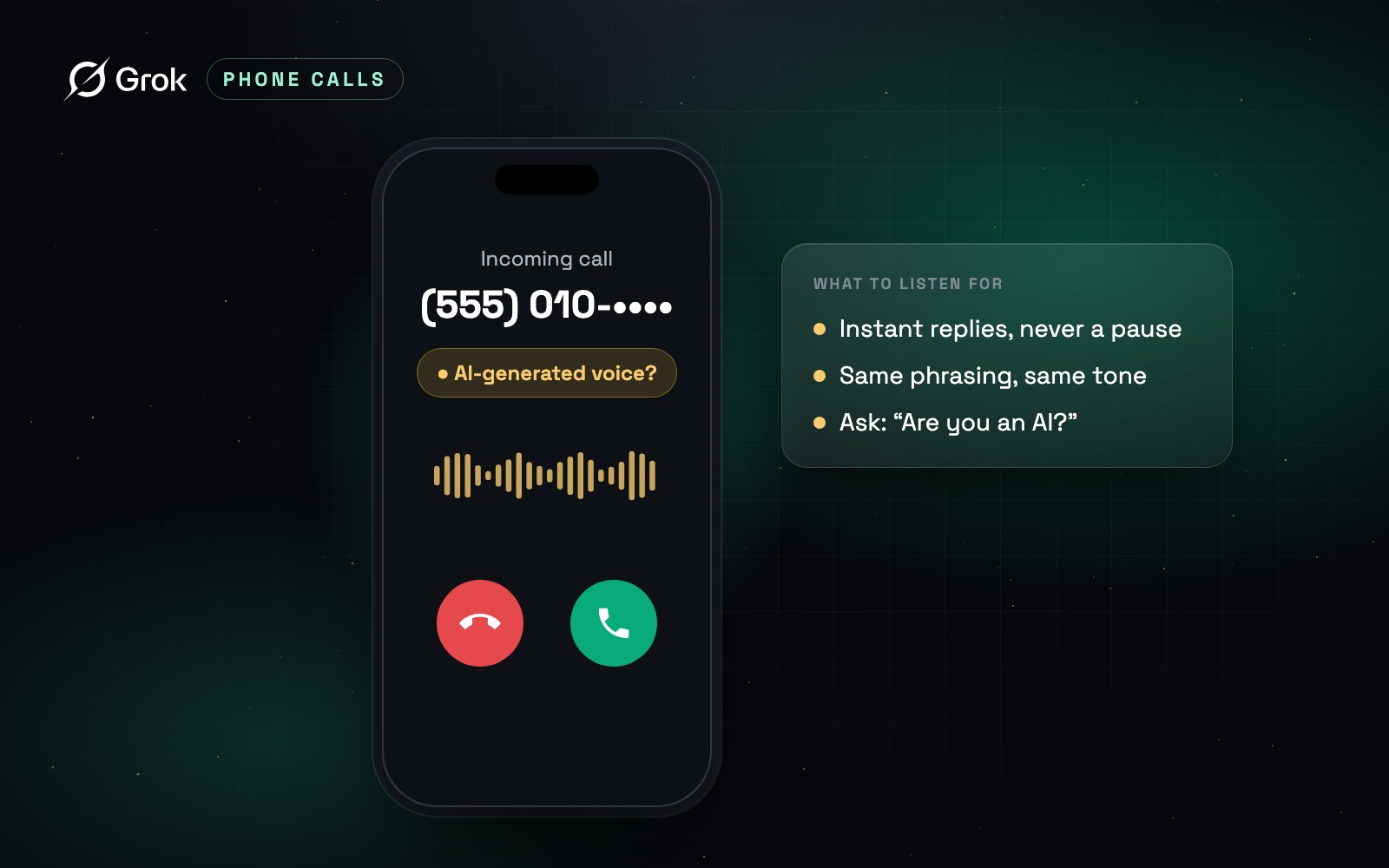
To tell if an AI is calling you, stop judging the voice and start testing the conversation: listen for perfect timing and an unchanging tone, push it off script, then ask point blank, “Am I speaking with an AI?” In the US, AI voices fall under the TCPA’s artificial-voice rules, and in the EU an AI caller must identify itself from the first exchange.
Here is the 20-second version of this article. The phone rings, a warm voice greets you by name, answers every question instantly and even laughs at your joke. You interrupt it mid-sentence and it stops cleanly, with zero awkwardness. You ask what it thinks of the weather and it steers you back to your appointment. That combination is the signature of a modern voice agent. Grok’s voice models answer in under a second according to xAI, can whisper or sigh on cue, and any business can plug one into a phone line.
This guide is written for the person who picks up, whether that is you at home or the receptionist at your clinic or office. For the products behind those voices, start with our guide to Grok and phone calls.
Why can’t you hear the difference anymore?
A few years ago, a robocall gave itself away in three seconds: a metallic voice, a long gap before every answer, and total confusion at any unexpected question. All three tells are close to gone.
The voice problem was solved by modern speech synthesis. Grok’s voice API launched in December 2025 with several voices (Ara, Eve and Leo) and accepts cues like laugh, sigh and whisper. The lag problem was solved by real-time voice-to-voice models, which listen and answer without converting everything to text first; our explainer on how Grok talks on the phone walks through why that matters. And the comprehension problem was solved by large language models, which handle a badly phrased question and bounce back.
So the question is no longer “does it sound human?” It is “does it behave like one?”
What are the 5 signs an AI is calling you?
No single sign proves anything. Two can be coincidence. Three is your cue to ask the question in the next section.
Context adds clues too: a call that lands at exactly the minute you were told, a caller who never gives a name or a job title, a conversation that follows a fixed path with no small talk at all.
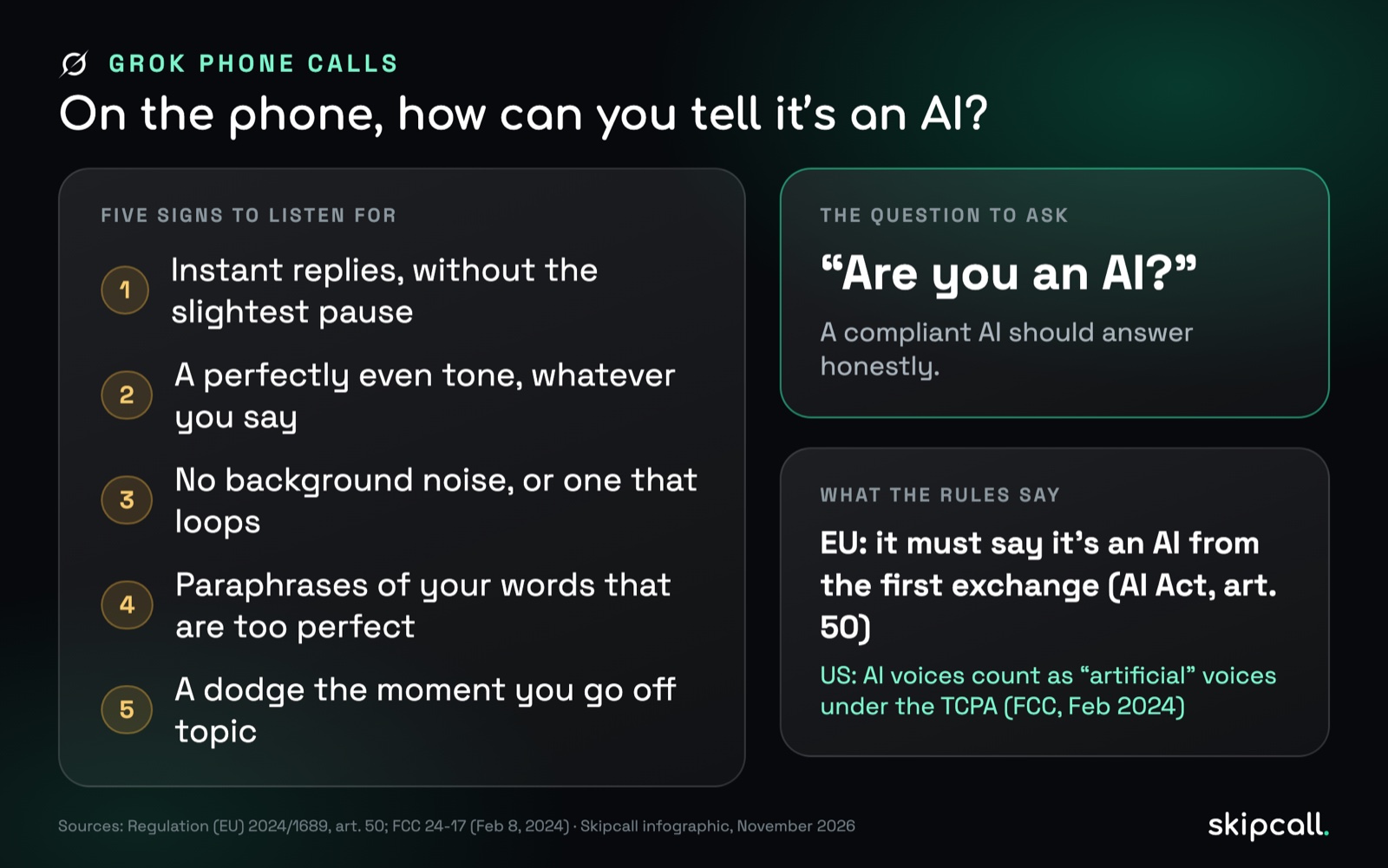
You no longer catch an AI by its voice. You catch it by what happens when you step off its script.
What question exposes an AI caller?
Ask it straight: “Am I speaking with an AI?” It sounds almost too simple, but it works because the people who build these systems have strong reasons to make agents answer honestly, and in the EU the law now requires it.
You will get one of three responses. A compliant agent says yes, plainly, and often offers to transfer you to a person. A poorly configured one sidesteps (“I’m the scheduling assistant for Acme”), which is already a strong signal. And an agent that claims to be human when it is not is a red flag worth writing down, because in the EU that puts its operator on the wrong side of the AI Act.
What does an AI caller owe you under US rules?
AI voices are “artificial” voices. On February 8, 2024, the FCC issued a declaratory ruling (FCC 24-17) stating that AI-generated voices, including cloned ones, are “artificial” voices under the Telephone Consumer Protection Act. That was not a ban. It means AI-voiced calls sit inside the same consent framework as prerecorded robocalls: the caller needs the called person’s prior express consent, and the bar is higher when the call is telemarketing.
Live human calls are a different category. A live, human call that a rep dials to a business landline does not need TCPA consent. The moment a workflow adds an artificial or prerecorded voice, including an AI voice, or automated outreach to a cell phone, it is inside the framework. Our explainer on the TCPA changes for B2B teams lays out where that line sits.
Opt-outs get more structured from November 25, 2026. The FCC’s order FCC 26-67 lets a caller designate an exclusive way to revoke consent, such as a key-press option during the call, a reply keyword by text, or a dedicated website or number. If a caller designates one, it must disclose it clearly in every call or text that requires consent. If you hear “press 9 to stop these calls,” that is likely what you are hearing.
Calling hours and stakes. Telemarketing calls are expected between 8 AM and 9 PM in your local time. And the stakes for callers are real: federal TCPA damages run from $500 to $1,500 per call or text, before state rules stack on top.
And in the EU?
Since August 2, 2026, Article 50 of the EU AI Act requires providers of AI systems designed to interact with people to inform them that they are dealing with an AI, unless it is obvious, at the latest at the first interaction. On a phone call, that means the first sentence. The EU’s 2026 simplification regulation, the “digital omnibus,” did not postpone this rule. Breaches can cost up to €15 million or 3% of worldwide turnover.
Grok Bot’s own terms. An excerpt of Grok Bot’s terms of service, surfaced in search results, says its calls “identify themselves as made by a virtual assistant” on the customer’s behalf and “may be recorded,” and that the customer may not alter or disable those disclosures. Those terms may still change while the calling feature is undocumented; our Grok Bot fact sheet tracks what is confirmed. Note the difference: an agent a business builds with the API or the Voice Agent Builder follows that business’s settings, not Grok Bot’s.
What should you say when an AI calls you?
You do not need to be an expert. Three lines tell you who you are dealing with and put you back in charge. They work on human callers too.
“Before we go on: am I speaking with an AI?”
Note the exact answer. A clear yes is a good sign. A dodge or a suspicious “no” is a strong signal.
“Which company are you calling for, and how did you get my number?”
A legitimate caller can name the business and the relationship. Vague answers justify hanging up.
“Put me through to a person” or “Do not call me again”
Pick the one you want. If it is a telemarketing call, a request not to be called again must be honored.
Then what? It depends on what you heard.
What if it’s your own assistant making the call?
The reverse case is growing fast: you ask an AI to call on your behalf, to book a table or chase a refund. Grok Bot, per Elon Musk’s announcement on October 25, 2026, and Google’s experimental “Call for Me” feature, reported in September 2026 for Pixel 11 phones in the US, both point that way. In that case your assistant is the one that must identify itself to whoever answers. See how Grok makes a call, step by step for the walkthrough, and when AI calls AI for what happens when both ends of the line are machines.
Why do honest callers come out ahead?
For any company that calls, with reps or with AI, trust is the most fragile asset it has. A person who realizes halfway through that they were talking to a machine hangs up and remembers. Worse, call-screening apps and carrier analytics learn from fast hang-ups and complaints, and the numbers that generate them end up labeled “Spam Likely.” We explain that mechanism in our guide to fixing a number marked as spam.
That is also why, in B2B prospecting, AI is more useful behind the rep than on the line. We sort which calls to hand over in Grok vs. sales reps.
The bottom line
A 2026 AI voice will not give itself away by sound. Listen for the five tells, from the always-instant answer to the polite dodge, and when three line up, ask: “Am I speaking with an AI?” Follow with two more lines: who is calling, and what you want. In the US, AI voices have been “artificial” voices under the TCPA since February 2024, which means consent first, and structured opt-outs arrive on November 25, 2026. In the EU, an AI must say what it is from the first sentence. For the tools behind these voices, head back to our guide to Grok and phone calls.
Sources: FCC, Declaratory Ruling FCC 24-17 (February 8, 2024); FCC, Order FCC 26-67, CG Docket No. 02-278 (effective November 25, 2026); Regulation (EU) 2024/1689, Articles 50 and 99; x.ai, Grok Voice Agent API (December 17, 2025), Voice Agent Builder (July 1, 2026) and Grok Voice 3.0 (October 14, 2026); Grok Bot terms of service (excerpt); Elon Musk on X (October 25, 2026); TechRepublic (September 2026).