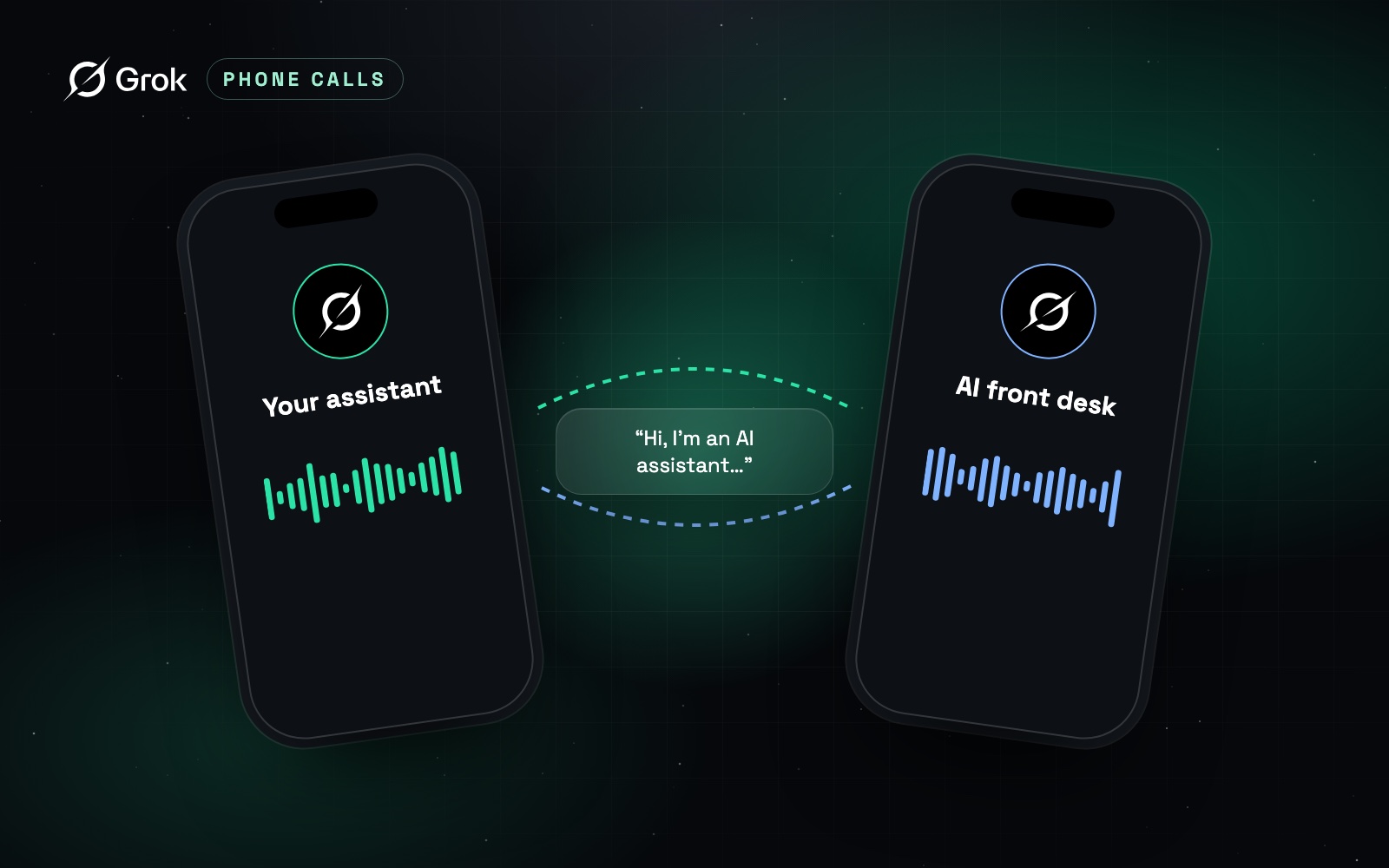
When AI calls AI, your assistant dials a business, the business’s AI front desk answers, and the two settle the request without a human speaking. That is no longer science fiction: in 2026 both ends of the line exist as products, from xAI, Google and OpenAI.
Picture a Tuesday afternoon. Ms. Carter needs to move her physical therapy appointment. She tells her assistant, “Push my Thursday session at the clinic to next week, any morning.” The assistant places the call. At the clinic, the AI front desk picks up, checks the schedule and offers two slots. The assistant takes one, and each side sends a summary to its human. The therapist was never interrupted. Neither was Ms. Carter.
What is missing is scale, not technology. This article looks at what exists on each side, how one of these calls actually unfolds, what changes for customer service, bookings and sales, the five problems nobody has solved, and a checklist to get your own front desk ready. For the Grok products involved, start with our guide to Grok and phone calls.
Why will AIs end up calling each other?
The phone has one property no other channel has: everyone has one. Plenty of clinics, restaurants, contractors and dealerships have no online booking, no API and no chat, but nearly all of them have a number. That is what makes assistants that can dial so powerful. They need zero integration to get something done in the real world.
Businesses are automating their phone lines for the opposite reason: to answer every call during business hours, in several languages, with no hold queue. Put the two trends side by side and the meeting is inevitable, starting with the most mundane requests: opening hours, availability, booking and rescheduling, order status.
What already exists on each end of the line?
None of this is mainstream yet. Grok Bot’s calling feature is announced but not yet documented, and the Builder is still in beta. But for the first time, nothing technical stands between the two ends of the wire. The caller-side walkthrough is in how Grok makes a call, step by step, and the business side in our Grok Voice Agent Builder review.
What does an AI-to-AI call sound like?
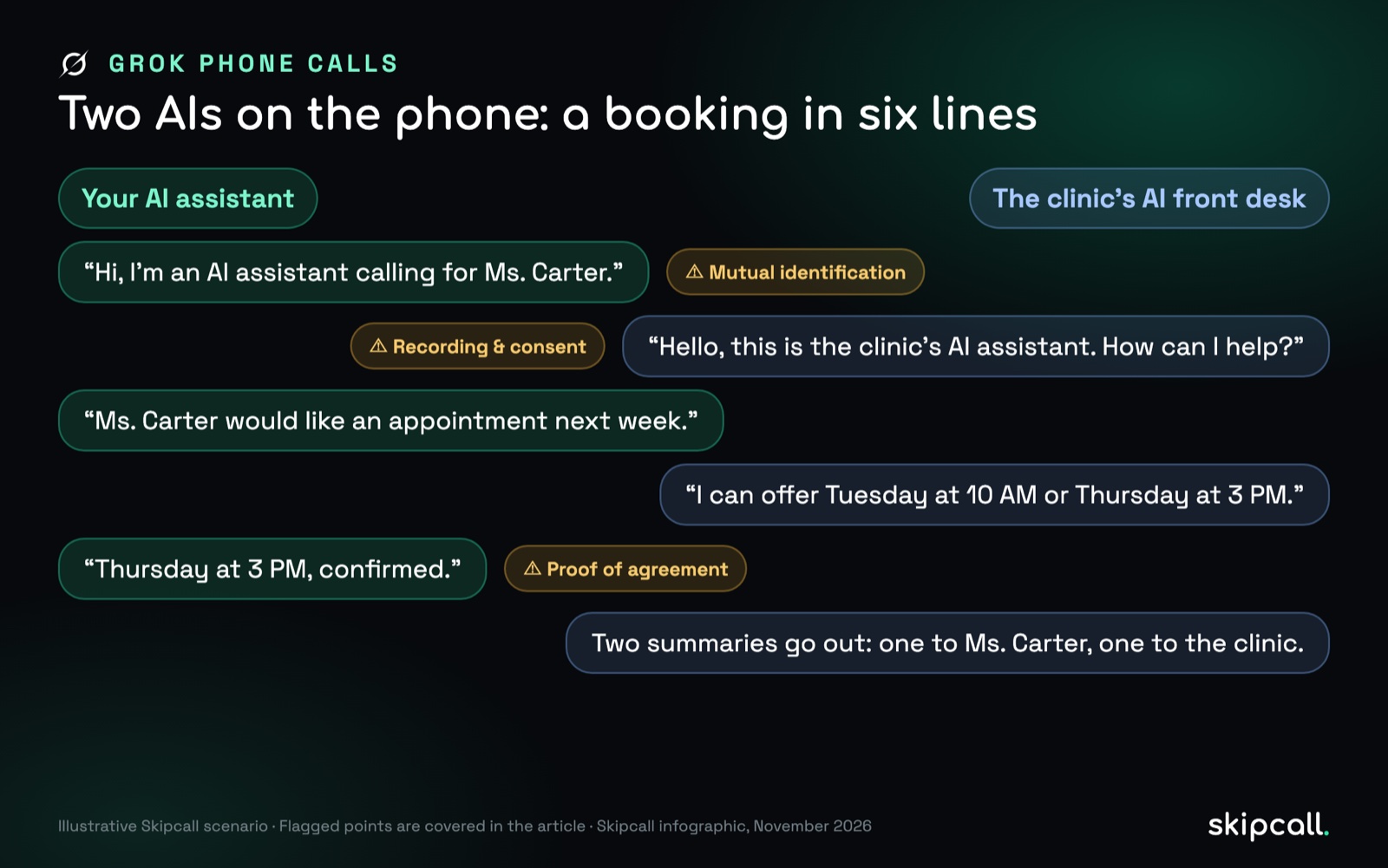
Here is Ms. Carter’s call, line by line.
Ms. Carter gives the brief
“Move my Thursday session at the clinic to next week, any morning.” The quality of this brief decides everything that follows.
Her assistant dials and identifies itself
“Hi, I’m an AI assistant calling for Ms. Carter.” Grok Bot’s terms, in an excerpt found in search results, say its calls identify themselves as made by a virtual assistant and may be recorded.
The clinic's AI answers and identifies itself too
“Hello, this is the clinic’s AI assistant. How can I help?” It understands the request, checks the connected calendar and offers times. Each reply lands in under a second.
The two agents agree
No hold music, no “let me transfer you.” If the request falls outside the rules, the front desk hands the call to a person.
Each side gets its record
Ms. Carter receives a summary. The clinic gets a calendar entry and a transcript.
What changes for businesses when the caller is a machine?
Customer service. A growing share of inbound calls will come from assistants, and assistants are more patient than customers. A long hold queue no longer discourages anyone: the assistant waits for you. Businesses will have to answer faster, or accept a phone line tied up by machines that never hang up.
Bookings. Restaurants, clinics, salons, contractors and service departments, every business where the calendar rules, will see fully automated conversations first. Their challenge will be making their front desk easy for an assistant to understand: clear slots, explicit rules, very little ambiguity.
Outbound sales. This is where the balance tips the most. If assistants start screening calls for their owners the way email filters screen spam, an automated sales call increasingly lands on another AI whose job is to say no. Volume stops paying. What remains is relevance: the right person, at the right time, with a real reason to call, delivered by a human voice. We sort which calls an AI can and cannot make in Grok vs. sales reps.
When both ends of the line are machines, a human conversation becomes a rare signal. And rare things are valuable.
What problems are still unsolved when AI calls AI?
Mutual identification. Each AI may announce what it is, but there is no standard technical handshake that would let two agents recognize each other and switch to something faster and safer than talking out loud. For now, two machines speak to each other the way two people would, for lack of anything better.
Proof of agreement. If your assistant accepts a price or a date, who committed you? You need to know what each agent was allowed to accept, and to be able to compare both transcripts. The Builder records and transcribes every call according to xAI; the two versions still have to match.
Error handling. An AI that mishears a time slot, facing another AI that confirms without checking: the mistake travels with no human to catch it. The handoff to a person has to trigger earlier than it would with a real customer.
Loops. Two overly polite agents can go in circles, each rephrasing the other’s request. Without a time limit and a clear exit, a call can drag on, and every minute is billed.
Consent and recording. The rules that already apply to each side still apply. In the US, AI-generated voices have been “artificial” voices under the TCPA since the FCC’s February 2024 ruling, so an outbound AI-voiced call that needs consent still needs it, whoever answers. In the EU, since August 2, 2026, each AI has to disclose that it is an AI at the first interaction. How those rules play out when both parties are machines has never been tested. The business-side view is in Grok vs. sales reps, and the receiving end in how to tell if an AI is calling you.
What will the phone call look like in a few years? Three scenarios
What is certain. AI front desks already answer phone lines, from xAI, OpenAI and others. Consumer assistants can already call businesses, at least in the US. In the EU, every AI has had to disclose itself since August 2, 2026.
What is announced. Grok Bot calling on its user’s behalf, per Elon Musk, with no official documentation so far. Google’s Call for Me on US Pixel 11 phones, per press reports. Ever faster, more expressive voice models, shipping roughly every two months at xAI.
What is a bet. A protocol that lets agents recognize each other and negotiate without speaking. Assistants that screen every incoming call for their owners. A phone network optimized for machine-to-machine conversations, a scenario we explore in Elon Musk’s phone play.
How do you get your front desk ready for AI assistants?
Whether your front desk is staffed or automated, your customers’ assistants are going to call it. Here is the checklist to work through now.
Make your information machine-readable
Hours, slots, public prices, cancellation rules: clear, current and identical on your website and in your front desk’s knowledge base. An assistant cannot guess what is written nowhere.
Decide what the front desk confirms on its own
An open slot, yes. A quote, a paid cancellation, a discount: human sign-off required. Write the list down.
Write the handoff rule
Which words, which topics and how much time before a call goes to a person. When the caller is another AI, hand off sooner than you would with a customer.
Script the opening line
The AI says it is an AI and mentions recording in its first sentence. Our call recording notice generator writes the second half.
Set a maximum length and an exit
After a few minutes without agreement, the call ends with a human callback or a written follow-up. That stops loops, and every minute is billed.
Review a sample every week
Read a few transcripts, starting with calls placed by assistants: wrong slots, unauthorized commitments, conversations going in circles.
Stay in control of your numbers
A cloud phone system lets you test an AI front desk on one line without touching the others, as our guide to connecting Grok to a real phone number explains.
And invest in what an AI does not replace: well-trained reps who call less, but better.
The bottom line
In 2026, both ends of a phone call can already be handed to an AI: an assistant like Grok Bot to dial, a front desk like the Grok Voice Agent Builder to answer. Their meeting will transform simple requests first: bookings, rescheduling, customer service. Five problems remain open, from mutual identification to proof of agreement, and the rules have not yet been tested on machine-to-machine calls. For businesses, the move is clear: work through the checklist now, and put your people where a human voice still makes the difference. For the full picture of Grok on the phone, head back to our guide to Grok and phone calls.
Sources: x.ai, Grok Voice Agent API (December 17, 2025), Voice Agent Builder (July 1, 2026) and Grok Voice 3.0 (October 14, 2026); Elon Musk on X (October 25, 2026); Grok Bot terms of service (excerpt); InfoQ on OpenAI gpt-realtime (September 2025); TechRepublic and How-To Geek on Google Call for Me (September 2026); FCC, Declaratory Ruling FCC 24-17 (February 8, 2024); Regulation (EU) 2024/1689, Article 50.