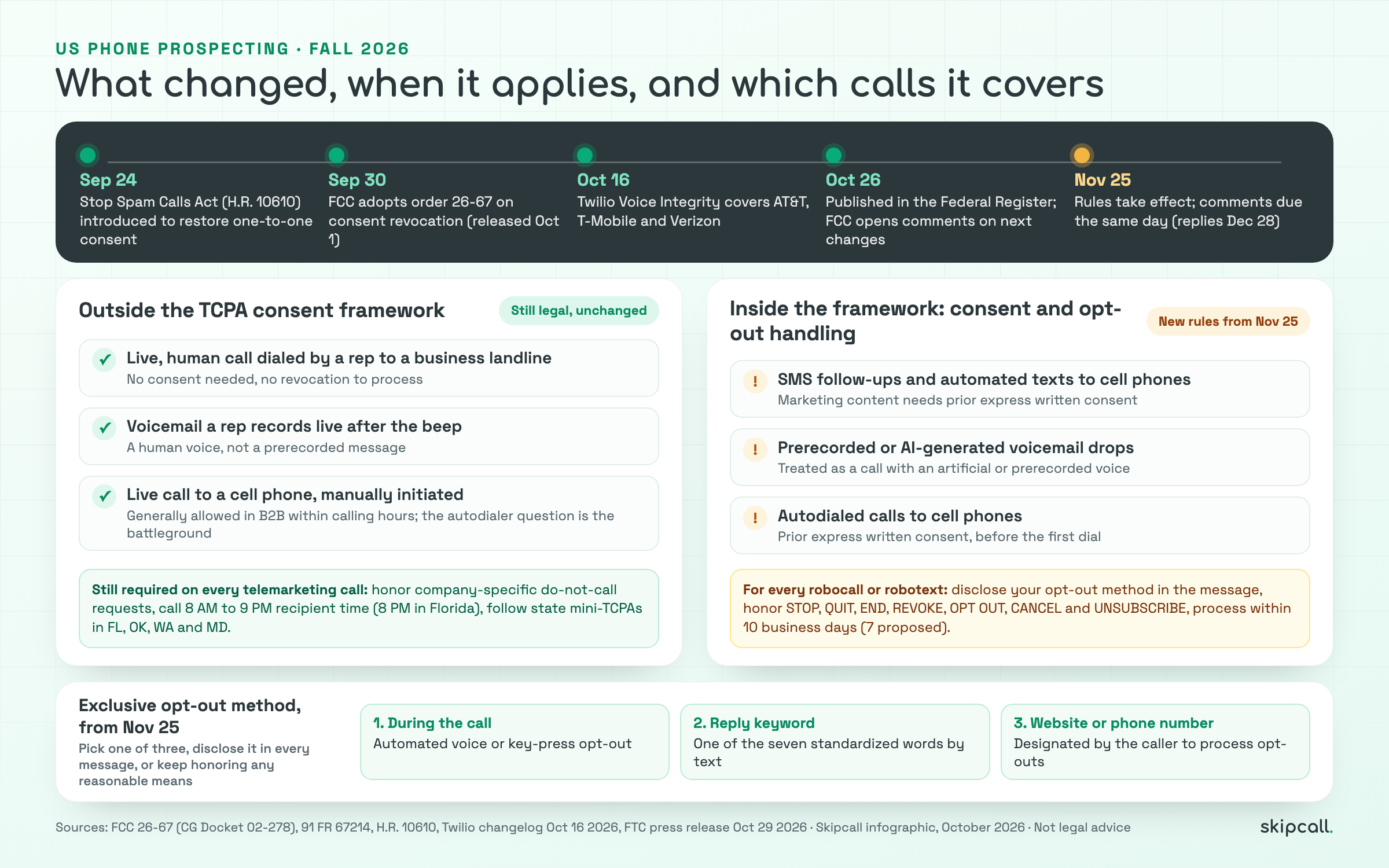
Between September 24 and October 29, 2026, three branches of the US government moved on phone prospecting at the same time. The FCC adopted a final order that rewrites how consumers revoke consent to calls and texts, and opened a new rulemaking on the same day it published it. A bipartisan House bill set out to resurrect the one-to-one consent rule the courts struck down in 2025. And FTC staff mailed warning letters to 25 lead generators and marketers in a single afternoon.
None of it bans cold calling. Most of it does not even touch a live, human call to a business line. But every B2B team that sends a text after a call, drops a voicemail, buys leads, or dials cell phones now has a compliance date on the calendar: November 25, 2026. This guide sorts the three events, explains what each one changes for an outbound team, and ends with the checklist to run before then. It is written for US teams first, with a section for the growing number of European companies that prospect the US with a local number.
Five weeks, five dates
September 24, 2026
- Who
- House of Representatives
- What happened
- Reps. Subramanyam (D-VA) and Shreve (R-IN) introduce the Stop Spam Calls Act, H.R. 10610, to restore one-to-one consent
- Status
- Bill introduced, not law
September 30, 2026
- Who
- FCC
- What happened
- Adopts order FCC 26-67 revising the 2024 consent-revocation rules; released October 1
- Status
- Final rule
October 16, 2026
- Who
- Twilio
- What happened
- Voice Integrity adds Verizon; number registration now covers all three major US networks
- Status
- Live
October 26, 2026
- Who
- Federal Register
- What happened
- Order published (91 FR 67214), effective November 25; Further Notice opens comments on seven-day deadline, two-way texting, one-step revoke-all, affiliates
- Status
- Comments due Nov 25, replies Dec 28
October 29, 2026
- Who
- FTC staff
- What happened
- Warning letters to 25 healthcare plan marketers and lead generators ahead of open enrollment
- Status
- No wrongdoing alleged; more letters to come
What the FCC order actually changes
The order, FCC 26-67 in CG Docket No. 02-278, revises rules the FCC had adopted in February 2024 and then postponed twice. The 2024 version never took effect; its broad “revoke all” provision had been pushed to January 31, 2027 before this order superseded it. Four things matter for an outbound team.
1. You may designate an exclusive opt-out method
Until now, a consumer could revoke consent by “any reasonable means,” and the burden was on the caller to catch a revocation buried in a voicemail, a chat window, or an email to the wrong department. From November 25, a caller or texter may designate one or more FCC-approved methods as the exclusive way to revoke, and is “not required to process revocation requests made by any other means.” The three approved types:
- an automated, interactive voice or key-press opt-out during the call;
- a reply text using one of the seven standardized keywords;
- a website or telephone number designated by the caller to process opt-outs.
Two conditions. The method must be clearly and conspicuously disclosed in every robocall or robotext that requires consent. And a caller that designates nothing keeps the old obligation: honor any reasonable means.
2. The seven keywords are non-negotiable
Even if your text says “Reply STOP to opt out,” you must recognize and honor STOP, QUIT, END, REVOKE, OPT OUT, CANCEL, and UNSUBSCRIBE. A homegrown SMS tool that only parses “STOP” is non-compliant on day one.
3. “Revoke all” is narrowed for informational messages, not for marketing
For informational calls and texts, a revocation may now be treated as applying only to the category it was sent in response to. A customer who opts out of payment reminders can keep receiving fraud alerts. For anything with advertising or telemarketing content, nothing changes: one opt-out revokes consent to all future marketing robocalls and robotexts from that caller. Sales teams live on the marketing side of that line.
4. The 10-business-day clock stays, for now
The duty to honor a revocation “within a reasonable period, not exceeding ten business days after receipt” is unchanged. The Further Notice published alongside the order asks whether that should become seven business days, whether texters should be required to support two-way texting so that a reply actually reaches someone, whether callers using category-specific revocation must offer a one-step revoke-all, and how to treat affiliates and separate business divisions. Comments are due November 25, 2026, reply comments December 28, 2026. Expect a second order in 2027.
The order gives you a choice you never had: pick the door consumers use to leave. The price is that you must put a sign on that door in every single message.
What it means for a B2B cold-calling team
Here is the part most law-firm summaries skip. The TCPA consent and revocation rules apply to robocalls and robotexts: calls made with an automatic telephone dialing system or an artificial or prerecorded voice, and text messages. They do not apply to a live human who dials a number and talks. Our guide on whether cold calling is legal in the US covers the baseline; the short version has not changed:
- Live, manually initiated calls to business landlines need no TCPA consent, and the National Do Not Call Registry primarily covers residential numbers.
- Cell phones are treated as residential. Any autodialed or prerecorded call to a cell phone needs prior express written consent, and most of your prospects now answer on a mobile. Read our playbook on cold calling cell phones before you build a sequence.
- Calling hours are 8 AM to 9 PM in the recipient’s local time, 8 PM in Florida. Our when-to-call tool does the time-zone math.
- Four states have mini-TCPAs with no B2B exemption: Florida, Oklahoma, Washington, and Maryland.
- Company-specific do-not-call requests must be honored on telemarketing calls whatever the dialing method. That duty predates this order and survives it.
So where does the new order bite a B2B team? In three places.
Your texts. The SMS you send after a missed call, the “quick follow-up” from the dialer, the automated reminder before a demo: each is a text message to a number that is almost always a cell phone. If it has marketing content, it needs consent and it must carry your opt-out disclosure, honor the seven keywords, and stop within ten business days. If you adopt an exclusive method, it goes in every text. Carrier-side registration is a separate requirement, covered in our guide to A2P 10DLC and cold texting rules.
Your voicemails. A prerecorded or AI-generated voicemail dropped on a cell phone is a call with an artificial or prerecorded voice. The FCC treated ringless voicemail that way in 2022. A rep recording a live message after the beep is not.
Your consent records. The order lets you narrow how people opt out. It does nothing to lower the bar for how they opted in. If your “consent” is a checkbox on a partner’s form that covered 400 marketing partners, you have a one-to-one problem waiting, which is what the next section is about.
The Stop Spam Calls Act: why lead buyers should watch H.R. 10610
In December 2023 the FCC adopted a one-to-one consent rule: a consumer’s written consent for marketing robocalls and robotexts would authorize only one identified seller at a time, and the calls had to be logically and topically related to the website where consent was given. The rule was due in January 2025. On January 24, 2025, the Eleventh Circuit vacated it in Insurance Marketing Coalition v. FCC, holding the agency had exceeded its statutory authority. Lead generation exhaled.
On September 24, 2026, Representatives Suhas Subramanyam (D-VA) and Jefferson Shreve (R-IN) introduced the Stop Spam Calls Act, H.R. 10610, with four cosponsors and the backing of the National Consumer Law Center, Consumer Federation of America, and three other consumer groups. The bill does not amend the TCPA itself. It directs the FCC to revise its written-consent rule so that consent authorizes no more than one identified seller, giving the agency a year to act and setting the effective date 18 months after enactment. Shreve’s one-line summary: “Americans should decide who has permission to call them.”
Three things to keep in proportion. It is a bill in a crowded calendar, with no committee action reported as of this writing. If it passed tomorrow, nothing would apply before 2028. And it targets consumer marketing robocalls and robotexts, not a live B2B conversation.
What it does tell you is the direction of travel. If any part of your pipeline depends on purchased leads with a multi-seller consent, start asking vendors for the consent language and the seller list now. A consent that names one seller, yours, is the only kind that survives every version of this rule. The same documentation habit protects you if the FTC comes knocking.
The FTC letters: lead generation under the lamp
On October 29, 2026, FTC staff sent warning letters to 25 companies that market Affordable Care Act Marketplace plans and related products, or that generate leads for them, timed to open enrollment. The letters flag claims that may violate the law: misrepresenting a plan’s benefits or limits, calling a limited plan “comprehensive,” misstating costs, or promising cash rewards for enrolling. The FTC says “the letters do not allege any wrongdoing by any of the recipients” and that more will go out on a rolling basis. They cite the agency’s recent cases against Assurance IQ and MediaAlpha in 2025 and Benefytt in 2022.
This is consumer health marketing, far from B2B software sales. The relevance is the method. The FTC is working through lead generators as a category and asking what consumers were told at the point of capture. Any team that buys data should be able to answer the same question about every number it dials: where did it come from, and what did the person agree to? If the answer is “the vendor says it is opt-in,” you do not have an answer.
Your numbers: Voice Integrity now covers all three carriers
Compliance is one half of US phone prospecting; reputation is the other. A legal call that shows up as “Spam Likely” is a call nobody takes. On October 16, 2026, Twilio announced that Voice Integrity, its number-registration service, now supports Verizon in addition to AT&T and T-Mobile. Businesses already enrolled were registered with the Verizon-side analytics vendor automatically; new customers follow the Voice Integrity documentation. If your dialer runs on Twilio, which many do, your registration now reaches the whole US market.
Twilio’s own caveat deserves repeating: registration “is not an allowlist” and does not guarantee you will never be mislabeled. Labels are driven by behavior, mainly dials per number per day, short-call rates, and recipient complaints. Our guide to a business number marked spam covers the Free Caller Registry, Hiya’s Caller Reputation dashboard, and the 200-to-250-dials-per-day ceiling; the number rotation calculator tells you how many numbers your volume needs.
The checklist to run before November 25
Inventory every automated touch to a phone number
List each text template, automated sequence step, voicemail drop, and reminder your team sends, and for each one note the trigger, the content (marketing or informational), and the number type it goes to. Anything automated to a cell phone with marketing content is a robotext or robocall under the TCPA. That list is the scope of everything below.
Decide whether to designate an exclusive opt-out method
For texts, the reply-keyword method is the natural choice: it is what consumers do anyway. If you designate it, every text must disclose it, and you must still parse all seven keywords. If you do not designate one, keep your any-reasonable-means process: a shared inbox and a weekly sweep of voicemail transcripts for “stop calling me.”
Fix the keyword parser and the clock
Test that STOP, QUIT, END, REVOKE, OPT OUT, CANCEL, and UNSUBSCRIBE each suppress the number, case-insensitive, with or without punctuation. Measure the time from reply to suppression. Ten business days is the legal maximum; the FCC is considering seven; your target should be same day, because that is what the sequence tool can do anyway.
Keep live calls live
A rep who clicks to dial one number and talks is making a live call. A prerecorded or AI voicemail to a cell phone is not. Route mobile numbers to human-initiated calls and live voicemails, and reserve automated messages for numbers with documented consent. Line type is the gate: identify cell versus landline at the contact level before the sequence starts.
Audit your lead sources for one-to-one consent
For every vendor, request the consent language, the list of sellers it covered, the capture URL, and the timestamp. Tag each source as single-seller, multi-seller, or unknown. Multi-seller consents are legal today and the first thing to go if H.R. 10610 or a successor passes. Unknown means you treat the number as having no consent.
Register your numbers and cap the volume
Enroll every outbound number through Voice Integrity or your provider’s equivalent, now that all three carriers are covered, and register them with the Free Caller Registry. Then cap dials per number at 200 to 250 a day and rotate. Registration without volume discipline buys you a week.
Put two dates on the calendar
November 25, 2026: the order takes effect and comments on the Further Notice are due. December 28, 2026: reply comments close. If a seven-day deadline or mandatory two-way texting would break your stack, say so in a comment or through your trade association; the docket is CG 02-278.
If you call the US from abroad
A growing share of Skipcall customers are European companies prospecting the United States with a US number: a French SaaS opening a New York office, a Spanish recruiter placing engineers in Texas, a German manufacturer calling distributors in the Midwest. Three things trip them up.
The law follows the recipient, not the caller. The TCPA and the Telemarketing Sales Rule apply to calls and texts received in the United States. A +1 number bought in Paris does not make you local in the eyes of a plaintiff’s attorney; it makes you reachable. Everything above applies in full, including state mini-TCPAs.
Time zones are a compliance rule, not a courtesy. 8 AM to 9 PM in the recipient’s local time means a Paris team cannot call Los Angeles before 5 PM Paris time, and must stop calling New York at 3 AM Paris time, which is not a problem. Our when-to-call tool handles it. Florida ends at 8 PM.
Local presence is about reputation, not permission. A US number raises answer rates because people pick up local numbers; see our guide to local presence dialing. It does not change what you may do with the call. Get the number the right way, with a verified business identity, through a provider that registers it with the carriers, and treat the GDPR habits you bring from home as a floor, not a substitute. The US rules are different, not looser, on texts and cell phones. Our guide to getting a US virtual phone number covers setup.
Where Skipcall fits
Skipcall is a phone system for outbound teams, used by US companies and by European companies calling the US. Its design maps onto the rules above. Calls are initiated by a rep, one click at a time, with a power dialer that works through your list rather than generating numbers. Line type is identified at the contact level, so mobile numbers can be handled differently from business landlines. Numbers are provisioned per rep with volume visible per number, so the 200-to-250 ceiling is a dashboard, not a guess. Two features deserve a deliberate setting under the rules above: the voicemail drop, which leaves a recorded message when a call goes unanswered, and the SMS follow-up. Both are automated messages. Reserve them for business landlines or for contacts with consent on file, and put your opt-out disclosure in every SMS template. Plans for sales teams start at $70 per user per month, with no long-term commitment; details are on the pricing page.
What to remember
The autumn of 2026 did not outlaw phone prospecting in the United States. It did three things: it gave callers a cleaner way to run opt-outs, with a disclosure duty attached and a shorter clock likely in 2027; it signaled that one-to-one consent may return by statute, which makes multi-seller lead consents a depreciating asset; and it reminded every lead buyer that regulators are asking what consumers were told. Live, human calls to business lines remain legal and effective. The work is in everything automated around them, and November 25 is the date to have it done.