Why this guide (and why the phone isn’t dead)
The phone is still the only prospecting channel that gives you an answer in 90 seconds instead of 9 days. An email gets read, filed and forgotten. A LinkedIn message waits in a queue. A connected call tells you right away whether your targeting is right, whether your opener holds, and whether this person has a problem you know how to solve.
The numbers don’t say cold calling is dead; they say it has become demanding. The average cold call lasted 93 seconds in 2025, and 93% of conversations happen within the first three attempts (Cognism, 2025 Cold Calling Report). On a list enriched with direct dials, connect rates can reach about 40%, against under 15% on an average list (Hatmada, 882,000 calls analyzed). In other words, the gap between an SDR who struggles and an SDR who books isn’t talent. It’s the list, the timing, the first ten seconds and the discipline.
What the usual playbooks skip. Most cold calling playbooks take twelve minutes to read: one opener, five objections, three gatekeeper hacks, and a page of advertising for the tool that published them. They don’t tell you how many dials you need for one meeting in your situation, how to read your own numbers, what is legal where you call, or what to do when the same objection comes back three times in one call. This guide takes the time.
Who it’s for. SDRs, BDRs and B2B salespeople who make calls every day, and the managers who want a shared baseline for their team. The scripts are in English and written for international B2B; the benchmarks come from US, UK and European datasets, and we say which is which.
How to read it. In order if you’re starting out: the chapters follow a calling day, from list preparation to CRM notes. If you already call, jump to the chapter that matches your bottleneck: few pickups (chapters 2 and 3), hang-ups in the first five seconds (chapter 4), conversations that lead nowhere (chapters 5 and 7), meetings that don’t hold (chapter 10). Every chapter ends with the one thing to change at your next session.
Chapter 1. The math of cold calling: know your numbers before you pick up
One meeting costs between 15 and 170 dials depending on list quality, and that’s the first number to know before anyone talks about scripts. Everything that follows in this guide moves one of the five rates below. If you don’t measure these five rates, you’ll never know which chapter is making you better.
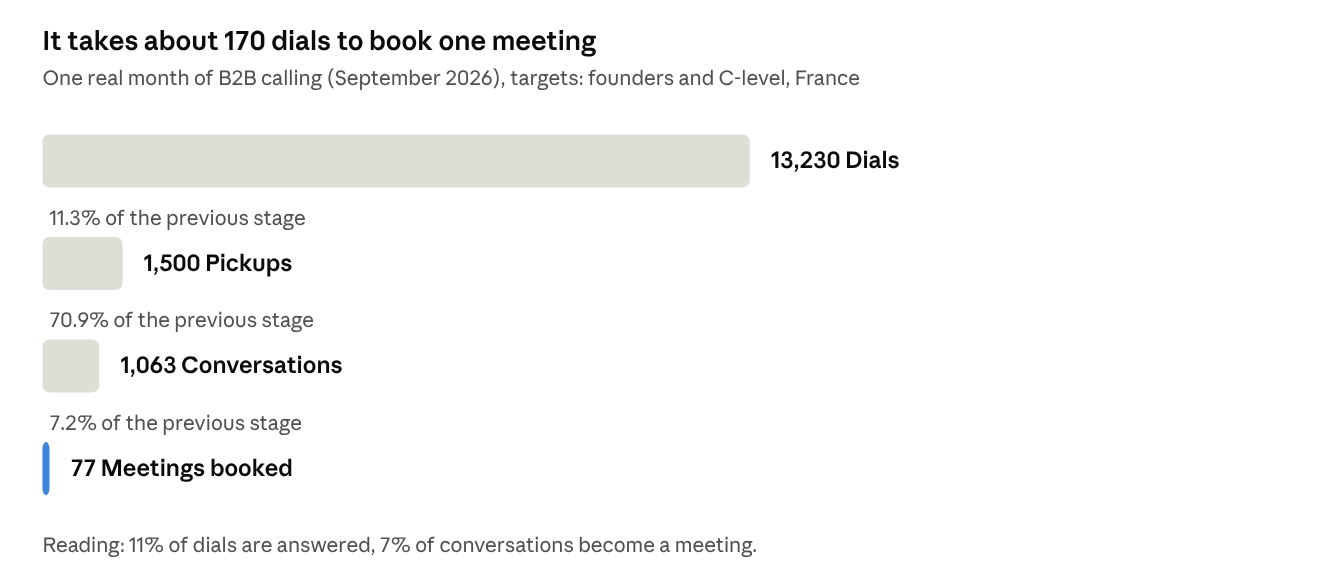
That month, Vgama was calling founders and executives at consulting firms, IT services companies and agencies, on partly flawed lists (on some databases, almost 4 pickups in 10 were wrong numbers, namesakes or out-of-target). Result: an 11% connect rate and 170 dials per meeting. On a list enriched with direct dials, Hatmada measures, across 882,000 calls, about 40% connect and 15 to 25 dials per meeting. Between the two: a factor of 7 to 11. The list weighs more than everything else combined.
The five rates to track
| Rate | Definition | Average list | Enriched list, trained team | What moves it |
|---|---|---|---|---|
| Connect | pickups ÷ dials | 11 to 30% | ~40% | Direct dials and mobiles, dead numbers removed, calling windows |
| Conversation | conversations ÷ pickups | 65 to 70% | 70%+ | Targeting quality (right person), opener |
| Conversion | meetings booked ÷ conversations | 5 to 7% | 10 to 15% | Hook, questions, objection handling, how you propose the slot |
| Show | meetings held ÷ booked | 60 to 70% without confirmation | ~93% with confirmation | Invite sent during the call, reminder the day before |
| Attempts to reach | dials before the first conversation | 3 on average | 3 | 93% of conversations happen within the first 3 attempts, 98.6% before the 5th |
Sources: Cognism, 2025 Cold Calling Report (65.6% conversation rate, attempts; also reports a 2.3% average meeting rate per call, 8% in the UK, 6% in Europe and the US for its own customers); Hatmada (connect, conversion, show rate); Vgama (average list). A conversion rate above 20% is not necessarily good news: check how the meetings are qualified, they rarely hold.
Computing your own numbers: work backwards
Start from the number of held meetings you want, not from the number of dials you think you can make. The dials follow:
Example: 20 held meetings a month, with 25% connect, 70% conversation, 12% conversion and 85% show. 20 ÷ (0.25 × 0.70 × 0.12 × 0.85) = 1,120 dials a month, or 56 dials a day over 20 working days. Change one rate at a time and you’ll see which one is worth the most: moving connect from 25% to 35% (a better list) drops the need to 800 dials, or 40 a day. Skipcall’s free prospecting calculator does the math for you.
The three most common misreadings
- Confusing pickups and conversations. A switchboard answering is a pickup, not a conversation. Count a conversation only when you spoke with the target person or a relevant decision-maker.
- Counting meetings booked, not meetings held. A no-show cost the same number of dials as a held meeting. Show rate is a prospecting metric, not a calendar detail.
- Comparing your rates with another market’s benchmarks. US figures often come from direct dials and high-volume dialers; UK rates run higher than continental Europe. Compare yourself with your own numbers from last month before you compare with the world.
Chapter 2. Before you dial: the list is most of the result
A calling session is won the day before, when the list is ready, enriched and sorted by persona. The SDR who looks up a number between two calls loses ten minutes per contact and their momentum with it. Separate the two activities strictly: a preparation block, then a calling block where you do nothing but call.
Define a target you can actually call
An ICP that works for the phone fits in five hard criteria and two timing signals. The hard criteria say who you call: industry, size (headcount or revenue), geography, tool or setup in place, decision-maker’s role. The timing signals say who you call this week: a job posting, a funding round, a new executive, a new office or country, a tool change announced on LinkedIn. A timing signal is worth more than a hard criterion: it’s what gives you the reason for the call in chapter 4.
“Every mid-market company in our country” isn’t a target, it’s a directory. The test: if you can’t say in one sentence why this company has this problem right now, it doesn’t belong on this week’s list.
One angle per persona, not one pitch for everyone
The same product sells with three different conversations depending on who picks up. Prepare one line per persona, in their words, not yours.
| Persona | Their #1 goal | Their constraint | The words they use | Calling angle |
|---|---|---|---|---|
| Head of Sales | Fill the quarter’s pipeline | A team that doesn’t hit its call volume | ”conversion rate”, “qualified meetings”, “ramp” | Conversations per day per rep |
| CFO or COO | Control cost per meeting | Stacked tools, under-used licenses | ”CAC”, “ROI”, “consolidation” | Cost per held meeting, with a number |
| SMB founder | Sign customers without losing their evenings | No dedicated sales team | ”save time”, “simple”, “works out of the box” | Hours saved per week, time to set up |
Fill this table with your own personas before the first session. The “words they use” column comes from your previous calls, customer reviews and the job ads your targets publish: it’s the raw material for the openers in chapter 4.
Build and enrich the list
List quality decides the connect rate before the first dial. On a list enriched with direct dials and mobiles, Hatmada measures about 40% connect; below 15%, the problem is the list or the time windows, not the script (source). At Vgama, on some databases, almost 4 pickups in 10 were wrong numbers, namesakes or out-of-target contacts (source). A dirty list costs you dials and, worse, conversations.
The preparation chain, in order:
- Source accounts that match the hard criteria: LinkedIn Sales Navigator for roles, company registries and databases for size and leadership, job boards and funding announcements for timing signals.
- Identify the right contact per account, plus a backup (one level up or down). One name per account is a lost dial the moment that person is away.
- Enrich in a waterfall: several data providers queried one after another until a direct dial or mobile turns up. In our experience, a single provider rarely covers more than half of a list; three or four in cascade go much higher. Skipcall compared the market: the best waterfall enrichment tools.
- Clean: dedupe, drop switchboard numbers where a direct line exists, flag mobiles, exclude customers, open opportunities and your internal do-not-call list (see below).
- Cut into batches of 50 to 100 contacts per session, sorted by persona and time zone. One batch = one session = one calling angle, so you’re not switching stories every three minutes.
A mobile gets answered more often than a landline (Cognism); a direct line also removes the gatekeeper problem of chapter 8. The time spent enriching comes back in the very first session.
The sales book: one page, not a novel
The sales book is the sheet in front of you during the session. Not a script to read, a safety net you know by heart. One page per persona:
- The opener, in one sentence (chapter 4).
- The reason for the call tied to the timing signal (“I saw you’re hiring two SDRs”).
- Three discovery questions, from the most open to the most specific (chapter 5).
- One value sentence with a number and a named comparable customer.
- This persona’s five most frequent objections and their responses (chapter 7).
- Two meeting slots to propose, already open in the calendar.
Update it after every session: an objection heard three times in a day goes into the sales book that evening.
Compliance basics: what you must know before calling, by region
B2B cold calling is legal in most markets, under rules that differ by country; this section is an orientation, not legal advice, and your counsel has the final word. The common ground everywhere: say who you are and why you call, display a real callback number, honor any request to stop, and keep an internal do-not-call list shared by the whole team.
| Region | What applies to B2B calls | In practice |
|---|---|---|
| European Union (GDPR) | Calling professionals can rest on legitimate interest when the subject relates to the person’s role; people must be informed and able to object simply and for free | Ask your data providers how they inform contacts; at first contact, be ready to say where the number came from and that they can object; name your provider if asked (chapter 7, objection 11); log every opt-out |
| France | B2B: legitimate interest, subject related to the person’s role, identification and simple opt-out at every call (CNIL). B2C: since August 11, 2026, prior consent is required, calls limited to Monday-Friday 10am-1pm and 2pm-8pm, four attempts per 30 days, fines up to €75,000 per call for individuals and €375,000 for companies (DGCCRF) | Treat sole traders and freelancers reached on a personal line as consumers when in doubt |
| United Kingdom | Live B2B calls are broadly permitted, subject to the corporate do-not-call register and any objection; identify yourself and your company | Screen lists against the corporate register before dialing; keep opt-outs |
| United States | Live calls by a human to business numbers are broadly permitted; consent rules bite on autodialed or prerecorded calls to mobile numbers, and several states have stricter “mini-TCPA” laws | No prerecorded cold calls, no number spoofing, check state rules where you call, and keep your dialer in a mode that only dials when a rep is available |
For data retention, a common practice in Europe is to delete or anonymize prospect data about three years after the last contact without response (indicative, to confirm with your DPO).
Chapter 3. When to call: the right window is worth several points of connect rate
Call between 9 and 11am and between 4 and 5:30pm local time, avoid the lunch hours, and make three attempts before adding written channels, five in total before switching channels. Those are the windows where the datasets agree, in Europe and in the US, but the final rule is yours: your own connect rate by hour, read over a month, beats any benchmark.
Hours
On a sample of 1,500 French B2B calls, Vgama measured 16% connect between 9 and 10am, 14.4% between 4 and 5pm, 13.9% between 10 and 11am, and almost nothing between 1 and 2pm (source). Cognism’s 2025 report puts the peak at 10-11am, a second window at 2-3pm, and sharp dips at 7-9am, noon and 5pm (source). Older US data cited by Gong points to 11am-noon and 4-5pm, with 7-10am as the worst window (Gong). The series overlap: the hour after people settle at their desk, late morning before lunch, and late afternoon.
| Window (prospect’s local time) | What’s happening on their side | Who it works for |
|---|---|---|
| 8:30-9:30am | Arrival, coffee, inbox not yet open; assistants not always in yet | Executives and senior managers, direct dials only, to test: the data put the real peak after 9am |
| 9:30-11:30am | The most reliable window: at their desk, not yet in meetings | Every persona, the core of the session |
| 11:30am-12:15pm | Wrapping things up before lunch, calls are short | Scheduled callbacks, meeting confirmations |
| 12:15-2pm | Lunch: connect rate at its lowest (in southern Europe especially) | Preparation, CRM, follow-up emails, no dialing |
| 2-3:30pm | Back from lunch, meetings restart | Managers and operational roles; weaker for executives |
| 4-5:30pm | Meetings end, people clear what’s left; switchboards close around 5:30-6pm | Executives, CFOs, direct dials; getting past the switchboard is easier |
| After 6pm | The most committed are still there, often alone | Founders, SMB owners, to test in small batches |
Calling across time zones: schedule the batch by the prospect’s local window, not yours, and sort the list by time zone so a session sweeps east to west.
Days
Tuesday is the day with the highest meeting-booking success; Friday books fewer meetings in volume, but it’s the day a conversation converts best: keep it for callbacks and already-warm contacts; Monday is clearly weaker, especially the morning (Cognism 2025). Older US datasets point to Wednesday and Thursday (Gong). Remember the inverse above all: Monday morning and Friday after 4pm are the two windows to sacrifice first when your week is short.
Seasonality matters as much as the weekday: August and the second half of December are troughs, September and January over-perform (Hatmada). Public holidays and the days around them are for warm callbacks, not cold lists.
How many attempts, at what rhythm
It takes three dials on average to reach a contact. The connect rate drops 73% between the first and second attempt, then 60% between the second and third; 93% of conversations happen within the first three attempts and 98.6% of reachable prospects are reached before the fifth (Cognism 2025). The fourth and fifth attempts are still worth it if they’re quick and spaced out; the sixth on the same number at the same hour is wasted time.
The callback rule that follows:
- Attempt 1: the most likely window for the persona (see the table).
- Attempt 2: the next day or the day after, in a different window (if the morning gave nothing, late afternoon).
- Attempt 3: three to four days later, in a third window, with a voicemail and an email the same day (chapter 9).
- Attempts 4 and 5: the following week, on the other number if you have one (mobile then direct line, or the reverse).
- Beyond: the contact moves to the email and LinkedIn sequence (chapter 11) and comes back onto the call list at the first signal (reply, click, new role).
A contact reached once who said “not now” is worth more than one never reached: callbacks convert to meetings more often than first cold calls (Cognism 2025). Schedule them for the date you said, and say the date on the call (“I’ll call you back on the 12th at 10am, does that work?”).
Reading your own windows
One month of data is enough to draw your curve. Export calls with their hour and outcome, group by one-hour slot, and compute the connect rate per slot. Two traps: a slot with fewer than 100 dials tells you nothing, and a good connect rate at 12:30 can hide 20-second conversations. Read connect rate and conversion rate together.
Chapter 4. The first ten seconds: four openers that hold
The prospect decides within the very first seconds whether they stay on the line, and they decide on your tone before your words. Everything you say in the first ten seconds has one job: earning the next thirty. Not presenting the company, not selling, not qualifying.
The four-beat structure
An opener that holds does four things, in this order, in twelve seconds at most:
- The name, calmly. “Hi Claire,” (or “Hi, Claire Martin?” if you’re not sure who picked up). Low tone, slow pace, as if you were calling her for the tenth time. First name alone works in startups and scale-ups; “Ms. Martin” is safer in manufacturing, banking and the public sector, and in markets where formality is the norm.
- Who you are, in five words. “Peter, from Skipcall.” No title, no “leading provider of”. They know neither you nor your company; one more sentence won’t change that.
- The reason for the call, in one sentence. Tied to the timing signal from chapter 2. It’s the most important sentence of the call: stating the reason explicitly multiplies the chance of a meeting by 2.1 (Gong, 90,380 calls analyzed).
- A question that hands over the floor. Short, open, easy to answer. Then you stop talking. Two seconds of silence feel long to you; to the prospect, it’s the moment they decide to speak.
Four opener models
1. The direct opener. You announce it’s a cold call and get to the point. It works because it does the opposite of what the prospect expects from a salesperson.
“Hi Claire, Peter from Skipcall. I’ll be direct: this is a cold call, you weren’t expecting me. I’m calling because you’re hiring two SDRs right now, and I work with teams that are building out their phone prospecting. Can I tell you in one sentence why, and you tell me if it’s worth continuing?”
When to use it: executives, heads of sales, anyone who gets a lot of calls. The risk: a hesitant tone turns it into an apology. It demands confidence and half a smile.
2. The signal opener. You don’t even say it’s prospecting: the reason for the call is so specific that it says it for you.
“Hi Mark, Peter from Skipcall. I saw you’re opening an office in Lyon next month. I’m calling because most teams that open a second site end up with two phone systems and a CRM that stops keeping up. How are you planning to handle that on your side?”
When to use it: whenever you have a real signal (job ad, funding, new role, new office, tool change). The risk: a wrong or outdated signal destroys credibility in one second. Check it the day before, not during the call.
3. The check-in opener. You open as if you already knew each other. On Gong’s US data, “how have you been?” multiplies the meeting rate by 6.6 against the baseline, and “how are you?” by 3.4 (source). The effect is partly a pattern interrupt: it sounds like a known contact, and the prospect answers before deciding. In more formal markets (France, Germany, Japan), a stranger’s “how are you?” can sound fake; a short, contextual check-in works better.
“Hi Sophie, Peter from Skipcall. How are you holding up, with quarter close in full swing?” (pause, answer) “That’s actually why I’m calling: roughly how many dials a day is your team making right now?”
When to use it: operational personas (managers, team leads) and callbacks. The risk: cultural mismatch. Test it on fifty calls before you adopt it or drop it.
4. The framed-permission opener. You ask for time, but a precise amount with an exit door. It isn’t “did I catch you at a bad time?”, which hands the prospect a ready-made refusal.
“Hi Julian, Peter from Skipcall. I know you weren’t expecting me: I’ll tell you in two sentences why I’m calling, and if it’s not for you, you tell me and I won’t call again?”
When to use it: heavily solicited targets, first contact after an unanswered email. The risk: if the two sentences that follow are soft, the exit door closes on you. Prepare the next sentence word for word.
The lines that get you hung up on
| Never say | Why | Say instead |
|---|---|---|
| ”Did I catch you at a bad time?”, “Is this a bad time?“ | 40% fewer meetings across 90,380 analyzed calls (Gong): you’re offering the refusal | ”I know you weren’t expecting me” then the reason |
| ”Sorry to bother you”, “I just wanted to” | You’re apologizing for existing before saying anything | Nothing. You don’t apologize for calling about something that concerns the person |
| ”Am I speaking with Ms. Martin, head of procurement at X?” | That’s a call center’s identity check | ”Hi Claire,” assuming it’s her |
| ”We’re a company specialized in…” | Nobody cares about the company description at second ten | The reason for the call, tied to the person |
| ”Hello? Hello?” after the pickup | Silence then hesitation signals a robot or a call center | Speak the second the line opens, name first |
| ”How are you doing today?” in a telemarketer’s voice | The tone betrays the script | The contextual check-in of model 3, or nothing |
When the prospect says “what’s this about?”
That’s good news: they’re still on the line. Answer with the reason for the call in one sentence, no detour, then the question that hands over the floor. Don’t repeat your name or company.
“About your two SDR hires: I work with teams that are building out their phone prospecting, and I wanted to know how you’d planned to equip the new people. Do you already have something in place?”
Testing an opener
An opener is judged over fifty conversations at least, not one morning, and over two hundred if you want to read the conversion rate. Keep a single variable (the opening sentence, not the opener and the persona at the same time) and measure two numbers: the share of conversations that last beyond thirty seconds, and the conversion rate to meetings. An opener that gets people talking but doesn’t convert is a friendly opener, not an effective one.
Chapter 5. Anatomy of a cold call that converts
A cold call that books lasts three to five minutes, and the prospect talks more than you do. Successful cold calls are almost twice as long as unsuccessful ones, with 77% more speaker switches per minute (Gong); a useful conversation averages 3.2 minutes with a talk ratio of 42% for the rep and 58% for the prospect (Hatmada). You don’t sell your product on the phone. You sell a twenty-minute meeting.
The five beats of the call
| Beat | Time | Goal | What you do |
|---|---|---|---|
| 1. Opener | 0:00 → 0:12 | Earn the next thirty seconds | Name, company, reason, question (chapter 4) |
| 2. Bridge | 0:12 → 0:45 | Get a problem recognized | One pain hypothesis, phrased as what their peers say, then “is that the case for you?“ |
| 3. Discovery | 0:45 → 2:30 | Understand their situation and what it costs them | Three questions at most, follow-ups, one summary |
| 4. Value | 2:30 → 3:15 | Tie what they said to what you do | One sentence, a comparable customer, a number |
| 5. Proposal | 3:15 → 4:00 | Book the meeting | Two slots, invite sent during the call (chapter 10) |
Objections come at any moment and are handled as in chapter 7, then you return to the beat you were on.
The bridge: the pain hypothesis
After the opener, the prospect knows who you are and why you’re calling. They don’t yet know why they should keep listening. The bridge gives them a reason by describing their problem before they’ve put it into words, using their peers’ words:
“When I talk to heads of sales who are hiring SDRs, they often tell me the same thing: new reps take three months to reach their call volume, and nobody really knows what’s being said on the phone. I don’t know if that’s the case for you?”
Three rules. One hypothesis, not three: if you stack several, the prospect picks the least embarrassing. Phrased in the third person, so they can correct it without losing face. Followed by a real question, not “right?”.
Discovery: three questions, not an interrogation
Three questions are enough to decide whether a meeting makes sense, and that’s all you’re looking for. In order:
- The situation: how it works today. “Concretely, what are your reps calling with, right now?”
- The impact: what it costs or prevents. “And when a new rep takes three months to get going, what does that represent for you, in meetings or revenue?”
- The attempt: what’s already been tried. “Have you already looked at solutions, or is it a topic you haven’t opened yet?”
Between questions, follow up without a new question: “meaning?”, “for example?”, “and what does that do to you?”, or plain silence. In successful calls, a prospect’s monologue averages 3.5 seconds against 8 seconds in failed calls (Gong): it’s not that the prospect talks less, it’s that you bounce back more often. Summarize once before moving to value: “So if I sum up: two new reps arriving in January, a tool that records nothing, and you can’t listen to them. Is that right?”
What you don’t do in discovery: qualify budget, ask who decides, fire closed questions in a row, take notes out loud. All of that happens in the meeting.
Value: one sentence anchored in what they just said
Value isn’t your pitch, it’s the mirror of discovery. It picks up their words, names a comparable customer and gives a number:
“That’s exactly what we did at [comparable customer], a 70-person IT services firm: their SDRs listen to the team’s best calls from week one, and their manager cut ramp time in half. I don’t know if we’d do the same at your place, that’s precisely what I’m suggesting we look at.”
Use “we” and “our” rather than “I” and “my”: successful calls contain 35% more “we” and 55% more “our” than failed calls (Gong). You represent a team that has already solved the problem, not a salesperson alone with a quota.
The proposal: you don’t ask whether they’re interested
“Would you be interested in learning more?” is the sentence that loses the most meetings after a good conversation. It asks the prospect to commit to an interest, when all you need is a time slot:
“Here’s what I suggest: twenty minutes Thursday at 10 or Friday at 2, I show you how it works at [customer], and you judge whether it holds for your team. Which one works better?”
Two precise slots, a short duration, concrete content, and the decision left to the prospect. Chapter 10 covers what follows: the invite sent during the call and the confirmation.
The full script, annotated
Scenario: Peter (Skipcall) calls Claire, head of sales at an 80-person IT services company that has posted two SDR openings. The italic notes say what’s at stake in each line.
Peter: Hi Claire, Peter from Skipcall. I’ll be direct, this is a cold call. I’m calling because you’re hiring two SDRs, and I work with teams building out their phone prospecting. Can I tell you in one sentence why, and you tell me if it’s worth continuing? Direct opener, reason tied to the signal, question that hands over the floor. Silence.
Claire: Go ahead, but quickly, I have a meeting in five minutes. “Quickly” isn’t a no. Five minutes is plenty.
Peter: Perfect, I’ll be short. When I talk to heads of sales hiring SDRs, they often tell me new reps take three months to reach their call volume, and they have no way to listen to what’s being said. I don’t know if that’s the case for you? The bridge: one hypothesis, in the third person, then a question.
Claire: That’s about right, yes. The last one took four months, and that’s being generous. She corrects the number upward: she recognizes the problem and makes it hers.
Peter: Four months. And today, concretely, what are they calling with? Her word picked up, then a situation question.
Claire: Their cell phones and the CRM. We tried a phone system last year but nobody used it, too complicated. Two pieces of information: the situation, and a failed attempt. The “we already tried” objection is already on the table.
Peter: Too complicated, meaning? Follow-up without a new question. No defending, just digging.
Claire: Everything had to be configured, nobody had the time, and after two months we dropped it.
Peter: Got it. And when an SDR takes four months instead of one, what does that represent for you, in meetings? Impact question. The problem gets a number, in her words.
Claire: About fifteen meetings a month that don’t happen, roughly.
Peter: Fifteen a month, for three months, for two people. So if I sum up: two SDRs arriving, a previous tool dropped because it was too heavy, and you can’t listen to their calls. Is that right? One-sentence summary. She hears her own problem, with a number.
Claire: That’s it.
Peter: That’s very close to what we did at [customer], a 70-person IT services firm. Their SDRs were live on day one with no configuration, and their manager listens to the week’s best calls in ten minutes. I don’t know if we’d do the same at your place, that’s what I’m suggesting we look at. Value: her words (“configuration”, “listen”), a comparable customer, a result.
Claire: Send me a deck, I’ll take a look. Reflex objection, chapter 7. Accept, isolate, propose.
Peter: Of course, I’ll send it. Honestly, it’ll be generic, and your case isn’t. Here’s what I suggest: twenty minutes Thursday at 10 or Friday at 2, I show you on your own setup, and you judge. Which works better? You don’t refuse the email, you make it insufficient. Two slots.
Claire: Friday at 2, but twenty minutes, no more.
Peter: Twenty minutes, noted. I’m sending the invite now, you should get it in a few seconds. Do you see it? Invite during the call, immediate confirmation (chapter 10).
Claire: Yes, got it.
Peter: Great. So Friday is useful: can you just tell me which CRM you use? A preparation question: it commits the prospect to the meeting.
Claire: HubSpot.
Peter: Thanks Claire, enjoy your meeting, talk Friday. Hang up first, without adding a sentence.
Duration: about three and a half minutes. Peter talked less than Claire, asked three questions, summarized once, handled one objection and got a slot without ever describing a feature.
Chapter 6. Voice: what the prospect hears before they listen to you
On the phone, the prospect has only your voice to decide whether you’re a peer or a call center, and they decide before the end of your first sentence. Pace, pitch, pauses and smile are worked on like a script. The difference is that they can’t be read: they’re drilled.
Six settings, and how to apply them
Slow down, always. Stress speeds up delivery, and fast delivery signals a recited script. Aim for 140 to 160 words a minute, noticeably slower than your natural conversation. The test: record your opener and time it. If the twelve seconds of chapter 4 fit in eight, you’re talking too fast.
Lower your voice on the opener. The first sentence is said half a tone below your normal voice, with a falling intonation on the name. A voice that rises at the end (“Hi Claire? Peter from Skipcall?”) asks for permission; a voice that falls states that you have a reason to call.
Mirror the prospect’s energy, then lead. If they talk fast and loud, go up a notch; if they’re measured, settle down. If someone whispers because they’re in an open space, whisper with them for a moment, then come back to normal volume. Mirroring builds rapport in the first seconds; afterwards, you set the rhythm.
Hold the silence. After a question, count two seconds before speaking again. After an objection, one second before answering: you show you heard it. Silence is the simplest and least practiced technique, because it’s uncomfortable for the caller and perfectly normal for the person answering.
Smile before you dial. Smiling changes the resonance of the voice, and it’s audible. A forced smile is audible too, so smile at something real: the previous conversation, a detail in the prospect’s profile. If the last call annoyed you, wait thirty seconds before dialing the next.
Name what you hear. Traffic noise, voices, a child: “sounds like you’re on the move, shall I call you back at 3?” You show you’re listening to the person and not your script, and you often get a precise slot instead of a refusal.
Posture
Standing or sitting doesn’t matter, as long as the upper body is open and your eyes are off the screen. Many good callers stand for difficult openers and sit down for discovery; others walk. Two things are certain: a voice folded over a keyboard is audible, and a good headset with a well-placed mic beats a phone wedged against the shoulder. If you use a dialer, keep your hand away from the mouse during discovery: clicks are audible.
The tics that give away the script
| The tic | What it signals | The fix |
|---|---|---|
| ”So”, “basically”, “you know” every ten seconds | You’re filling silence out of fear of the void | Replace with a pause. Count the tics on a recording, aim for half next week |
| ”I just”, “quick” (“a quick call”, “a quick question”) | You’re minimizing what you ask for | Delete. A twenty-minute meeting, a question |
| Nervous laugh after an objection | You don’t know what to answer | One second of silence, then the chapter 7 method |
| Rising intonation on every sentence | You’re asking permission to continue | End statements downward, only questions go up |
| Pace that speeds up when proposing the slot | The proposal embarrasses you | Slow down precisely there, it’s the most important sentence |
Three ten-minute drills
- The opener recording. Record yourself ten times in a row on the same opener, changing one parameter each time (slower, lower, smiling, standing). Listen blind and rank them. In ten minutes you’ll know what makes you credible.
- The reverse call. In pairs, a colleague plays the prospect and answers only in monosyllables. Your goal: get a full sentence out of them with open questions and silences, without ever restating your pitch.
- Best and worst replay. Every Friday, replay your best call and your worst call of the week (your phone system records and transcribes them). Note one thing to repeat and one thing to fix. No more: that’s what actually changes in a week.
Chapter 7. Objections: fourteen cases, one method
An objection heard in the first twenty seconds is about the call, not about you; the same objection after discovery is about your offer. That’s the only distinction that matters, and it decides the answer. On French data, the most frequent objection is timing (“not the right moment”); the most lost is “I’m not the decision-maker”, abandoned more than one time in two (Vgama). Both can be handled.
The four-step method
- Acknowledge. One second of silence, then repeat their words. “Not the right moment, okay.” No “I understand, but…”: the “but” erases everything before it.
- Isolate. One question that separates the reflex from the real reason. “Is it the topic that doesn’t speak to you, or the timing?” The answer tells you what to handle; without it, you answer the wrong thing.
- Answer short, with new information. A fact, a customer example, a clarification. Never a repeat of the pitch, never more than two sentences.
- Re-engage. An open question or the slot proposal. The objection isn’t handled until the conversation has resumed.
If the same objection comes back a second time, stop arguing: name it (“I feel like I’m dragging you where you don’t want to go”) and propose either the smallest possible step or a dated callback. A third time is a no, and a well-accepted no is worth a callback in six months.
The fourteen objections
1. “Send me an email / a deck.” What it means: early in the call, “leave me alone politely”; after a real conversation, “I need something to show someone”.
Reflex: “Sure, I’ll send it. Honestly, it’ll be generic, and your situation isn’t. What would you need to find in it for it to be worth opening?” After discovery: “Happy to. I’ll send you the [customer] case instead, it’s the closest to what you described. And shall we book twenty minutes Thursday to talk it through once you’ve read it? That way it doesn’t sit at the bottom of your inbox.”
2. “I don’t have time.” What it means: if they stay on the line after saying it, they have time, just not for this, right now. If they hang up, call back another day without hard feelings.
“I figured, I’ll be short: the reason for the call in one sentence, and if it doesn’t speak to you, I’ll let you go?” Then, if the reason lands: “I won’t keep you. Fifteen minutes Thursday at 10 or Friday at 2, to talk when you have the headspace?”
3. “Not interested.” What it means: before any explanation, they’re refusing a sales call, not your topic, which they don’t know yet. After an explanation, it’s a real objection to dig into.
Reflex: “That’s fair, you don’t know yet what I’m talking about. In one sentence: [the reason for the call tied to their signal]. Does that change anything, or is it really a no?” After explanation: “Okay. So I don’t call you back for nothing: is it because you already have something that works, or because it’s not a priority this year?” The justification they give is the real objection; handle that one.
4. “We already have a provider / a solution.” What it means: they have an incumbent, and they don’t know yet whether you’re an alternative or a complement. It’s the best-handled objection in the market: Hatmada measures a 95.9% handling success rate (source), because an incumbent is a topic of conversation, not a wall.
“Great, most of the teams I work with had one too. What do you mainly use it for?” (listen) “And what would make you say, a year from now, that it was the right choice?” Never criticize the competitor. Look for what the incumbent doesn’t do, and propose the meeting on that precise point: “I’m not suggesting you change everything. Twenty minutes to look only at the [call listening] part, and you judge whether it complements what you have.”
5. “Not the right time, call me back in six months.” What it means: either a real calendar (budget, ongoing project), or the politest way to say no. Isolate.
“Okay. What happens between now and six months that would make the topic easier to open?” If the answer is concrete (“we close the budget in March”): “Then I’ll call you on February 15, before it’s locked. Shall I send you a callback invite so we don’t lose each other?” If the answer is vague: “Understood. Just so I’m useful the day I call back: is it the topic that isn’t a priority, or the idea of changing something?”
6. “I’m not the decision-maker / I don’t handle that.” What it means: sometimes true, often a way to pass the buck. It’s the most lost objection because reps ask for the decision-maker’s name and hang up. Do the opposite: keep the person as an ally.
“I understand. You, on the other hand, live it every day: if it changed tomorrow, what constraint would it remove for you?” (listen) “That’s exactly what [the decision-maker] needs to hear. Would you rather I call them on your behalf quoting what you just told me, or we do the twenty minutes as a three-way?” You get either a warm introduction or a meeting with the decision-maker and their internal sponsor. Both beat a name.
7. “We don’t have budget.” What it means: early in the call, a reflex; after discovery, either “the budget is elsewhere” or “I don’t see yet what it returns”.
“I figured. I’m not calling to make you spend, I’m calling because [comparable customer] replaced two tools with one and pays less than before. And today, roughly, what does [the topic] cost you in time?” The number they give becomes the basis of the meeting: “Then it’s worth twenty minutes to check whether we do better for less. Thursday or Friday?”
8. “How much is it?” What it means: either real interest, or a way to eliminate you fast. Never give a price alone on the phone: without context, it’s always too expensive.
“Good question, and I’ll answer it. It depends on two things: how many people call, and whether you need [the option]. To give you an order of magnitude, a team like yours lands between X and Y a month. What matters is what it replaces: what do you have today?” An honest range, then back to discovery. If the range scares them off, that’s information: note it and move to the next.
9. “We already tried, it didn’t work.” What it means: a real scar. It’s the best objection you can get, because the person already wanted to solve the problem.
“Ah, what didn’t work?” (listen without defending) “Okay. So if [what broke] were fixed, the topic would be interesting again?” Propose the meeting on that precise point: “I suggest twenty minutes only on that. If we hit the same wall, we stop there.”
10. “I’m in a meeting / driving.” What it means: exactly what they say. Don’t attempt your pitch, take a slot.
“Sorry, I’ll let you go. Shall I call you back at 3, or tomorrow at 9:30?” Then, once the slot is given: “Perfect, 3 o’clock.” And you call at 3 sharp, opening with: “Peter from Skipcall, as agreed at 3.” The on-time callback is the first act of credibility in the relationship.
11. “How did you get my number?” What it means: suspicion, sometimes annoyance. A vague or embarrassed answer kills the call; a clear answer often restarts it, and it’s an obligation (chapter 2).
“Fair question: through [your data provider’s name], because your role matches what I wanted to talk about. If you’d rather not be called again, I’ll note it right now and it’s done. Otherwise, shall I tell you in one sentence why I’m calling?” If the person asks not to be called again, note it, respect it, and thank them. It’s not a defeat, it’s the law.
12. “We’re too small / we do it in-house.” What it means: they think your offer is built for bigger companies, or that it would replace someone.
“That’s what I often hear, and it’s precisely teams your size that get the most out of it, because every hour counts. Today, who handles [the task] for you, and how much of their week does it take?” You don’t contradict, you move the question to the cost of doing it in-house.
13. “I don’t book meetings over the phone.” What it means: a personal rule, sometimes a company rule. Don’t contest it, go around it.
“I respect that. What works for you: I email you two slots and you pick, or I send you the [customer] case and you tell me whether it’s worth a conversation?” The invite by email goes out while you’re still on the line (chapter 10), which amounts to the same thing with the form respected.
14. “I’ll call you back.” What it means: almost never. It’s the market’s politest no.
“Happy to. And since I know how weeks fly by, shall we block a slot now instead, even three weeks out? And if it’s a no, just tell me, I’d rather know.” Said with a smile, it defuses the moment, and the person answers frankly. Both answers save you time.
The clean no
When it’s a no, take it. Thank them, and ask one closing question: “Just so I don’t call you back for nothing, is it the topic or the timing?” The answer goes into the CRM with a callback date if it’s timing, and onto the do-not-call list if the person asks. In a mid-sized market, you’ll call the same companies again within a year; how you hung up is the first thing they’ll remember.
Chapter 8. Gatekeepers and switchboards: the assistant isn’t the enemy
The best way past a switchboard is not to call it: a direct dial or a mobile solves the problem before it exists. When the switchboard is unavoidable, the person answering is doing their job, which is routing calls, not blocking you. Treat them as a colleague with the org chart in front of them, and they’ll behave like one.
The principle: the less you say, the more you get through
Reps get blocked because they volunteer information nobody asked for. A transfer request sounds like a transfer request, not a presentation.
“Hi, Claire Martin, please.”
That’s it. No “this is Peter from Skipcall”, no “it’s regarding”. Calm, firm tone, the tone of someone calling Claire for the tenth time. First name and last name, said as a given, get through far more often than “the head of sales”.
When the assistant asks questions
| Question | Answer | Why it works |
|---|---|---|
| ”Who’s calling?" | "Peter Durand.” (first and last name, no company) | You answer exactly the question, nothing more |
| ”From which company?" | "From Skipcall.” | Same. An unknown company isn’t grounds for refusal; a pitch is |
| ”What’s it regarding?" | "Her SDR hires, she’ll know what it’s about.” | A precise, internal topic, not a sales argument. The timing signal from chapter 2 serves here too |
| ”Is she expecting your call?" | "No, she isn’t expecting me. Is she reachable now, or would you rather I call back at a better time?” | Honest, and you give the assistant the choice, which they prefer to refusing |
| ”Send an email, I’ll pass it on." | "Gladly. So it’s useful, can you tell me which day she’s easiest to reach? I’ll call back then.” | You accept, and you get the information that matters: the window |
Never lie about your identity, about a meeting that doesn’t exist or an imaginary relationship with the person. It works once and burns the account for a year: the assistant remembers, and talks.
Making the assistant an ally
An executive assistant knows who decides, when, and in what mood. Often, they’ll give you more than a transfer if you ask with respect:
“I won’t waste your time: I’m looking for the right person to talk about [topic] at your company. Is it Claire Martin, or rather someone on her team?”
If they point you to someone else, thank them by name, note it, and tell the person they sent you to: “it’s Natalie at reception who told me you were the right contact”. You arrive recommended from the inside.
The workarounds, and what they’re worth
Two tactics circulate in every guide: calling before 9am or after 5:30pm, when the switchboard is closed and executives are still in, and going through another department (sales, say) that transfers without screening. Off-hours calling is a sound, clean practice, and chapter 3’s data confirms it for executives. The other department works on one condition: say frankly who you are and who you’re looking for, so the person you reach can answer “how did you get through to me?” without awkwardness. In a small market where you’ll call the same accounts next year, the enriched direct dial remains the best workaround.
When the switchboard is a phone tree
Look for the “directory” option or dial the name on the keypad if the system offers it; otherwise, the sales option, saying who you are and who you’re looking for (salespeople pick up and transfer willingly, they’re your peers). Note in the CRM the path that worked (“press 2 then 1”) so you don’t redo it on every attempt.
Chapter 9. Voicemail, SMS and email: leave a trace that works
A voicemail almost never generates a callback, and that’s not its job: it makes your email recognizable and your next call expected. When you hit voicemail on the third attempt, the right reflex is a synchronized trio: a fifteen-second voicemail, an email within five minutes that references it, and an SMS if you have the mobile and a real link to the person’s role.
The voicemail: fifteen seconds, one idea
Don’t ask for a callback, nobody does it. Give a reason and announce what’s coming.
“Hi Claire, Peter from Skipcall. I was calling about your two SDR hires, I have a specific idea for their first month. No need to call me back: I’m sending you an email in five minutes with ‘SDR hires’ as the subject, and I’ll call you again Thursday morning. Have a good day.”
The rules: your name at the start, not the end; the reason tied to the signal; the exact email subject; the date of the next call. No phone number dictated (it’s in the email), no “feel free to”. Leave it once, on the third attempt, never on every call. If your tool lets you drop a pre-recorded message in one click, record one per persona and per signal, not a generic one.
One exception: the prospect who missed a booked meeting. There, the message explicitly asks for a reply (“let me know which slot works better”): that’s no longer prospecting, it’s a relationship.
The email that follows the missed call
Short, no attachment, with the subject announced in the voicemail. It does three things: restate the reason, give a proof point, propose the next call’s slot.
Subject: SDR hires
Hi Claire,
I just left you a voicemail. I was calling because you’re hiring two SDRs: at [comparable customer], a 70-person IT services firm, the new reps were live on the phone from week one, and their manager listens to their best calls in ten minutes a week.
I’ll call you Thursday around 9:30. If another time suits you better, just reply “Friday 2pm” and I’ll adapt.
Peter
No long signature, no booking link on first contact (it turns a conversation into a form), no “I hope this email finds you well”.
The SMS: only with a mobile and a business reason
An SMS to a decision-maker who doesn’t know you is intrusive; the same SMS after a voicemail and an email is a simple confirmation. Two lines, your name, the link to the call, and nothing to click:
“Hi Claire, Peter from Skipcall. I left you a voicemail and an email about your SDR hires; I’ll call you Thursday 9:30 unless another time suits you better. Reply STOP if you’d rather not be contacted again.”
If the person replies “stop” or “no thanks”, that’s an opt-out: note it and stop every channel. Automated bulk SMS to mobiles is another trade with other rules, and in the US consent rules apply; this guide only covers the manual, one-to-one SMS after a call attempt.
Linking the three channels in the CRM
Each contact carries a single dated “next action”, and everything else is history. After the voicemail + email + SMS trio, the next action is Thursday’s 9:30 call, full stop. If the prospect replies to the email in the meantime, the call becomes a warm callback, and you open with “thanks for your reply”. If you use automated sequences, the call is a manual step you validate yourself: an automated email never goes out the day you had the person on the line.
Chapter 10. Booking the meeting, and making it hold
A meeting booked on the phone without confirmation has a one-in-three chance of not happening; with a confirmation ritual, show rate rises to 93% (Hatmada). A no-show costs as many dials as a held meeting. Booking doesn’t stop when the prospect says yes; it stops when they’re on the video call.
What you need before proposing a slot
Four things, and not one more. The right person, or an ally who agreed to bring the decision-maker. A problem recognized in their own words, not yours. A reason to act now, the timing signal or a number they gave. And a slot they choose themselves. Budget, decision process and the list of competitors in play get qualified in the meeting; asking for them on the phone loses more meetings than it filters.
The proposal
Two precise slots, a short duration, named content, the decision left to the prospect:
“Here’s what I suggest: twenty minutes Thursday at 10 or Friday at 2. I show you how [customer] solved [their specific problem], and you judge whether it holds for your team. Which one works better?”
If neither works: “Which day is quietest for you next week?”, then you propose two times that day. You keep control of the form, they keep control of the choice. Aim for a meeting within five working days: beyond ten days, show rate drops and you need an interim touch.
The invite goes out during the call
It’s the single gesture that moves show rate the most. You send the invite from the calendar while the person is on the line, and you wait for them to see it:
“I’m sending the invite now, you should get it in a few seconds. Do you see it?”
The invite itself is part of the work. Its title uses the prospect’s words (“Skipcall x [Company]: ramping the two SDRs”, not “Skipcall demo”). Its body fits in three lines: what we’ll look at, what they’ll leave with, and your mobile number. The video link is in it, and the location is never “TBD”. No attachment, no deck: it would come from a conversation that hasn’t happened yet.
Before hanging up, one preparation question: “so Thursday is useful, can you just tell me [your CRM’s name / how many people call]?” Answering commits the prospect to the meeting: they’ve already put something of theirs into it.
The confirmation ritual
| Moment | Action | If no response |
|---|---|---|
| During the call | Invite sent and seen | Don’t hang up before it’s received |
| Day +1 | Check the invite is accepted | If not accepted at 48h, a short email: “I haven’t seen your acceptance, are we still on for Thursday 10am?” |
| In between, if the meeting is more than 5 days out | One useful piece of content, only one: the customer case mentioned on the call | Nothing more. It’s not a follow-up, it’s preparation |
| Day -1, end of day | A two-line SMS or email: “See you tomorrow at 10, I’ve prepared [the thing promised].” | If no reply and no acceptance, call that morning |
| Day 0, start time + 3 minutes | If the person isn’t there, call directly | Voicemail with an explicit request for a reply (chapter 9’s exception), then an email with two new slots |
A prospect who answers nothing for four days isn’t a meeting, it’s a contact to call back. Better to know the day before than on the day.
The no-show
A first no-show is handled without reproach: “I imagine the day got busy. I suggest Thursday at 2 or Friday at 10.” A second no-show is handled on the phone, not by email, with a frank question: “Is the topic still current for you? If it’s not the moment, tell me, I’d rather know.” On the third, the contact goes back into regular prospecting, with a note in the CRM. You don’t chase a meeting; you chase a problem someone wants to solve.
The handoff to the AE (if you’re an SDR)
The meeting belongs to whoever will run it. Within ten minutes of the call, the CRM record contains, in the prospect’s words: the context and the signal, the problem and what it costs (the number given), the incumbent and past attempts, the objections heard and what was answered, who else is involved, and what you promised to show. If your phone system records and transcribes, the link to the call is worth more than your summary: the AE hears the tone, not just the facts. A meeting handed over without these six lines starts with twenty minutes of repetition, and the prospect feels it.
Chapter 11. The phone inside a multichannel sequence
The phone is the fastest channel, not the only one: some prospects never answer an unknown number and reply to a LinkedIn message in ten minutes. A well-built sequence plays the three channels over fifteen working days, eight to ten touches in all, five calls at most, varying windows and angles. The two models below differ only in where the phone sits, and that choice depends on your list, not your preferences.
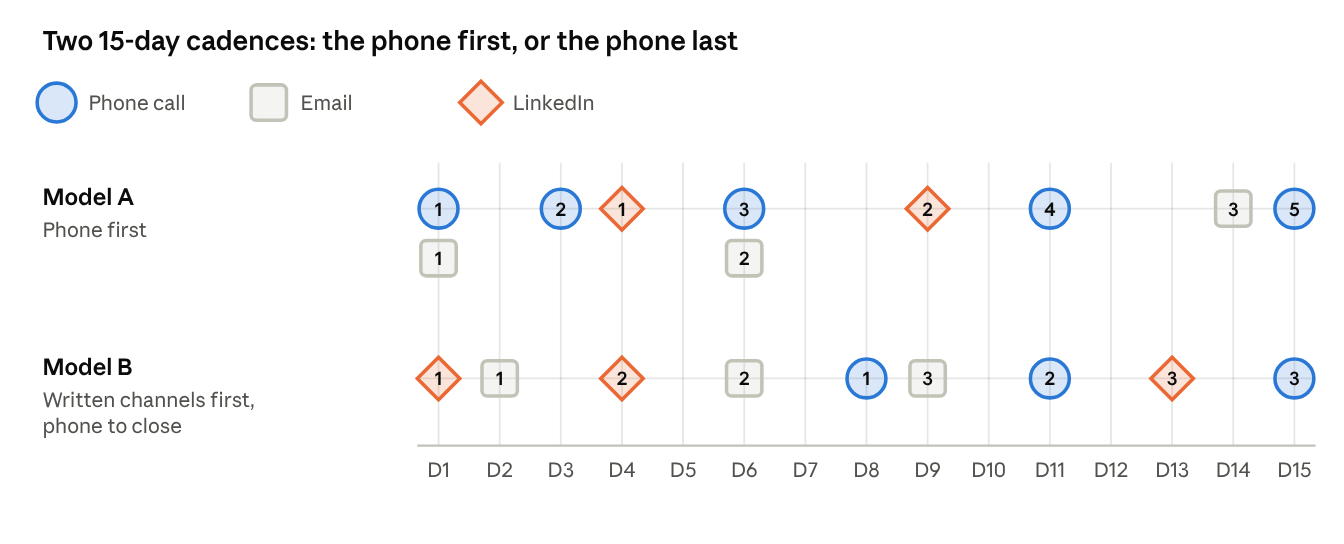
Model A opens with the call and uses writing to make the following calls expected. Model B prepares the ground in writing and calls when the name has become familiar. In both cases, five phone attempts at most: beyond that, 98.6% of reachable prospects have already been reached (Cognism 2025); and five to eight attempts across all channels over three to four weeks, varying windows and channels (Hatmada).
Which model for which list
| Situation | Model | Why |
|---|---|---|
| New market or new persona to test | A, phone first | The call validates targeting in one morning; writing would take two weeks to tell you |
| Direct dials and mobiles available | A | Connect rate is good, use it right away |
| High-value accounts, short list | A | Each account deserves a conversation, not an industrial sequence |
| Large list, low connect rate (switchboards, generic numbers) | B, written first | You call first those who opened, clicked or accepted: connect rate climbs sharply |
| Heavily solicited targets (CIOs, CFOs at large companies) | B | A name already seen makes the call acceptable |
| Long sales cycle, committee purchase | B | Written content circulates internally before the call |
The touches of model A in detail
| Day | Channel | Content |
|---|---|---|
| D1 | Call 1 | Chapter 4 opener, reason tied to the signal. No voicemail on the first call |
| D1 | Email 1 | If not reached: three lines, the reason for the call, the customer case, the callback date (chapter 9) |
| D3 | Call 2 | A different window from D1. Still no message |
| D4 | LinkedIn 1 | Connection request with a one-sentence note or no note. Never a pitch in the invite |
| D6 | Call 3 + voicemail | Third window, fifteen-second voicemail announcing the email |
| D6 | Email 2 | A different angle from email 1: a question, or a number from their industry |
| D9 | LinkedIn 2 | A short message if the request was accepted: “I called you about…, is that a topic on your side?” |
| D11 | Call 4 | On the other number if you have two (mobile or direct line) |
| D14 | Email 3 | The break-up email: “I won’t insist, here’s where to find me if the topic comes back” |
| D15 | Call 5 | Last call, then the contact leaves the active sequence and comes back at the first signal |
Model B uses the same content in a different order: LinkedIn request on D1, email on D2, LinkedIn message on D4, second email on D6, first call on D8 (the name is known), email on D9, second call with voicemail on D11, last LinkedIn message on D13, last call on D15.
The three rules that make a sequence hold
Each channel done well, or not at all. A generic email followed by a copy-pasted LinkedIn message followed by an unprepared call is worth less than one good call. If you don’t have time to personalize the writing, shorten it instead of making it generic: three personal lines beat ten lines of template.
The phone reacts to signals, writing creates them. A repeated email open, a click, an accepted request, a visit to your site: that’s a call within the hour, outside the sequence, that opens with “I see you looked at the [customer] case”. The sequence sets the rhythm; signals set the exceptions.
The call doesn’t get automated. Emails and LinkedIn tasks can go out from a sequencing tool; the call is a step you validate by hand, and a contact reached on the line leaves every automation immediately. Nothing damages a conversation more than an automated “I couldn’t reach you” email landing the day after a booked meeting.
And one absolute stop rule: a “no”, a “stop” or a request not to be contacted on any channel stops every channel, the same day.
Chapter 12. Cadence, rituals and mindset: the call block
Calling happens in blocked sessions, not between two tasks: two 90-minute blocks a day for a full-time SDR, three blocks a week minimum for a rep who both prospects and closes. During a block, you don’t call “when you can”, you do nothing else. Reps who prospect mainly by phone hold 6.8 quality conversations a day, against 3.3 for those who prospect mainly by email (Bridge Group, cited by Cognism); the gap comes from time actually spent on the line, not from talent.
How many dials a day
A full-time SDR with a ready list and a tool that dials for them makes 60 to 100 dials a day and holds 8 to 15 conversations. Below 40 dials, the problem is almost always organization: research between calls, a CRM filled by hand, emails read between two numbers. Volume isn’t a goal in itself, it’s the consequence of a clean session. Chapter 1 tells you how many you need; this chapter tells you how to sustain them without burning out.
Before the session: ten minutes
- Today’s list is open, sorted, with the signal next to each name (chapter 2).
- The persona’s sales book is in view, the opener has been said out loud (chapter 4).
- The calendar is open with four slots spotted within five days (chapter 10).
- Email, Slack and notifications closed; only the CRM and the calling tool stay on screen.
- Headset on, water within reach, standing or sitting well.
- The first three calls are warm callbacks or contacts already reached: you warm up on easy conversations before cold numbers.
During the session: the flow
Between two calls, ten seconds: the outcome logged (no answer, pickup without conversation, conversation, meeting), the next action dated, and you dial the next. No research, no email, no re-reading the record: all of that was done before. After a good call, go straight to the next, the energy carries over. After a bad call, thirty seconds standing, one breath, and you dial again; after three hang-ups in a row, two minutes away from the screen, then a warm callback to restart.
A calling tool that dials the list, detects voicemails, records and transcribes removes most of the ten seconds between two calls and the five minutes of typing after each conversation. That’s the point of chapter 14: more time on the line, less time writing down what you just said.
After the session: fifteen minutes
The promised invites went out during the calls; what’s left are the follow-up emails, the dated callback tasks for every “not now”, and the sales book update with the day’s new objection. Then a replay: the best call and the worst, ten minutes, one thing to keep, one thing to change (chapter 6). No two-hour debrief: what doesn’t fit in fifteen minutes won’t be applied tomorrow.
Rejection: the math against the ego
Over a hundred conversations, your conversion rate promises you ten meetings; the other ninety are the normal price of the ten. A “no” isn’t about you, it’s about a call the person wasn’t expecting, at a time they didn’t choose. Three practices that last:
- Count conversations, not only meetings. A session with twelve conversations and zero meetings is a good session: the meeting will come at the callback. A session with two conversations is the real warning sign, and it points to the list or the window.
- Keep a log of useful no’s. Every argued refusal teaches you a word, an objection, a competitor, a timing. Note it in one line. After a month, it’s your best market study.
- Never call angry. The prospect hears your state before your words (chapter 6). If the mood isn’t there, ten minutes of warm callbacks or preparation, then back to it. A cold call made irritated costs an account for a year.
As a team: the group session
The best teams call together, at the same time, with a shared goal and a manager who listens. A team power hour is: a fixed time (10-11am on Tuesday and Thursday, say), a goal in conversations rather than dials, the manager listening discreetly on two or three calls per person, ten minutes of debrief at the end where everyone shares one objection heard and the answer that worked. Beginners progress more in one month of group sessions than in a quarter alone, because they hear other people’s good calls live. Skipcall is building shared calling rooms for this, with manager listening, chat and challenges (Skipcall Rooms); an always-on video call and a shared board do the job to start.
A useful challenge rewards what depends on the rep: the number of conversations over two minutes, the number of objections handled through to a re-engagement, the best call of the week voted by the team. The number of meetings also depends on the list and the market; making it the only criterion pushes people to book meetings that won’t hold.
Chapter 13. Measure and improve: six numbers, one review a week
Six indicators are enough to know which chapter of this guide to work on, and each points to one or two chapters. A dashboard of thirty metrics doesn’t get read; six numbers, read every Friday over the past week, change the following week.
The six indicators and what they point to
| Indicator | Calculation | Alert threshold | If it’s low, work on |
|---|---|---|---|
| Dials per session | dials ÷ sessions | under 30 per 90-minute block | Chapter 12: session organization, and chapter 14: the tool that dials |
| Connect rate | pickups ÷ dials | under 15% | Chapter 2: the list and direct dials; chapter 3: the windows |
| Conversation rate | conversations with the right person (over 30 s) ÷ pickups | under 60% | Chapter 4: the opener; chapter 6: the voice |
| Conversion rate | meetings booked ÷ conversations | under 5% | Chapter 5: discovery and proposal; chapter 7: objections |
| Show rate | meetings held ÷ booked | under 80% | Chapter 10: the invite during the call and the confirmation |
| Contacts without a next action | contacts with no dated action ÷ contacts touched | over 10% | Chapters 9 and 11: every contact carries a next touch |
Read them in the table’s order: a low conversion rate means nothing if the conversation rate is bad, because the conversations that remain are those of the most hostile prospects. Fix from top to bottom.
What call listening teaches that numbers don’t
Numbers say where it breaks, listening says why. Three calls a week per person are enough, chosen by the rep themselves: the best, the worst, and an average one. For each, a five-question grid, always the same:
- Does the opener fit in twelve seconds, with the reason for the call?
- Who talked most, and after how long did the prospect first speak for more than ten seconds?
- How many questions were asked before the first sentence about the product?
- Was the objection isolated before being handled, and did the conversation resume afterwards?
- Was the slot proposed, with two options, and the invite sent on the line?
Tools that record, transcribe and summarize every call make this listening possible without spending the day on it: you search “no budget” across the week’s transcripts and listen to the three best answers. What AI does well here is find and summarize; what it doesn’t replace is the manager’s ear for tone and silence.
Coaching that changes something
Useful coaching fits in one instruction per week per person. Not five. The manager listens, names a single thing to change (“you propose the slot too early, before you’ve summarized”), has the sequence replayed three times in pairs, and listens to a real call the following Friday. Beginners get the instructions in chapter order: opener and voice first, then discovery, then objections, then the proposal. Giving the “objections” instruction to someone whose opener doesn’t hold loses two weeks.
Testing: one variable, fifty conversations
An opener, a pain hypothesis, a way of proposing the slot get tested like an email: a version A, a version B, a single change, and the same list split at random. Fifty conversations per version are enough to read the share of conversations that run past thirty seconds; for the conversion rate, count on two hundred conversations per version, or read the trend over a month. Below that, you’re reading chance and persona. Measure conversation rate and conversion rate together, and keep the version that wins on the second even if it loses a little on the first: an opener that gets people talking but doesn’t convert is pleasant, not effective.
The tests worth the most, in order: the calling window per persona (the fastest gain), the opener, the pain hypothesis, the way of proposing the meeting, the voicemail. One test per fortnight, no more, or nobody knows which version they’re saying.
The weekly review: twenty minutes
Friday, twenty minutes, alone or as a team. The week’s six numbers side by side with the previous week’s; the chapter to work on next week, only one; the week’s new objection and its answer, added to the sales book; the “not now” contacts whose callback date falls next week, already placed in the sessions. That’s it. A review that runs over twenty minutes produces resolutions, not changes.
Chapter 14. The 2026 tool stack: four building blocks, and the truth about dialers
Four building blocks are enough: a data source with enrichment, a CRM, a phone system that dials, records and transcribes, and a writing tool for emails and LinkedIn. Anything added must buy time on the line or list quality; otherwise, it’s buying tools instead of prospecting.
The four blocks
| Block | What it’s for | Examples | Price range (per user per month) |
|---|---|---|---|
| Data and enrichment | Find accounts, the right people, direct dials and mobiles; in a waterfall across several providers | Sales Navigator, company registries; Kaspr, Lusha, Fullenrich, Apollo, Cognism | $50 to $150 |
| CRM | History, dated next action, handoff, do-not-call list | HubSpot (free to start), Pipedrive, Attio, Salesforce | $0 to $60 |
| Phone system and dialer | Numbers per country, automatic dialing (power or parallel), voicemail detection, recording, transcription and summary, CRM sync | Skipcall (power and parallel dialer, numbers in 14 countries included, AI transcription, two-way sync with HubSpot, Pipedrive, Salesforce, Attio); Aircall, Orum, Nooks | $20 to $120 |
| Writing and sequences | The emails and LinkedIn tasks of chapter 11’s cadence, with the call as a manual step | lemlist, La Growth Machine, the CRM’s or phone system’s native sequences | $0 to $100 |
Prices are public orders of magnitude and vary with volume; count $100 to $300 a month per rep for a complete stack, against the cost of one rep-hour a day lost to typing and number hunting.
Manual, power dialer or parallel dialer: the latency question, without the marketing
A power dialer dials the list’s numbers one by one, as soon as the previous call ends; a parallel dialer dials two to four at once and hands you the first one that answers, discarding voicemails and dead numbers. Both camps publish numbers, and both are right on their own ground.
What the published data says. Orum, which sells both modes, measures a higher connect rate in power at every seniority level, and more meetings per conversation in power (about 6.4% against 3.8% in parallel); but per hour of dialing, parallel yields more meetings for most operational roles (0.88 against 0.62 per hour on individual contributors, for instance), thanks to 2.5x the dialing velocity; power stays ahead on IT, legal and administrative leadership (Orum, power vs parallel). TitanX, which sells power dialing, argues that parallel’s roughly two-second connection delay and the degraded reputation of high-volume numbers halve the connect rate (TitanX). Skipcall, which sells both, puts the breakpoint around 60 dials a day per rep: below it, power is enough; above it, parallel lowers cost per meeting (Skipcall, parallel vs power dialer).
What to take from it when choosing:
| Your situation | Recommended mode | Why |
|---|---|---|
| Under 50 to 60 dials a day, short list, high-value accounts, executives | Power dialer | Every pickup counts, zero delay, better conversion per conversation |
| Over 60 dials a day, large cold list, operational personas, new market to test | Parallel dialer, 2 to 3 lines to start | More conversations per hour; targeting gets validated in one morning |
| Scheduled callbacks, contacts already reached, warm prospects | Power dialer or manual dial | You don’t make someone who knows you wait a second |
| A list of switchboards and generic numbers | Enrich first | No dialer compensates for a list without direct dials |
If you go parallel, four rules separate a tool that helps from a tool that burns your list. Speak the second the call is handed to you, name first, never “hello?”: the delay is mostly your reaction. Start at two lines and go up only if your conversation rate (chapter 13) doesn’t drop. Measure every week the connect rate in parallel against power on the same list; if the gap exceeds a third, go back to two lines or to power. And watch your numbers’ reputation: no more than a few dozen calls per number per day, a rotation of local numbers per country, and a regular check of what your number displays on a mobile (“likely spam” is a silent death sentence).
Predictive dialers, which dial more numbers than there are reps available and leave abandoned calls, are to be avoided in B2B: they produce exactly the silence on pickup that makes people hang up, part of the calls are never taken, and in the US they trigger the consent rules of chapter 2.
What AI does well, and what it does badly
AI changed the work around the call, not the call. It transcribes and summarizes every conversation, updates the CRM without typing, detects voicemails, finds “no budget” across two hundred calls for the coaching meeting, and drafts the follow-up email from what was actually said. Those tasks used to take one to two hours a day; they now take nothing, and that’s as much time on the line.
It does two things badly. Voice agents that make cold calls in your place: prospects spot them in three seconds, hang up, and in several jurisdictions the caller must be clearly identified; in B2B, the brand risk outweighs the volume gain. And mass-generated written personalization: an email that quotes the prospect’s LinkedIn post in a template’s voice gets spotted as fast as an automated call. Keep AI behind the call, not in front of it.
What you don’t need
A twelve-module sales engagement platform for two SDRs. Intent data before you have a clean list. A dialer that doesn’t sync with your CRM (you’ll be back to double entry within a week). A third writing tool because the second one didn’t work. And a thirty-metric dashboard: the six in chapter 13 are enough, and the prospecting calculator tells you how many dials you need before you buy anything.
Chapter 15. Checklists and the 30-day plan
Three lists to print and a ramp plan: that’s what’s left of the guide when you’re in front of the phone.
Before the session
- List of 50 to 100 contacts, one persona, enriched with direct dials, cleaned
- Timing signal written next to each name
- Persona’s sales book open: opener, pain hypothesis, three questions, five objections
- Opener said out loud five times, timed at twelve seconds
- Four twenty-minute slots spotted in the calendar, within five days
- CRM and calling tool open, everything else closed
- Headset, water, posture; three warm callbacks to start
During each call
- Name first, the second the line opens
- The reason for the call in one sentence, then a question, then silence
- One pain hypothesis, not three
- Three questions at most before the first sentence about the product
- One summary in their words before value
- Objection: one second of silence, acknowledge, isolate, answer short, re-engage
- Two precise slots, never “would you be interested?”
- Invite sent and seen during the call, one preparation question before hanging up
After each call and after the session
- Outcome logged in ten seconds: no answer, pickup without conversation, conversation, meeting
- Dated next action for every contact touched
- Opt-outs logged in the shared do-not-call list
- Promised emails sent; voicemail + email + SMS linked for those unreached on the third attempt
- New objection added to the sales book
- Best and worst call replayed: one thing to keep, one to change
- The week’s six numbers filled in on Friday
The 30-day plan for a new SDR
| Week | Goal | What you work on | What you measure |
|---|---|---|---|
| 1 | Run a clean session | List and sales book (chapter 2), opener and voice (chapters 4 and 6), one opener only, fixed windows (chapter 3). Target: 40 dials per session, no research between calls | Dials per session, connect rate |
| 2 | Get the prospect talking | Pain hypothesis and three questions (chapter 5), silence after the question, summary. Target: the prospect talks more than you in half the conversations | Conversation rate, conversation length |
| 3 | Handle the persona’s five objections | Four-step method (chapter 7), daily ten-minute role plays, two-slot proposal (chapter 10) | Conversion rate, objections handled through to a re-engagement |
| 4 | Make meetings hold and close the cadence | Invite during the call, confirmation ritual (chapter 10), voicemail + email + SMS and sequence (chapters 9 and 11), first review of the six numbers (chapter 13) | Show rate, contacts without a next action |
At the end of the month, an SDR who followed this plan makes 60 to 80 dials a day over two sessions, holds 8 to 12 conversations, and knows which of their six numbers to work on first. Meetings follow: rarely in week 1, almost always from week 3, when the callbacks from week 1 come around.
Sources
- Cognism, 2025 Cold Calling Report: conversation rate, attempts, days and hours, average duration, regional rates
- Cognism, cold calling statistics: RAIN Group and Bridge Group data
- Hatmada, B2B phone prospecting benchmarks, 882,000 calls: connect, conversion, dials per meeting, show rate, seasonality (France)
- Vgama, one month of phone prospecting broken down: real funnel, windows, objections (France)
- Gong, cold call opening lines and Gong, cold calling tips: openers, duration, talk ratio, vocabulary (US)
- CNIL, commercial prospecting by phone: French B2B and B2C framework
- DGCCRF, rules for telephone canvassing: the August 11, 2026 reform, hours, penalties
- Orum, power vs parallel dialing, TitanX, Skipcall: the dialer debate, three vendor viewpoints