An AI voice agent built on Grok can take over your reminders, confirmations, inbound bookings and front desk for $0.08 a minute. What it cannot do in 2026 is replace a sales rep on the calls that actually build pipeline: cold calls to busy buyers, real objections and negotiation.
If you run a sales team, you have probably sat through the demo. Someone types a few lines describing the agent, connects it to a number, and a friendly voice books a meeting without breaking a sweat. It never has a bad Monday and never skips the 40th dial. The obvious question follows: how many of my reps’ calls could this take? This guide answers it call by call, then gives you the real math, a five-question handoff test, the US consent rules that apply to AI-voiced calls, and a 30-day pilot you can run next month. For the xAI products themselves, start with our guide to Grok and phone calls.
Which sales calls can an AI voice agent handle?
Modern voice agents have two decisive strengths. They answer in under a second, as our explainer on how Grok talks on the phone shows, and they follow a script without ever getting bored. That makes them strong on calls where the conversation is predictable and volume matters more than nuance.
What these calls share: the other person expects the call or placed it themselves, the emotional stakes are low, and a mistake is easy to fix. That is also why the Grok Voice Agent Builder is designed mainly for inbound use.
Where do sales reps still beat AI?
Some calls resist automation, and they are exactly the ones that pay.
B2B cold calls. The VP was not expecting you, has 20 seconds, and decides almost instantly whether to listen. An agent that must open with “I’m a virtual assistant” starts that window at a serious disadvantage, and in the US an AI voice calling a cell phone without consent is a compliance problem before it is a sales problem.
Objections. “We already have a vendor.” “Send me an email.” “Not this quarter.” Every objection hides information. A good rep hears it, digs, and reframes. An AI answers the sentence, not what is underneath it.
Negotiation. Granting a discount, offering a trial, moving a deadline: it takes authority, judgment and the ability to commit the company. No sensible business hands that to an agent that still hallucinates now and then.
Relationships. The customer who renews, refers and forgives a mistake is the one who knows the voice on the other end. Multi-year accounts are not built on a synthetic voice.
AI takes the calls where everything is predictable. Reps keep the calls where everything is decided.
How do AI agents and reps compare, call by call?
The scorecard below rates eight common calls. A check means a good fit, a tilde means it works under conditions, a cross means avoid.
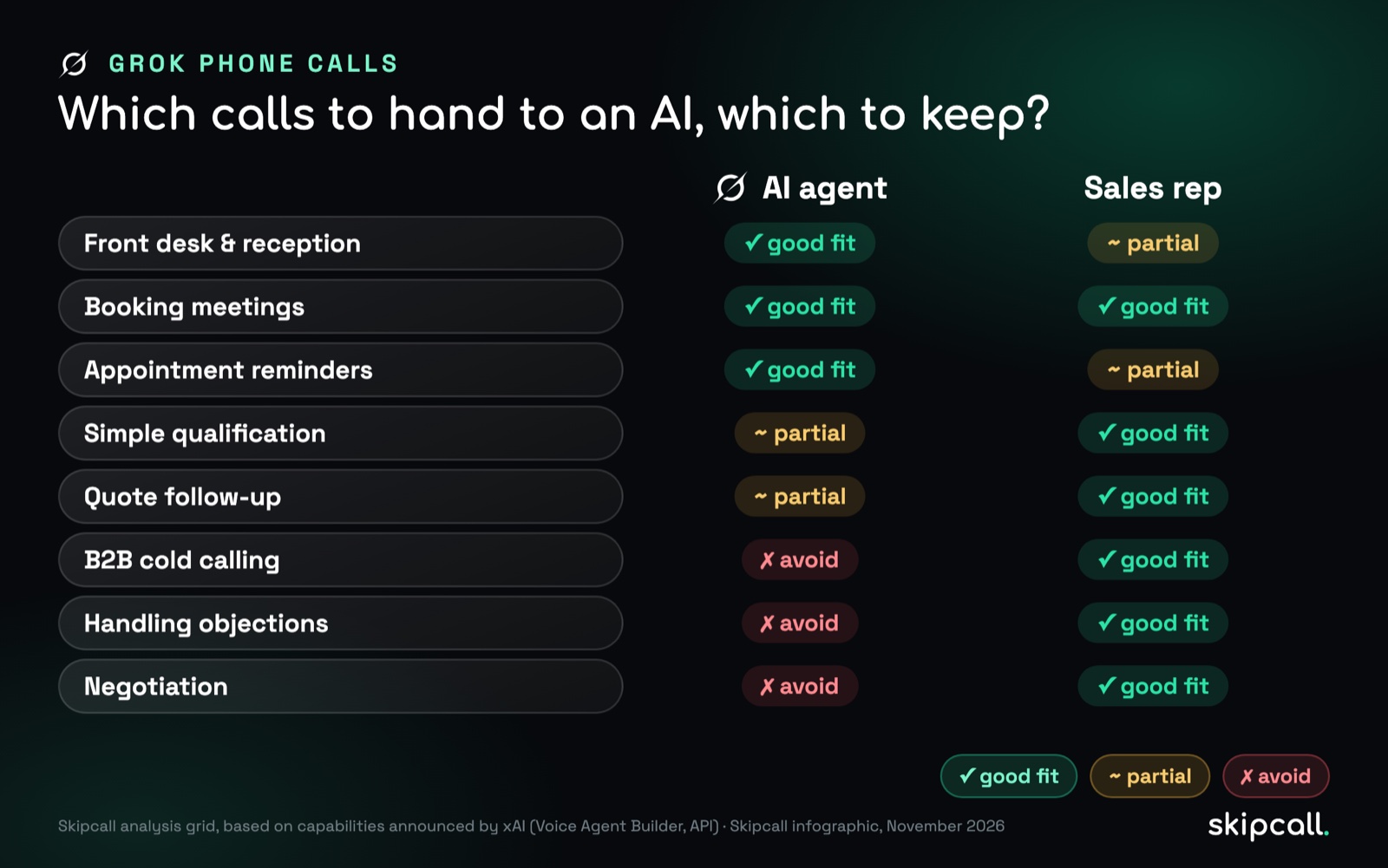
| Call | Best owner | Why |
|---|---|---|
| Appointment reminder | AI | Expected call, yes-or-no answer, no stakes |
| Inbound callback after a campaign | AI, then rep | AI screens and books; the rep runs the meeting |
| Quote follow-up | Rep, prepared by AI | Reading hesitation matters; AI preps the notes and last-call summary |
| Cold call to a decision-maker | Rep | Hook, credibility and objections in the first 30 seconds |
| Negotiation and close | Rep | Authority and judgment; no place for a voice agent in 2026 |
What does an AI voice agent really cost compared to a rep?
On the AI side, the public prices are simple. xAI currently charges $0.08 per minute of conversation, for both the Voice 3.0 API and the Voice Agent Builder, which comes to $4.80 an hour, with no platform fee. Tools used during the call are billed on top, and the phone number xAI provides adds $0.01 per minute. Example: 100 three-minute calls add up to 300 minutes, so $24 of conversation, or $27 with xAI’s number. More scenarios are in our Voice Agent Builder review.
That figure is misleading on its own. Add the hours spent writing and tuning the script, the CRM integration, someone reviewing transcripts, and above all the opportunities lost when the AI fumbles a call a person would have converted. In the other direction, a rep is expensive per hour, but one good conversation can be worth a five-figure deal.
So the right unit is not the minute. It is the booked meeting. Our cost per meeting calculator gives you that number for your own team, which is the bar any AI agent has to beat.
Should this call go to an AI? The five-question handoff test
Before you hand a call type to an AI, answer yes or no to each question.
- Does the person expect the call, or are they the one calling? Agreed callbacks and inbound calls work. Cold calls much less.
- Does the conversation fit a short script with few branches? Confirm, offer three slots, answer ten FAQs: yes. Explore a project: no.
- Is a mistake easy to undo? A wrong time slot can be fixed. A discount granted by accident cannot.
- Do you have the consent an AI-voiced call requires? An AI voice is an artificial voice under the TCPA. Calling a cell phone with one, without consent, fails this test outright.
- Does the call survive the line “Hi, I’m a virtual assistant”? In the EU that sentence is mandatory, and in practice it is good manners everywhere.
Is it legal to prospect with an AI voice agent in the US?
Start with the 2024 ruling that changed everything for AI voices. On February 8, 2024, the FCC ruled (FCC 24-17) that AI-generated voices, cloned ones included, are “artificial” voices under the Telephone Consumer Protection Act. That puts AI-voiced calls in the same consent framework as prerecorded robocalls, with a higher bar for telemarketing.
What stays outside the consent framework. A live, human call that a rep dials to a business landline does not need TCPA consent. That is still the backbone of compliant B2B cold calling. Our guides to whether cold calling is legal and cold calling cell phones cover the details.
What sits inside it. Calls with an artificial or prerecorded voice, an AI voicemail drop, autodialed calls and texts to cell phones. From November 25, 2026, the FCC’s order FCC 26-67 also changes how consent can be revoked: you may designate an exclusive opt-out method, and if you do, you must disclose it in every call or text that requires consent. Our breakdown of the TCPA changes for B2B teams walks through the checklist.
What it costs to get wrong. Federal TCPA damages run from $500 to $1,500 per call or text, and several states, including Florida, Oklahoma, Washington and Maryland, have their own mini-TCPAs on top. Calling hours still apply: 8 AM to 9 PM in the recipient’s local time, 8 PM in Florida.
On the consumer side, Grok Bot settles it. According to an excerpt of its terms of service, xAI’s consumer assistant prohibits telemarketing and mass calling. It is built for your own errands, not for prospecting. To see these calls from the receiving end, read how to tell if an AI is calling you.
How do you run a 30-day AI calling pilot?
A good pilot avoids two mistakes: handing everything to AI after one slick demo, or dismissing it without measuring anything.
Pick one call and set the metrics
Take the call that scored best on the handoff test, usually appointment reminders or after-hours inbound. Record your baseline: show rate, missed calls, meetings booked, cost per meeting.
Write the script and the guardrails
Opening line disclosing the AI and any recording, allowed answers, forbidden topics, trigger words that send the call to a person. Confirm consent for every number on the list. Run about 20 internal test calls.
Go live on a slice of volume
Roughly one call in five, with a transfer to a person always available. Read a sample of transcripts every day and fix the script.
Measure and decide
Compare with the baseline: show rate, transfer rate, average call length, complaints and opt-out requests, true cost per meeting. Then scale, adjust or stop.
What’s the smartest setup: AI behind the rep?
In 2026, the teams getting the most out of AI are not handing it the microphone. They hand it everything around the call: prospect research before dialing, live transcription and a summary of every conversation, spotting the objections that keep coming back, coaching after the call. The voice agent itself sticks to repetitive, low-stakes calls like reminders and the inbound front desk.
That is the model behind tools like Skipcall: reps dial themselves with a power dialer and business phone numbers, while AI transcribes, summarizes and helps them improve, from $25 per month (billed annually), no commitment. And for a look at where fully automated conversations are heading, read when AI calls AI.
The bottom line
An AI like Grok does not replace a sales rep. It replaces some of a rep’s calls. It is excellent on reminders, confirmations, inbound booking and the front desk, at $0.08 a minute from xAI. To decide which calls to hand over, run each one through the five-question test, then pilot it for 30 days before scaling. It stays weak where revenue is made: cold calls, objections and negotiation. And in the US, an AI voice is an artificial voice under the TCPA, so consent comes before the first dial. For the full picture of what Grok can do on the phone, go back to our guide to Grok and phone calls.
Sources: x.ai, Grok Voice Agent API (December 17, 2025), Voice Agent Builder (July 1, 2026, pricing as displayed in November 2026) and Grok Voice 3.0 (October 14, 2026); FCC, Declaratory Ruling FCC 24-17 (February 8, 2024); FCC, Order FCC 26-67, CG Docket No. 02-278 (effective November 25, 2026); Regulation (EU) 2024/1689, Article 50; Grok Bot terms of service (excerpt).