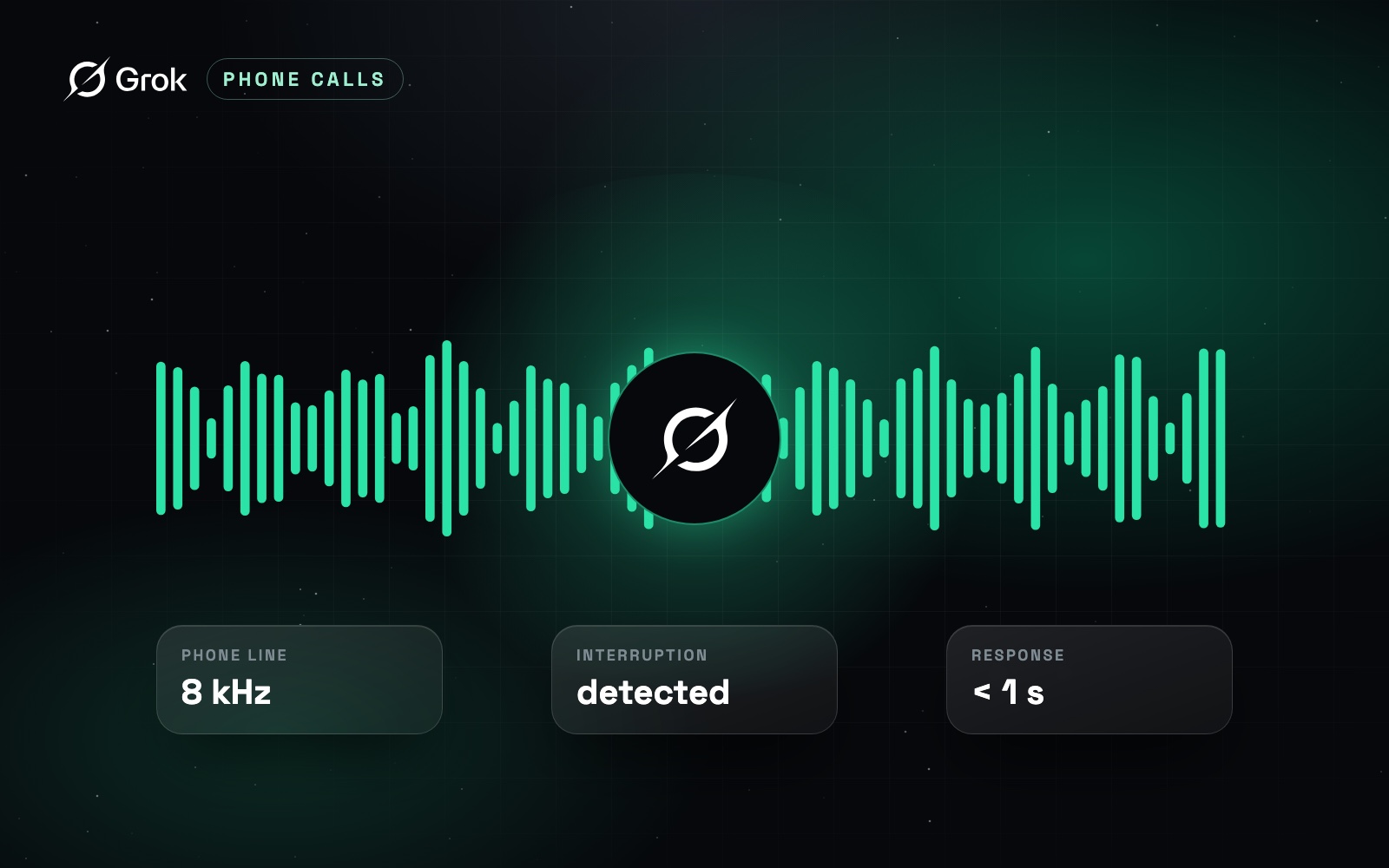
Grok’s voice AI works on the phone because a single real-time model listens to audio and answers in audio, without converting your words to text first. That is how xAI gets replies under a second, short enough that the other person never wonders whether the line dropped. What it cannot change is the phone line itself, which carries sound at 8 kHz and makes every voice, human or AI, sound like a phone call.
If you have ever shouted “representative!” at an automated phone line, you know why this matters. This guide explains, without jargon, what changed under the hood, what we know about Grok’s voices and languages, and how to test a voice agent before you put it in front of customers. For the overview of xAI’s phone products, see our Grok phone calls guide.
Why did older voice bots sound so robotic?
Until recently, getting an AI to talk on the phone meant wiring three separate programs together, like an assembly line.
Speech-to-text
A speech recognizer listens and waits until you finish your sentence before turning it into text. That is the first wait: the system has to decide you are done talking.
The language model
A language model reads the text and writes a reply, also as text. Your tone, your hesitation, your irritation were lost in the previous step: the model only sees words.
Text-to-speech
A synthetic voice reads the reply aloud. It has to guess the intonation from text alone, which is where the flat, slightly off delivery of older assistants came from.
Each link adds its own delay, and the delays stack. Add the trip across the phone network and you get the familiar beat of silence before every answer, just long enough to make the conversation feel wrong.
What does “speech-to-speech” actually mean?
A speech-to-speech model, which LiveKit calls “voice-to-voice,” removes the assembly line. It takes in the sound of your voice and produces the sound of its reply, inside one model, with no mandatory stop at text in between.
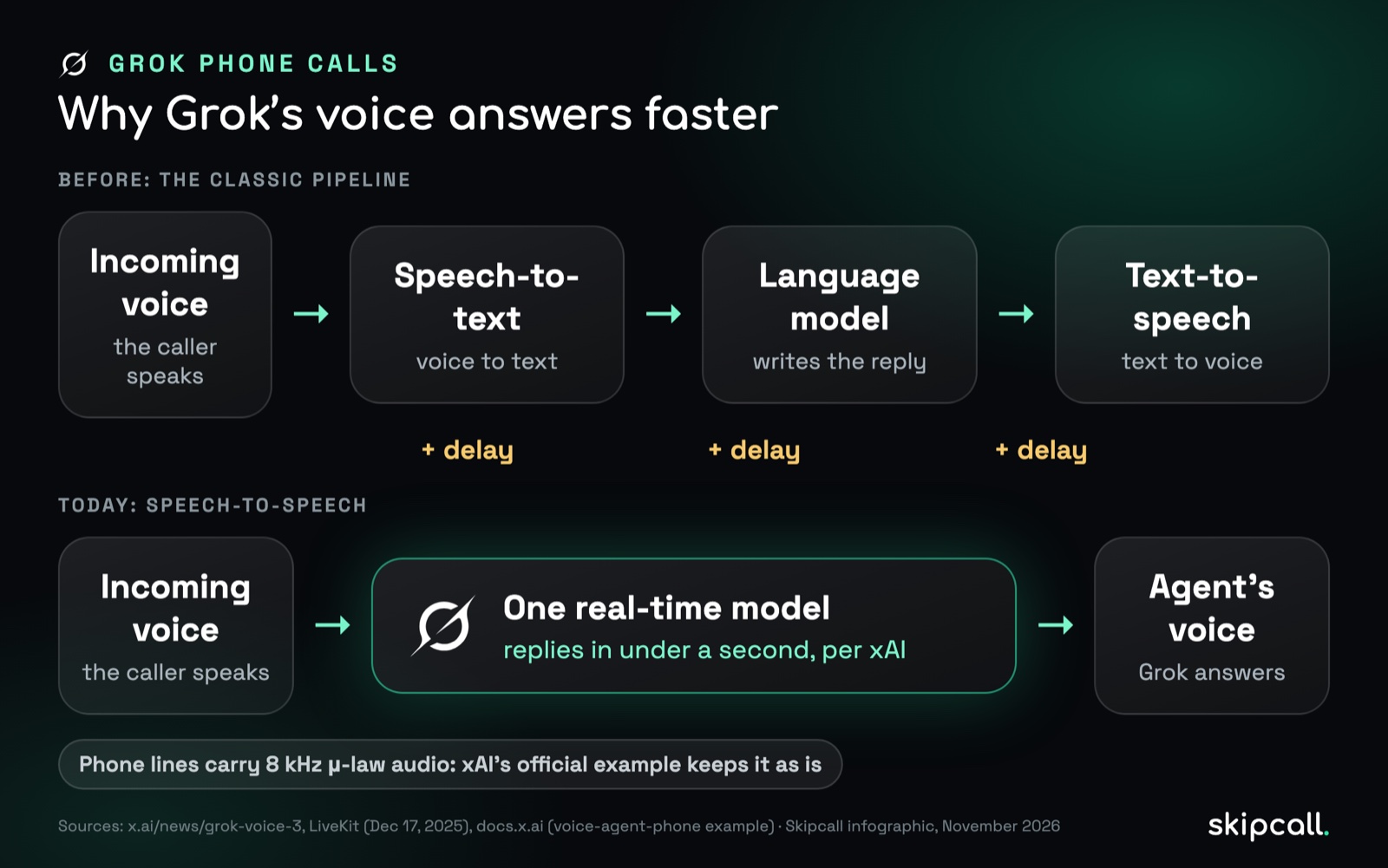
That is how LiveKit, xAI’s partner for the Grok Voice Agent API launch on December 17, 2025, described the technology: a single voice-to-voice model that, by its measurements, reliably responds in under 700 milliseconds. xAI’s own wording is “under one second,” and for Grok Voice 3.0 it claims 40 percent lower latency than OpenAI’s GPT-Live-1 on its τ-Voice benchmark.
The real progress in voice AI is not that it sounds better. It is that it answers fast enough for you to forget you were waiting.
How fast does Grok actually respond on a call?
Latency is the gap between the end of your sentence and the start of the reply. Face to face, you see the other person thinking. On the phone, silence sounds like a dropped call. Under a second, the exchange feels natural. Beyond that, both sides start talking over each other.
Total latency on a call is more than the model’s thinking time. It adds the trip from the caller to xAI’s servers and back, plus the phone network on each end. xAI’s real-time API documentation lists one server region, us-east-1, on the US East Coast. For a caller in New York or Atlanta, that is a short trip. For a caller in Seattle it is longer, and for a caller in London or Sydney longer still, which eats into the sub-second budget.
Can you interrupt Grok in the middle of a sentence?
People interrupt all the time: “no, Thursday,” “it’s spelled with a K.” A voice agent has to notice, in real time, that the caller has started speaking, stop talking and listen. This is called turn-taking, and it is what separates a natural call from a frustrating one.
Speech-to-speech models have an edge here, because they listen continuously instead of waiting for a complete sentence. The tuning is still delicate: too sensitive, and the agent stops at every cough or passing car; not sensitive enough, and it keeps talking over the caller. xAI has not published how Grok Bot handles this on its own calls. Developers who build with the API configure it themselves, as covered in our Grok Voice Agent API guide.
Why does every AI voice still sound like a phone call?
Even the best synthetic voice loses detail on a call, and the reason is the line, not the AI. The traditional phone network carries audio at 8 kHz, encoded in μ-law (pronounced “mew-law”), the G.711 format used across North America and Japan for decades to save bandwidth. Only frequencies up to roughly 4 kHz get through, so the highs, the breathiness and part of the timbre disappear.
In practice, an AI voice will always sound a bit more “phone” on a call than it does inside an app, where the audio is far better. For how the agent actually gets onto the phone network, through a number, a SIP trunk or Twilio, see how to connect Grok to a real phone number.
Which voices and languages does Grok offer?
When the API launched in December 2025, xAI introduced three voices: Ara, Eve and Leo. The Grok Voice Agent Builder, the no-code tool in beta since July 1, 2026, lists more than 25 languages and brand-voice cloning from about two minutes of recorded audio. The original API announcement also mentioned switching languages mid-conversation.
Voice cloning deserves a warning. A cloned voice can mislead the person on the other end about who is calling, which is exactly why Grok Bot’s terms require it to identify as a virtual assistant, and why the FCC has treated AI-generated voices as artificial voices under the TCPA since February 2024. For using a cloned voice in an agent that answers your line, see our Grok Voice Agent Builder review.
How do you test an AI voice agent in five minutes?
Vendor numbers are no substitute for listening. If you are considering a voice agent for your business, call it yourself from a cell phone, not from the computer where it was configured, and run these five checks.
The pause after your sentence
Ask a simple question and count in your head. If the reply takes long enough that you are tempted to speak again, the latency is too high for your customers, whatever the spec sheet says.
The interruption
Cut the agent off mid-sentence to correct something. It should stop quickly and use the correction, not finish its sentence over you.
Background noise
Call from a street corner, a car or a busy kitchen. A poorly tuned agent either stops at every noise or stops hearing you.
Names and numbers
Spell a last name, read out an order number and a street address. This is where 8 kHz audio trips up understanding most often.
The off-topic question
Ask something the agent is not supposed to know. It should say it does not know or offer a person, not invent an answer.
The same checks work from the other side of the line. The tells of an artificial voice, and what it is required to disclose, are covered in how to tell if an AI is calling you.
Voice AI vocabulary, in one line each
| Term | What it means |
|---|---|
| Latency | The gap between the end of your sentence and the start of the reply. Under a second feels natural. |
| Speech-to-speech | One model that hears audio and produces audio, with no stop at text in between. |
| Speech-to-text (STT) | The program that turns a voice into text, the first step of the old pipeline. |
| Text-to-speech (TTS) | The program that reads text aloud, the last step of the old pipeline. |
| Turn-taking | Knowing who is speaking, going quiet when the other person starts, and resuming at the right moment. |
| G.711 μ-law | The 8 kHz audio format of North American phone lines, which keeps frequencies up to about 4 kHz. |
| Voice cloning | Creating a synthetic voice that imitates a real one, from about two minutes of audio in xAI’s Builder. |
What can’t a great voice fix?
A fast, expressive voice guarantees neither that what it says is right nor that the call is allowed. An AI can be wrong with total confidence, and a natural voice makes the mistake more believable. On the phone, it does not replace what makes a good sales call either: a relationship, a customer history, the ability to handle an objection nobody scripted. For those calls, AI works better behind the scenes, transcribing and summarizing, than on the line itself, as we argue in Grok vs. sales reps.
For your own calls, sound quality starts with your connection. Latency, jitter and packet loss do more for a clear call than any model.
The bottom line
Grok talks on the phone through a speech-to-speech model: it hears audio and produces audio directly, without the old speech-to-text, language model, text-to-speech chain that created those awkward pauses. xAI claims replies under a second for Grok Voice 3.0, and LiveKit measured under 700 ms at the API launch; both are vendor figures. The phone line still sets the ceiling: 8 kHz μ-law audio, which xAI’s example keeps as is. Voices, 25+ languages and cloning are there, but a natural voice does not make a call accurate or legal. Test any agent yourself in five minutes before your customers do. For the full picture, see our Grok phone calls guide.
Sources: x.ai, “Grok Voice Agent API” (December 17, 2025), “Grok Voice 3” (October 14, 2026) and “Grok Voice Agent Builder” (July 1, 2026); LiveKit, xAI partnership announcement (December 17, 2025); docs.x.ai, real-time API and “voice-agent-phone” example; GitHub, xai-org/xai-cookbook; FCC 24-17 (February 8, 2024).