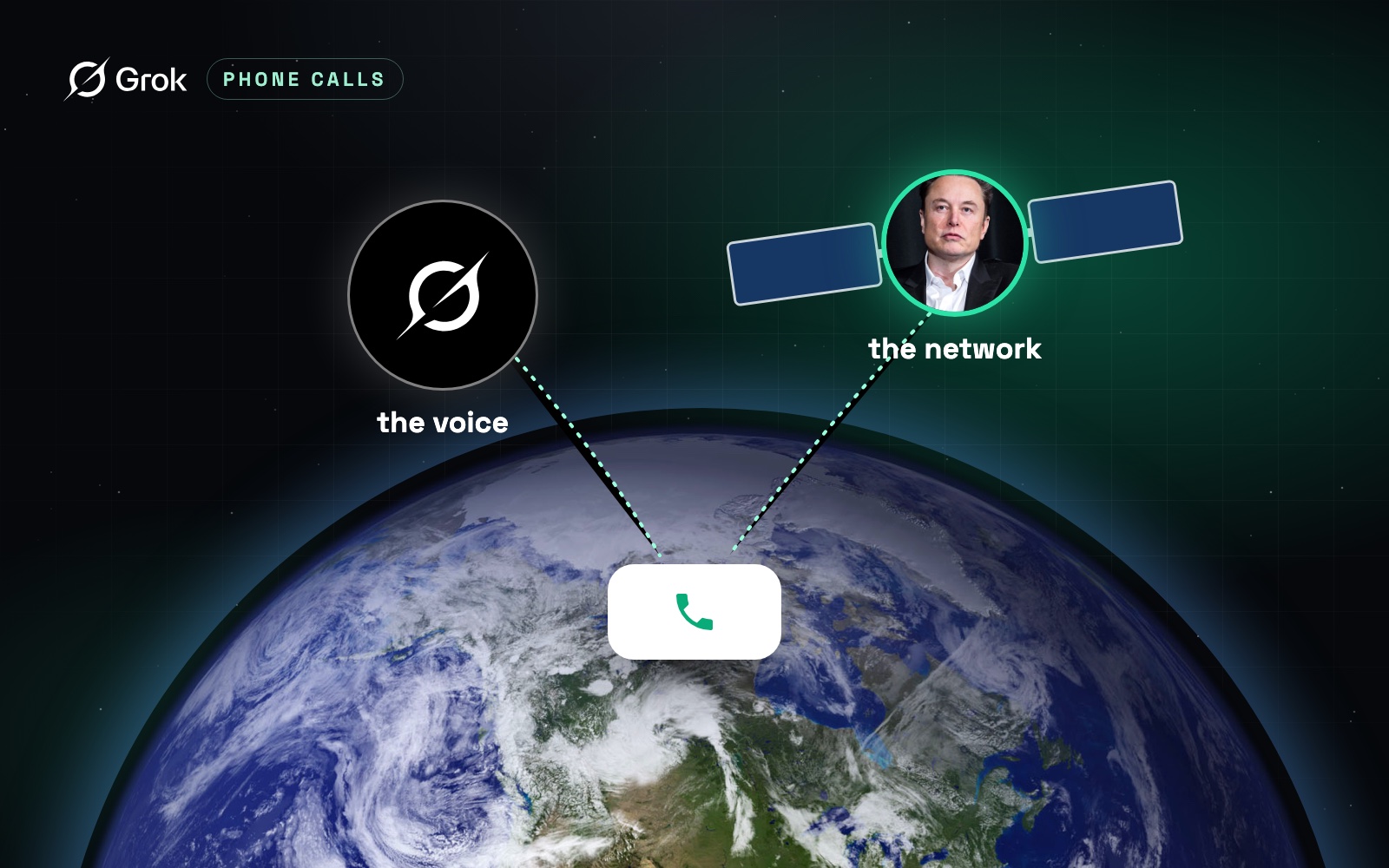
Elon Musk’s phone strategy comes down to owning every layer of a call. Since SpaceX acquired xAI in February 2026, one group controls the voice (Grok), the network (Starlink and its newly bought spectrum), the app that places calls (Grok Bot) and the distribution (X). No US carrier owns that full stack, and Wall Street has noticed.
For a century, the pieces of a phone call belonged to different players: handset makers, carriers, and the government that licenses spectrum. This article lays out how Musk’s companies came to hold all four layers, what is shipping versus what is only announced, how AT&T, Verizon and T-Mobile are pushing back, and the moves a US business can make now so that it wins whoever wins. For the product overview, start with our guide to Grok and phone calls.
Which pieces of a phone call does Musk now control?
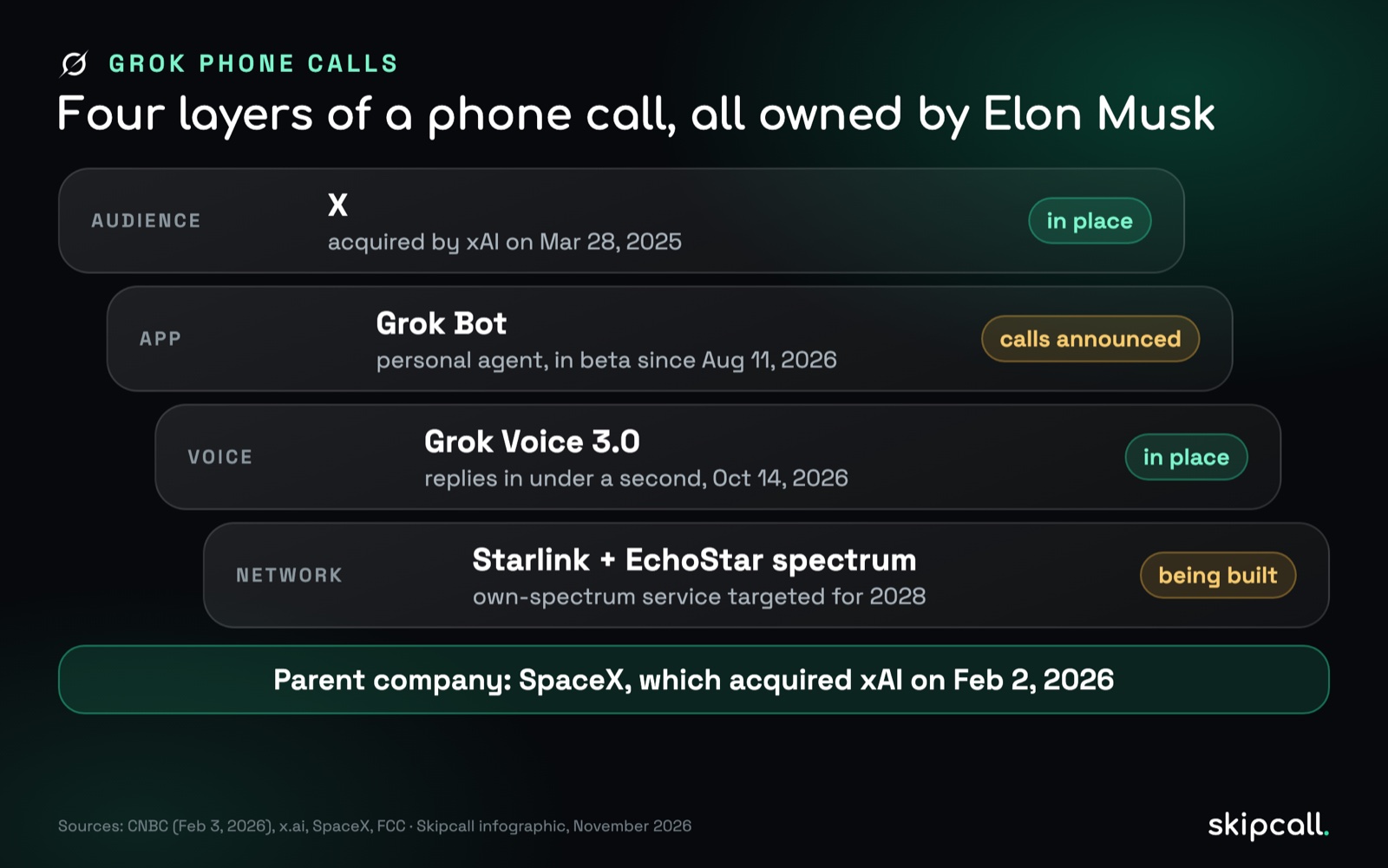
The corporate map changed fast, so it helps to lay it out. On March 28, 2025, xAI, the company behind Grok, acquired X in an all-stock deal. On February 2, 2026, SpaceX acquired xAI, valuing the pair at $1.25 trillion according to CNBC. xAI became a SpaceX subsidiary and was renamed SpaceXAI in July 2026. In August, the group also closed its acquisition of Cursor, the software company where Grok Bot was built.
The result is a parent company that holds four layers no carrier combines.
How far along is the voice layer?
Grok’s voice arrived in three waves, each aimed at a different buyer. Developers came first with the Grok Voice Agent API on December 17, 2025. Businesses without engineers got the Grok Voice Agent Builder on July 1, 2026, which turns a written brief into an agent that answers a number. Consumers came last: on October 25, 2026, Musk posted that Grok Bot can now call a person or a business on your behalf.
The engine improved quickly along the way, with Voice 2.0 in August and Voice 3.0 on October 14, 2026, at a response time xAI puts under one second. That is roughly the threshold where a phone conversation stops feeling robotic, as we explain in how Grok talks on the phone. The consumer calling feature is still more announced than documented, and we track what is verifiable in our Grok Bot breakdown.
How close is Starlink to being a real carrier?
While Grok learned to talk, SpaceX bought the means to carry voices. In September 2025, it agreed to buy EchoStar’s AWS-4 satellite spectrum and H-block licenses for about $17 billion, then EchoStar’s unpaired AWS-3 licenses for $2.6 billion. The FCC approved the EchoStar transfer on May 12, 2026. In October 2026, the agency partly authorized 15,000 next-generation direct-to-cell satellites, approved SpaceX’s purchase of AWS-3 licenses from Tristar, and SpaceX announced a deal for Grain Management’s nationwide 800 MHz portfolio, about $8 billion according to the Wall Street Journal and still awaiting approval.
Then, on October 29, the FCC voted unanimously to propose opening 13 cellular bands to satellite-to-phone service instead of 5, about 482 MHz more, and replacing the requirement to lease spectrum from carriers with coexistence agreements. We broke it down in the FCC’s direct-to-device overhaul and why SpaceX comes out ahead.
Carriers own the network but not the intelligence. AI labs own the intelligence but not the network. Musk’s group is the first to own both.
How are AT&T, Verizon and T-Mobile reacting?
Markets moved before regulators did. On August 4, 2026, in its first earnings call as a public company, SpaceX said it expected to win “quite a few” customers from the big three. On October 23, after reports that SpaceX wanted access to at least 80,000 US cell sites, AT&T fell 8% and T-Mobile 7.7% in a single session, while the S&P 500 slipped 0.5%. Analyst Roger Entner of Recon Analytics has started calling it the “Starlink doctrine.”
The carriers’ response runs on two tracks. At the FCC, through their trade group CTIA, they are concentrating on the 2.5 GHz and 3.45 GHz bands, which carry much of their 5G traffic, and asking for “same customer, same rules” performance standards for satellite and terrestrial service. Commercially, they formed a joint venture on October 1, 2026, to pool spectrum for satellite service, so SpaceX is not the only option for coverage from space. Commissioner Anna Gomez, who voted for the proposal, has also asked whether one or two companies could end up dominating direct-to-device.
What is still missing from the picture?
Today the voice and the network live side by side without touching. Grok calls over other companies’ networks: an agent built on the API goes through a carrier like Twilio or a SIP trunk, and Grok Bot through your phone line or a connector. Starlink’s direct-to-cell service carries texts and some data, not live conversations with an AI. Nothing has been announced that connects the two.
Three obstacles stand between the pieces and a working “Musk carrier”:
- Regulation. The FCC item is a proposal with a comment period and a second vote still to come, and the 2.5 and 3.45 GHz fight is unresolved.
- Handsets. SpaceX’s next-generation satellites will also use its own satellite frequencies, which current phone chips do not support. Musk has talked about roughly two years to bring compatible modems to market.
- Rockets and trust. The heavier satellites depend on Starship, and many people hang up as soon as they realize they are talking to an AI, which we cover in how to tell if an AI is calling you.
Several analysts place a fully standalone SpaceX mobile service between 2028 and 2030.
What is certain, what is announced, and what is a bet?
Certain. The SpaceX group owns xAI, Grok, X and Cursor. Grok holds voice conversations in under a second according to xAI. Businesses can already put a Grok agent on a phone number. SpaceX holds US cellular spectrum and a constellation that talks to ordinary phones.
Announced. Grok Bot placing calls for consumers. A SpaceX mobile service on its own spectrum in early 2028. Next-generation satellites for voice and data. The FCC’s direct-to-device rules, which still need a final vote.
A bet. A Musk-branded carrier selling lines with Grok built in. Calls where the AI dials, talks and negotiates on your behalf over SpaceX’s own network. Whether carriers’ joint venture and the FCC’s final rules leave room for that. For the long-term question of whether carriers survive at all, read will phone carriers disappear?.
What should a US business do while this plays out?
Nothing changes in how you buy phone service this quarter. But the direction is clear: the phone is becoming software, and the network a pipe you can swap. Four decisions keep you flexible whoever wins:
- Put business numbers on a cloud phone system, reachable from office Wi-Fi, any carrier’s 5G or a Starlink dish. Your number no longer depends on one network. Our guide to VoIP over Starlink covers that setup.
- Split the team across two carriers, or add an eSIM backup, so one carrier’s outage never silences the whole team.
- List the repetitive calls you could hand to a voice agent one day, such as reception, reminders and scheduling, and the ones that must stay human.
- Own your call data: recordings, transcripts and numbers should move with you if you change providers.
When you are ready to pilot an agent, our guide to connecting Grok to a phone number shows how it joins the phone network without changing your number. And if you want to understand the satellite side in plain terms, start with direct-to-cell explained.
The bottom line
Elon Musk has not announced a phone or a carrier. He has done something quieter and more structural: putting the voice (Grok), the network (Starlink and its spectrum), the app (Grok Bot) and the reach (X) under one parent. The voice already handles business calls, the network already reaches ordinary phones, and the link between them is still unbuilt. Carriers are fighting at the FCC and in the market, and nothing is final until the agency’s second vote. The practical hedge for any business is the same either way: keep your numbers on IP. For every article in this series, visit our Grok phone calls guide.
Sources: CNBC (February 3, 2026); xAI announcements for the Grok Voice Agent API (December 17, 2025), Voice Agent Builder (July 1, 2026), Grok Bot (August 11, 2026) and Grok Voice 3 (October 14, 2026); Elon Musk on X (October 25, 2026); FCC, GN Dockets 26-281 and 23-65; FCC Memorandum Opinion and Order DA 26-1129 (October 21, 2026); Broadband Breakfast; Capacity; Trefis (October 25, 2026); Journal du Net (October 19, 2026).