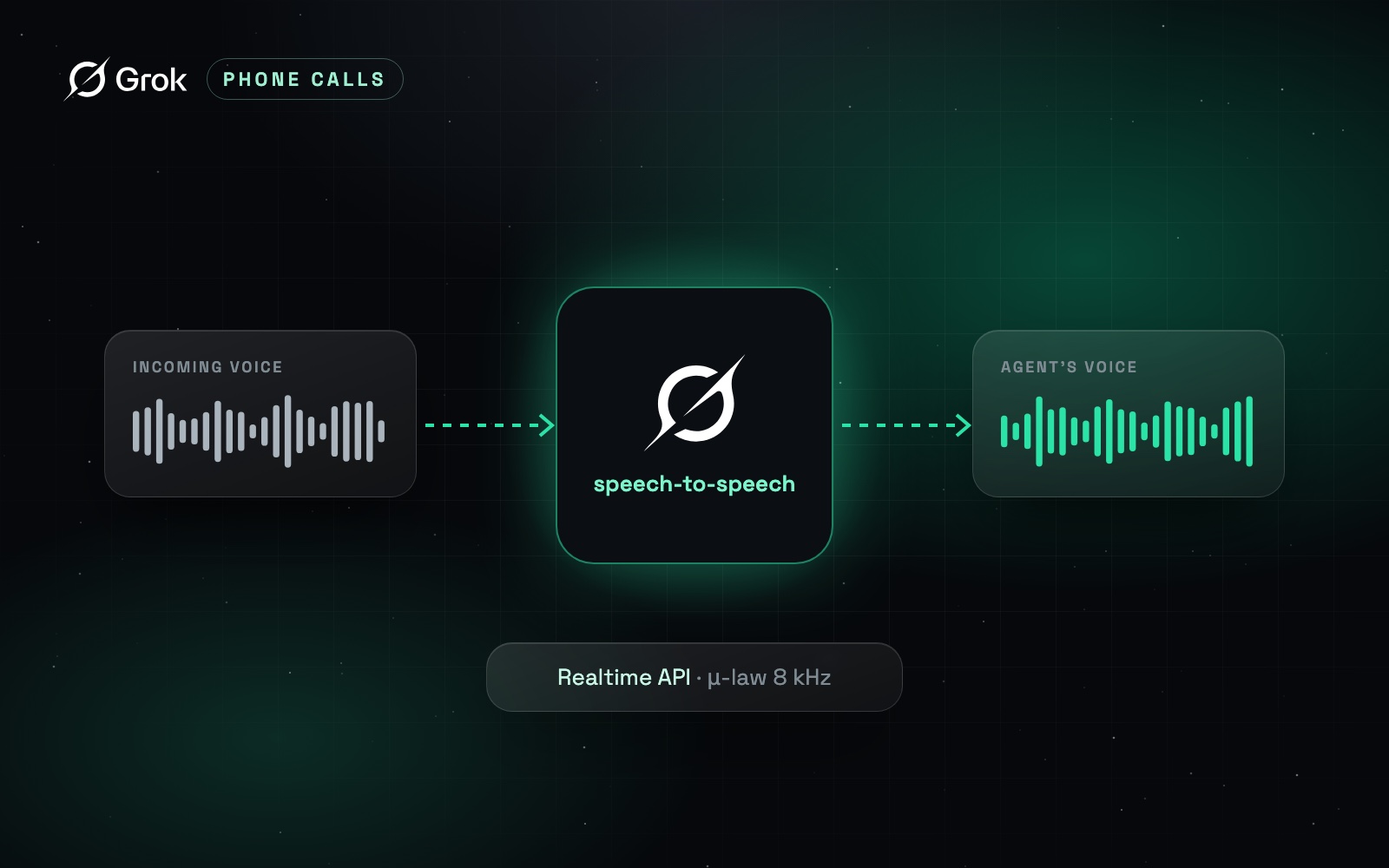
The Grok Voice Agent API is the developer layer of xAI’s voice stack: you stream a caller’s audio to Grok over a WebSocket, and Grok streams a spoken reply back in under a second, according to xAI. It costs $0.08 per minute in November 2026, and it is the building block behind custom help lines, booking agents and in-app voice assistants.
If you are deciding whether to build on it, this guide covers what matters in practice: how a session flows, what you will actually pay, where it differs from OpenAI’s Realtime API, and what to clear with legal and security before go-live. For the big picture of Grok Bot, the API and the no-code Builder, start with our guide to Grok and phone calls.
What does the Grok Voice Agent API actually do?
Think of it as a live phone line between your software and Grok. Your application sends audio, from a browser microphone or a phone call, and Grok listens, decides what to say and answers out loud. The connection stays open the whole time, so the conversation flows instead of advancing one request at a time.
xAI shipped it on December 17, 2025, priced at $0.05 per minute, with an official LiveKit plugin. LiveKit is an open-source platform many teams already use to build voice agents, so the plugin gave them a short path to production. xAI also describes the API as compatible with the OpenAI Realtime specification, the de facto format for real-time voice.
In xAI’s lineup, the API sits in the middle. Above it are two finished products: Grok Bot, which can place calls for you, and the Grok Voice Agent Builder, which creates a phone agent without code. Below it are the voice models themselves, most recently Grok Voice 3.0.
Why does a voice-to-voice model feel faster?
Older voice assistants chained three systems: speech-to-text, a language model that wrote a reply, and text-to-speech that read it out. Each hop added delay, and tone of voice got lost because the model only ever saw words.
LiveKit describes the xAI model as voice-to-voice: sound goes in and sound comes out of one model. In practice that gives you two things:
- Shorter pauses. LiveKit reports replies in under 700 milliseconds. xAI’s figure for Voice 3.0 is under one second, and it claims 40% lower latency than GPT-Live-1 on the τ-Voice benchmark.
- More expressive delivery. The model can laugh, sigh or whisper, and xAI exposes that through tags such as [laugh], [sigh] and [whisper].
We unpack the voice side, from barge-in to the 8 kHz sound of a phone line, in how Grok talks on the phone.
Callers forgive a slightly odd word choice. They do not forgive a two-second silence after every sentence.
How does a session with the API work, step by step?
Exact event names depend on your SDK and version, so treat this as the shape of every session rather than copy-paste code. The transport is a WebSocket, a channel that stays open for the whole conversation instead of firing one request per message.
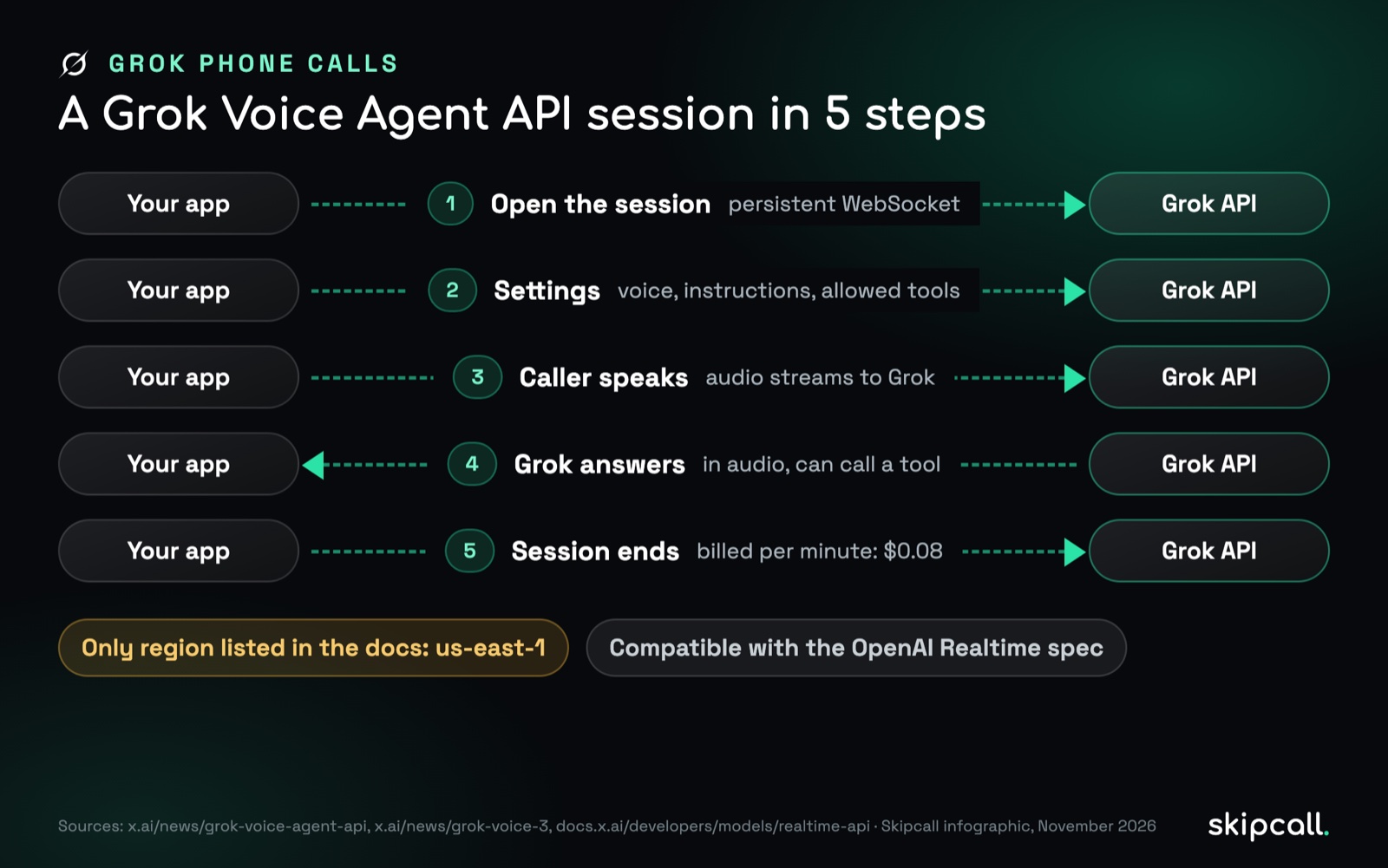
Open the session
Your server opens an authenticated WebSocket to xAI with your API key. It stays open until the call ends.
Send the settings
You send the agent’s instructions (role, tone, goal), the voice, the audio format and the tools it may call, such as an availability lookup in your calendar.
Stream the caller's audio
Audio goes up in small chunks. For phone calls, xAI’s official example keeps the telephone format, μ-law at 8 kHz, with no conversion.
Play Grok's answer and run tools
Grok streams audio back along with events: speech started, speech stopped, transcript, tool requested. Your code runs the tool and returns the result to the model.
Close and log
Close the socket, then store what you need (transcript, summary, duration) according to your disclosure and retention policy. Session length drives the bill, at $0.08 per minute.
To put this behind a real phone number, xAI publishes an official example that connects a Twilio number to the API. Numbers, SIP trunks and porting are covered in our guide to connecting Grok to a phone number.
How much does the Grok Voice Agent API cost?
You pay per minute of conversation, and the rate has changed since launch. Many blog posts still quote the old number.
| Period | Model | Price per minute | Per hour |
|---|---|---|---|
| December 2025 (launch) | grok-voice-think-fast-1.0 | $0.05 | $3.00 |
| From August 5, 2026 | Grok Voice 2.0 | $0.08 | $4.80 |
| From October 14, 2026 | Grok Voice 3.0 | $0.08 | $4.80 |
Three more lines usually show up on the invoice:
- Tools. Web search and other tool calls are billed separately. Trade press reports $5 per 1,000 web searches.
- Telephony. If the agent answers the phone, your carrier, for example Twilio, bills the number and its own per-minute rate.
- Hosting. The small server that bridges the phone call and the API runs on your infrastructure.
A quick sizing example: a help line handling 1,000 calls a month at an average of three minutes uses 3,000 minutes, which is $240 of Grok conversation before tools, numbers and carrier minutes. At 10,000 calls, it is $2,400, and the carrier side starts to weigh as much as the AI side.
Grok Voice Agent API vs. OpenAI Realtime: what is actually different?
Because xAI claims spec compatibility, the comparison comes up in every evaluation. Here is what the sources support, without guesswork.
| Grok Voice Agent API | OpenAI Realtime API | |
|---|---|---|
| Generally available | December 17, 2025 | August 28, 2025 (gpt-realtime) |
| Model type | Voice-to-voice, per LiveKit | Real-time model gpt-realtime |
| Stated latency | Under one second (xAI) | Not compared here |
| Wire format | Compatible with the OpenAI Realtime spec | The reference spec |
| Phone calls | Official example through Twilio Media Streams | SIP calling supported |
| Extras cited | [laugh], [sigh], [whisper] tags, LiveKit plugin | MCP servers, image input |
| Price | $0.08/min (Voice 2.0 and 3.0) | Not compared here |
| Region listed in docs | us-east-1 | Not compared here |
“Not compared here” means we did not verify the figure, not that it does not exist.
The practical difference for a phone project is the plumbing. OpenAI documents native SIP calling, while xAI’s official phone example bridges through Twilio Media Streams. Both work, but they are set up differently, and compatibility at the message level does not mean identical behavior. Run the same call scripts on both before you commit.
What should you settle before going to production?
Ask xAI these five questions in writing and keep the answers with your vendor file:
- Where are audio and transcripts processed and stored? Is any region other than us-east-1 available?
- How long is data retained, and can you request deletion?
- Are conversations used to train models? If so, can you opt out?
- Which subprocessors touch the data? Hosting, telephony, any tool providers.
- What transfer mechanism covers non-US callers? Ask which one applies to your contract.
Then check the calling rules that apply to your use case:
- Outbound calls in the US. In February 2024, the FCC confirmed that AI-generated voices are “artificial” voices under the TCPA, so consent rules for artificial-voice calls apply. The FCC’s consent revocation rules changed again on November 25, 2026, as we explain in the TCPA changes for B2B teams. Our cold calling compliance checker walks through the basics.
- Callers in the EU. Since August 2, 2026, Article 50 of the AI Act requires telling people they are talking to an AI, at the latest at the first interaction.
- Recording notices. If you record or transcribe, say so at the start of the call. Our call recording notice generator drafts the wording.
Who should build on the API, and who should not?
One reality check for sales leaders: a voice agent does not replace a rep on a prospecting call. Most revenue teams still win with good business numbers and tools that make humans faster. That is Skipcall’s job: a VoIP phone system for sales reps with a power dialer, transcription and CRM sync, from $25 per month (billed annually), no commitment.
The bottom line
The Grok Voice Agent API gives developers xAI’s real-time voice over a WebSocket, compatible with the OpenAI Realtime spec, at $0.08 per minute with Grok Voice 3.0. It is fast and expressive, but young: prices changed twice in ten months, the docs list only us-east-1, and outbound use in the US runs into TCPA rules on artificial voices. Build on it when you have engineers and a clear inbound use case, and test it against the alternatives first. For how the API fits next to Grok Bot and the Builder, head back to our Grok phone calls guide.
Sources: xAI, “Grok Voice Agent API” (December 17, 2025) and “Grok Voice 3” (October 14, 2026); xAI real-time API documentation; LiveKit, xAI partnership announcement (December 17, 2025); GitHub xai-org/xai-cookbook, voice-agent-phone example; InfoQ on gpt-realtime general availability (September 2025); FCC Declaratory Ruling FCC 24-17 (February 8, 2024); Regulation (EU) 2024/1689, Article 50.