Wall Street saw it coming before the regulators voted. On Friday, October 23, 2026, AT&T shares fell 8% and T-Mobile 7.7% in a single session, on reports that SpaceX wanted access to at least 80,000 US cell sites. Six days later, the FCC voted unanimously to rewrite the rules that govern how satellites talk to ordinary phones.
The proposal is technical, but its effect is simple to state. Spectrum that carriers paid billions for becomes reachable by satellite operators without a lease, while the FCC asks whether satellite spectrum should stay off-limits to everyone else. One company sits on both sides of that line: SpaceX. This guide walks through what the FCC proposed, why the balance favors SpaceX, where the carriers are pushing back, what is still undecided, and what it means for a business that relies on mobile phones to sell.
What the FCC actually voted on
The item is titled “Unleashing Licensed Spectrum for Direct-to-Device” and sits in GN Dockets 26-281 and 23-65. It builds on the Supplemental Coverage from Space (SCS) framework the FCC created in March 2024, the rules behind T-Mobile’s T-Satellite service with Starlink.
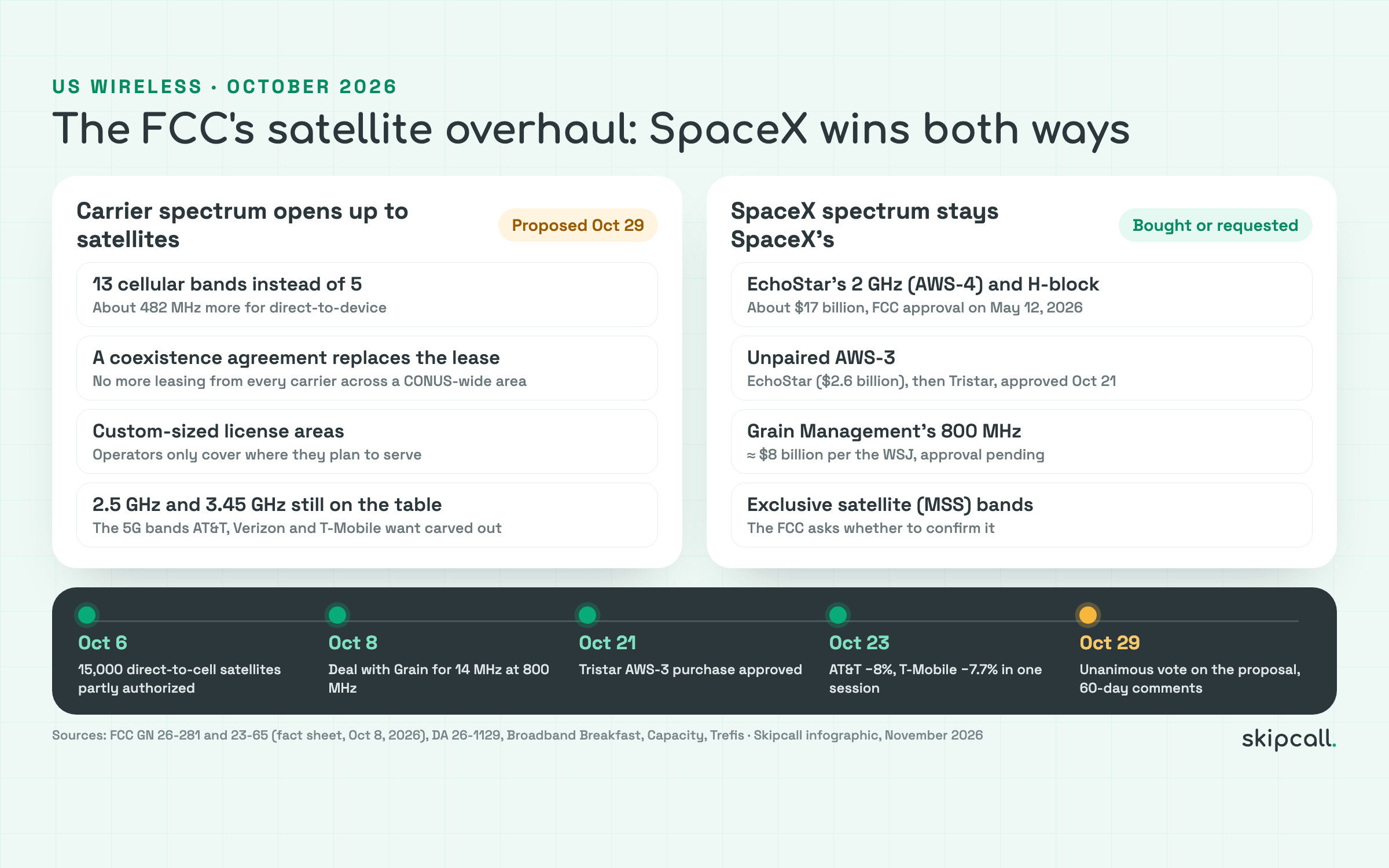
That first framework was deliberately cautious. Satellites could use only five bands, only through a lease from the terrestrial licensee, and only across a geographic footprint so large that in practice it required deals with every carrier holding the same frequencies. The new proposal treats that caution as outdated. Chairman Brendan Carr called it the agency’s “most comprehensive step yet” to modernize direct-to-device rules, and Commissioner Anna Gomez, the lone Democrat, voted with the majority.
Because it is a Notice of Proposed Rulemaking, nothing in it applies yet. It sets the agenda for the fight that follows.
The four rule changes, in plain English
Open their bands, protect yours
Les Echos summed up the deal with a line that has stuck: “What’s mine is mine, and what’s yours is also mine.” The asymmetry is written into the proposal itself.
On one side, carrier spectrum becomes far more accessible to satellites. On the other, the FCC “seeks comment on confirming the exclusive nature of MSS bands,” citing regulatory certainty. MSS bands are the frequencies set aside for mobile satellite service, and the most valuable of them in the US, the 2 GHz AWS-4 block, now belongs to SpaceX.
The proposal does not hand SpaceX a single megahertz. It rewrites the rules so that whoever owns both satellites and terrestrial licenses no longer needs anyone’s permission.
SpaceX’s spectrum buying spree, in order
The reform lands on a company that spent the previous year assembling exactly the assets it rewards.
- September 2025: SpaceX agrees to buy EchoStar’s AWS-4 and H-block licenses for about $17 billion in cash and stock, then adds EchoStar’s unpaired AWS-3 licenses in November for $2.6 billion.
- May 12, 2026: the FCC approves the EchoStar transfer and waives the usual terrestrial buildout requirements, noting that SpaceX would be both the terrestrial licensee and the satellite operator.
- October 6, 2026: the FCC partly grants SpaceX’s plan for up to 15,000 next-generation direct-to-cell satellites, deferring some spectrum requests.
- October 8, 2026: SpaceX announces a deal for Grain Management’s nationwide 800 MHz portfolio, up to 14 MHz of low-band spectrum, reportedly about $8 billion according to the Wall Street Journal. FCC and Justice Department approval are still pending.
- October 21, 2026: the FCC approves SpaceX’s purchase of unpaired AWS-3 licenses in the 1695-1710 MHz band from Tristar (DA 26-1129).
Put together, SpaceX is now a satellite operator, a terrestrial licensee and an MSS spectrum holder. Under the proposed rules, that combination needs nobody’s lease. SpaceX President Gwynne Shotwell has said the company aims to offer service on its own spectrum in early 2028, and in its first earnings call as a public company on August 4, 2026, SpaceX said it expected to win “quite a few” customers from the big three. Analyst Roger Entner of Recon Analytics has started calling it the “Starlink doctrine.”
The 2.5 GHz and 3.45 GHz fight
AT&T, Verizon and T-Mobile are not trying to kill the whole proposal. Through their trade group, CTIA, they are focused on two bands that together make up 290 MHz of the 482: 2.5 GHz, the backbone of T-Mobile’s 5G, and 3.45 GHz, a key mid-band for AT&T and others.
The technical argument is about TDD, or time-division duplexing. In TDD bands, uplink and downlink share the same frequency and alternate on a precise schedule. A satellite downlink that does not follow that schedule raises the noise floor at every cell site under its beam. In filings with the FCC, T-Mobile said that up to 96% of a site’s uplink coverage area could be affected, with uplink throughput dropping 88 to 99 percent. It also reminded the agency that the FCC itself excluded 2.5 GHz from satellite use in 2024.
CTIA’s broader ask is “same customer, same rules”: identical performance standards for satellite and terrestrial service. Executives from all three carriers met FCC staff on October 20, and T-Mobile CEO Srini Gopalan pressed the case directly with Chairman Carr. The carriers have also moved commercially: on October 1, 2026, they formed a joint venture to pool spectrum for satellite service, a way to avoid leaving the field to SpaceX alone.
What to watch over the next six months
- The comment cycle. Once the item is published in the Federal Register, comments are due within 60 days and replies within 90. Expect detailed interference studies from carriers and counter-studies from SpaceX and AST SpaceMobile.
- The fate of 2.5 and 3.45 GHz. The FCC can keep them, drop them, or add stricter coexistence conditions. This is the single biggest swing factor.
- The Grain Management deal. Approval of the 800 MHz purchase would give SpaceX valuable low-band spectrum that travels far and penetrates buildings.
- Handsets. SpaceX’s next-generation satellites will also use its own satellite frequencies, which today’s phone chips do not support. Elon Musk has talked about roughly two years to bring compatible modems to market.
- Starship. The heavier next-generation satellites depend on it. Several analysts place a fully standalone SpaceX mobile service between 2028 and 2030.
What it means for business phone lines
If you run a sales or field team in the US, this quarter brings no change to how you buy phone service. Satellite-to-phone is still a coverage add-on: texting, location sharing and limited data where no tower reaches. It does not provide business numbers, call routing, call recording or CRM logging.
What the reform does signal is a market in motion. Carriers are pooling spectrum, a rocket company is becoming a carrier, and network outages remain a fact of life. The practical response has not changed:
- Keep your business numbers on a cloud phone system, so reps can call and answer from a laptop or mobile app over any connection, office Wi-Fi, a second carrier or a Starlink dish. Our guide to running VoIP over Starlink covers the setup and the latency to expect.
- Do not put every rep on the same carrier. A split across two networks, or an eSIM backup on a second one, costs little and removes a single point of failure.
- Treat satellite as a dead-zone backup, useful for field reps in rural territory, not as your phone system. For how direct-to-cell actually works today, see direct-to-cell explained.
None of this touches calling compliance. Consent and opt-out rules changed separately on November 25, 2026, and we cover them in our guide to the TCPA changes for B2B teams.
The bottom line
The FCC’s October 29 proposal would open nearly every US cellular band to satellite-to-phone service and remove the leases that kept carriers in control. In the same breath, it considers making satellite bands exclusive. SpaceX, the only player holding a constellation, terrestrial licenses and satellite spectrum at once, wins on both counts. The carriers have a 60-to-90-day window to get the 2.5 and 3.45 GHz bands removed, and nothing is final until a second vote. For a broader look at whether satellite operators can really replace carriers, read will phone carriers disappear?. For your own team, the rule is unchanged: never let your business numbers depend on a single network.
Sources: FCC fact sheet and draft NPRM, “Unleashing Licensed Spectrum for Direct-to-Device,” GN Dockets 26-281 and 23-65 (October 8 and 29, 2026); FCC Memorandum Opinion and Order DA 26-1129 (October 21, 2026); Les Echos; Broadband Breakfast; Capacity; Tesla North; Trefis (October 25, 2026).