You have a decision maker’s name, their company, and nothing to dial except a main line that routes to voicemail. In B2B, the number people actually answer is more and more often their cell, because desk phones ring in empty offices since hybrid work took hold. This guide walks through twelve ways to find it, six free and six paid, and ranks them on what actually matters: what happens when you dial. An easy number that lands on a switchboard is worth less than a mobile that took two more minutes to find. Then come the exact words to use, what the tools cost, how to verify the number, and which rules apply in the US, the UK and the EU.
Before you search: what you need besides the name
A name alone leads nowhere reliable. There are too many namesakes, and a number “found” for the wrong Michael Johnson costs you a dial and a bit of credibility. Every method in this guide starts from the same point: three pieces of information gathered before the first search.
If you only have the name and the company, start by finding the person’s LinkedIn profile: it gives the exact title, the city and often the company domain. If you only have the name with no company, stop there: you are no longer looking for a prospect, you are looking for a person, and nothing in this guide applies to that.
Why look for the cell instead of the direct line
Finding “a number” is not enough: a desk line in an empty office and a switchboard are not worth a mobile. Public measurements disagree on the exact figures, but they agree on the order.
Each source has limits worth knowing. Gong does not split its study by line type. SMARTe and Prospeo sell mobile data, and the ScaleX figures were collected early in the pandemic, when offices were empty. Keep the order of magnitude rather than the number: mobiles come first in every source, and the gap between direct lines and switchboards changes from one study to the next.
Mobiles come first in every source: that is the number to look for first.
For your own lists, our direct dial checker applies adjustable rates to each number type and shows how many conversations you gain by calling mobiles first. Our guide to direct dial vs mobile vs switchboard defines each number type and shows how to spot it in an export, and our cold call connect rate benchmarks go deeper by industry.
The six free methods, step by step
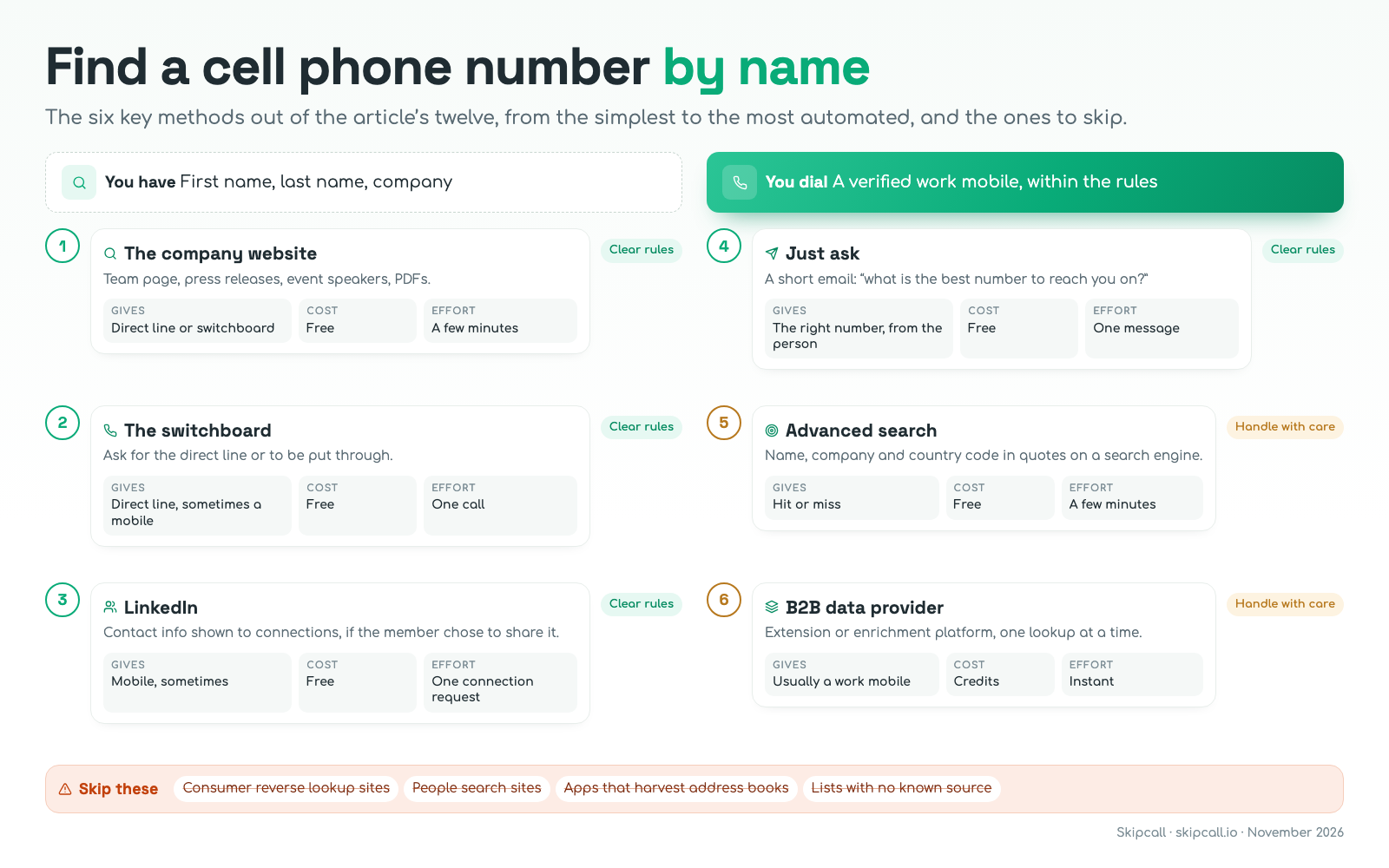
These six methods cost nothing but time and often open a conversation along the way. You do not have to follow them in order: for a key account, start with the switchboard; for a list of two hundred names, go straight to the paid methods in the next section. The figure below sums up the path, from free to automated.
Find a cell phone number by name
The six key methods out of the article’s twelve, from the simplest to the most automated, and the ones to skip.
- Clear rules
The company website
Team page, press releases, event speakers, PDFs.
- Gives
- Direct line or switchboard
- Cost
- Free
- Effort
- A few minutes
- Clear rules
The switchboard
Ask for the direct line or to be put through.
- Gives
- Direct line, sometimes a mobile
- Cost
- Free
- Effort
- One call
- Clear rules
LinkedIn
Contact info shown to connections, if the member chose to share it.
- Gives
- Mobile, sometimes
- Cost
- Free
- Effort
- One connection request
- Clear rules
Just ask
A short email: “what is the best number to reach you on?”
- Gives
- The right number, from the person
- Cost
- Free
- Effort
- One message
- Handle with care
Advanced search
Name, company and country code in quotes on a search engine.
- Gives
- Hit or miss
- Cost
- Free
- Effort
- A few minutes
- Handle with care
B2B data provider
Extension or enrichment platform, one lookup at a time.
- Gives
- Usually a work mobile
- Cost
- Credits
- Effort
- Instant
Skip these
- Consumer reverse lookup sites
- People search sites
- Apps that harvest address books
- Lists with no known source
Skipcall · skipcall.io · November 2026
The company website and what it publishes
Best for: small and mid-sized companies, founders and executives, outward-facing roles (sales, procurement, partnerships, communications).
Start with what the company makes public itself. It is free, and the rules are the clearest of all: the company chose to publish that number so people could reach it.
- 01
The team or contact page:
many smaller companies list a direct line per person, sometimes a cell for salespeople and executives. - 02
Press releases:
the media contact is often an executive or marketing lead, with a direct number at the bottom of the release. - 03
Events and webinars:
speaker pages and PDF agendas sometimes list the speakers’ contact details. - 04
Public documents:
brochures, catalogs, bid responses and public procurement notices name a contact with a number. - 05
Business directories and registries:
company registries, state business filings, Companies House in the UK, Yelp or Yellow Pages list officers and, when they have a phone, mostly the main number: a switchboard or a landline, very rarely a mobile.
Give it five minutes at most. If nothing turns up, move on rather than combing the whole site. What you will find most often: a direct line or the main number, and a cell when the person is the listed point of contact.
The switchboard
Best for: key accounts, large companies and decision makers with little online presence.
The most underrated method. The receptionist knows everyone, and many will give a direct line or a work mobile to a polite caller who knows why they are calling. Three lines that work:
Write down everything you are given: an assistant’s first name, a good time, an extension. Those details pay off on the next call. Our gatekeeper script covers the phrasing that gets through and the phrasing that closes the door.
Avoid if: you cannot say in one sentence why the person would want to talk to you. Receptionists screen out vague calls first.
Best for: managers and executives active on the network, especially in tech, consulting and services.
A profile’s “Contact info” section can hold a phone number, but only if the member added it and chose to show it, usually to first-degree connections. Zeliq estimates that fewer than 5% of members fill in their number, without citing a study: treat it as an order of magnitude. The method comes down to three steps, and it opens the conversation as much as it finds the number.
- 01
Send a connection request:
with no sales pitch, or one sentence on why you follow their work. - 02
Once accepted, open Contact info:
phone, email or website show up if the person filled them in. - 03
Otherwise, ask:
a short message that announces the call rather than replacing it (see method 4).
Do not scrape profiles in bulk with an extraction tool: LinkedIn’s user agreement prohibits it, and you lose track of where the data came from, which you may need to tell the person. Our roundup of LinkedIn prospecting tools covers the ones that automate invitations and messages without harvesting profiles.
Just ask
Best for: every prospect you have already exchanged with, by email, on LinkedIn or at an event.
The most reliable method, and the most forgotten. The number they give you is the right one by definition, the call that follows is expected, and the compliance question answers itself. Three moments where it works especially well:
Two rules make the ask work: offer a short, specific slot (ten minutes, this week), and let them pick the time. A vague ask (“can I have your number?”) gets a vague answer.
Advanced search on a search engine
Best for: one last free attempt on a specific target before you spend a credit.
A search engine sometimes finds what tools miss: a speaker bio, a trade association directory, a signature published in a document. A few operators are enough:
| Query | What it looks for |
|---|---|
"Sarah Miller" "Company Name" "+1" | The name and company with a country code |
"Sarah Miller" "Company Name" "+44 7" | The same with a UK mobile prefix |
"Sarah Miller" site:company.com | Every page of the company site that mentions her |
"Sarah Miller" "Company Name" filetype:pdf | Brochures, event agendas, presentation decks |
Results are hit or miss, and they need care: check that the page is professional and that the number was published by the person or their company. A number copied by a third-party site has no clear source, and it is often a personal one.
Email signatures and auto-replies
Best for: prospects you have already exchanged an email with, even without a real answer.
An email signature often carries the direct line and, for salespeople and executives, the work cell. The person published that number to be reached: it is one of the cleanest sources there is. Two places are easy to miss:
Log the date and the source email in your CRM: if the person asks where you got their number, you have the exact answer.
The six paid methods
When volume or timing rules out searching by hand, six families of tools take over. They are faster, return a work mobile more often, and need care on credits and on where the data comes from.
LinkedIn extensions
Best for: a rep who prospects from LinkedIn or Sales Navigator and wants a number while looking at the profile.
Kaspr, Lusha, Apollo, Surfe or Datagma add a button to the profile: one click, a few credits, and a number shows up when their database has one. It is the easiest paid method to start with, often with a small free plan. It remains a one-at-a-time tool: beyond a few dozen profiles a day, enriching a whole list at once works better.
Waterfall enrichment
Best for: lists where a single provider finds too few mobiles, especially outside the US.
FullEnrich, Zeliq or Clay query several providers in a row until one returns a number. Find rates go up, and most charge only for numbers found. Published success rates come from the vendors themselves and need checking on your own list. Our comparison of waterfall enrichment tools covers them in detail.
B2B contact databases
Best for: volume, speed, and targeting by industry, size or role before you even have a name.
ZoomInfo, Cognism, Apollo or Seamless.AI sell access to a database of decision makers with their contact details: you build the list and pull the numbers in the same tool. ZoomInfo is strongest in North America, Cognism in Europe, and both mostly sell on quote.
Enrichment inside your CRM or calling software
Best for: teams that already have their contacts in a CRM or a file and want to fill in numbers without switching tools.
Some CRMs and calling tools fill in the records you already have, on credits. The benefit is one database and a call right after. Check which provider sits behind the service, and whether it returns mobiles or only main lines.
Outsourcing
Best for: a one-off campaign on a narrow target, when nobody in-house has time to search.
A lead generation agency or a virtual assistant finds the numbers for you, by hand or with their own tools. Ask for the method and the source of every number in writing: you remain responsible for the call, and you must be able to tell the person where their number came from.
Buying signals
Best for: deciding who to call before you spend a credit.
A job change, a funding round or a hiring spree spotted by a signals tool points to the right decision maker at the right time. The number then comes from one of the methods above. A signal does not replace the search for a number: it tells you whom it is worth searching for.
What a mobile costs at five providers
All these methods run on credits, and a mobile costs several credits. Here are five public price grids, checked on the vendors’ pricing pages on November 6, 2026.
 Lusha
- Credits per phone
- 5
- Entry plan
- Free: 40 credits a month; Pro: $69.90 a month for 600 credits
- Mobile on the Pro plan
- about $0.58
- When nothing is found
- Unmatched CSV rows not charged; bulk reveals charged even for partial data
 FullEnrich
- Credits per mobile
- 10
- Entry plan
- $29 for 500 credits
- Mobile on the entry plan
- about $0.58
- When nothing is found
- No data, no credit charged
Datagma
- Credits per mobile
- 30
- Entry plan
- $49 a month for 3,000 credits, or 100 mobiles
- Mobile on the entry plan
- about $0.49
- When nothing is found
- No match, no credit used
 Zeliq
- Credits per mobile
- 10
- Entry plan
- Starter: $59 per user a month for 750 credits, or 75 mobiles
- Mobile on the entry plan
- about $0.79
- When nothing is found
- Credits used only when data is found and verified
 Kaspr
- Phone credits
- Free: 5 a month; Starter: 100 a month
- Worth knowing
- LinkedIn extension, monthly credits roll over; Kaspr has been part of Cognism since 2022
Prices move often, and the plan price does not tell the whole story: what counts is the cost per number found and correct. Weigh both sides before you buy:
- Speed: one click per contact, or a whole list in minutes.
- Work mobiles: the number type these databases target first.
- Traceability: the provider can tell you where the data came from, which you may need to tell the person.
- Coverage by country: very uneven from one provider to the next, see B2B phone data coverage by country.
- Credit rules: some charge even without a complete result.
- Disguised switchboards: a number labeled “direct” can be the company’s main line.
Our phone enrichment pricing tool works out the cost per number, per conversation and per meeting for 18 providers. If one provider is not enough, query several in sequence: that is waterfall enrichment. And to pick one for your countries, roles and budget, our eight-question quiz recommends two or three tools, with no vendor bias.
Test a provider before you commit
Every provider claims great coverage, and none of them publishes country-by-country mobile figures you can rely on. The only number that matters is the one you measure on your own market. A test takes an afternoon and saves months of paying for the wrong database.
- 01
Build a reference list of 100 contacts:
people in your target roles and countries whose real cell number you already know, from your CRM, past deals or events. - 02
Run the same list through two or three providers:
on free plans or trials, with names, companies and domains only, so the providers do not see the numbers you hold. - 03
Score three things per provider:
how many numbers came back, how many match the real one, and how many are switchboards or personal lines. - 04
Turn it into a cost per correct mobile:
credits spent divided by correct mobiles found. That is the figure to compare, not the plan price. - 05
Repeat every six months:
databases improve and decay unevenly, and the winner on your market can change.
Our guide to B2B phone number enrichment details the test protocol and what real match rates look like by role. Once you have measured match rates, plug them into the phone enrichment pricing tool to see the cost per conversation and per meeting.
The twelve methods, ranked by what happens when you dial
The right ranking is not about ease. A method is worth the type of number it returns (mobile, direct line or switchboard), the share of correct numbers and who answers. The table ranks the twelve methods from most to least favorable to the call.
| Method | Time per contact | Number found | Most common type | Cost |
|---|---|---|---|---|
| Ask the person | One message | Almost always, after an exchange | Mobile or direct line of their choice | Free |
| Signatures and auto-replies | One read | When an exchange took place | Direct line, often a mobile | Free |
| LinkedIn extensions | One click | Varies by country | Work mobile | Credits |
| Waterfall enrichment | A list in minutes | Higher than a single provider | Work mobile | Credits, often only when found |
| B2B contact databases | A list in minutes | Varies by country | Mobile or direct line | Subscription or quote |
| Enrichment in the CRM or calling tool | A list in minutes | Depends on the provider behind it | Varies | Credits |
| LinkedIn Contact info | One connection | Under 5% of members, per Zeliq | Mobile | Free |
| Switchboard | One call | Often a direct line | Direct line, sometimes a mobile | Free |
| Company website | A few minutes | Mostly small companies and founders | Direct line or main number | Free |
| Outsourcing | The vendor’s turnaround | Depends on the vendor | Varies | Service fee |
| Advanced search | A few minutes | Hit or miss | Varies | Free |
| Directories and registries | A few minutes | The head office number | Switchboard or landline | Free |
Buying signals are not in the table: they tell you whom to call, not which number. Vendor success rates call for caution: La Growth Machine, for example, states it retrieves phone numbers for 10 to 25% of LinkedIn profiles, a vendor figure with no published method.
If you want to stay free for now, our roundup of free B2B phone numbers lists what each free plan and trial really gives in mobiles.
Four real-world cases
The methods combine differently depending on the target. Four common situations, and the order that works best in each.
Whatever the case, keep a simple rule of thumb: spend your free minutes on the accounts that matter most, and your credits on the long tail. A rep who spends ten minutes hunting the cell of a small account is not calling the twenty accounts behind it.
The methods to skip
Some tactics show up in every consumer guide. In B2B, they cause more trouble than they solve.
Before you dial: verify, sort, pick the time
A number you found is not yet a number you can dial. Six checks take seconds and prevent most wasted calls.
- 01
Line type:
in the UK, mobiles start with 07 (+44 7). In the US and Canada, mobiles and landlines share the same area codes, so only a carrier lookup tells them apart. Our phone number validator gives the type where the numbering plan allows it, and the E.164 format for a whole list. - 02
Disguised switchboards:
one number assigned to several contacts at the same company is almost always a switchboard, even when it is labeled “direct dial”. The direct dial checker spots it and suggests a call order, mobiles first. - 03
Freshness:
a number found a year ago may have changed hands. The B2B data decay calculator estimates how many of your numbers are probably dead given the age of your data. - 04
File format:
if your numbers come from a messy export (delimiters, accents, extra columns), run it through the CSV cleaner before you import it. - 05
Time slot:
the when to call tool shows each number’s local time and the allowed calling hours. - 06
Compliance:
the cold calling compliance checker tells you, country by country, whether you can call now and on what terms.
If you prospect across borders, mobile prefixes change from country to country:
| Country | Mobiles | International format |
|---|---|---|
| United Kingdom | 07 | +44 7 |
| France | 06 and 07 | +33 6, +33 7 |
| Germany | 015, 016, 017 | +49 15, +49 16, +49 17 |
| United States and Canada | Cannot be told apart from a landline by the number | +1, carrier lookup needed |
Work cell or personal cell?
The prefix tells you a number is a mobile, not who pays the bill. The difference matters: B2B rules assume you are calling the person about their work, and a personal number found by chance takes you away from that. A few signs help you decide.
When in doubt, ask at the start of the call: “Am I reaching you on your work line?”. If the answer is no, offer to call back on the right number and remove the other one from your file. With owners of very small businesses and freelancers, one cell often serves both purposes: what sets the frame then is the purpose of your call, tied to their business.
The rules that apply in 2026
General information, not legal advice.
Once you have the number, the rules of the country you are calling apply, not the rules of the country you are calling from. Here are the three markets most English-speaking teams call.
- The FTC’s Telemarketing Sales Rule exempts most calls to businesses from the National Do Not Call Registry provisions.
- The TCPA is the one to watch on cell phones: calls placed with an autodialer or a prerecorded or artificial voice need prior express consent, B2B included. Hand-dialed calls are the safe default.
- Several states, Florida among them, have their own telemarketing laws that can be stricter than federal rules.
- Under PECR, you must not make live marketing calls to numbers registered with the TPS (individuals and sole traders) or the CTPS (companies), unless the person has specifically agreed to your calls.
- B2B callers are expected to screen against both registers and their own do-not-call list. The ICO fined one company £80,000 in May 2023 for calls to registered numbers.
- Calling a professional about their job can rely on legitimate interest under GDPR Article 6(1)(f). Article 14 requires you to tell the person where you got their details at the latest at the first contact, and Article 21 gives them the right to object.
- Countries add their own layer. France allows B2B calls on legitimate interest since its consumer opt-in took effect on August 11, 2026; Germany’s unfair competition act (UWG, section 7) requires at least presumed consent to call a business, which is much stricter.
A work cell, a call about their job, one sentence on where you got the number, and a do-not-call list you actually keep: that is most of the job.
The practical version fits in three habits, whichever method found the number:
- 01
Say who you are and where the number came from:
“I’m calling your cell because it’s listed on your company’s contact page.” In the EU and the UK this meets the information duty; in the US it simply disarms suspicion. - 02
Make it easy to say no:
and make sure the whole team honors it on every later call, across every number you hold for that person. - 03
Dial cell phones by hand in the US:
unless you have prior express consent, keep autodialers and prerecorded messages away from wireless numbers. Our guide to cold calling cell phones explains where the line sits.
Our cold calling compliance checker covers the rules country by country, and our article on whether cold calling is legal goes into more detail.
The mistakes that cost the most
Six mistakes come up again and again when a team starts hunting for cell numbers. Each one costs calls, credits or credibility.
Once you have the number: nail the first call
A cell number you found is a door left ajar, not a meeting. Calling someone’s mobile is more direct than calling a switchboard, and they know it: the first twenty seconds decide what happens next.
- 01
Pick the moment:
on a work cell, avoid the usual meeting hours and the very start of the day. Our when to call tool shows each number’s local time and the allowed calling hours. - 02
Introduce yourself and say where the number came from:
”Hi Sarah, it’s Tom from Company X. I’m calling your cell because it’s on your company’s contact page.” Transparency lowers the guard. If they ask how you got their number, our “How did you get my number?” script has the answer. - 03
Give the reason in one sentence:
what you noticed about them, and why it relates to their job. - 04
Offer an exit:
”If this isn’t the right time or the right topic, just say so and I won’t call again.” People who can say no easily say no less often.
If they do not pick up, a short voicemail with your name, your reason and your number is enough. Our B2B voicemail scripts give templates. Calling three times in the same day, on the other hand, turns a curious prospect into a contact who blocks your number, and that is how a number ends up flagged as spam.
From one name to two hundred: scaling up
The free methods work for one name, or a handful of key accounts. Beyond that, the question becomes bulk enrichment: real match rates, a 100-contact test, provider waterfalls. Our guide to B2B phone number enrichment covers it in depth. If your data comes from several providers, the waterfall enrichment merger matches the contacts and keeps the best number for each.
How Skipcall fits this workflow

Skipcall is a calling platform: it has no contact database and does not build lists. Its contact base enriches the numbers of contacts you already have, imported from a CSV or synced from your CRM, on credits. Once you have the mobiles, the parallel dialer calls up to four numbers at once and only connects you to the prospects who pick up; every recorded call is transcribed and summarized on the contact record.
Key takeaways
- A name is not enough: add the company, its domain and the job title before you search.
- Look for the cell first: it beats direct lines and switchboards in every public measurement.
- Start free: company website, switchboard, LinkedIn, signatures, and above all, ask. These methods already open a conversation.
- Move to paid methods when volume demands it: extension, waterfall or database, comparing the cost per number found and the credit rules.
- Rank methods on the call: a correct mobile is worth more than an easy number that lands on a switchboard.
- Skip reverse lookup sites, people search sites and lists with no known source.
- Verify line type, disguised switchboards and freshness before you dial.
- Know the rules: hand-dial cells in the US without consent, screen TPS and CTPS in the UK, tell people the source in the EU.