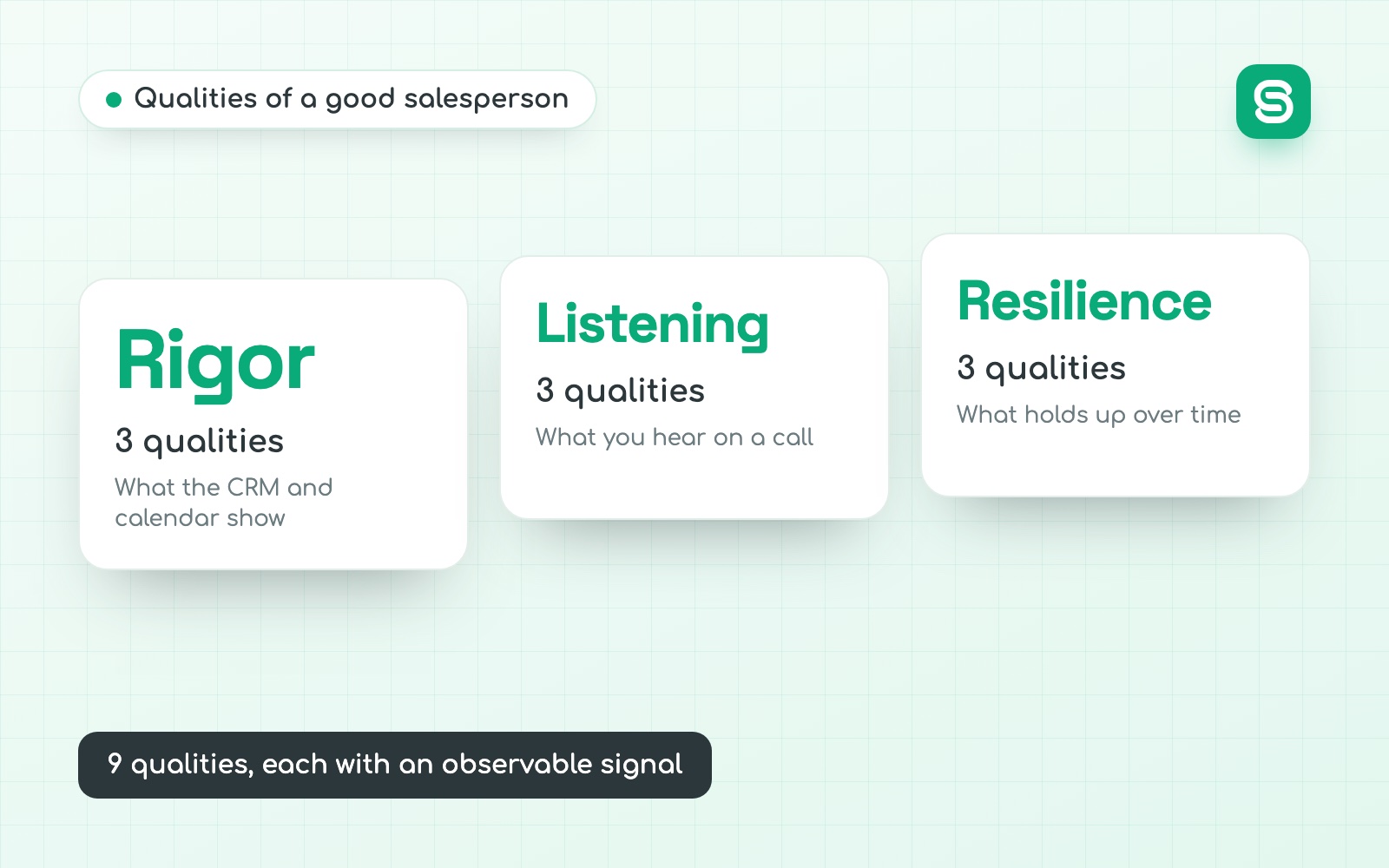
Ask ten sales leaders for the qualities of a good salesperson and you get the same list: persistent, a good listener, organized, empathetic, a strong communicator. All true, and none of it usable. Not one of those words helps you choose between two candidates, tell a rep what to change on Monday morning, or know whether you are getting better yourself. This article works the other way around: a quality only makes the list if it leaves a trace you can hear on a call, read in the CRM or see on a calendar.
What are the qualities of a good salesperson?
A good salesperson is someone whose work is predictable for the customer and for the manager. The customer knows the callback will come Tuesday because Tuesday is what was said. The manager knows the call blocks will happen because they happened the last twelve weeks. Behind the flattering adjectives, what you are really looking for is fairly plain: repeated moves, made at the right time, including when nobody is watching.
That is why the nine qualities here are written as behaviors. “Organized” becomes “every promised follow-up happens on the date announced.” “Good listener” becomes “restates what the prospect just said before answering.” The change looks small. It turns an opinion into something you can count, correct and teach.
- Activity discipline Calendar Planned call blocks are held, week after week.
- Follow-up reliability CRM Every promised follow-up happens on the date announced.
- Preparation CRM A reason to call is written on the record before the call.
- Active listening Call They restate what the prospect just said before answering.
- Curiosity Call They ask a second question about the answer instead of moving on.
- Clarity Call The call ends on a dated next step, said out loud.
- Resilience Calendar The next call starts within a minute of a rejection.
- Courage Call They ask for the commitment, and can say a prospect is not a fit.
- Coachability Call Monday’s feedback can be heard in Tuesday’s calls.
None of these qualities is judged by the impression left in an interview: each one leaves a trace that two different people can check.
The three families answer three simple questions. Rigor: do they do what they said they would do? Listening: do they understand before they pitch? Grit: do they hold when it pushes back? A rep can be excellent on two families and fragile on the third, and the weak family almost always explains the results.
A quality you cannot hear, read or count helps nobody hire and nobody improve.
Why are lists of twenty adjectives useless?
They fail for three reasons, always the same.
The way out is to translate each adjective into a move you can check. Here is the translation for the nine words that show up most often on a resume or in a job posting.
| Resume adjective | Observable behavior | Where to check it |
|---|---|---|
| “Persistent” | Starts the next call within a minute of a rejection | Calendar, call log |
| “Organized” | Makes every follow-up on the promised date | CRM |
| “Good listener” | Restates what the prospect said before answering | Recorded call |
| “Empathetic” | Asks a second question about the prospect’s answer | Recorded call |
| “Strong communicator” | Ends the call on a dated next step | Call and CRM |
| “Motivated” | Holds call blocks four weeks in a row | Calendar |
| “Self-starter” | Writes a reason to call before dialing | CRM |
| “Ambitious” | Asks for the commitment and closes out dead deals | Call and CRM |
| “Humble” | Applies feedback the day after receiving it | Next week’s calls |
The right-hand column makes all the difference: if you do not know where to check a quality, you can neither hire for it nor build it.
The same goes for a job description. One written for a prospecting rep is better off describing the real work than personality traits; that is the stance of our SDR job description template, which covers the skills specific to that role. To draft the posting itself, the free sales job description generator gives you a starting structure. The subject here is wider: the qualities that hold for any salesperson, whatever the seat.
Rigor: which qualities show up on the calendar and in the CRM?
Rigor is the least glamorous family and the one that pays best. You do not see it in meetings. You see it between meetings.
Activity discipline
A disciplined rep protects the time when they produce. They block call time on the calendar, start on time, and do not give it up for an internal meeting or a quote that could wait until the afternoon. The signal needs no interpretation: over the last four weeks, how many planned blocks actually happened? Our SDR daily routine shows what a week built around those blocks looks like.
Follow-up reliability
This is the quality customers mention most readily, in other words: “they do what they say.” Every call ends with a promise, even a small one: send a document, call back Thursday, come back with a price. The reliable rep keeps each of those promises on the date announced, and gives notice when they cannot. The signal is in the CRM: the share of follow-up tasks closed on the planned day. A follow-up does not have to be a call: an email or a message counts, as long as it goes out on the date you gave. Our guide to multichannel prospecting shows how to split the channels without losing the thread.
Preparation
Preparing a call does not mean reading annual reports for twenty minutes. It means knowing, before you dial, why you are calling this person today, and having written it down. One sentence is enough: an open role, a tool change, an industry you know. The signal reads in the CRM: a reason-to-call note exists on the record, dated before the call.
Listening: which qualities can you hear on a call?
The second family is judged by ear. That means listening to real calls, yours or your team’s.
Active listening
Listening actively means proving to the prospect that you understood before you answer. The simplest move is restating: “so if I have this right, your team loses time retyping call notes.” The prospect corrects or confirms, and the rest of the call stands on solid ground. The rep who does not listen moves on to the prepared argument whatever the answer was. The techniques are covered in our article on active listening in sales, and measuring talk time in the one on the talk-to-listen ratio. Listening also assumes you can hear: a headset chosen for calls and a line free of echo and dropouts keep you from asking the prospect to repeat, and from losing what they were about to say.
Curiosity
Curiosity shows in the second question. The prospect says “we tried a tool last year, it didn’t stick.” The average rep moves to the next question on the list. The curious rep asks: “what didn’t stick?” The real information is almost always in that second answer. On a recorded call, you count the questions that build on the previous answer. Our list of cold call discovery questions gives you the starting material; curiosity is what you do with the answers.
Clarity
A clear rep says in one sentence what they do and for whom, and ends every conversation on a next step both sides heard: “I’ll send the proposal tomorrow and call you Thursday at 10.” The signal is double: the closing sentence can be heard on the call, and the date shows up in the CRM. A call that ends on “I’ll let you get back to me” has no next step.
Grit: which qualities hold when it pushes back?
The third family only shows under pressure: a rejection, a negotiation, a critique.
Resilience in front of rejection
Prospecting is, to a large extent, hearing no. Resilience is not feeling nothing. It is not letting a rejection decide the rest of the day. The measure is simple: how much time passes between a call that goes badly and the next one? The solid rep dials again within a minute. The fragile rep tidies the desk, rereads email, goes for coffee. The mechanics, and ten ways through them, are in our article on call reluctance.
Courage
Sales courage comes down to three moves many reps avoid. Asking for the commitment: “shall we put the meeting on the calendar?” Politely contradicting a prospect who misreads their own problem. And disqualifying: telling someone you are not the right answer for them. On a call, you can hear whether the decision question gets asked or dodged. In the CRM, you can see whether dead deals get closed or drag on for months. The lead qualification frameworks give you the criteria; courage is applying them when the answer is unwelcome.
Coachability
This is the quality that makes all the others reachable. A rep who applies feedback improves on the eight lines above; a rep who argues with it plateaus, whatever the starting talent. You hear the signal from one week to the next: can Monday’s feedback (“you interrupt after the first objection”) be heard in Tuesday’s calls? Live call coaching rests entirely on this quality.
What can be trained, and what do you hire for?
These qualities do not build at the same speed. Six are moves: with a drill and a measure, they shift in a few weeks. Three depend more on long-standing habits; they can improve, but you are better off checking them before you hire. This split is a practitioner’s rule of thumb, not a research finding.
| Quality | Verdict | Indicative time | How to check it |
|---|---|---|---|
| Activity discipline | Trainable | 2 to 4 weeks | Blocks held out of blocks planned |
| Preparation | Trainable | 1 to 2 weeks | Reason to call written before the call |
| Active listening | Trainable | 4 to 6 weeks | Restatements counted on three calls |
| Curiosity | Trainable | 4 to 6 weeks | Second questions counted on three calls |
| Clarity | Trainable | 2 to 3 weeks | Calls ended on a dated step |
| Courage | Trainable | 4 to 8 weeks | Commitment question asked or not |
| Follow-up reliability | Hire for it | Slow | Dated examples, then follow-ups on the planned date |
| Resilience | Hire for it | Slow | Account of a bad week, time before the next call |
| Coachability | Hire for it | Slow | Second round of a role play |
The practical consequence for hiring: there is no point requiring a beginner to already restate or close, you will teach that. Be demanding on the last three lines instead. A candidate who shines in conversation, does not call back at the agreed time and argues with your feedback after the role play is already showing you month six.
What does the research say about top sales reps?
The subject attracts a lot of unsourced claims. Here are two pieces of work we reopened on November 11, 2026, with their limits.
Two cautions. Grant’s study covers a single call center: it shows that extraversion is not an automatic asset, not that you should hire on a personality test. The Challenger study comes from an advisory firm and was published in a book and articles, not in a peer-reviewed journal; our article on the Challenger Sale covers what is worth keeping. Both still point the same way as this article: what sells is less a temperament than a way of running the conversation.
For activity numbers (connect rates, dials per meeting), see our cold calling statistics page, where every figure links to its primary source.
Do the qualities of a salesperson change with the role?
The nine qualities hold everywhere, but their weight shifts. Three broad seats stand apart, and the difference between the first two is detailed in our SDR vs account executive comparison.
This split explains common failures. An excellent prospector promoted into complex sales can get lost if the reflex to close fast stays. A very good account manager moved into prospecting can suffer from the volume of rejection. Before a promotion, look at the qualities of the destination seat, not only the results in the current one; our article on the SDR career path describes that move.
Which myths should you drop?
What are the traits of a bad salesperson?
A sales flaw is almost always a missing quality, or a quality pushed too far. The table below starts from what you observe, because that is where a manager or a recruiter starts. Each line points to a quality to work on and a first move, not to a verdict on the person.
| What you observe | Where it shows | Quality to work on | First move |
|---|---|---|---|
| Promises a callback and does not make it | CRM: late or missing tasks | Follow-up reliability | A dated task before hanging up |
| Talks more than they listen | Call: no restatement | Active listening | One restatement before every proposal |
| Recites the pitch | Call: no question about the prospect’s answer | Curiosity | Two questions about the same answer |
| Avoids asking for a decision | Call: ends with no next step. CRM: deals that drag on | Courage and clarity | The commitment question before minute three |
| Stops after a rejection | Calendar: long gaps between two calls | Resilience | The one-minute rule |
| Argues with every piece of feedback | Next week’s calls: nothing changed | Coachability | One written point to work on per week |
| Calls without knowing why | CRM: record with no reason to call | Preparation | The two-minute rule |
| Pushes call blocks back | Calendar: blocks moved or canceled | Activity discipline | Two fixed blocks, marked “held” or “skipped” |
Two cautions. A flaw seen for one week is not a trait: look for it over four weeks before you raise it. And a rep who ticks four lines does not have four problems. Most often they have a rigor problem that drags the rest down: start there.
The self-assessment scorecard to copy
Score yourself on one real week of facts, not on a feeling. Each line is worth 0 to 3: 0 if the behavior is absent, 1 if it is occasional, 2 if it is frequent, 3 if it is systematic. The total is out of 27.
Rigor
- Activity discipline Call blocks held out of blocks planned
- Follow-up reliability Follow-ups made on the promised date Goal for the month
- Preparation Reason to call written before the call
Listening
- Active listening One restatement before each proposal (three calls replayed)
- Curiosity A second question about the prospect’s answer
- Clarity Calls ended on a dated next step
Grit
- Resilience Next call started within a minute of a rejection
- Courage Commitment question asked, poor-fit prospects disqualified
- Coachability Last week’s feedback can be heard
Total19/27
Weakest lineFollow-up reliability
Sales rep self-assessment, week of …
Scale: 0 absent, 1 occasional, 2 frequent, 3 systematic.

1. Activity discipline: call blocks held out of blocks planned. Score: … / 3
2. Follow-up reliability: follow-ups made on the promised date. Score: … / 3
3. Preparation: reason to call written before the call. Score: … / 3
4. Active listening: one restatement before each proposal (three calls replayed). Score: … / 3
5. Curiosity: a second question about the prospect’s answer. Score: … / 3
6. Clarity: calls ended on a dated next step. Score: … / 3
7. Resilience: next call started within a minute of a rejection. Score: … / 3
8. Courage: commitment question asked, poor-fit prospects disqualified. Score: … / 3
9. Coachability: last week’s feedback can be heard. Score: … / 3

Total: … / 27. Weakest line: … That is my goal for the month.
The example adds up to 19 out of 27, which puts it in the middle band. The useful information is elsewhere: a single line sits at 1, follow-up reliability. That line, and only that line, becomes the goal for the month. The button under the scorecard copies the blank version, ready to paste into a document or your notes app.
A quick reading: above 21 with no line at 0 or 1, the base is solid. Between 14 and 21, two or three lines pull the whole down. Below 14, work one family at a time, starting with rigor. These thresholds are a method proposal. In every case, the total matters less than the weakest line.
Three mistakes distort the score, and all three are tempting.
If your three listening lines are the lowest, the active listening self-assessment breaks them down move by move.
How do you use these qualities to hire?
The questions above fit into a structured interview in four moves.
- 01
Pick four qualities, not nine:
the three you hire for (reliability, resilience, coachability) and the one that weighs most for the seat. Trying to test everything in an hour means testing nothing. - 02
Ask past-behavior questions:
“Tell me about the time when…” Follow up until you get a date, a number and what the person did next. An answer in the conditional does not count. - 03
Run a call, then run it again:
four minutes, one specific piece of feedback, a second round. It is the only moment in the interview where you observe instead of listening to a story. - 04
Score separately, then compare:
each interviewer fills in their own scorecard before any discussion. The conversation is about the gaps between scores, not about the general impression.
To go further, our article on SDR interview questions gives thirty questions sorted by category and the questions you should never ask, and the free SDR interview scorecard builds a scoring sheet ready to print. To put a number on what a hiring mistake costs, the sales rep turnover cost calculator lays out the math.
What does a 90-day improvement plan look like?
You do not work on nine qualities at once. The plan moves one family at a time, one month each, with a priority quality roughly every ten days and one signal measured per week.
- 01
Days 1 to 30, rigor:
set two fixed call blocks a day, then the “no conversation without a dated task” rule, then the reason-to-call line. Friday measure: blocks held, follow-ups on the planned date. - 02
Days 31 to 60, listening:
replay three calls a week. Work on restating, then the second question, then the dated closing sentence. Friday measure: number of restatements and of calls ended on a step. - 03
Days 61 to 90, grit:
apply the one-minute rule after a rejection, ask the commitment question in role play and then on real calls, clean out dead deals. Friday measure: one piece of feedback applied, deals closed out.
At the end of each month, redo the self-assessment. If a line has not moved, keep it for another month rather than moving on: a half-installed quality disappears in the first busy week. For a new hire, this plan slots well into an SDR onboarding plan, which supplies the calendar for the first weeks, and the free 30-60-90 day sales onboarding plan builds the week-by-week version.
How does a manager build these qualities?
Three levers do most of the work, and none needs a budget.
The twenty-minute weekly one-on-one, step by step
These three levers fit into one short meeting, always built the same way.
- 01
Two minutes, the facts:
call blocks held, follow-ups made on the planned date. You read the week’s numbers; you do not comment on them yet. - 02
Eight minutes, one call:
chosen by the rep, listened to together. You look only for the signal of the quality being worked on this month. - 03
Five minutes, one piece of feedback:
worded as a move (“restate before you propose”), never as a trait (“listen more”). - 04
Five minutes, run it again:
the passage in question, once. The rep then writes down the point to work on this week, which you will replay on Friday.
To score the call you listened to, the free sales call scorecard supplies the criteria. If the team works remotely, the agenda does not change: calls just need to be recorded and each rep needs a proper calling setup at home, which our guide to a phone system for remote teams walks through.
A word on tooling, without overdoing it. Several of these signals assume you can listen back to your calls. Skipcall records calls and produces a transcript and an AI summary from its Business VoIP plan, from $25 per user per month: useful for counting restatements or checking that a next step was actually said. The tool does not score a rep for you and does not replace a manager’s ear. If you record calls, tell the people involved and check the consent rules that apply to you; the call recording and transcription page covers the feature. To compare what is on the market, see our pick of the best VoIP for sales teams. To practice alone, the free objection handling practice tool also does the job.
What to remember
- The qualities of a good salesperson are only useful when written as behaviors: what you hear on a call, read in the CRM, see on the calendar.
- Nine qualities, three families. Rigor (discipline, reliability, preparation), listening (active listening, curiosity, clarity), grit (resilience, courage, coachability).
- Follow-up reliability is the most decisive and the simplest to measure: follow-ups made on the promised date.
- Six qualities can be trained in a few weeks; reliability, resilience and coachability should be checked before hiring, with dated examples and a replayed role play.
- Extraversion is not the criterion: Grant’s study of 340 reps puts the middle of the scale ahead of both extremes.
- Every quality has an excess, and it often explains a results ceiling.
- A flaw is a missing quality: start from what you observe, name the quality to work on, give a first move.
- One quality at a time: the scorecard names the weakest line, and the 90-day plan works on it with one signal measured every Friday.