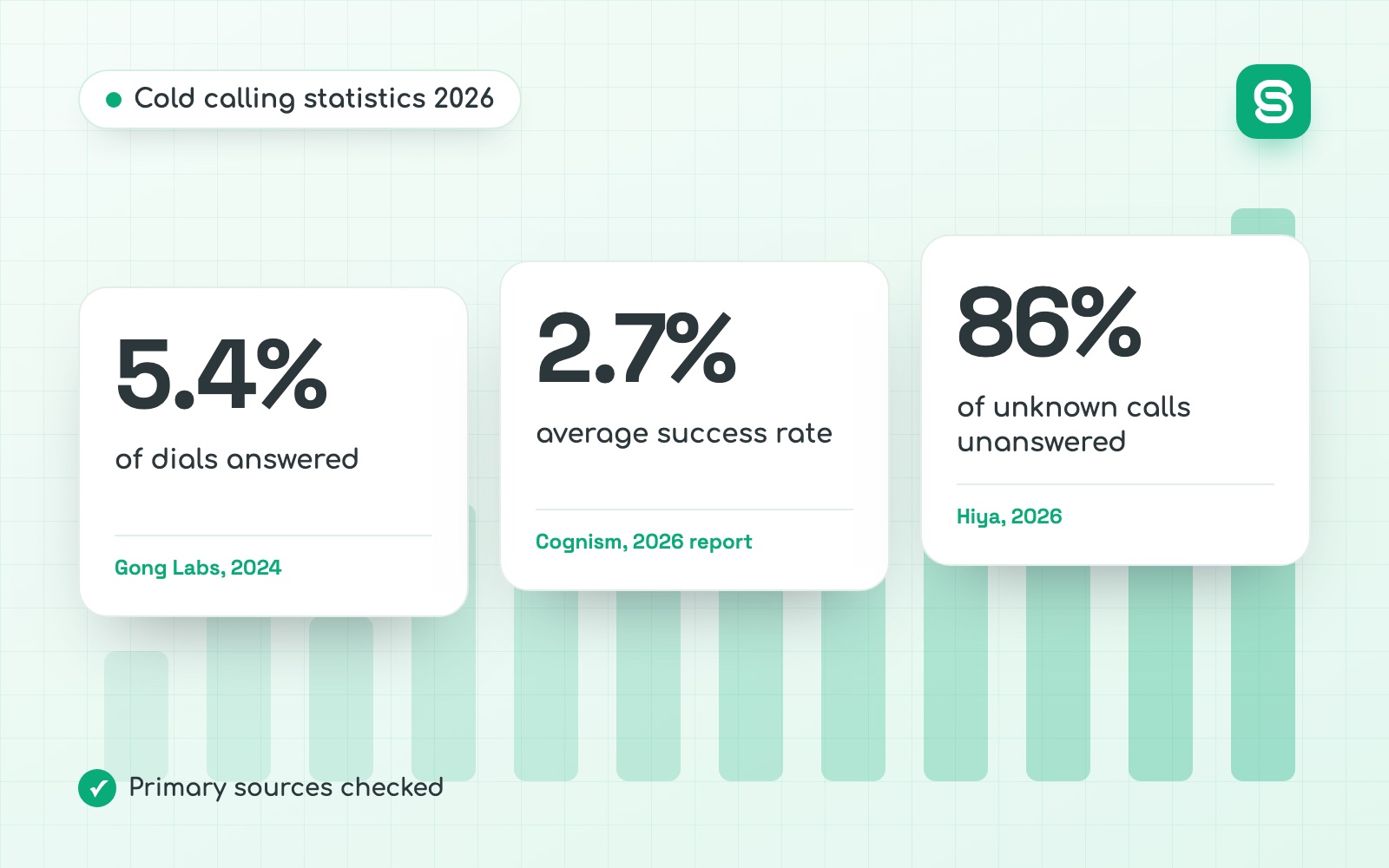
The most reliable cold calling statistics for 2026 say three things. The average rep gets 5.4% of dials answered and the top quartile 13.3% (Gong Labs, 300M+ calls, 2024). The average success rate is 2.7% on 2025 data (Cognism with WHAM, 200K+ calls). And 86% of unknown calls go unanswered according to consumers (Hiya, 2026). Every number on this page carries its primary source, its year and its sample, and we opened each source on November 11, 2026.
Most cold calling statistics pages copy each other. The same thirty figures circulate without a link to a study, sometimes with the meaning changed along the way. This page works the other way round: fewer numbers, each one traceable, sorted by the question you are actually asking.
What are the key cold calling statistics for 2026?
Here are the six figures that answer most questions, before the detail. Each one is developed, with its limits, in the section that follows.
The sources behind this page fall into four families, and they do not carry the same weight.
How do you read a cold calling statistic?
A cold calling statistic can be read correctly in five checks. They take one minute and they explain most of the contradictions between two pages that quote “the” success rate.
- 01
Find the denominator:
A rate is a division. “Connect rate” can be answered calls divided by dials (Gong Labs’ definition), conversations divided by dials, or connects divided by contacts. The same team can report 5%, 11% or 18% depending on the choice.
- 02
Find the definition of success:
A meeting booked, a meeting held, a qualified lead and a conversation over 30 seconds are four different successes. Gong’s 2018 analysis counted meetings actually held; Cognism’s 2024 report counted meetings booked out of conversations.
- 03
Look at who was measured:
Customers of one vendor, one team, one country, consumers or businesses. Real estate agents calling private homes in 2011 and SDRs calling CFOs in 2025 do not produce comparable numbers.
- 04
Separate the data year from the publication year:
A “2026 report” usually analyses 2025 calls. A blog post updated last month can still quote a 2007 study. Phone screening has changed too much to mix eras.
- 05
Ask who publishes it:
Dialer and data vendors have an interest in showing that calling works; advisors on digital buying have the opposite interest. That does not make a number false, but it tells you which way it may lean.
What percentage of cold calls get answered?
Between roughly 5% and 18% of dials, depending on the list, the number type and the definition. Three sources measure it directly, and one survey explains why it is falling.
Gong Labs, 300M+ calls. In its analysis published on July 18, 2024, Gong Labs defines connect rate as the calls answered by a prospect divided by the dials made by a rep. The result is 5.4% for the average rep and 13.3% for the top quartile. In dials, that is 19 cold calls for one conversation on average, and 8 for a top-quartile rep. Source: Gong Labs, “The hidden power of cold calling”.
Cognism with WHAM, 2024 report. Out of 55,701 dials, 9,247 were connected and 5,265 became conversations. The report does not print a percentage; the division gives about 16.6% connected and 9.5% in conversation, on a base of direct dials supplied by a data vendor. Source: Cognism, The State of Cold Calling.
A Skipcall sample, one B2B team. In a fully anonymized sample of 86,168 outbound calls placed with Skipcall over 12 months (November 2025 to November 2026) by a B2B prospecting team calling mostly French companies, 17.9% of calls were picked up and 11% became a conversation longer than 30 seconds. That is 5.6 dials per pickup and 9.1 dials per conversation. The rest is mostly voicemail.
Source: Skipcall internal sample, November 2025 to November 2026. Excludes lines dropped automatically when another line picks up. One team, one market: a benchmark, not an industry average.
Hiya, consumer survey. Hiya’s State of the Call 2026, based on more than 12,000 consumers in six countries, leads with one figure: 86% of unknown calls go unanswered. The 2024 edition of the same report gave 46% of unidentified calls unanswered. Hiya’s page does not explain the difference, so do not read the two as a trend line; read them as the same message, that an unrecognized number starts with a handicap. Sources: Hiya, State of the Call and Hiya’s 2024 press release.
How to move the rate, lever by lever, is the subject of our cold call connect rate benchmarks. The technical causes of a low rate are in why prospects don’t answer cold calls, and the effect of phone-side filtering in cold calling and iPhone call screening.
How many cold calls does it take to book a meeting?
About 413 dials for the average rep and about 48 for a top-quartile rep, according to Gong Labs’ two published ratios. The spread between reps is the most important number on this page.
Gong Labs reports that 4.6% of conversations turn into a meeting for the average rep, against 16.7% for the top quartile. Combined with dials per conversation, the funnel looks like this.
Dials answeredshare of dials
Dials per conversationlower is better
Conversations bookedshare of conversations
Meetings per monthon 800 dials
Source: Gong Labs, "The hidden power of cold calling", 300M+ calls, published July 18, 2024, read November 11, 2026. Meetings per month: Gong's assumption of 800 dials a month.
Two other sources frame the same question differently.
- Cognism with WHAM reports an average success rate of 2.7% on 2025 data, up from 2.3% the year before. The 2024 report defined the rate as meetings booked out of conversations (4.82%, or 254 meetings from 5,265 conversations). Source: Cognism’s 2026 cold calling report.
- Attempts needed to reach someone: the same 2026 report gives 1.55 attempts on average to reach a prospect on 2025 data, against 2.9 the year before. The 2024 report called 3 the optimal number of attempts.
The gap between two reps on the same dial volume is larger than any gap between two years.
These are broad averages. On a verified list in a good window, the count drops sharply, which is what we work through in how many cold calls to book a meeting. To turn your own rates into a number of attempts per contact, use the call attempts calculator.
How many cold calls do SDRs make per day?
A median of 44 phone activities per day, inside 112 total daily activities, according to The Bridge Group’s 2025 SDR report. The figure comes from a survey of 351 B2B companies run in 2024 and 2025 and published on February 6, 2025.
Two cautions. This is survey data: leaders report what their teams do, the calls are not counted by a system. And the report page does not define a quality conversation, so compare it with your own definition before you set a target. Source: The Bridge Group, 2025 SDR Models and Metrics report.
The most useful reading is the comparison inside the report: teams that lean on the phone make twice the dials and hold about a third more quality conversations per day than teams that lean on email. How to set a daily number for your own team is covered in how many cold calls per day.
What is the best time and day to cold call?
The studies disagree, and that is the honest answer. Each one measures a different population, in a different country, with a different definition of a good call.
That last study is the origin of most “call at 4 PM” advice, and it is routinely misquoted. Its authors wrote that 4 to 6 PM is the best time to make contact with a lead, 114% better than 11 AM to noon, and that 8 to 9 AM is 164% better than 1 to 2 PM for qualifying. They also found Thursday 49.7% better than the worst day for making contact. All of it concerns people who had just filled in a web form, in data collected before 2007.
The hour-by-hour detail, by industry and by time zone, is in best time to cold call in B2B, and the day question in best day to cold call.
How long does a cold call last?
82 seconds on average on 2025 data, down from 93 seconds the year before, according to the Cognism and WHAM 2026 report. The same page notes that Cognism’s own SDRs average two minutes.
What happens inside the call is better documented by Gong’s analysis of cold calls, published on August 16, 2021 (“thousands of cold calls”, no exact count given).
Source: Gong, “8 data-driven cold call techniques”. Read these as correlations in one vendor’s recordings: the opener figures are five years old and the sample is not stated, so they are a reason to test an opener, not a guarantee.
Duration by outcome is developed in how long should a cold call last, the split between talking and listening in talk-to-listen ratio, and the openers themselves in cold call openers. To rehearse one before testing it on real prospects, use these cold call role play scenarios.
Should you leave a voicemail on a cold call?
One or two, yes, mainly because of what they do to your emails. That is the finding of Gong Labs’ second 2024 analysis, published on August 8, 2024 on the same 300M+ call base.
The two effects pull in opposite directions: a voicemail roughly doubles the chance of an email reply, and lowers the chance that the next call is answered. Gong also notes that skipping the voicemail lets a rep make 25% more calls in the same time. Source: Gong Labs, “Should you leave voicemails when cold calling?”.
The scale of the question shows in our own sample: 70.8% of the 86,168 calls ended on voicemail. What you do with that minute decides a large part of the day. The practical choice, attempt by attempt, is in should you leave a cold call voicemail.
On the email side, the first Gong Labs study adds one more number worth keeping: reps who call get a 3.44% email reply rate against 1.81% for those who do not, even when the call is not answered. Calls and emails are not competitors, which we develop in cold call vs cold email. When to switch from one channel to the other is covered in our multichannel prospecting guide.
Do mobile numbers get answered more often than landlines?
Yes in the one dataset we can vouch for, with a gap of about five points. We found no large published study that separates answer rates by number type with a stated method, so this section rests on the Skipcall sample alone.
Two readings matter more than the percentages. On a switchboard, a pickup is not a conversation with the right person: reception or a phone menu answers and the transfer is still to obtain. And the lists launched after a signal, such as a content download or a webinar, were picked up 15.3% of the time against 13.3% for regular lists, by the same team.
The full comparison by number type is in direct dial vs mobile vs switchboard, and the effect of timing on signal lists in buying signals and the call list.
Does multi-line dialing change the numbers?
It changes conversations per hour, not the answer rate, and the gain flattens quickly. There is no independent study of this that we could verify, so what follows is a model with its assumptions shown, not a measurement.
With a parallel dialer, several numbers ring at once for one rep and the first person who picks up gets the conversation; the other lines are cancelled while they ring. At a 10% human answer rate, our model gives these results.
The rule that comes out of it is simple: lines multiplied by answer rate should stay at or under 0.4, which means 4 lines at 10%, 3 lines at 15% and 2 lines at 20%. The formula, the tables and every assumption are in how many lines a parallel dialer should run.
When a vendor quotes “3 times more conversations”, ask for the answer rate, the number of lines and the list type behind the figure. Without them it cannot be compared with anything. Line counts and published prices, tool by tool, are in our comparison of multi-line dialers.
Do buyers still accept cold calls?
Many do, and they are less patient with irrelevant ones. The most detailed buyer data is RAIN Group’s Top Performance in Sales Prospecting, a 2018 study of 488 B2B buyers responsible for $4.2 billion in purchases and 489 sellers.
Sources: RAIN Group, Top Performance in Sales Prospecting (PDF) and RAIN Group on touchpoints. The study is eight years old. It remains the reference because nothing as detailed has replaced it, but smartphone screening has changed a lot since.
Set next to Hiya’s 86%, the picture is consistent: buyers take calls that bring them something and ignore numbers they do not recognize. Whether that still makes the phone worth it is the argument of is cold calling dead.
Which popular cold calling statistics could we not verify?
Eight figures that appear on most statistics pages either have no traceable study, or come from a study that says something else. We searched for each one on November 11, 2026.
None of this means the underlying idea is wrong. Following up matters, late afternoon can work, direct dials do connect better in our own sample. It means the number attached to the idea cannot be defended in front of a skeptical CFO.
Which cold calling statistics can you quote, with the source?
Ten figures you can copy as they are. Each card gives the number, what it measures, the source and the date, and the button copies the sentence with its source.
- 5.4% 5.4% of dials are answered for the average rep and 13.3% for the top quartile. Gong Labs, 300M+ calls, July 18, 2024
- 19 It takes 19 dials for one conversation on average and 8 for a top-quartile rep. Gong Labs, July 18, 2024
- 4.6% 4.6% of conversations become a meeting for the average rep, 16.7% for the top quartile. Gong Labs, July 18, 2024
- 3.44% Reps who call get a 3.44% email reply rate, against 1.81% for those who do not. Gong Labs, July 18, 2024
- 5.87% Leaving voicemails raises the email reply rate from 2.73% to 5.87%, and three or more lower it to 2.2%. Gong Labs, August 8, 2024
- 2.7% The average cold call success rate is 2.7% on 2025 data, up from 2.3% a year earlier. Cognism with WHAM, 2026 report, 200K+ calls
- 82 s The average cold call lasts 82 seconds on 2025 data, down from 93 seconds a year earlier. Cognism with WHAM, 2026 report
- 44 SDRs log a median of 44 phone activities and 4.1 quality conversations a day. The Bridge Group, 351 B2B companies, February 6, 2025
- 69% 69% of B2B buyers have accepted a call from a provider they had not worked with. RAIN Group, 488 buyers, 2018
- 17.9% In a fully anonymized sample of 86,168 outbound calls by one B2B team, 17.9% of calls were picked up and 70.8% reached voicemail. Skipcall, November 2025 to November 2026
When you quote one, keep the parenthesis. A figure without its sample and its date is how the unverifiable numbers above were born.
How do you build your own cold calling benchmark?
In 30 days and with five numbers. Published statistics tell you the order of magnitude; only your own data tells you what to change.
- 01
Week 1, fix the definitions:
Write down what counts as a dial, a pickup, a conversation (for example, more than 30 seconds with the right person) and a meeting (booked or held). Use the same words in the CRM, the dialer and the weekly review.
- 02
Week 1, tag every list:
Number type (mobile, direct dial, switchboard), source of the data and, if there is one, the signal that put the contact on the list. Without the tag, you can only compute one average, and averages hide everything.
- 03
Weeks 2 and 3, call in two windows:
Same kind of list, two time slots, at least a few hundred dials in each. Log outcomes with the same dispositions for everyone.
- 04
Week 4, compute five numbers:
Pickup rate, conversation rate, dials per conversation, conversation-to-meeting rate and dials per meeting, each one per list type and per window.
- 05
Week 4, compare and choose one lever:
Put your numbers next to the published ranges. If dials per conversation is the weak point, work on the list and the window. If conversation-to-meeting is the weak point, work on the opening and the reason for the call.
Three free tools do the arithmetic: the sales funnel calculator for the ratios, the call attempts calculator for the number of tries per contact, and the cost per meeting calculator to turn the result into money. Which indicators deserve a place on the weekly dashboard is covered in call metrics and KPIs.
One practical point about tooling. A calling tool logs every outcome the same way for every rep, which is what makes these five numbers possible. Skipcall records the outcome, duration and recording of each call and writes them back to HubSpot, Pipedrive, Salesforce or Attio; it does not supply the contact lists, so list quality stays your job.
What to remember
- Answer rate: 5.4% of dials for the average rep, 13.3% for the top quartile (Gong Labs, 2024). On cleaner lists the two datasets we read sit near 17%: 16.6% connected in Cognism’s 2024 report and 17.9% picked up in the Skipcall sample.
- Calls per meeting: about 413 dials on average and about 48 for the top quartile, by Gong’s ratios. The spread between reps is wider than any change between years.
- Success rate: 2.7% on 2025 data (Cognism with WHAM), a number that only means something with its definition.
- Timing: Thursday 10 to 11 AM in one study, Tuesday 9 to 10 AM in another. Test two windows on your own list.
- Voicemail: one or two help your emails, three or more hurt, and they lower later answer rates (Gong Labs, 2024).
- Buyers: 69% have accepted a call from an unknown provider (RAIN Group, 2018), and 86% of unknown calls go unanswered according to consumers (Hiya, 2026). Being recognized and being relevant decide the outcome.
- Method: check the denominator, the definition, the sample, the data year and the publisher before you repeat a number.
If a figure on this page is out of date or if you hold a primary source for one of the numbers we could not trace, tell us and we will update the page with the date of the change.