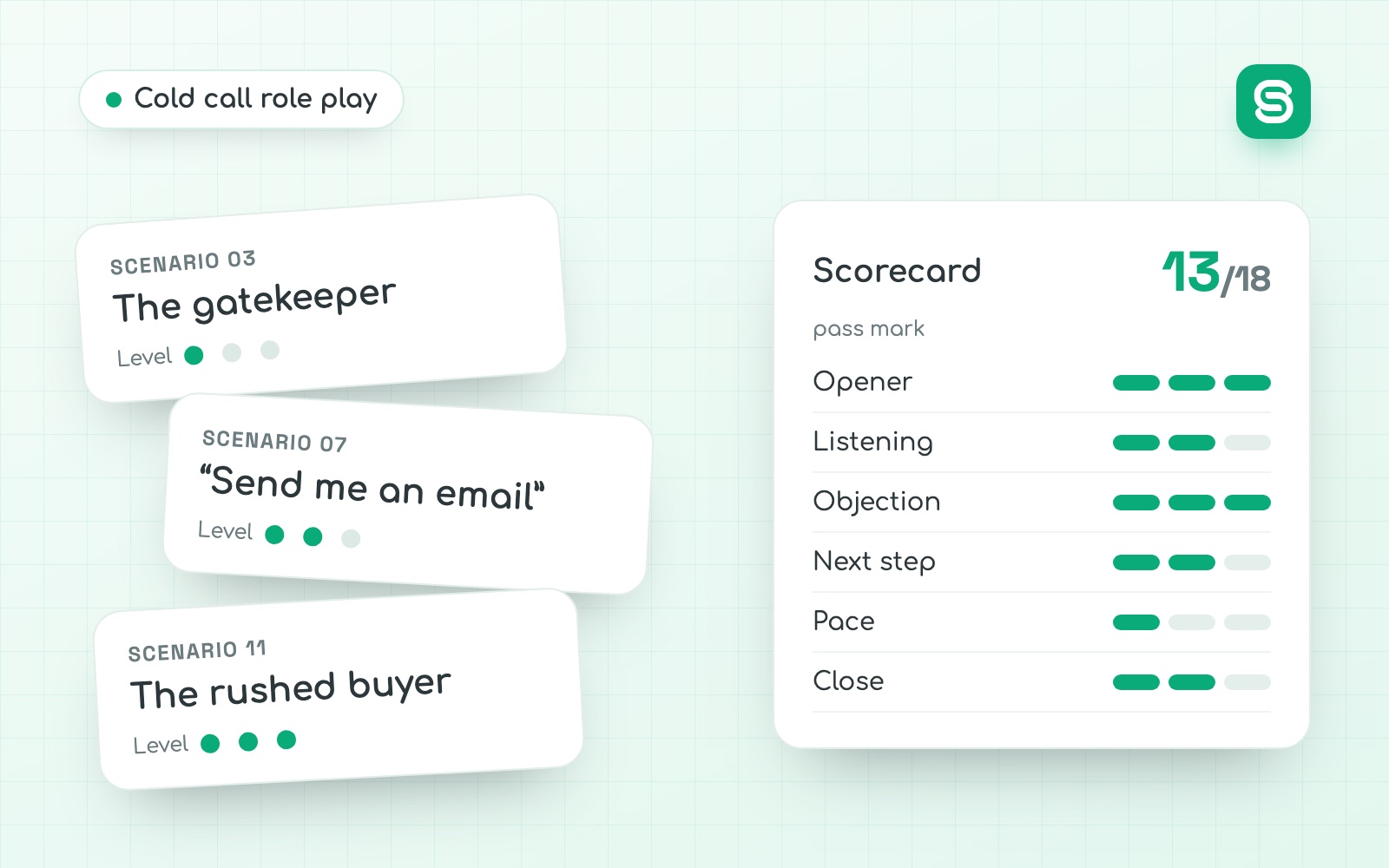
Most cold call role play scenarios fail for the same reason: a colleague improvises a prospect, the rep recites a script, everybody says “that was good”, and nothing changes on the next live call. This kit is built to be used tomorrow morning. It contains twelve scenarios, a scorecard, a session format, a solo routine and a program for a new hire.
What makes a cold call role play actually work?
A sales role play is a rehearsal, and a rehearsal is only worth the time if it resembles the performance. Four rules separate a session that changes behavior on the phone from a session that only fills a calendar slot.
The first round shows the problem, the debrief names it, the second round fixes it.
This article does not rewrite scripts. The wording itself is covered elsewhere on this site: the cold call script template for the overall structure, the cold call openers for the first fifteen seconds, and the answers to cold call objections for the replies. Role play is where those words get said out loud until they stop sounding read.
The 12 cold call role play scenarios, from easiest to hardest
The scenarios are ranked in three levels. Play them in order: a rep who cannot hold the structure of a call with a cooperative prospect will not learn much from a hostile one.
The 12 scenarios, from warm-up to hard mode
Play them in order. Move up a level once a rep scores 13 out of 18 twice in a row.
Short on time? Pick the scenario from what you hear on live calls this week.
| What you hear on live calls | Play this |
|---|---|
| Reps talk for a minute before asking anything | Scenarios 1 and 9 |
| Calls end in the first ten seconds | Scenarios 2 and 8 |
| Voicemails never get a callback | Scenario 3 |
| Nobody gets past the assistant | Scenario 4 |
| ”Call me back” with no date, “send me an email” | Scenarios 5 and 6 |
| Booked meetings that never happen | Scenario 12 |
Each card reads the same way. The prospect block is read aloud to both players. The secret brief goes to the prospect only, on paper or by direct message. The rep’s goal and the trap are read to the rep before the round. The pass criteria are for the observer. All company names, roles and lines below are invented for training purposes. On a phone, the cards are folded: tap one to open it.
Level 1: hold the structure of a call. These four scenarios contain no real resistance. They exist so that the opening, the reason for the call, two questions and a next step become automatic.
01 Scenario 1 · Level 1 The prospect who has two minutes
The trap : Talking for ninety seconds about the product because the prospect is not interrupting.
The prospect who has two minutes
The trap : Talking for ninety seconds about the product because the prospect is not interrupting.The prospect
Operations manager at a 60-person logistics company. Picks up on the second ring, in a neutral mood, between two meetings.
Secret brief for whoever plays the prospect
Be polite and brief. Answer every question honestly in one or two sentences, but volunteer nothing. If the rep proposes a meeting without having asked you at least two questions, say: “A meeting about what, exactly?” If they did ask, accept a 20-minute call next week.
The rep’s goal
Run the whole call in under four minutes: opening, reason for the call, two questions, a dated next step.
The trap
Talking for ninety seconds about the product because the prospect is not interrupting.
Passed if
- The reason for the call is stated in one sentence
- At least two questions are asked before any proposal
- A day and a time are agreed and repeated back
the cold call script template and the full method in how to cold call.
02 Scenario 2 · Level 1 Who is this?
The trap : Dodging the question “Is this a sales call?” or apologizing for calling.
Who is this?
The trap : Dodging the question “Is this a sales call?” or apologizing for calling.The prospect
Head of sales at a software company of 40 people. Did not recognize the number and picked up out of curiosity. Guarded, not hostile.
Secret brief for whoever plays the prospect
Interrupt the rep after five seconds with “Sorry, who is this?” If the answer is clear and short, let them continue. If they launch into a pitch, cut in a second time: “Is this a sales call?” A direct, honest yes followed by one good reason earns thirty more seconds.
The rep’s goal
Survive the first fifteen seconds and earn permission to continue.
The trap
Dodging the question “Is this a sales call?” or apologizing for calling.
Passed if
- Name and company are given without hesitation
- The rep answers “yes” to the sales call question and gives one reason in one sentence
- The prospect grants time explicitly
the openers that earn the first fifteen seconds and the words to avoid on a cold call.
03 Scenario 3 · Level 1 The voicemail
The trap : Starting with a long introduction, so that the reason for the call is cut off by the timer.
The voicemail
The trap : Starting with a long introduction, so that the reason for the call is cut off by the timer.The prospect
Finance director at a 200-person manufacturer. The call goes to voicemail. The person playing the prospect stays silent and times the message.
Secret brief for whoever plays the prospect
Say only: “You have reached the voicemail of Dana Reyes, please leave a message.” Then start a timer. Stop the rep at 30 seconds, whatever they are saying. Afterward, say what you remember of the message without notes: name, company, reason, number.
The rep’s goal
Leave a message of 20 seconds or less that a busy person could act on.
The trap
Starting with a long introduction, so that the reason for the call is cut off by the timer.
Passed if
- The message lasts 20 seconds or less
- The listener can repeat the caller’s name and the reason for the call
- The callback number or the next attempt is stated once, slowly
the guide to leaving a cold call voicemail and the B2B voicemail scripts.
04 Scenario 4 · Level 1 The gatekeeper
The trap : Bluffing familiarity with the decision-maker, or pitching the assistant as if they were the buyer.
The gatekeeper
The trap : Bluffing familiarity with the decision-maker, or pitching the assistant as if they were the buyer.The prospect
Executive assistant to the CEO of a 120-person services firm. Professional, protective, has heard every trick.
Secret brief for whoever plays the prospect
Ask “What is this regarding?” then “Is she expecting your call?” If the rep is vague or pretends to know the CEO, offer to take a message and end the call. If the rep states plainly who they are and why they are calling, and asks for your advice on the best time, give a time slot or a direct line.
The rep’s goal
Leave the call with a transfer, a direct line or a precise time to call back.
The trap
Bluffing familiarity with the decision-maker, or pitching the assistant as if they were the buyer.
Passed if
- The purpose is stated honestly in one sentence
- The rep asks the assistant a question instead of pushing
- The call ends with a concrete element: a time, a line or a name
the gatekeeper script.
Level 2: stay in the call when it resists. Five scenarios, one per common objection. The secret brief always states how many times the prospect pushes back, so the rep learns that a first no is rarely the last word.
05 Scenario 5 · Level 2 This is a bad time
The trap : Accepting “next week” with no day, or ignoring the objection and pitching anyway.
This is a bad time
The trap : Accepting “next week” with no day, or ignoring the objection and pitching anyway.The prospect
HR director at a retail chain. Picks up while walking to a meeting. Sounds rushed, slightly out of breath.
Secret brief for whoever plays the prospect
Say “This is a bad time” as soon as the rep has introduced themselves. If the rep simply asks when to call back, give a vague “sometime next week” and hang up. If the rep offers a specific slot, or asks for twenty seconds to say why they are calling so you can decide, accept one of the two.
The rep’s goal
Turn a brush-off into either twenty seconds of attention or a callback with a day and a time.
The trap
Accepting “next week” with no day, or ignoring the objection and pitching anyway.
Passed if
- The rep acknowledges the timing in a few words
- A specific slot is proposed by the rep, not asked of the prospect
- The callback is confirmed with a day and a time, or the twenty seconds are granted
06 Scenario 6 · Level 2 Send me an email
The trap : Saying “Sure, what is your address?” and hanging up satisfied.
Send me an email
The trap : Saying “Sure, what is your address?” and hanging up satisfied.The prospect
Marketing director at a 90-person B2B company. Polite and efficient. Uses “send me an email” to end most calls.
Secret brief for whoever plays the prospect
After the rep’s reason for the call, say “Sounds interesting, send me an email.” Repeat it up to three times. Give in only if the rep asks a question about what the email should cover so that it is worth your time. Then answer that question for real, and accept a short call if the rep ties it to your answer.
The rep’s goal
Find out whether the request is real interest or an exit, and leave with one piece of information about the prospect.
The trap
Saying “Sure, what is your address?” and hanging up satisfied.
Passed if
- The rep agrees to send the email without arguing
- One question is asked about what the prospect wants to read
- The email is tied to a dated follow-up accepted by the prospect
the answers to the most common objections, and where that email fits in a sequence in the multichannel prospecting guide.
Scenario 6, second round: what the pass version can sound like
Sounds interesting, send me an email.
Happy to. So that it is worth opening: is the issue more the volume of leads or what happens to them once sales gets them?
Honestly, the second one. Half of them never get a call.
Then I will send you two paragraphs on that only. Can I call you Thursday at ten to hear what you think of it?
Thursday at ten works.
The observer ticks: no argument, one question, a dated follow-up.
07 Scenario 7 · Level 2 We already have a supplier
The trap : Asking “Are you happy with them?”, which gets a yes and ends the call.
We already have a supplier
The trap : Asking “Are you happy with them?”, which gets a yes and ends the call.The prospect
IT manager at a 150-person company. Signed with a competitor eighteen months ago. Reasonably satisfied, not a fan.
Secret brief for whoever plays the prospect
Say “We already work with someone for that” and name no one. If the rep criticizes the supplier or asks you to switch, close the conversation. If the rep asks what you would change if you could change one thing, admit that reporting takes your team half a day each month. Accept a comparison call only if it is presented as a benchmark, not a replacement.
The rep’s goal
Open one gap without attacking the current supplier, and earn a benchmark conversation.
The trap
Asking “Are you happy with them?”, which gets a yes and ends the call.
Passed if
- No negative word is said about the current supplier
- The rep asks the “one thing you would change” question or an equivalent
- The next step is framed as a comparison, with a date
the answers to cold call objections and, for the in-house variant, the reply to “we do it in-house”.
08 Scenario 8 · Level 2 Not interested
The trap : Treating the reflex as a reasoned objection and arguing against it.
Not interested
The trap : Treating the reflex as a reasoned objection and arguing against it.The prospect
Managing director of a 30-person agency. Receives several sales calls a week and has a reflex answer.
Secret brief for whoever plays the prospect
Say “Not interested, thanks” within the first ten seconds, before the rep has finished the reason for the call. If the rep insists or asks “May I ask why?”, repeat it and hang up. If the rep accepts the answer calmly and asks one short question you can answer in a word, answer it. If the answer reveals a real problem, allow one more minute.
The rep’s goal
Get one more exchange after a reflex no, without pressure.
The trap
Treating the reflex as a reasoned objection and arguing against it.
Passed if
- The rep accepts the no in a calm voice
- One short, easy question is asked
- The call ends politely, with either one more minute or a clean exit
the answers to cold call objections and the note on how long a cold call should last.
09 Scenario 9 · Level 2 The one-word answers
The trap : Filling every silence, or firing a list of closed questions like a survey.
The one-word answers
The trap : Filling every silence, or firing a list of closed questions like a survey.The prospect
Purchasing manager at an industrial group. Agreed to talk, but is doing something else at the same time.
Secret brief for whoever plays the prospect
Answer every closed question with “yes”, “no” or “it depends”. Answer open questions with one short sentence. Only if the rep stays silent for three full seconds after a question do you add a real detail: your team re-keys orders by hand every Friday.
The rep’s goal
Get the prospect to say at least three full sentences.
The trap
Filling every silence, or firing a list of closed questions like a survey.
Passed if
- At least two open questions are asked
- The rep leaves a silence of three seconds at least once
- The rep picks up a word the prospect used in the following question
the discovery questions for a cold call, the talk-to-listen ratio and the use of silence in sales.
Level 3: keep control under pressure. Three scenarios where the difficulty is emotional as much as technical. Play them only with reps who pass level 2, and keep the debrief short and factual.
10 Scenario 10 · Level 3 How did you get my number?
The trap : Getting defensive, inventing a source, or pressing on as if nothing had been said.
How did you get my number?
The trap : Getting defensive, inventing a source, or pressing on as if nothing had been said.The prospect
Founder of a 25-person company, reached on a mobile number. Irritated, speaks fast.
Secret brief for whoever plays the prospect
Cut the rep off with “How did you get this number?” in a sharp tone. If the answer is evasive, ask again, louder. If the rep states the source plainly and offers to remove your number, calm down. You then have a choice: if the rep asks permission before going on, grant one sentence. If they do not ask, end the call.
The rep’s goal
Defuse the tension with a truthful answer, and leave the prospect in control of what happens next.
The trap
Getting defensive, inventing a source, or pressing on as if nothing had been said.
Passed if
- The source of the number is stated truthfully in one sentence
- The rep offers to remove the number without being asked twice
- The rep asks permission before continuing
the reply to “how did you get my number?” and the rules in cold calling laws by country.
11 Scenario 11 · Level 3 The expert who tests you
The trap : Inventing an answer to save face.
The expert who tests you
The trap : Inventing an answer to save face.The prospect
Technical director who knows the subject better than the rep. Curious, a little amused, likes to check whether people know what they are talking about.
Secret brief for whoever plays the prospect
Ask one technical question the rep can probably answer, then a second one they almost certainly cannot. If the rep bluffs, press with a follow-up question and lose interest. If the rep says they do not know and offers to bring the person who does, accept that meeting, on the condition that the rep can say in one sentence what the expert should prepare.
The rep’s goal
Keep credibility without knowing everything, and convert the test into a meeting with the right person.
The trap
Inventing an answer to save face.
Passed if
- The rep says “I do not know” in clear words
- The prospect’s question is rephrased correctly
- A meeting with a named expert is proposed, with what will be prepared
the live call coaching methods, useful to debrief this one.
12 Scenario 12 · Level 3 The soft yes
The trap : Hanging up delighted with a meeting that does not exist.
The soft yes
The trap : Hanging up delighted with a meeting that does not exist.The prospect
Sales director at a 300-person company. Friendly, agrees with everything, hard to pin down.
Secret brief for whoever plays the prospect
Be warm and say yes to the idea of talking again: “Sure, let’s do that sometime.” Avoid any date. If the rep proposes a slot, say “Just send me an invite.” Give a real date only if the rep proposes two precise options and asks who else should be on the call. You then name your head of operations.
The rep’s goal
Turn a pleasant, vague yes into a meeting with a date, a duration and the right attendees.
The trap
Hanging up delighted with a meeting that does not exist.
Passed if
- Two precise slots are proposed
- The rep asks who else should attend
- Date, duration and attendees are repeated back before hanging up
Scenario 12, first round: what the fail version sounds like
Sure, let’s do that sometime.
Great! I will send you an invite then.
Perfect, talk soon.
No date, no attendee, no duration: next step scores 0. The replay starts from the prospect’s first line.
How do you score a sales role play? The scorecard to copy
Feedback such as “be more natural” cannot be acted on. The scorecard below replaces opinion with six behaviors an observer can hear, each scored from 0 to 3. It is a proposal: adjust the wording to your own calls, but keep the criteria observable.
Cold call role play scorecard
Six criteria, 0 to 3 each, 18 points in total. The observer fills it in during the round.
- 1Opening
0Scores 0 when the rep pitches before saying who is calling and why.
3Scores 3 when name, company and reason for the call are said in under 15 seconds, and the prospect is asked for a short moment.
0123 - 2Listening
0Scores 0 when the rep talks over the prospect or answers a question that was not asked.
3Scores 3 when the rep lets the prospect finish, then repeats one of their words before replying.
0123 - 3Questions
0Scores 0 when no question, or only yes-or-no questions read from the sheet.
3Scores 3 when at least two open questions, the second one built on the first answer.
0123 - 4Objection
0Scores 0 when the rep argues, repeats the pitch or gives up at the first no.
3Scores 3 when the rep acknowledges, asks one question, gives one short answer, then moves on.
0123 - 5Next step
0Scores 0 when the call ends on “I will send you something”.
3Scores 3 when a dated next step is proposed, accepted out loud and repeated back.
0123 - 6Voice and pace
0Scores 0 when rushed delivery, filler words, a script that sounds read.
3Scores 3 when steady pace, short sentences, and a pause left after each question.
0123
0 absent · 1 attempted · 2 solid · 3 could be played to the team as a model
Pass mark: 13 out of 18, with no criterion at 0. Two passes in a row on a scenario unlock the next one.
Cold call role play scorecard
0 absent · 1 attempted · 2 solid · 3 could be played to the team as a model

1. Opening : __ / 3
   0 = the rep pitches before saying who is calling and why
   3 = name, company and reason for the call are said in under 15 seconds, and the prospect is asked for a short moment
2. Listening : __ / 3
   0 = the rep talks over the prospect or answers a question that was not asked
   3 = the rep lets the prospect finish, then repeats one of their words before replying
3. Questions : __ / 3
   0 = no question, or only yes-or-no questions read from the sheet
   3 = at least two open questions, the second one built on the first answer
4. Objection : __ / 3
   0 = the rep argues, repeats the pitch or gives up at the first no
   3 = the rep acknowledges, asks one question, gives one short answer, then moves on
5. Next step : __ / 3
   0 = the call ends on “I will send you something”
   3 = a dated next step is proposed, accepted out loud and repeated back
6. Voice and pace : __ / 3
   0 = rushed delivery, filler words, a script that sounds read
   3 = steady pace, short sentences, and a pause left after each question

Total : __ / 18
Pass mark: 13 out of 18, with no criterion at 0. Two passes in a row on a scenario unlock the next one.
Three rules keep the scoring useful.
The same six lines also work on real calls. If your calls are recorded, scoring one of your own conversations a week with this scorecard is the cheapest form of call coaching there is.
How to run a 30-minute role play session
A session needs three roles, a timer and one printed scorecard. Three people is the ideal group: with two there is no observer, and beyond four most people spend the session watching.
- 01
Minutes 0 to 3: the brief.
Choose one scenario and say which criterion of the scorecard is being worked on. Hand the secret brief to the prospect. Nobody discusses the script. - 02
Minutes 3 to 7: round one.
Four minutes on the timer, no interruption, even if the call goes badly. A call that ends early is a result, not a reason to restart. - 03
Minutes 7 to 10: debrief.
The rep speaks first: what would they redo? Then the prospect says at which sentence they wanted to hang up or to keep listening. The observer closes with one keep and one change. - 04
Minutes 10 to 14: round two, same scenario, same rep.
The replay starts from the beginning. The prospect keeps the same brief. This is the round that gets scored. - 05
Minutes 14 to 16: score.
The observer reads the six scores aloud. No discussion: if the round is passed, it is noted, if not, the scenario comes back at the next session. - 06
Minutes 16 to 27: rotate.
The roles turn and the second rep plays two rounds on the same scenario, with a shorter debrief since everyone has just seen it. - 07
Minutes 27 to 30: one commitment each.
Each rep says one sentence they will use on live calls today. The session ends on time, and the calls start right after.
The trio is the default. Four variants are worth knowing when the team gets tired of it.
How to practice cold calling alone
No partner is available every day, and a lot of the work can be done solo. The condition is the same as in a group: the words must be said out loud. Reading a script silently trains the eyes, not the voice.
Replaying your own calls deserves a method, because it is where practice meets reality.
- 01
Choose one call, not ten.
Take a conversation of more than a minute that did not end in a meeting. Short calls and wins teach less. - 02
Find the turning sentence.
Read the transcript until the line where the prospect’s tone changed. It is usually one sentence of yours, often just before an objection. - 03
Listen to the twenty seconds around it.
The transcript gives the words, the recording gives the pace: how fast you were talking, whether you left a silence, whether you spoke over the prospect. - 04
Rewrite it and say it five times.
Write one better version of your sentence, shorter than the original, and say it aloud five times in a row. The fifth take is the one that will come out on the phone. - 05
Score yourself on two criteria only.
Take the scorecard and score only the two lines concerned by that moment. A full self-assessment every day does not last a week.
This is the part where the calling tool matters. In Skipcall, calls are recorded and transcribed, and each one gets an AI summary, from the Business VoIP plan (from $25 per seat per month) upward, so the raw material for steps 1 to 3 is already in the call history. The details are on the call recording and transcription page and in the guide to AI call transcription and summaries. To be clear about the limit: Skipcall is a calling tool, not a role play simulator. It does not play a prospect and does not score a practice round. Dedicated AI role play products exist for that, and the scorecard above works with or without them. What AI really does inside a calling tool is sorted out in the comparison of AI dialers by type of AI.
How to turn your own calls into scenarios
The twelve scenarios above cover what most B2B teams hear. The thirteenth, the one your team needs most, is specific to your market. It takes about ten minutes to write from a real call.
- 01
Collect three lost calls from last week.
Ask each rep for one. Choose calls that reached the right person and still went nowhere. - 02
Name the difficulty in five words.
”Asks for the price immediately”, “says the team is too small”, “wants a reference in their industry”. If you need more than five words, there are two scenarios. - 03
Write the prospect in two lines.
Role, company size, mood. Change the names and anything that could identify the real person. - 04
Write the secret brief backward.
Start from what would have made this prospect say yes, then write the resistance before it: what they say, how many times, and what unlocks them. - 05
Write three pass criteria.
Each one must be something the observer can hear. Then test the card once with two experienced reps before giving it to a new hire.
Keep the cards in one shared folder and retire a scenario once the whole team passes it twice. A library of twenty living cards is worth more than a hundred that nobody plays. If your scenarios follow a qualification method, the call plan template gives a structure to align them with.
A four-week role play program for a new SDR
A new SDR should not discover objections on live prospects. The program below runs alongside the first calls, three sessions of 30 minutes a week. It fits inside a broader SDR onboarding plan, which covers product, tools and targets.
Week 1: the structure
Three sessions on level 1. The goal is a pass on scenarios 1 and 2 by Friday. The voicemail of scenario 3 is recorded solo every morning, three takes. First live calls can start midweek on a low-stakes list.
Week 2: the common objections
One objection per session, plus five minutes of rapid fire as a warm-up. The new hire plays the prospect at least once per session: holding the secret brief is the fastest way to understand what unlocks it.
Week 3: listening, and the first own-call scenario
Scenario 9 until the three-second silence stops feeling long. Scenario 10 once. The third session uses a card written from one of the new hire’s own recorded calls.
Week 4: hard mode and certification
Two sessions on level 3, then a certification: three scenarios drawn at random, one per level, a single round each, scored by someone other than the usual coach. Pass mark: 13 out of 18 on each.
After the first month, one session a week is enough for a ramped rep, with an extra one whenever a new objection appears on live calls. Add some variety with the formats in cold calling games for SDR teams: several of them are role plays with a scoreboard.
Six mistakes that make role play useless
Does role play help with call reluctance?
Often, yes, because a large part of the fear of calling is the fear of not knowing what to say when the prospect resists. A rep who has heard “not interested” twenty times from a colleague, and survived, hears it differently from a stranger. It also helps to know how ordinary a no is: the sourced figures are in the cold calling statistics. Role play does not treat everything, though: the causes and the other remedies are covered in the article on call reluctance.
Two adjustments help a rep who dreads the exercise itself. Start with scenario 3, the voicemail, which has no partner and no audience. And let them hold the prospect role for a whole session before taking the rep’s seat: watching colleagues stumble on the same sentence is reassuring, and it shows that the scorecard measures the call, not the person.
What to remember
- A useful role play isolates one difficulty, gives the prospect a secret brief, replays the same scenario after the feedback and scores what can be heard.
- The twelve scenarios go from a cooperative prospect to a soft yes with no date. Play them in order and move up after two passes in a row.
- The scorecard has six criteria out of 3 and a pass mark of 13 out of 18 with no zero. The debrief holds one keep and one change.
- A session lasts 30 minutes and is scheduled right before a calling block.
- Alone, fifteen minutes a day out loud is enough: your own recorded calls are the best material you have.
- A new SDR gets 12 sessions and 24 scored rounds in four weeks, ending with a certification on three scenarios drawn at random.
All the wording to rehearse is in the sales scripts library. And if your team needs its own calls recorded and transcribed to build scenarios from, the plans are on the Skipcall pricing page.