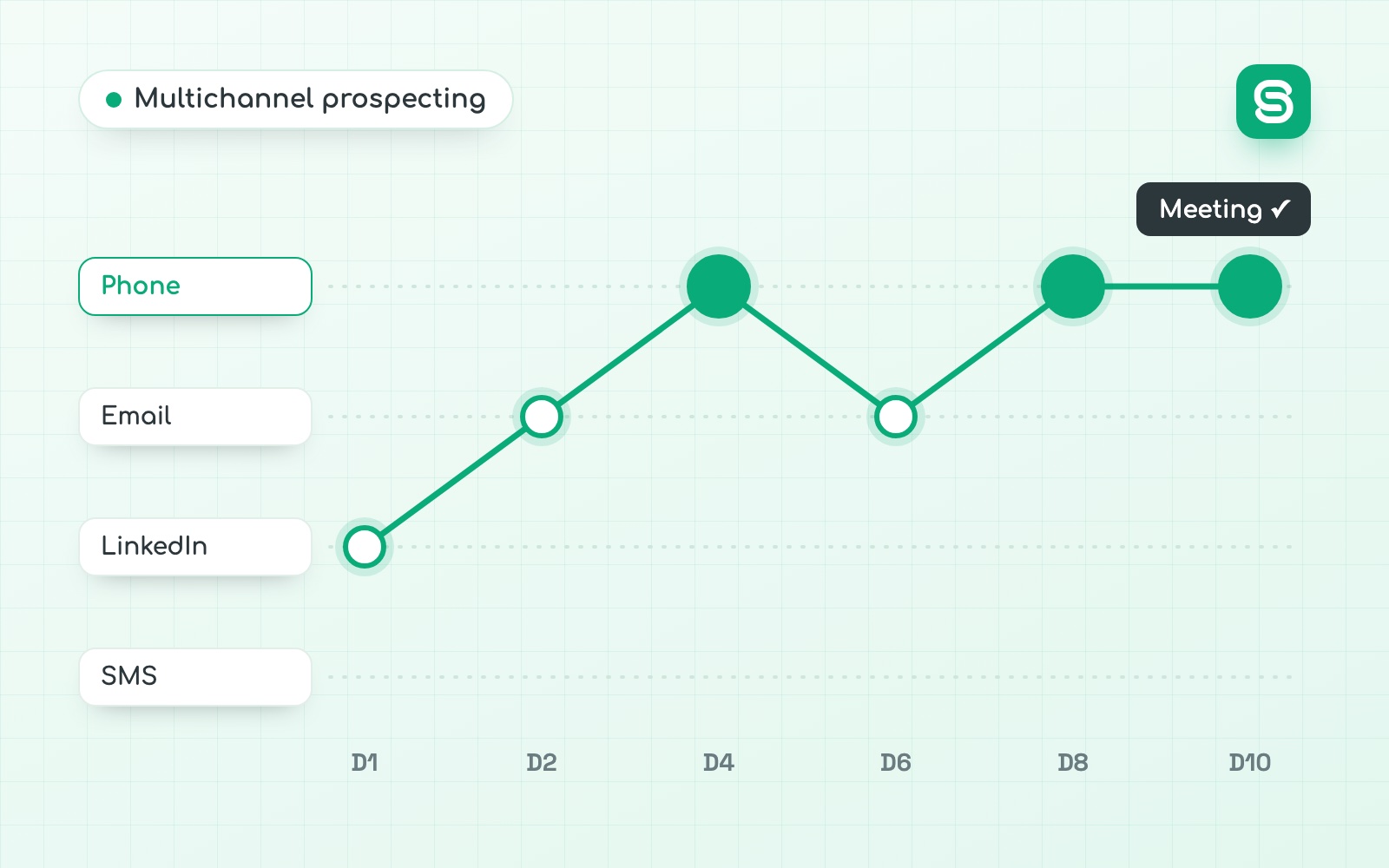
Multichannel prospecting means reaching the same prospect through several channels in a planned order, so that each touch makes the next one more likely to work. In B2B, the order that works is simple: LinkedIn and email make your name familiar, the phone creates the conversation and books the meeting, and a short email or text confirms it. The mistake is to treat the channels as four copies of the same message.
Most guides on multichannel outreach are written by tools that send emails or LinkedIn messages, and the phone shows up as one line near the end. This one starts from the other side: the call is where the meeting gets booked, and the job of every other channel is to make that call easier.
What is multichannel prospecting, and what is it not?
Multichannel prospecting, also called multichannel outreach, is a way of organizing outbound work around the prospect instead of around a tool. One person receives a small number of coordinated touches on different channels, in an order you chose on purpose.
It is often confused with three other things.
The debate between phone and email is a separate question, and we settled it in cold call vs cold email: the two are not rivals. What this guide adds is the mechanics of making them work together, step by step.
These three figures come from RAIN Group’s Top Performance in Sales Prospecting research, as presented on its website on November 11, 2026, based on sellers who prospect outbound. They say two useful things. First, one touch is almost never enough. Second, the best performers need fewer touches, not more: the quality and the order of the touches matter more than their number. For the wider set of figures on answer rates and attempts, each traced to its source, see our cold calling statistics.
Which channel does what in multichannel outreach?
Before building a sequence, give each channel a single job. A channel can do other things, but it does one thing better than the others.
Two other channels appear in some sequences. A short personalized video can replace a mid-sequence email when written messages get no reaction. A handwritten note or a parcel can open a strategic account. Both are expensive in time, so they belong in sequences aimed at a few dozen accounts, not a few thousand.
Email and LinkedIn do not book the meeting. They decide whether your call sounds like a stranger or like the person who wrote yesterday.
How does one channel set up the next?
The idea behind orchestration is that a touch has two effects: its own direct result, which is usually nothing, and what it leaves behind for the next touch. A profile visit almost never produces a reply. It does make your connection request look less random. Here is the chain, in the order it usually runs on a cold contact.
- 01
The profile visit makes the request familiar.
On LinkedIn, the prospect can see who viewed their profile. A visit followed by a connection request the next day reads as interest in them, not as a mass send. - 02
The connection makes the email recognizable.
Whether the request is accepted or still pending, your name and photo have been seen once. The email that arrives the day after is no longer from a complete stranger. - 03
The email gives the call its first sentence.
You no longer open with a pitch. You open with a reference: you wrote yesterday about one specific problem, and you are calling to ask one question about it. Our guide to cold call openers covers how to phrase it, and these cold call role play drills let a rep rehearse it before the first live call. - 04
The voicemail gives the next email its subject.
A short voicemail that names you and the email is rarely returned. It does make the follow-up email, sent within the hour, far more likely to be opened. See whether to leave a cold call voicemail. - 05
The conversation gives the text and the recap their content.
Once you have spoken, every later message quotes the prospect’s own words. That is the point where a sequence stops being outreach and becomes follow-up, which we cover in how to follow up on a cold call.
This is also why the order matters more than the count. Three touches that build on each other do more than six that ignore each other.
When should you switch channels? The 10 handoff rules
A sequence written as a fixed calendar breaks as soon as the prospect does something. The handoff rules below turn the calendar into a decision tree: when a given event happens, you leave the plan and do the move in the second column.
| When this happens | Do this next | Within |
|---|---|---|
| The prospect accepts your LinkedIn request | Call. Your name is on their screen right now. | 1 business day |
| The prospect clicks a link or replies with a question | Call, and open on what they clicked or asked. | The same day |
| The prospect visits your pricing page or engages with your content | Call, with the signal as the reason. | The same day |
| You leave a voicemail | Send a short email, or a text where the rules allow it, that names the call. | 1 hour |
| The prospect picks up and says "send me an email" | Send it while you are still on their mind, and agree a callback day before hanging up. | 10 minutes |
| The prospect replies "not now" | Stop the sequence. Create a call task for the date they gave. Connect on LinkedIn. | Immediately |
| The number is wrong or the person has left | Pause the phone steps. Check the profile, then check whether the number is still active or find another one. | Before the next call step |
| Three calls at three times of day go unanswered | Stop calling for this cycle. Finish with email and LinkedIn, and come back in 30 to 45 days. | After call 3 |
| You receive an out-of-office reply | Move every remaining step to the day after their return. | Immediately |
| The prospect replies or opts out on any channel | Stop every channel, not only the one they answered on. | Immediately |
Two of these rules lean on other guides: how to rank the events worth a same-day call is in buying signals, and how to check whether a number is still active before you dial it again has its own method.
The last rule is the one teams break most often, and almost always by accident. The email tool knows the prospect replied; the calling tool and the LinkedIn tool do not. The prospect says “call me in March” by email and receives a LinkedIn message two days later asking for 15 minutes. If your channels live in separate tools, decide who stops what, and write it down.
The eighth rule protects your list. Calling the same number again and again without an answer teaches the prospect, and sometimes their carrier, to treat your number as a nuisance. The reasoning is in how a prospect list gets burned.
Six multichannel sequences to copy, by situation
One sequence cannot serve every prospect, because the right first channel depends on how much the prospect already knows about you. The six sequences below cover the situations a B2B team meets most often.
These are starting templates built from the logic above, not measured benchmarks. Run one for a month, measure it as described further down, and change one step at a time. In each drawing, the phone is in green: it is the channel where the meeting gets booked.
Sequence 1: the cold list
Use it when: the prospect has never heard of you and nothing specific happened at their company this week.
- D1 LinkedIn Profile visit, then a connection request with no note
- D2 Email Email 1: one problem, one question
- D3 Phone Call 1, short voicemail that names the email
- D5 Phone Call 2 at another time of day, no voicemail
- D8 LinkedIn Message if connected, otherwise react to a post
- D10 Email Email 2: a new angle or one proof
- D12 Phone Call 3, voicemail with one reason to call back
- D15 Email Closing email, door left open
The first two days are silent or light on purpose. The connection request carries no note, because a note on a first request reads as a pitch and lowers acceptance. Email 1 asks one question about one problem. The first call comes on day 3, when your name has been seen twice.
The three calls are placed at three different times of day. If the prospect did not answer at 10 a.m. on Tuesday, calling at 10 a.m. on Thursday repeats the same bet; our best time to cold call benchmarks show how much the slot matters. Only two of the three calls leave a voicemail, so the prospect does not find three messages from the same number.
Handoff to watch: an accepted connection at any point moves the next call to within one business day.
Sequence 2: the buying signal
Use it when: something just happened: a new hire in the role you sell to, a funding round, a job posting, a visit to your pricing page.
- D0 Phone Call the same day, open on the signal
- D0 Email Email right after a missed call, signal in the subject
- D1 LinkedIn Connection request with a note about the signal
- D2 Phone Call 2 at another time of day
- D4 Email Email with one proof from a similar case
- D7 Phone Call 3 and voicemail, then back to the nurturing list
Here the order is reversed. The signal is your reason to call, and it expires: a funding announcement is news for a few days, then every vendor has called. So the phone goes first, the same day, and the email goes out only if the call is missed.
The LinkedIn request carries a note this time, because you have something specific to say. The sequence is short on purpose: after 7 days the signal is stale, and the contact goes back to a slower list. How to find and rank signals is the subject of from buying signals to today’s call list, and if your signals come from LinkedIn, the workflow in from Sales Navigator to a call list gets you from a saved search to a dialing session.
Handoff to watch: if the prospect picks up and asks for an email, send it within 10 minutes and fix the callback day on the call.
Sequence 3: after a trade show
Use it when: you met the person, in person, in the last few days. They know your face and gave you their details.
- D1 Email Email with what you promised at the booth
- D2 Phone Call 1, open on the conversation you had
- D2 SMS Text after voicemail, from the number that called
- D4 LinkedIn Connection request that names the event
- D7 Phone Call 2, offer two time slots
- D10 Email Last email: recap and booking link
The prospect met forty vendors in two days. The email on day 1 has one job: deliver exactly what you said you would send, with a line that recalls the conversation. The call on day 2 opens on that conversation, not on your product. A ready-made structure is in our trade show follow-up call script.
This is the first sequence with a text. It is acceptable here because there is a prior exchange and the prospect gave you their number, but it still follows a call, and the rules of the country apply. Wording examples by situation are in SMS after a sales call.
Handoff to watch: speed. Every day you wait, the prospect remembers less. If the list arrives late from the event organizer, start with the contacts whose badges you scanned yourself.
Sequence 4: the strategic account
Use it when: the company is worth months of effort and several people take part in the decision.
- D1 LinkedIn Connect with three contacts, no pitch
- D2 Email Email to the likely champion
- D4 Phone Call the champion
- D7 Phone Call a user to learn how the team works today
- D9 Email Email the decision maker with what you learned
- D11 Phone Call the decision maker
- D16 LinkedIn Message to accepted connections with one useful item
- D21 Phone Last round of calls, then a quarterly follow-up
The unit here is the account, not the contact. Three people are approached in parallel: a likely champion, a user, and the decision maker. The call to the user on day 7 is not a sales call. It is there to learn how the team works today, so that the email to the decision maker on day 9 contains something true about their own company.
Each role needs its own way in. We wrote a guide per function, for example how to cold call CFOs and how to cold call a VP of Sales.
Handoff to watch: the stop rule applies to the whole account. When one contact replies, pause the other two until you know what was said, or three people will compare notes about three different messages.
Sequence 5: reactivation
Use it when: you already spoke: a lost deal, a demo that went quiet, a former customer, a contact who has changed company.
- D1 Email Email: what has changed since last time
- D3 Phone Call 1, refer to the past exchange
- D3 SMS Text after voicemail
- D7 LinkedIn Message or comment, no pitch
- D10 Phone Call 2
- D14 Email Closing email: ask when to come back
The email goes first because you owe the prospect a reason for coming back. “Checking in” is not one. A new feature that answers their objection, a price change, a new person in the role: that is one. The call on day 3 refers to the past exchange by name and date. Our script for reopening a lost deal gives the wording.
Handoff to watch: a “not now” here is valuable. Ask for a date, stop the sequence, and put the call in the calendar. A reactivated contact who is called on the day they named is rarely cold.
Sequence 6: the warm inbound
Use it when: someone downloaded a guide, attended a webinar or started a signup, without asking to talk to sales.
- D0 Phone Call within the hour
- D0 Email Email with the resource they asked for after a missed call
- D1 Phone Call 2 at another time of day
- D1 SMS Text after voicemail, if your form notice covers it
- D3 LinkedIn Connection request
- D5 Phone Call 3
- D8 Email Last email, then the nurturing list
Speed matters most here: the person is thinking about the subject right now. The call goes out within the hour, and the email that follows a missed call contains the resource they asked for, so the two touches reinforce each other. The difference between this and a true cold call is covered in warm calling vs cold calling.
The text on day 1 is conditional. Send it only if the form where the prospect left their number told them they could be contacted this way.
Handoff to watch: three calls in five days is the ceiling. Someone who downloaded a guide did not ask to be chased; after day 8 they go to a slower list.
How much work is a multichannel sequence?
A sequence looks light on one prospect and heavy on a list. Count the work before you launch, or the call steps will be the first ones skipped.
Two consequences follow. First, the call steps are the bottleneck, so they deserve the tooling. A power dialer removes the manual dialing between calls, and a parallel dialer calls several numbers at once and connects you to the person who answers. If you are choosing one, our power dialer comparison lists what each plan unlocks. Second, the size of the list you put into a sequence should be set by how many call attempts your team can make per day, not by how many emails your tool can send.
What rules apply to each channel?
Each channel has its own rules, and a sequence has to respect all of them at once. This section points to the detailed guides rather than repeating them; none of it is legal advice.
One rule cuts across all four. When a prospect asks you to stop on one channel, treat it as a request to stop on all of them, and record it where every tool can read it. In Europe, the GDPR also expects you to know where each contact detail came from.
How do you measure which channel booked the meeting?
Most teams report one number per channel: emails sent, calls made, connections accepted. Those are activity counts. They do not tell you which step of the sequence is useful. To know that, record three facts for every meeting booked.
- 01
The booking channel.
Where did the prospect say yes to a date: on a call, in an email reply, in a LinkedIn message, by text? - 02
The first-response channel.
Where did the prospect react for the first time, even with a simple “who are you?” or an accepted connection? - 03
The touches before.
Which steps of the sequence had already happened when the meeting was booked, and how many?
Read alone, the booking channel is misleading. In a sequence built around the phone, most meetings are booked on a call, and the conclusion seems to be that email and LinkedIn are useless. The other two facts correct this.
Then track a small set of numbers per channel, and one number for the sequence as a whole.
| Channel | Number to track | What it tells you |
|---|---|---|
| Phone | Connect rate, then meetings per conversation | Whether the earlier touches make people pick up, and whether your opening works |
| Reply rate and share of positive replies | Whether the message is read as relevant, not only delivered | |
| Acceptance rate | Whether your profile and targeting look credible | |
| SMS | Reply rate after a voicemail | Whether the text identifies you clearly enough |
| Whole sequence | Meetings per 100 contacts | The only number that compares two sequences fairly |
The definitions of the phone metrics, and the three that mislead, are in call metrics worth tracking. For connect rates by type of number, see our connect rate benchmarks.
Which tools do you need, and where does Skipcall fit?

A multichannel sequence needs four things: something to send email, something to act on LinkedIn, something to call and text, and one place where the result of every touch is recorded. There are three common ways to assemble them.
Skipcall is a tool for the second setup, and it covers the phone part only. To be precise about what it does and does not do:
In practice, the email and LinkedIn steps of the six sequences run in your outreach tool, the call and text steps run in Skipcall, and the CRM is where both write. Skipcall’s open API exposes contacts and call results, so the other tool can read what happened on the phone. The stop rule, the tenth handoff rule, is then enforced in the CRM: one field that both tools check before they send anything. For the wider picture of what a team needs around the dialer, see the outbound sales stack.
The sequence brief to copy
Before a sequence goes live, write it on one page. The brief below forces the decisions that are usually left implicit, and it is what a new rep needs to run the sequence without asking.
Sequence name: (situation it serves, for example “Buying signal: new VP of Sales”)
Who goes in: (the list or the trigger, and who is excluded)
Reason for getting in touch: (one sentence the prospect would agree is true)
Steps: (day, channel, purpose of the touch, and what it sets up for the next one)
Call steps: (how many, at which times of day, which ones leave a voicemail)
Handoff rules: (the events that change the plan, and the move for each)
Stop rule: (what stops everything, and who updates the shared record)
Capacity: (call attempts per rep per day, so how many contacts at a time)
What we measure: (meetings per 100 contacts, booking channel, first-response channel)
Review date: (when we read the numbers and change one step)
Seven mistakes that break a multichannel sequence
What to remember
- Multichannel prospecting is orchestration. The same prospect receives a few coordinated touches, each one preparing the next. It is not the same message on four channels.
- Each channel has one job. LinkedIn makes you recognizable, email explains, the phone converts, SMS confirms.
- The warmer the prospect, the earlier the call. Day 3 on a cold list, the same day on a signal or an inbound lead.
- Handoff rules beat fixed calendars. An accepted connection, a click or a reply changes the plan, and any reply or opt-out stops every channel.
- Size the list on call capacity. The call steps are the bottleneck; if they slip, the sequence stops working.
- Measure meetings, and what came before them. Booking channel, first-response channel, touches before: the three together tell you which steps earn their place.
Pick the one sequence that matches your most common situation, write its brief, and run it on a list your team can actually call. When the numbers are in, change one step. For the rhythm and the number of touches by deal size, continue with how many touches a cadence needs; for the phone part of the follow-up, with the five-touch phone follow-up.