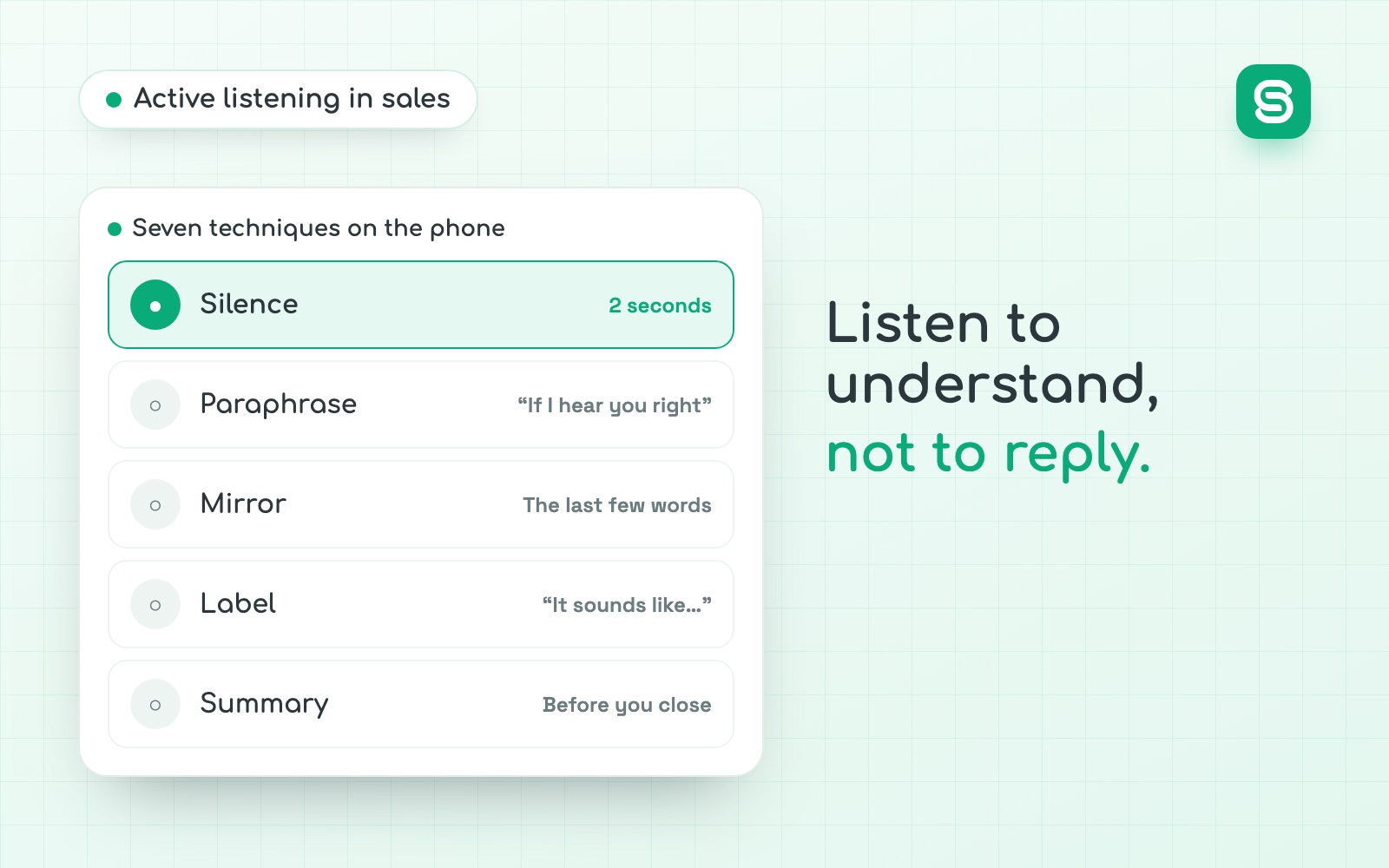
Every sales rep says they listen. Few prospects would agree. Active listening in sales is what separates the two: a way of listening the other person can notice, because they get proof they were understood. On the phone, that proof cannot come from a nod or eye contact. It comes from what you say right after they stop talking.
What is active listening in sales?
Active listening is a way of listening in which the listener has a job to do. They are not waiting for their turn. They work out what the other person means, check that they got it right, and show it.
The phrase comes from two American psychologists, Carl Rogers and Richard Farson. Their paper, titled “Active Listening,” was published in 1957 by the Industrial Relations Center at the University of Chicago and reprinted in 1987 in the collection Communicating in Business Today. It was written for supervisors, not therapists: it is a text about work. An excerpt is reproduced by Gordon Training International, which we reread on November 11, 2026.
Three ideas from that paper apply directly to a sales rep.
That last idea is uncomfortable in a job where you are paid to persuade. It does not say you may never propose anything. It says in which order: understand first, propose second. A pitch delivered before the prospect has finished describing the problem is unrequested advice.
Answering the content alone answers half the message.
What active listening is not
It is not silence. A rep who stays mute while the prospect talks, then launches into the pitch as if nothing had been said, let the prospect talk. They did not listen.
It is not a string of phrases. “So what I’m hearing is,” repeated every other sentence, sounds like a tic. The prospect spots the technique and closes up.
It is not a ratio either. You can talk 30% of the time and retain nothing. Talk time is covered, with the studies, in our article on the talk-to-listen ratio in cold calls; here the subject is what you do with what you hear.
What does the research say about active listening?
Less than you usually read, and it is better to know that. Many articles quote spectacular percentages with no source. We repeat none of them. The verifiable numbers on phone prospecting itself are gathered in our cold calling statistics.
One study is often cited and accessible: Weger, Castle Bell, Minei and Robinson, “The Relative Effectiveness of Active Listening in Initial Interactions”, published in 2014 in the International Journal of Listening (volume 28, issue 1, pages 13 to 31). We reread its abstract on November 11, 2026.
The honest reading is this. Paraphrasing gives the other person the sense of being understood, which is exactly what an unsolicited call lacks. Nothing in this study shows that it closes deals. It keeps you from answering the wrong thing, and a rep who answers the wrong thing loses the call for a reason that has nothing to do with the offer.
Why is active listening harder on the phone?
Face to face, much of listening shows without a word: you look, you nod, you lean in. The prospect can see they are being followed. On the phone none of that exists, and three things change.
The five cues you can hear
Here is what an attentive rep picks up in a voice. None of these cues is proof. Each one is a hypothesis to check with a question or a paraphrase, never a conclusion to keep to yourself.
- 01
Pace.
A prospect who speeds up wants to be done, or is getting animated about something that matters to them. A prospect who slows down is choosing words: what they say then counts. - 02
Pauses.
A gap before an answer often means the question landed. A gap in the middle of a sentence announces a detail they are unsure about sharing. - 03
The energy of the yes.
A “yeah” that falls and fades does not mean what a crisp “yes” means. The first is politeness, the second is agreement. - 04
Repeated words.
When the same word shows up three times in the prospect’s mouth, it is their topic, not yours. Reuse that word, not your brochure vocabulary. - 05
Hedging words.
”Honestly,” “between us,” “to be frank” almost always come right before the useful information in the call. Do not talk over them.
To hear these cues you need decent audio on both ends. A clipping microphone or a crackling headset erases the nuance you are listening for: our free microphone test takes two minutes. If the sound stays choppy or delayed, the cause is usually the network, and our guide to VoIP call quality problems helps you find it. For the hardware, see how to pick a headset for calls.
Distracted or active listening: what do you hear in the same call?
The diagram below takes four lines from the same prospect. For each one it shows what a rep waiting for their turn retains, and what a rep listening to content, feeling and voice retains. The difference shows in the next sentence.
The same call, heard twice
Four lines from a VP of Sales, and what each rep does with them.
- 1The prospect says
“We already tried a tool like that last year.”
In the voice: A sigh before the sentence, pace slowing on “last year.”
Distracted listeningHearsAn objection: they already have a tool.
Replies“That’s exactly why ours is different, let me show you.”
Active listeningHearsA disappointment: something went wrong and he does not want to relive it.
Replies“Last year… it didn’t go the way you expected?”
- 2The prospect says
“Honestly, the team never really got on board.”
In the voice: The word “honestly,” then a two-second pause.
Distracted listeningHearsAn adoption problem, so a pitch about ease of use.
Replies“With us, onboarding takes ten minutes.”
Active listeningHearsHe still carries that failure: he was the one who championed the project.
Replies“It sounds like you were the one left dealing with the fallout.”
- 3The prospect says
“Yeah… well, I’d need to run it by Nadia.”
In the voice: A falling, flat “yeah,” and a first name said quickly.
Distracted listeningHearsAgreement: he will discuss it internally.
Replies“Great, I’ll send over a deck you can forward.”
Active listeningHearsA polite yes, and a decision that is not his alone.
Replies“Is Nadia the one who makes the call on this, or do you two decide together?”
- 4The prospect says
“Call me back in January, we’re slammed right now.”
In the voice: Fast pace, keyboard noise: he is already back at work.
Distracted listeningHearsA polite no: push now or lose him.
Replies“It only takes twenty minutes, surely you have that on Thursday?”
Active listeningHearsA real constraint, and a date: January means something.
Replies“Slammed until January: what wraps up then?”
Example written for this article, not a transcript of a real call.
In all four cases the distracted rep answers a sentence the prospect did not quite say. They hear “objection” where there is disappointment, “agreement” where there is politeness. The reply is correct on paper and wrong in the call. The rep who listens does nothing spectacular: they send back what they heard as a short question and let the prospect fill in the rest.
The 7 active listening techniques, one by one
The table below sums up the seven techniques: when each one helps, what it sounds like, and the trap that makes it fail. The detail follows.
| Technique | When it helps | What it sounds like | The trap |
|---|---|---|---|
| Silence | After your question, after their sentence ends | Two seconds without talking, then “okay” | Past five seconds, they think the call dropped |
| Paraphrasing | When they have just described a problem | “So the activity is happening, you just see it after the fact.” | Repeating word for word instead of condensing |
| Mirroring | When one word carries more weight than the rest | “Too complicated to roll out?” | Using it three times in a row |
| Labeling | When you hear irritation or fatigue | “Sounds like you're tired of people taking your time.” | Following it with “but” |
| Clarifying question | When they use a vague word | “Expensive compared to what?” | Answering what you imagine is behind the word |
| Summarizing | Right before you propose a next step | “Let me play that back: … Did I miss anything?” | Summarizing your offer instead of their situation |
| Validating | When they defend a position or a past decision | “That makes sense.” | Flattery: “great question” |
Each technique comes with a sample exchange. These exchanges were written for this article: they are not real calls, and none of them should be recited. They show the move, not the sentence.
Silence
The easiest technique to describe and the hardest to hold. After a question, stop talking. After the prospect finishes a sentence, count two seconds before you speak. Most people add something in that gap, and what they add is often more specific than their first answer.
On the phone, silence has a limit: past four or five seconds the prospect thinks the call dropped. A low “mm-hm” or “okay” is enough to say you are there without taking the floor.
Silence that gets the rest of the story
What made you reorganize the team in September?
We lost two reps back to back.
The rep says nothing for two seconds.
Well, lost… one of them went to a competitor and took his book with him. That's really what forced us to rethink everything.
Took his book with him. Okay.
Our script page on silence in sales covers when it helps and when it turns into unwelcome pressure.
Paraphrasing
Paraphrasing means saying back, in your own words, what you understood, then letting the prospect confirm or correct. A good paraphrase is shorter than the original sentence. It condenses rather than repeats. It ends in silence, not in a pitch.
It does two things. It checks that you understood, which keeps you from building the rest of the call on a misreading. And it gives the prospect proof they were heard, which they do not expect from a prospecting call.
A paraphrase that checks
The problem is we have three tools, nobody fills in the CRM, and every Monday I spend the morning piecing together who called whom.
So the activity is happening, you just see it after the fact, and you're the one paying for it on Monday morning.
Exactly. And that's when I manage to piece it together at all.
Mirroring
Mirroring means repeating the prospect’s last two or three words, or the word carrying the most weight, with a slight upward inflection. Nothing else. The prospect hears their own words and elaborates.
Chris Voss, a former FBI negotiator, describes this move as “mirroring” in Never Split the Difference, written with Tahl Raz and published in 2016. It is a negotiator’s practice reported by a practitioner, not a lab finding: treat it as a tool to try, not a law.
Mirroring the word that matters
We looked at this two years ago, but it was too complicated to roll out.
Too complicated to roll out?
Yeah, we had to go through IT for every single seat. We gave up after three weeks.
Mirroring has a flaw: used three times in a row, it turns you into a parrot. Once per call, on the right word, it opens a door a long question would have closed.
Labeling the emotion
Labeling means saying out loud the feeling you pick up, as a hypothesis: “it sounds like,” “it seems like,” “it looks like.” You are not telling the prospect what they feel. You are offering a reading, and they correct it if it is wrong.
The same book by Chris Voss calls this “labeling.” It lines up directly with the Rogers and Farson paper, which asked the listener to respond to feelings and not only to content.
A label that defuses
Look, I get pitched this kind of thing four times a week.
Sounds like you're tired of people taking your time for the same promise.
A little, yeah. Fine, what do you do that's different?
Two cautions. Label an emotion you actually heard in the voice, not one that suits you. And never follow a label with “but”: “it sounds like you’re swamped, but this will only take two minutes” cancels what you just said.
The clarifying question
Use it when the prospect says something vague: “complicated,” “expensive,” “not the right time,” “we’ll see.” Instead of answering what you imagine is behind the word, ask what it covers. “Expensive compared to what?” “Not the right time, meaning?”
It is a question, but it is not a discovery question: it follows their sentence, not your plan. The list of questions to qualify a prospect in a few minutes is in our guide to cold call discovery questions.
Clarifying a vague word
Frankly, it's not a priority right now.
When you say not a priority, what's ahead of it?
Hiring. I have four open roles and nobody to train the new people.
Summarizing
The summary gathers, in two or three sentences, what the prospect has said since the start. It comes before you propose anything. It starts with their words and ends by asking for confirmation.
This is the move that sets up the next step. A meeting proposed after a confirmed summary rests on a problem the prospect has just acknowledged. A meeting proposed without one rests on your pitch.
Summarizing before you propose
Let me play that back: four new hires to train, nobody free to do it, and activity tracking you rebuild by hand on Mondays. Did I miss anything?
No, that's it. Add that the budget is locked until March.
Locked until March. Got it.
Validating
Validating means acknowledging that what the prospect says holds up, without agreeing with everything. “That makes sense.” “I can see why you stopped.” “I’d have asked the same question.” Validation is about the reasoning or the feeling, not the conclusion.
Keep it short and do not flatter. Rogers and Farson warned against positive evaluations and empty reassurance, which stop the other person from saying what is wrong. Real validation says “what you are saying makes sense.” It does not say “great question.”
Validating without giving in
I'm not switching tools every year to keep vendors happy.
That makes sense. Every switch costs you a month of the team finding its feet.
Right. So it would really have to be worth it.
In what order?
There is no required sequence, but a logic keeps coming back. Silence and mirroring get the prospect talking. Paraphrasing and clarifying questions check. Labeling and validating deal with the feeling. The summary closes the listening phase and opens the proposal.
10 active listening examples in sales, before and after
The ten lines below come up on most B2B prospecting calls. For each, the reflex answer deals with the content. The active listening answer deals with the total meaning. These are examples to adapt to your own voice, not scripts.
| The prospect says | Reflex answer | Active listening answer |
|---|---|---|
| “Send me an email.” | “Sure, what's the address?” | “I'll send it. So it's useful: is it the topic that doesn't land, or the timing that's bad?” |
| “We already have a vendor.” | “We're cheaper and more complete.” | “You're already set up. What's working well with them today?” |
| “It's too expensive.” | “I can give you a discount.” | “Too expensive compared to what: what you pay today, or what you'd expect to get?” |
| “I don't have time.” | “This will only take two minutes.” | “You're in the middle of something. Should I call Thursday morning, or is one sentence now enough for you to decide?” |
| “Let's look at it next year.” | “Why wait? Prices are going up.” | “Next year. What will have changed by then?” |
| “I'm not interested.” | “You don't know what I'm offering yet.” | “I hear that. Sounds like you've been made this promise before and it wasn't kept.” |
| “I need to talk to my partner.” | “Great, I'll call back next week.” | “It's a decision for the two of you. What will matter most to them?” |
| “We tried it, it didn't work.” | “It'll be different with us.” | “It didn't work… What happened exactly?” |
| “How did you get my number?” | “It's public, you know.” | “Fair question. It's listed on your company website. Would you rather I stop using it?” |
| “Yeah, sure, why not.” | “Perfect, I'll book Tuesday at 2.” | “I'm hearing a “why not” more than a “yes.” What's holding you back?” |
Three notes on this table. The active listening answer is almost always a question, but one that starts from their words. It is never more than a line longer than the prospect’s own line. And it accepts the possibility of a no: on the ninth line, saying where the number really came from and offering to stop using it is the only answer that shows you heard the concern.
For the substance of each reply, meaning what you say once the prospect has spelled out their thinking, see how to handle cold call objections. Active listening does not replace the reply: it makes sure you reply to the right objection. To drill these lines on your own, our objection handling practice tool is free.
Which listening move at which point in the call?
A prospecting call has four moments, and listening plays a different role in each. Here is the most useful move for each one, and what to hear before moving on.
The first twenty seconds
The prospect reacts to your reason for calling, often with half a sentence: “Yes?”, “What’s this about?”, “I’m in a meeting.” Listen to the tone before the words. One second of silence after your opener gives them room to actually answer. How to build that first sentence is in our guide to cold call openers.
The first objection
This is where reps most often answer the wrong thing. Before any argument, check what the objection covers: a vague word calls for a clarifying question, irritation calls for a label.
The exchange about their situation
Two or three questions, no more. After each useful answer, a short paraphrase the prospect confirms. If your next question reuses none of their words, you are back on your list.
Proposing the next step
Summarize in two sentences using their words, wait for “yes, that’s it,” then propose. If they correct the summary, you just avoided a meeting built on a misunderstanding.
The same logic applies to a voicemail or a follow-up call, with less material: you bring back what the prospect said last time, in their words, before saying why you are calling again. It applies in writing too. A follow-up email that quotes “the Monday morning spent piecing activity together” proves you listened better than a recap of your offer, and that is what ties the channels together in multichannel prospecting. The qualification method that frames these exchanges is in our guide on how to qualify leads on the phone.
The 7 mistakes that pass for listening
The first mistake is the parent of the other six. It comes from fear of the gap: you prepare a sentence so you are never caught without one. That reflex is handled like call reluctance, through practice more than willpower.
How do you take notes without losing the thread?
On the phone nobody sees you write. That is an advantage and a trap: you can take as many notes as you like, and so you take too many.
- 01
Write words, not sentences.
Three of the prospect’s words per answer are enough, ideally the ones they used themselves: “Monday morning,” “IT,” “burned.” Those are the ones you will reuse in the summary. - 02
Separate facts from feeling.
Two columns on a page or two lines in the record: what they said about their situation, and what you heard in their voice. The second column is the one people forget. - 03
Write during your own sentences.
Take notes while you talk or during an acknowledgment, not while they develop a point. What you miss while writing is always more important than what you write. - 04
Fill in the gaps within a minute.
Nuance fades fast. Thirty seconds after hanging up, add what you did not have time to write, and the date they mentioned if there was one.
A recorded and transcribed call changes this constraint: you can listen during the call and find the exact words afterward. More on that below.
How do you practice active listening?
Listening does not improve by reading an article. It improves when you practice under mild pressure and then listen back. Here are four five-minute drills for two people, then a routine to do alone.
Four drills in pairs
- 01
Two seconds.
One person talks about a real work problem for two minutes. The other may only reply after two full seconds of silence at the end of each sentence. Then swap. Most people discover they interrupt without noticing. - 02
The confirmed paraphrase.
One talks, the other paraphrases in one sentence. The speaker answers only “yes” or “no.” You move on only after a “yes.” Three “no” answers in a row mean you are paraphrasing what you wanted to hear. - 03
Back to back.
Both turn their backs to recreate the phone. One says the same sentence three times, for example “let’s look at that later,” with three different intentions. The other has to name each one. This is the drill that trains the ear for vocal cues. - 04
The blind summary.
One describes their week for three minutes. The other takes no notes, then summarizes in three sentences. The speaker says what is missing. Repeat with three-word notes and compare.
These drills work as the opening of a fuller session. Our article on cold call role play scenarios gives twelve scenarios and a scorecard with a listening criterion: the drills above are the warm-up.
Alone: replay your own calls
This is the most effective practice, and the least pleasant the first few times. You will hear where you interrupt, the questions you asked without waiting for the answer, the cues you let go by.
Pick one call
Take a conversation longer than a minute that went nowhere. Failed calls teach more about listening than successful ones.
Read the transcript, pen in hand
Underline every place where your sentence starts before theirs ends, and every question that reuses no word from their previous answer.
Replay the three underlined passages
The transcript gives the words, the recording gives the voice. Look for what you missed live: a sigh, a slowdown, a flat “yeah.”
Rewrite a single line
Pick the moment the call turned and write what you could have said using one of the seven techniques. Say it out loud five times.
A four-week plan
Working on all seven techniques at once does not hold: under pressure you fall back on reflexes. One move per week is enough, with one line of the scorecard below to check it.
- 01
Week 1: silence.
Two seconds after every question, on every call. Check it with line 2 of the scorecard. This is the most uncomfortable week, and the one that changes the call the most. - 02
Week 2: mirroring and paraphrasing.
Once per conversation, reuse one of the prospect’s words or condense what they just said. Lines 3 and 4 of the scorecard. - 03
Week 3: the first objection.
Before any argument, a clarifying question or a label. Lines 5 and 6. Replay one call a day to hear what the prospect added. - 04
Week 4: the summary before the ask.
No meeting request without a confirmed summary. Line 9. At the end of the month, compare your “yes” total with week one.
The replay routine assumes you have the recording and the transcript of your calls. In Skipcall, calls are recorded and transcribed, and each one gets an AI summary, from the Business VoIP plan (from $25 per seat per month). Details are on the call recording and transcription page, and the principle is explained in our article on AI call transcription and summaries.
The self-assessment scorecard to copy
Fill it in within a minute of hanging up, while you still remember. Ten lines, yes or no. It does not measure talent: it counts moves.
Count your “yes” answers. The total only means something against your own total from last week. More useful: find the line that comes back “no” three calls in a row. That is your one thing to work on this week. Line 10 is the hardest to check honestly.
For a fuller rating of a call that goes beyond listening, we offer a free sales call scorecard to fill in online.
How does a manager assess listening on the team?
“You need to listen better” is useless feedback: nobody knows what to do with it. Listening is assessed on what you can hear in a recording, with markers two people would count the same way.
A twenty-minute listening session
- 01
One call per rep, chosen by the rep.
Each person brings a two-to-four-minute conversation they are not happy with. The choice is theirs: people work better on a call they decided to share. - 02
One listen, one marker.
The whole team listens to the clip counting only one of the six markers, announced in advance. Counting one thing keeps it quick and free of overall judgment. - 03
The rep speaks first.
They say what they heard on replay. Most of the time they find, on their own, the moment they stopped listening. - 04
Replay twenty seconds.
A colleague delivers the prospect’s line and the rep tries a different answer using one of the seven techniques. Once, then on to the next call.
The session works just as well remotely, since it runs on recordings anyone can open: how to organize a distributed team is covered in our guide to a remote team phone system.
Listening can also be worked on during the call itself, when a manager follows the conversation and whispers a cue. The rules and limits of that are in our article on live call coaching. For a new hire, listening fits into the first weeks described in the SDR onboarding plan. It is only one family of behaviors among others: rigor and grit count just as much, and we break them down, with observable signals, in the qualities of a good salesperson.
Where the tool helps, and where it replaces nothing
No software listens for you. A calling tool can only remove what stops you from listening and give you back what you missed.
Skipcall is an outbound calling tool: calls start in Skipcall, are recorded, transcribed and summarized, and the activity syncs to HubSpot, Pipedrive, Salesforce or Attio. So you get the prospect’s exact words back after every conversation. What you do with them stays your work, with the scorecard above.
One last note on pace. A rep who chains calls without a break listens worse on the fortieth than on the fifth. If you use an automatic dialing mode, keep a few seconds between conversations to finish your notes and clear your head. Call length is covered in our article on how long a cold call should last.
What to remember
- Active listening means listening for total meaning: the content and the feeling under it, per the 1957 Rogers and Farson paper. Then showing it before you answer.
- On the phone, everything runs through the voice. Pace, pauses, the energy of the yes, repeated words, hedging words: five cues, all to be checked.
- Seven moves, two per call. Silence, paraphrasing, mirroring, labeling, clarifying questions, summarizing, validating. Using all of them sounds mechanical.
- The research is modest. A 2014 study shows paraphrasing makes people feel more understood, with small effects and outside a sales setting. Be wary of percentages with no source.
- The first mistake is drafting your reply. The other six follow from it.
- Listening is trained. Four drills in pairs, one move per week for a month, one replayed call a day, and a ten-line scorecard filled in within a minute.
- A manager assesses audible moves, not an impression: interruptions, silences, reused words, how questions chain, the confirmed summary, and what the prospect taught the rep.