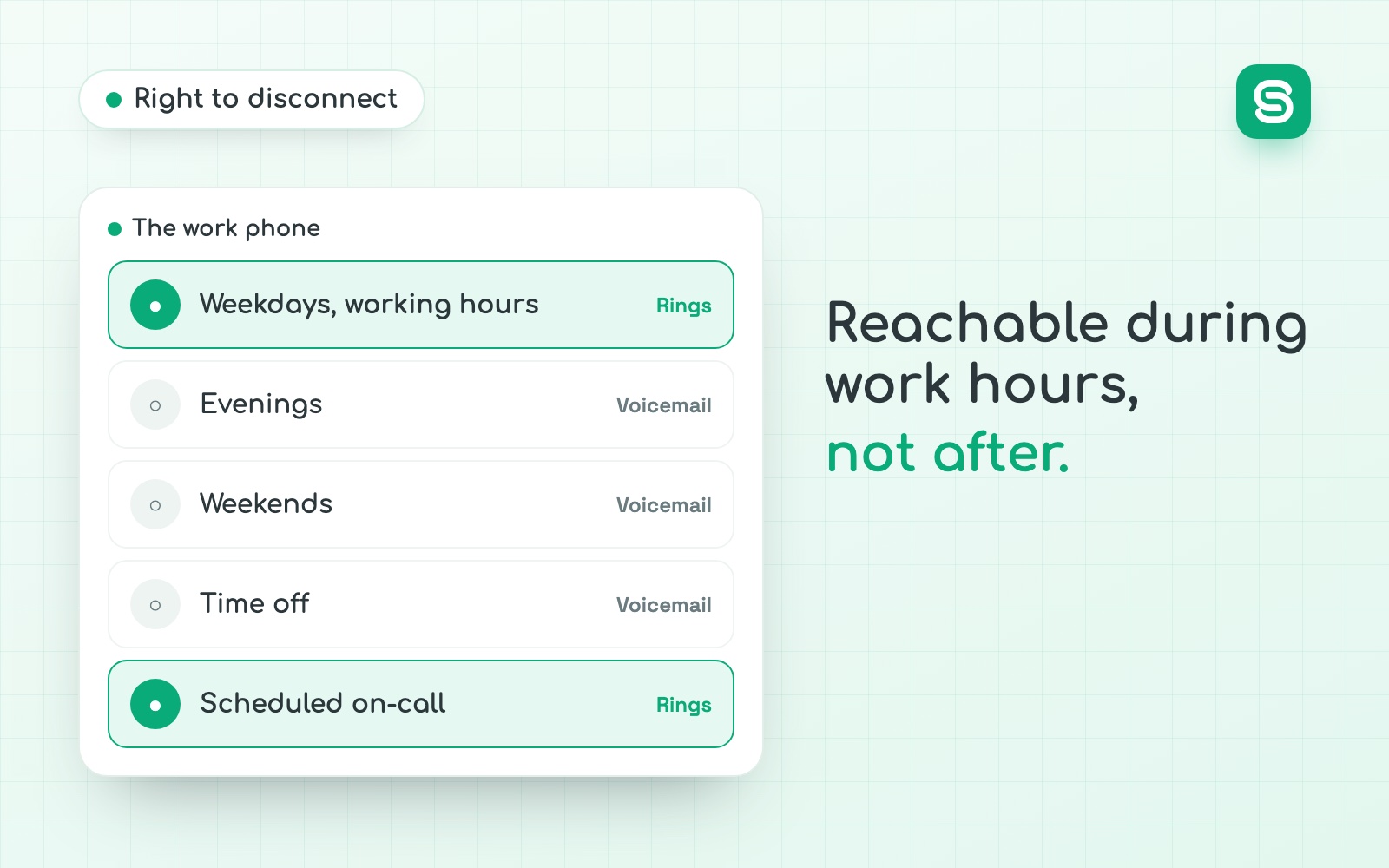
The right to disconnect is an employee’s right not to take work calls, emails or messages outside working time. Several countries have written it into law or into an official code, and none of those texts sets a cutoff hour. They all ask the employer to write its own rules. For the work phone, that comes down to three decisions: when it rings, who stays reachable for emergencies, and what the voicemail says the rest of the time.
Which countries have right to disconnect laws?
Five official texts, each read at its source on November 11, 2026. They show three different ways of handling the same problem. The list is not exhaustive.
| Jurisdiction | Text | What it requires |
|---|---|---|
| France | Labor Code, Article L2242-17, point 7 | A mandatory bargaining topic where bargaining applies. Without an agreement, the employer writes a charter after consulting the works council, with training for staff and management. |
| Spain | Organic Law 3/2018, Article 88 | A right to digital disconnection for workers and public employees. The employer draws up an internal policy after hearing employee representatives, executives included, with training on reasonable use of technology. |
| Belgium | Law of October 3, 2022 (Federal Public Service Employment notice) | Employers with at least 20 workers set the arrangements in a company collective agreement or, failing that, in the work rules: practical arrangements, guidelines for digital tools, training. |
| Ireland | Workplace Relations Commission Code of Practice | Three elements: not routinely working outside normal hours, not being penalized for refusing to, and respecting other people's right to disconnect. Not an offense in itself to ignore it, but admissible in evidence. |
| Ontario, Canada | Employment Standards Act, official guide | Employers with 25 or more employees on January 1 must have a written policy on disconnecting from work, in place before March 1. The guide says the Act does not require creating a new right: the employer decides the content. |
The Irish code is the most practical of the five, and it reads like a manual. It accepts that occasional out-of-hours contact can be legitimate, for example to cover at short notice for a sick colleague or in an emergency, as long as it stays the exception.
It also asks employers to address work across global time zones. It tells managers to talk to a team member who sends emails at odd hours, because that is often a sign of workload trouble. And it supplies sample out-of-office and footer wording, quoted further down. Spain’s Article 88 adds one point the others leave implicit: disconnection must be preserved for remote work and work done from home.
No text we read says at what time the phone must go quiet. Each one makes the employer decide, and write it down.
What does French law actually say?
France is the reference case, because its wording has been copied and discussed widely. The right entered the Labor Code with Law No. 2016-1088 of August 8, 2016, and now sits in point 7 of Article L2242-17.
The article makes the following a bargaining topic: the ways an employee fully exercises the right to disconnect, and the company’s arrangements for regulating the use of digital tools, in order to ensure respect for rest periods, leave, and personal and family life. If no agreement is reached, the employer draws up a charter after consulting the works council. The charter must define how the right is exercised and plan training and awareness actions for employees, managers and executives.
Other French rules do the heavy lifting. Article L3131-1 guarantees at least eleven consecutive hours of daily rest. For employees paid on an annual day-count basis rather than by the hour, Article L3121-64 requires the collective agreement to set how the right to disconnect is exercised, and Article L3121-65 says that, failing that, the employer defines the arrangements and communicates them to the employees concerned.
The eleven-hour rule is the one a late call breaks most easily.
- Rest
- Rest cut short
- Call handled
- Work
Outside the exceptions the French Labor Code provides. General information, not legal advice.
One evening call costs an hour of the next morning, or eats into the rest period if nobody does the math.
A recent ruling shows where the line falls. France’s official Service Public site reported on April 13, 2026 a decision of the Cour de cassation dated March 25, 2026. An employee on sick leave had logged in on his own initiative and answered his emails. His claim for breach of the right to disconnect failed. He had acted spontaneously, the emails were automatic notifications he had no duty to answer, and nothing showed the employer had required a reply. The lack of a charter was not enough on its own.
Is there a right to disconnect in the United States?
We found no federal statute that creates a right to disconnect. The federal framework looks at a different question: is the time paid?
The Department of Labor’s Fact Sheet #22 explains hours worked under the Fair Labor Standards Act. It recalls that the Act defines “employ” as “to suffer or permit to work”. Work the employer did not request but allows still counts as hours worked.
For a US sales team, the business case does not depend on a statute. Uncounted after-hours calls create pay exposure for hourly staff, and constant availability wears people out. A written phone policy solves both, and it is the same document a French or Belgian entity would need anyway.
One policy for several countries: what should it contain?
If you employ people in more than one of these places, you do not need five documents. The texts overlap enough that one policy, written to the most demanding standard, covers the substance. What changes is the form: who must be consulted, where the document is filed, and by when.
- 01
Practical arrangements for not being reachable.
Belgium requires them by name, France and Spain ask for the ways the right is exercised. In practice: written windows, voicemail outside them, a defined on-call. - 02
Guidelines for using digital tools.
Belgium lists them, and the French and Spanish texts speak of regulating or using tools reasonably. For the phone: delayed send, no internal calls outside the window, notifications off. - 03
Training and awareness, management included.
France, Spain and Belgium all require it, and all three name managers or executives. Plan it at onboarding and once a year. - 04
No penalty for not answering.
It is the second element of the Irish code, and the sentence employees look for first. Write it plainly. - 05
A date, and proof of distribution.
Ontario requires the date the policy was prepared and any change dates, a copy to employees within 30 days, and three years of retention after the policy stops applying. Do the same everywhere: it costs nothing.
For a US-only company, we found no federal statute that makes any of this mandatory. It is still the cheapest way to settle two real problems at once: unrecorded working time for hourly staff, and a team that never fully stops.
Can my employer call me after hours?
The question comes up more than any other. The honest answer has three layers.
- 01
The call itself is rarely banned.
None of the texts we read forbids an employer from placing a call. They organize a right for the employee and a duty for the company to set rules. - 02
What is protected is rest, or pay, or both.
France protects rest periods and leave. Ireland’s code protects against being penalized for not answering. US federal law protects pay for time worked by non-exempt employees. - 03
Your company's written rule decides the rest.
An agreement, charter or policy says when you are reachable, what counts as urgent and who is on call. Without one, only the general rules on rest and working time apply.
What can you do as an employee if the work phone keeps ringing?
Before it becomes a dispute, five simple steps clarify where you stand. They are just as useful to a manager who wants to know what the team is living through.
- 01
Find the written rule.
A company agreement, a charter, a policy or your contract: your reachable hours are in there, or should be. Ask HR or your employee representatives for the text. - 02
Write down the facts.
Date, time, length, who called, and what was expected of you. Two weeks of notes carry more weight than an impression. If you are paid by the hour, the same notes are your record of time worked. - 03
Ask the question in writing.
”Am I expected to be reachable after 6 pm? If so, on what basis?” A written answer settles the expectation, one way or the other. Expectation is what decided the French ruling of March 25, 2026. - 04
Set your phone.
A Focus mode outside your hours, and a voicemail greeting that gives a callback time. Ready-made wording is further down. - 05
If nothing changes, do not stay alone with it.
Your employee representatives, HR and the labor authority in your jurisdiction are the channels meant for these questions.
Why is the phone a special case?
Most disconnect policies are written about email. The phone is a different problem, for four reasons.
The third point is the most common in small teams. As long as customers call a rep’s personal cell, no policy can be enforced. The first step is to separate the numbers, which is the subject of our guide to running a business number on a personal phone, and more broadly to choosing a virtual business phone number that lives in an app.
What does a week look like when the phone follows the policy?
Here is an example for a sales team. Three states only, so everyone knows at any moment which one they are in.
- Reachable. The phone rings. Internal and customer calls come through.
- On call. Only the on-call line rings, for the named and compensated person.
- Disconnected. Voicemail with a greeting. Nobody expects an answer before the next window.
Lunch break counted as disconnected time. Saturday morning on call: one person, in rotation.
Three things make this model workable.
- Few states. Reachable, on call, disconnected. A fourth state such as “reachable if important” ruins everything, because each person reads it differently.
- Lunch counts. If the phone rings through lunch, the day has no break. Voicemail takes over, as it does in the evening.
- On-call is a visible exception. It has its own color, its own person and its own compensation.
The hours in the example are not a standard. A team that calls restaurant owners does not work the same windows as a team that sells to finance leaders. To set yours, start from your call data, from our benchmarks on the best time to cold call and from the free When to Call tool, then close everything else.
How should on-call work be organized?
On-call is the proper name for “reachable in case of emergency”. Naming it is what keeps the rest of the policy honest.
French law gives a precise model: Article L3121-9 defines on-call duty as a period when the employee, without being at the workplace or permanently at the employer’s disposal, must be able to step in. Time spent stepping in counts as working time, the period itself gives rise to compensation, and employees are told their schedule within a reasonable time. Article L3121-10 adds that, apart from time spent stepping in, the on-call period counts toward daily and weekly rest.
“A definition of urgent” is the card teams skip most often. Here is a sample appendix for a sales team, to adapt to your business.
What if customers are in other time zones?
A New York team selling into California takes calls until 8 pm Eastern. A team selling into Europe starts before dawn. A disconnect policy does not disappear in that case: it forces a choice.
- 01
Shift the window, do not stretch it.
A rep covering the West Coast works 11 am to 7 pm Eastern, not 9 am to 8 pm. The disconnected block moves with them. - 02
Split time zones between people.
Two staggered windows cover a twelve-hour span without any single phone ringing for more than eight. - 03
Tell the customer when they will be called back.
A greeting that gives the callback time, in the customer’s time zone, beats a call answered half asleep. To identify the country behind a missed call before you call back, keep the list of international dialing codes at hand. - 04
Write the exception into the policy.
If some people work shifted hours, the policy says so, with their windows. An unwritten exception becomes an obligation for everyone.
Do not confuse this with the rules on what time of day you may call a prospect. Those protect the person being called, not your employee, and vary by country. They are covered in our overview of cold calling laws by country.
What about managers?
The French and Spanish texts both name management explicitly, and the Irish code lists a duty to respect other people’s right to disconnect. That is no accident: most evening calls come from managers.
Three habits change the picture at no cost: schedule evening messages to send the next morning, keep one-to-ones inside the reachable window, and never comment the next day on a missing after-hours reply. In a distributed team, those habits are built with the rituals described in our article on calling culture in a remote SDR team.
The link with retention is direct. A team whose phone never stops wears out faster, and burnout is one of the causes covered in our guide to reducing SDR turnover. To put a dollar figure on it, the sales rep turnover cost calculator starts from your own numbers.
The 10 work phone settings that enforce the policy
A rule holds when the tool applies it instead of people. Here are the ten settings, from the most structural to the finest.
- 01
A separate business number for each person.
As long as the business number is the personal number, nothing else is possible. This setting unlocks the nine that follow. - 02
Written ring windows.
By team, by time zone, day by day. They appear in the policy and in the tool, identically. - 03
An after-hours voicemail greeting.
It gives the name, the hours, the callback time and the on-call number if there is one. Ready-to-record examples are in our voicemail greeting scripts. - 04
Scheduled Do Not Disturb.
On the cell phone, a Focus mode scheduled to the policy’s hours silences the work app and lets personal calls through. - 05
A separate on-call line.
One number, one person, one schedule. It is the only number that rings outside the windows. Setting up several lines in a small business has its own guide. - 06
Notifications off with the ringer.
Missed calls, voicemails and texts do not appear in the evening. They wait for the next window, grouped. - 07
A callback planned for the next window.
After-hours missed calls become tasks for the next morning. The customer is called back at the announced time, and nobody needs to check at night. - 08
A rule for internal calls.
No calls between colleagues outside the window, except on-call. Messages written in the evening go out on a delay. - 09
Time off connected to the tool.
During an absence, calls go to a named colleague or to voicemail, with a greeting that gives the return date. The how-to is in our guide to call forwarding and call transfer. - 10
A monthly measure.
Calls and messages handled outside the window, per person. If the number is not zero, the policy is not applied, and it is the organization that needs fixing.
The tenth setting is the safeguard. Without a measure, you discover the problem when someone resigns. Call statistics are enough: time of call, duration, person. For US teams with hourly staff, the same report tells you which after-hours calls belong on a timesheet. If you record calls, the notice and consent rules are in our guide to call recording laws for businesses.
What should you actually say? Eight lines to copy
Settings silence the phone. Words tell the caller and the team what happens next. These are the lines that come up most often, to use as they are or to adapt.
| Moment | The line | What it settles |
|---|---|---|
| After-hours voicemail greeting | "Hi, you have reached [first and last name] at [company]. I take calls Monday to Friday, 9 am to 12:30 pm and 2 pm to 6 pm. Leave me a message and I will call you back tomorrow before 10 am." | The customer knows when the callback comes. There is no reason left to keep trying tonight. |
| Greeting when an on-call line exists | "For an emergency that cannot wait until tomorrow, call [on-call number]. For everything else, leave me a message." | Urgent matters have one door, and only one. A colleague's cell is never given out. |
| Vacation greeting | "I am away through [date]. While I am out, [first name] can help you at [number]." | Nobody expects a reply during time off, and the customer still has a contact. |
| A manager's message written in the evening | "Nothing to do tonight. Let's talk tomorrow at 9:30." Better still: the same message on delayed send. | The expectation of a reply is gone, in writing. |
| Email or text signature | "My normal working hours are from X to Y. I will respond to you when I am back at work." | This is the sample wording in Ireland's Code of Practice. |
| A customer asks for your personal cell | "This is the number where you are sure to reach me. Outside my hours, voicemail passes your message on and I call you back at the time it announces." | The personal number stays personal, without sounding evasive. |
| The morning after a missed internal call | "I saw your call from last night this morning. What do you need?" | No apology, no justification: the answer comes inside the window, as planned. |
| Taking the on-call shift | "I am on call Saturday, 9 am to 1 pm. Urgent cases on the list come to the on-call line. Everything else waits for Monday." | The whole team knows who is reachable, and that nobody else is. |
One line is missing on purpose: “I’ll stay reachable if you need me”. It sounds kind, and it cancels everything else. The Irish code offers a second footer for people who choose to write late: “I am currently working flexibly so while it suits me to send this email now, I do not expect a response or action outside your own working hours”.
A work phone policy template to adapt
This template is a starting point. It does not replace bargaining where it is required, consultation with employee representatives, or review by your counsel. It covers the phone only: add email and team messaging.
The appendices you add (hours by team, the list of urgent cases, on-call compensation) are what matter most. A policy with no dated, numbered appendix remains a statement of intent.
Six common situations, and what the policy should answer
A policy is judged on its edge cases. These are the ones that come up in teams that live on the phone.
| Situation | What the policy answers | The setting that applies it |
|---|---|---|
| A customer calls the rep at 7:45 pm | Outside the window: voicemail answers and gives the callback time. | Ringer off, after-hours greeting, callback task at 9 am. |
| The manager wants a number by 8 am tomorrow | A written message on delayed send. No call, unless it is a listed urgent case. | Scheduled send, internal call rule. |
| A prospect can only talk at 8 pm | A phone meeting booked in advance, counted as work, with the next day's window shifted to match. | Slot in the calendar, window adjusted that day. |
| An employee on vacation gets a customer call | The call goes to the named colleague or to voicemail, which gives the return date. | Absence forwarding switched on before leaving. |
| A serious incident happens on a Saturday | It is on the urgent list: the on-call line rings, and only that line. | On-call number, rotation, compensation. |
| A rep calls prospects back in the evening on their own | Nothing requires it, and the policy says so. If it becomes a habit, the manager raises it: it is a workload signal, and for hourly staff it is time worked. | Monthly measure of after-hours calls. |
The third case deserves a word. A right to disconnect does not forbid working late on a given day. It asks that the late hour be chosen, counted and offset by rest, not endured every evening.
How do you roll the policy out in four weeks?
- 01
Week 1: measure.
Pull a month of call history. Count calls received and placed outside usual hours, per person and by origin: customers, colleagues, managers. - 02
Week 2: write.
Set the windows by team, the urgent list and the on-call organization. Start from the template above. Consult employee representatives where required. - 03
Week 3: configure.
Apply the ten settings. Record the greetings. Have each person check, on their own phone, that nothing rings at 8 pm. - 04
Week 4: check.
Run the measure again. The after-hours calls that remain show where the organization, not the person, has to change.
If part of the team works from home, the boundary between work and rest depends even more on the tool, because there is no office door to close. Same windows as in the office, a line you can shut with one tap, and an end-of-day signal for the team. Equipment is covered in our guide to a phone system for remote teams.
Six mistakes that empty the policy of meaning
Where Skipcall helps, and where it does nothing

Skipcall is an outbound calling tool. On this topic it helps on three precise points and no more.
What Skipcall does not do: the tool has no phone menu, no call queues and no inbound routing to an on-call line. The after-hours cutoff is set on the phone itself, with Do Not Disturb or a Focus mode. If your main need is a front desk that forwards automatically to a duty line, a cloud phone system is the right tool. Skipcall’s Business VoIP plan starts from $25 per license per month, with no commitment, and our comparison of the best VoIP for sales teams shows where it sits next to the alternatives.
What to remember
- France, Spain, Belgium, Ireland and Ontario each have an official text on disconnecting from work. None sets a cutoff hour.
- In the US, we found no federal right to disconnect. For non-exempt employees, after-hours work calls are a pay question under the FLSA.
- An evening call is rarely banned in itself. What matters is the expectation of a response that the company creates, through its instructions and its habits.
- The phone needs its own treatment: a separate number, ring windows, voicemail, on-call duty that is named and compensated.
- Ten settings, eight lines and a monthly measure do more than a three-page policy nobody applies.