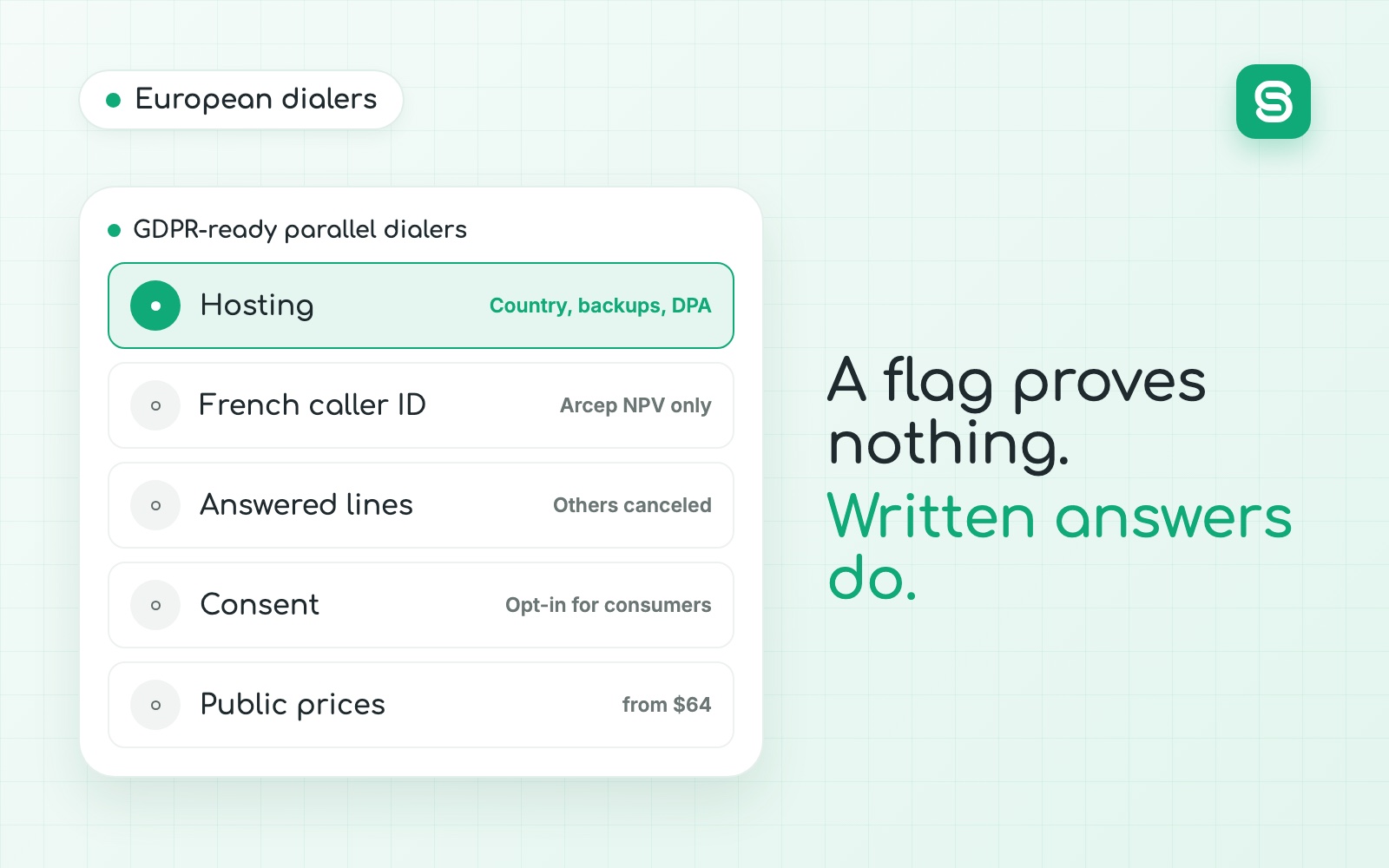
Most well-known parallel dialers were built in the US, for US numbers, US rules and US business hours. That works until your team starts calling Paris, Munich or Amsterdam. Then the questions change, and a “GDPR compliant” badge on a pricing page does not answer most of them.
What makes a parallel dialer “European”?
A parallel dialer dials several numbers at the same time for one rep and connects the rep to whoever answers first; the other calls stop. The mechanics are covered in our explainer on what a parallel dialer is. The question here is what “European” adds to that, because vendors use the word to mean three different things.
A tool can check the first box without the second, or the second without the third. When a vendor says “European” or “GDPR ready,” treat it as a lead to follow, not as evidence.
When a vendor says “GDPR ready,” treat it as a lead to follow, not as evidence.
So the choice between a European and a US dialer comes down to facts you can verify. The seven below are the ones that keep coming up when a team selling into Europe compares tools. The picker tells you which carry the most weight in your case.
Your situation: which criteria actually matter?
A four-rep US team adding German prospects and a two-rep French startup calling local SMBs do not share the same deal-breakers. Set the five options below: the criteria re-rank, tool families get sorted, and the vendor question list updates so you can copy it.
Your situation: which criteria matter, which tools stay
Five settings. The deciding criteria light up, tool families get sorted, and you leave with your questions for vendors.
You call
You mostly call
Your CRM
Reps on the phone
Data hosting
The criteria, from deciding to least useful for you
-
Data hostingImportant
Country of the servers for the app, backups, recordings and transcripts, and a data processing agreement (DPA) available before the trial. -
Subprocessors and transfersImportant
A published list of subprocessors (carrier, transcription, AI) and the legal basis for each transfer outside the EU. -
Caller ID shown in FranceImportant
In automated modes, French regulator Arcep bans ordinary 01 to 05, 06, 07 or 09 numbers: you need a “verified multipurpose number” (NPV). -
Local numbers per countryImportant
A number from the country you call, issued by the vendor, with the paperwork each country requires and whether calls are included. -
Abandoned and silent callsImportant
What happens to the other lines when a prospect picks up, and the delay between their “hello” and the moment the rep hears them. -
Consumers: consentImportant
In the US, the TCPA and the FTC Telemarketing Sales Rule apply to consumer calls; in France, calling a consumer has required prior consent since August 11, 2026. -
CRM syncImportant
What reaches the CRM after each call (outcome, recording, summary), in which direction, and whether you can test it on your own account. -
Seat minimums and contractImportant
Minimum number of seats, contract length, published price or quote only: what decides whether the tool is even within reach. -
Billing currency and VATImportant
Prices in dollars or euros, EU VAT, minutes, numbers and texts included: the real cost per rep per month. -
Support language and hoursImportant
Language of the interface, onboarding and support, and opening hours in your European and US time zones. -
Recording and transcriptionImportant
Notice to the prospect, adjustable retention, deletion of a recording or transcript on request.
Tool families, sorted for your situation
-
Parallel dialer from a European vendorCheck first
Example: Skipcall European hosting stated by these vendors, published prices. Get the hosting country and the caller ID shown in France confirmed in writing. -
Parallel mode as an add-on to cloud telephonyCheck first
Examples: CloudTalk, Ringover Convenient if you already run the phone system: parallel mode is a paid per-user add-on. -
Quote-only dialer for large teamsCheck first
Examples: Orum, Nooks Built for large teams. Pricing on request, often with a seat minimum. -
Power dialer, one line at a timeCheck first
Examples: Aircall Professional, Ringover Business Fewer conversations per hour, but nobody picks up to an empty line. Solid if volume stays modest. -
Contact center predictive dialerCheck first
Contact center software Dials more lines than there are free agents: abandoned calls by design. Not needed for B2B at this size.
Your questions for every vendor
Generated from your settings, from deciding to secondary. Send them in writing and keep the answers.
Questions before a parallel dialer trial

1. In which country are the application, backups, recordings and transcripts hosted? Can you send us your data processing agreement (DPA) before the trial?
2. Which subprocessors handle our data, in which countries, and on what legal basis is each transfer out of the European Union made?
3. For our parallel-mode calls into France, which number does the prospect see? Is it a verified multipurpose number (NPV) in a range reserved by Arcep?
4. In which countries do you issue numbers yourselves, with what paperwork, and are calls to those countries included in the subscription?
5. When a prospect answers, are the other lines canceled while ringing, or answered and then dropped? How long between their “hello” and the moment our rep hears them?
6. How do we keep contacts without recorded consent, or who opted out, off our call lists, and does that exclusion sync with our CRM?
7. With our CRM, what syncs after each call, in which direction, and can we test it on our own account during the trial?
8. What is the minimum number of seats, the contract length, and the price per seat for our team, calling included?
9. Which currency do you invoice in, how is EU VAT handled, and what does the per-seat price include: minutes, numbers, SMS, transcription?
10. In which languages and during which hours, in CET and US Eastern time, are support and onboarding available?
11. Can we set the retention period for recordings and transcripts, and delete them when a prospect asks?
Three patterns come up often. Small teams hit the seat minimum first: several US tools are out of reach before data even comes up. Teams calling several countries need to check local number coverage and the paperwork each country requires. And teams calling consumers have to look at consent before line count; our cold calling compliance checker helps frame that.
Does GDPR apply to a US team calling Europe?
It can, and you should plan as if it does. Article 3(2) of the GDPR extends the regulation to organizations outside the EU that process personal data of people in the EU when they offer them goods or services or monitor their behavior. A sales rep calling a named buyer in Lyon is processing that buyer’s personal data: name, number, job title, call outcome, and possibly a recording.
Two other parts of the text shape what you need from a dialer vendor. Article 28 requires a contract between you, the controller, and the vendor, the processor: that is the data processing agreement, or DPA. Chapter V (Articles 44 to 49) governs transfers outside the EU, which need an adequacy decision, standard contractual clauses or another safeguard the text provides. The full regulation on EUR-Lex is the reference; we read it on November 13, 2026.
For the US, the European Commission adopted an adequacy decision for the EU-US Data Privacy Framework on July 10, 2023: personal data can flow to US companies that participate in it, according to the Commission’s page on EU-US data transfers, read on November 13, 2026. A US vendor is not ruled out by default. It simply has to tell you, in writing, on what basis it receives your data.
Where is a dialer’s data hosted, and why it is the first question to ask
The answer you want fits in one written sentence: “the app, backups, recordings and transcripts are hosted in this country, with this provider, and here is our DPA.” If a vendor cannot write that sentence, the rest of the comparison matters less.
A dialer holds more personal data than it seems. For every call it stores the number, name, company, time, length and outcome. If it records, it stores the prospect’s voice. If it transcribes and summarizes, it stores the text of the conversation, often after passing it through a third-party speech or AI service.
| Data | Where it can travel | What to ask |
|---|---|---|
| Contacts and call history | App database and its backups | Country of servers and backups |
| Recordings | The carrier's storage, sometimes separate from the app | Storage country and adjustable retention |
| Transcripts and summaries | Third-party speech or AI service | Subprocessor name, country, transfer basis |
| Synced activity | Your CRM and its own servers | What leaves for the CRM, and in which direction |
”Hosted in Europe” does not mean “no transfers”
A vendor can host its database in Paris and still send recordings to a US carrier, or transcripts to an AI provider outside the EU. That is not unlawful: it is a transfer, which has to be documented in the subprocessor list and covered by a mechanism. The problem is not knowing about it.
What Skipcall publishes on this

We appear in the vendor list below, so here is what we publish, to give you a yardstick for other answers. The application and customer data (contacts, calls, recordings, transcripts) are hosted in the European Union, at Scaleway in Paris, with backups replicated in Amsterdam; recordings are stored on Twilio’s European servers. A data processing agreement is available and the subprocessor list is published with its transfer safeguards. Recording, retention and deletion settings follow your internal policy. That is the level of detail to expect from every vendor, us included.
Recording notice rules differ by country and by US state; our guide to call recording laws for businesses covers them.
Which caller ID can a parallel dialer show in France?
A verified multipurpose number, and nothing else, whenever the tool dials automatically. This is the check US-built tools most often miss, because nothing like it exists in the US.
Since January 1, 2023, Arcep, France’s telecom regulator, has prohibited ordinary numbers starting with 01 to 05, 06, 07 and 09 on calls placed by automated systems, with limited exceptions. Cell numbers (06 and 07) are reserved for person-to-person communication. For automated calling, Arcep created a separate category: verified multipurpose numbers, or NPVs, in twelve ranges.
All three come from Arcep’s guide to the numbering plan for businesses, read on November 13, 2026.
Why a parallel dialer counts as “automated”
The same Arcep guide says what does not count as an automated system: calls placed “with no possible parallelization and on the explicit command of a human for each call.” A preview tool, where the rep clicks to launch every call, can stay outside the scope. A parallel dialer parallelizes by definition, so it falls inside, along with progressive and predictive dialers.
Ask the question plainly and in writing. A good answer names a range, such as a number starting with 09 48 or 01 62. A vague one (“your local number,” “any number you buy”) deserves a follow-up.
The caller ID question, asked of a vendor (exchange written for this article)
When we call France in parallel mode, what number does the prospect see?
Whatever you choose. You can buy a Paris 01 number or a French cell number.
In automated mode, Arcep limits caller ID to verified multipurpose numbers. Do you provide those?
Let me check with the product team and get back to you.
Thanks. Could you put it in writing, with the range you use?
In Skipcall, power and parallel modes display a verified multipurpose number on calls into France. Other countries have their own numbering plans and paperwork for local numbers; our guide to cold calling laws by country gives the framework market by market.
A parallel dialer parallelizes by definition, so it counts as an automated calling system in France.
For reference, Skipcall’s base offer issues a number and includes calling in 23 countries, 17 of them in Europe (France, Belgium, Switzerland, Luxembourg, Germany, Austria, the Netherlands, the UK, Ireland, Spain, Portugal, Italy, Denmark, Sweden, Finland, Estonia and Romania), plus the US and Canada.
Abandoned calls: why parallel is not predictive
A well-built parallel dialer only dials for a rep who is free. When a prospect answers, it cancels the other lines while they are still ringing, so those prospects see a missed call. A predictive dialer answers calls for which no agent is free. One rare case is worth raising in every vendor demo: two people answering in the same second, covered in our 25 questions to ask before choosing a parallel dialer. With Skipcall, the connection happens with no lag; as soon as one contact answers, the other calls are stopped automatically and show up on their end as a missed call they can return.
The difference is arithmetic. A predictive dialer dials more numbers than there are available agents, betting on an average answer rate; when too many people pick up, some hear nothing. A parallel dialer dials several numbers for a rep who is already free, and drops the rest as soon as one person answers.
| Mode | Lines per rep | What the prospect gets | Risk |
|---|---|---|---|
| Power dialer | One at a time | A normal call | No answered call without a rep |
| Parallel dialer | Several, for a free rep | A normal call, or a missed call if someone else answered | Connection delay to watch |
| Predictive dialer | More lines than free agents | Sometimes silence, then a hang-up | Abandoned calls by design |
In the US the line is drawn precisely. Under 47 CFR 64.1200(a)(7), a telemarketer may not abandon more than 3 percent of calls answered live by a person, measured over 30 days per campaign, and a call is abandoned if it is not connected to a live sales rep within two seconds of the called person’s completed greeting. We read the rule on November 13, 2026. Recent TCPA changes are covered in our post on TCPA rule changes in November 2026.
What to actually test: the connection delay
Even without abandoned calls, a parallel dialer can leave a beat of dead air between the prospect’s “hello” and the moment the rep hears it. That beat triggers hang-ups and gives away the automated call. We wrote a full piece on dead air on cold calls; before you pick a tool, have it call you and time it. With Skipcall, the connection happens with no lag: the rep hears the prospect from their first “hello.”
Line count matters too. The more lines a tool dials at once, the faster it burns through your list for each conversation. Our post on how many lines a parallel dialer should use explains why a moderate number protects the list.
Those figures describe one team and one market, not an industry average; the details are in our cold calling statistics.
Consent and opt-outs: B2B versus consumers
For business prospects in France, cold calling remains allowed without prior consent, with notice and an easy way to object. For consumers, France switched to opt-in on August 11, 2026.
Sources: the CNIL’s page on phone prospecting and Decree No. 2026-662 of July 23, 2026, both in French, read on November 13, 2026. US consumer calls stay governed by the TCPA and the FTC’s Telemarketing Sales Rule.
The dialer does not change these rules, but it can help or get in the way. It helps if a “do not call me again” logged by a rep is excluded everywhere and synced to the CRM. It gets in the way if it redials a list without seeing opt-outs captured elsewhere. Ask how an opt-out propagates.
Support hours, billing currency and seat minimums
These look minor on a comparison grid. They are often what decides, because they rule tools out before the trial starts.
The full picture, minutes and numbers included, is in our breakdown of how much a dialer costs. Our own plans are on the pricing page.
These look minor on a comparison grid. They are often what decides, because they rule tools out before the trial starts.
CRM sync: test it, don’t just read it
An integration listed on a website is not an integration that works for your team. What matters is what lands on the contact record after each call, how fast, and in which direction.
- 01
Import a real list from your CRM.
Twenty contacts is enough. Check that direct dials, cell numbers and time zones land in the right fields. - 02
Make ten real calls.
With mixed outcomes: conversation, voicemail, wrong number, callback requested. - 03
Open the records in the CRM.
Are the outcome, duration, recording, transcript or summary there? In what form, and how long after the call? - 04
Change a record in the CRM.
Update a number or log an opt-out. Does the dialer see it before the next call?
There are two ways to tie calling to a CRM: call from inside the CRM, or call from a dialer that updates the CRM afterward. Both have strengths, laid out in our comparison of CRM calling vs a dedicated dialer. Skipcall takes the second route: you call from Skipcall, and the record is then updated in HubSpot, Pipedrive, Salesforce or Attio.
Seven vendors side by side, with public prices
This is not a ranking. For each vendor, it records what its official pages said on November 13, 2026: dialing modes, the public price or “quote only,” the seat minimum, and what is stated about hosting. We are on the list, and we flag it.
The French vendor with a parallel mode
 Skipcall
- Vendor
- French company
- Dialing
- Power dialer and parallel dialer up to 4 lines, AI voicemail detection
- Public price
- From $70 per seat per month (Starter, parallel included), no seat minimum
- Hosting
- European Union (Scaleway, Paris), DPA and subprocessors published
Cloud phone systems that add parallel mode (or don’t)
 CloudTalk
- Vendor
- Offices in Europe and North America, including Bratislava, Prague, Munich, Toronto and New York
- Dialing
- Parallel add-on: up to 5 contacts at once per rep, up to 10 on request
- Public price
- Parallel add-on $39 per user per month billed annually, on top of any plan
- Hosting
- GDPR, ISO 27001 and SOC 2 badges; region not stated on the pricing page
 Ringover
- Vendor
- French company
- Dialing
- Power Dialer in Business; Parallel Dialer add-on (two calls at once), available in the US, Spain and the UK per its help center
- Public price
- Business $49 per user per month, 12-month commitment, 3 users minimum
- For France
- France is not among the countries where the parallel add-on is available
 Aircall
- Vendor
- Founded in Paris in 2014
- Dialing
- Power Dialer on Professional: up to 1,000 numbers dialed in sequence
- Public price
- Essentials $30, Professional $50 per license per month billed annually, 3 licenses minimum
- Parallel mode
- No parallel dialer described: the page lists "parallel calls" on every plan without saying they mean dialing several numbers for one rep
Sources: CloudTalk’s parallel dialer page, Ringover’s pricing, Ringover’s legal notice (in French), Ringover’s help article on the Parallel Dialer and Aircall’s pricing and its about page (in French), read on November 13, 2026. Detailed comparisons: Skipcall vs CloudTalk, Skipcall vs Ringover, and our page on Aircall alternatives for outbound sales teams.
Quote-only dialers
 Orum
- Vendor
- Orum Inc., per its terms of service
- Dialing
- Parallel Dialer included, up to 10 caller IDs per month
- Public price
- Quote only, 9-seat minimum
- For a small team
- Out of reach below nine reps
 Nooks
- Vendor
- Nooks Communications, Inc., San Francisco, per its terms
- Dialing
- Parallel, multi-line and power dialing, automated number rotation
- Public price
- Not published on its pricing page
- Ask about
- Hosting region, European numbers, seat minimum
 JustCall
- Vendor
- Cloud phone vendor, prices listed in dollars
- Dialing
- SalesPro plan: predictive dialer up to 10 lines, power and dynamic dialers
- Public price
- Team $29, Pro $49, Pro Plus $89 per user (annual); SalesPro quote only, 2 licenses minimum
- Ask about
- Whether multi-line is predictive or parallel, and caller ID in France
Sources: Orum’s pricing, Nooks’ pricing and terms, and JustCall’s pricing, read on November 13, 2026. Comparisons: Skipcall vs Orum and Nooks alternatives.
| Vendor | Parallel lines | Public price | Seat minimum |
|---|---|---|---|
| Skipcall | Up to 4 | From $70 | None |
| CloudTalk | 5, up to 10 on request | $25 + $39 add-on | 1 (3 on Expert) |
| Ringover | 2, France not listed | $49 + add-on | 3 |
| Aircall | Not described | $50 (power dialer) | 3 |
| Orum | Included, count not stated | Quote only | 9 |
| Nooks | Presented, count not stated | Not published | Not stated |
| JustCall SalesPro | Predictive up to 10 | Quote only | 2 |
Monthly price per seat, annual billing where the vendor distinguishes the two. For a feature-first comparison, see our roundup of the best parallel dialers, or take the which dialer quiz.
When a US dialer is still the right call
A US tool remains a sound choice when your team is large, most of your calls go to North America, and the vendor has answered the data questions in writing. Switching tools over a flag makes no sense.
Many US teams end up with one dialer per market, not because the law demands it, but because their US tool lacks European numbers or a French NPV. Before splitting your stack, check whether one tool can cover both with local numbers in every country you call.
How to run a two-week trial across two markets
A demo shows the tool at its best. A pilot on your own lists shows what it will do for you. Two weeks are enough if the protocol is fixed in advance.
- 01
Fix the lists and the time slots.
Split one list into comparable halves per market, same reps, same local business hours. Otherwise you are comparing lists, not tools. - 02
Week 1: your current tool.
Log conversations per hour (over 30 seconds), meetings booked, and actual talk time. - 03
Week 2: the new tool.
Same metrics. Add the connection delay, timed on a few calls to a colleague. - 04
Check caller ID in each country.
Have a colleague in France receive a parallel-mode call. Is the number an NPV? What happens when they call it back? - 05
Open the CRM.
Ten random records: outcome, recording, summary. What is missing during the pilot will be missing afterward.
Time zones shape the pilot more than US teams expect. Paris is usually six hours ahead of New York and nine ahead of San Francisco, so a West Coast rep calling French buyers during their morning starts before dawn. Most teams solve this with a small pod working European hours, or by calling Europe early in the US morning and North America after lunch. Whatever you choose, run both tools in the same slots: an answer rate measured at 4 p.m. Paris time and one measured at 10 a.m. are not the same number. Keep the pilot’s lists separate by country too, because number formats, caller ID and the share of direct dials differ from one market to the next, and a blended result hides where the tool actually works.
Do not measure dials: a tool that runs more lines inflates that number without saying anything about meetings. The detailed questions to put to each vendor during the pilot are in our parallel dialer buyer questions; the picker above already generates the list for your situation.
Mistakes to avoid
A vendor scorecard to copy
Paste this into a spreadsheet, one column per vendor. Fill it only with written answers: a verbal “yes” in a demo does not count.
Where Skipcall fits, factually
Skipcall is a French company that builds phone prospecting software. Its parallel dialer dials up to four lines and screens out voicemail with AI; its power dialer dials one line at a time. Calls are recorded, transcribed and summarized by AI, sequences chain calls and texts, and activity syncs with HubSpot, Pipedrive, Salesforce and Attio. Data is hosted in the European Union, and automated modes display a verified multipurpose number on calls into France.
What Skipcall does not do, so the comparison is complete: no contact database for sale (enrichment works on contacts you already own), no inbound routing or call queues, no automatic number rotation, no calling from inside the CRM record. If one of those is a deal-breaker, another tool on this list will suit you better.
For the full method, from list to meeting, our cold calling guide walks through every step.
Key takeaways
- “European” can mean three things: where the vendor is based, where data is hosted, and whether the tool is built for European calling. Only the second really matters for GDPR.
- GDPR can apply to a US team calling Europe. Get the DPA and the subprocessor list before the trial. A transfer out of the EU is allowed when it is covered and documented.
- In France, a parallel dialer must display a verified multipurpose number, from one of Arcep’s twelve ranges. An ordinary 01 or 06 number does not qualify in automated mode.
- Parallel is not predictive: the other lines are canceled while ringing. Time the connection delay of every tool you test.
- Since August 11, 2026, French consumers can only be called with prior consent; B2B calls need notice and an easy opt-out.
- In this review, public prices for parallel dialing start at $64 to $70 per seat per month; several US tools are quote-only with seat minimums.
- Pilot for two weeks on your own lists, in each market, and measure conversations and meetings, not dials.




