“Hello?” Then nothing. One second, maybe two. The prospect says “Hello?” again, sharper this time, and either your voice finally shows up or they are already gone. Dead air is the first question sales leaders ask when they look at a parallel dialer, and it is the right question: it costs conversations, and it teaches prospects to stop picking up your number.
This guide answers it straight. Where the silence comes from, link by link. What the FCC, the FTC and the UK regulator say about it. How to measure it yourself instead of taking a vendor’s word for it, ours included. How to shrink it. And what to say in the first second when it has already happened.
What is dead air on a cold call?
Dead air is the silence the prospect hears between their own “Hello?” and the rep’s first syllable. It does not start when the phone rings or when the rep clicks dial. It starts when the prospect has finished speaking and is waiting for an answer.
That starting point matters because three very different delays get lumped together. The first happens before the pickup: the time from dial to first ring. The prospect never hears it; only the rep gets impatient. The second is dead air itself, after the pickup. The third is the call where nobody ever comes on.
In US rules the key term is the “abandoned” call: one that is not connected to a live rep within two seconds. The UK’s Ofcom splits it in two: a “silent call” when the person hears nothing at all, and an “abandoned call” when an information message plays instead of an agent. In this guide, “dead air” means the silence before the rep speaks, and “silent call” means the rep never does.
It starts when the prospect has finished speaking and is waiting for an answer.
Why does a two-second pause feel so long?
Because human conversation runs on a timing of a few hundred milliseconds, and a phone call gives the listener nothing but sound.
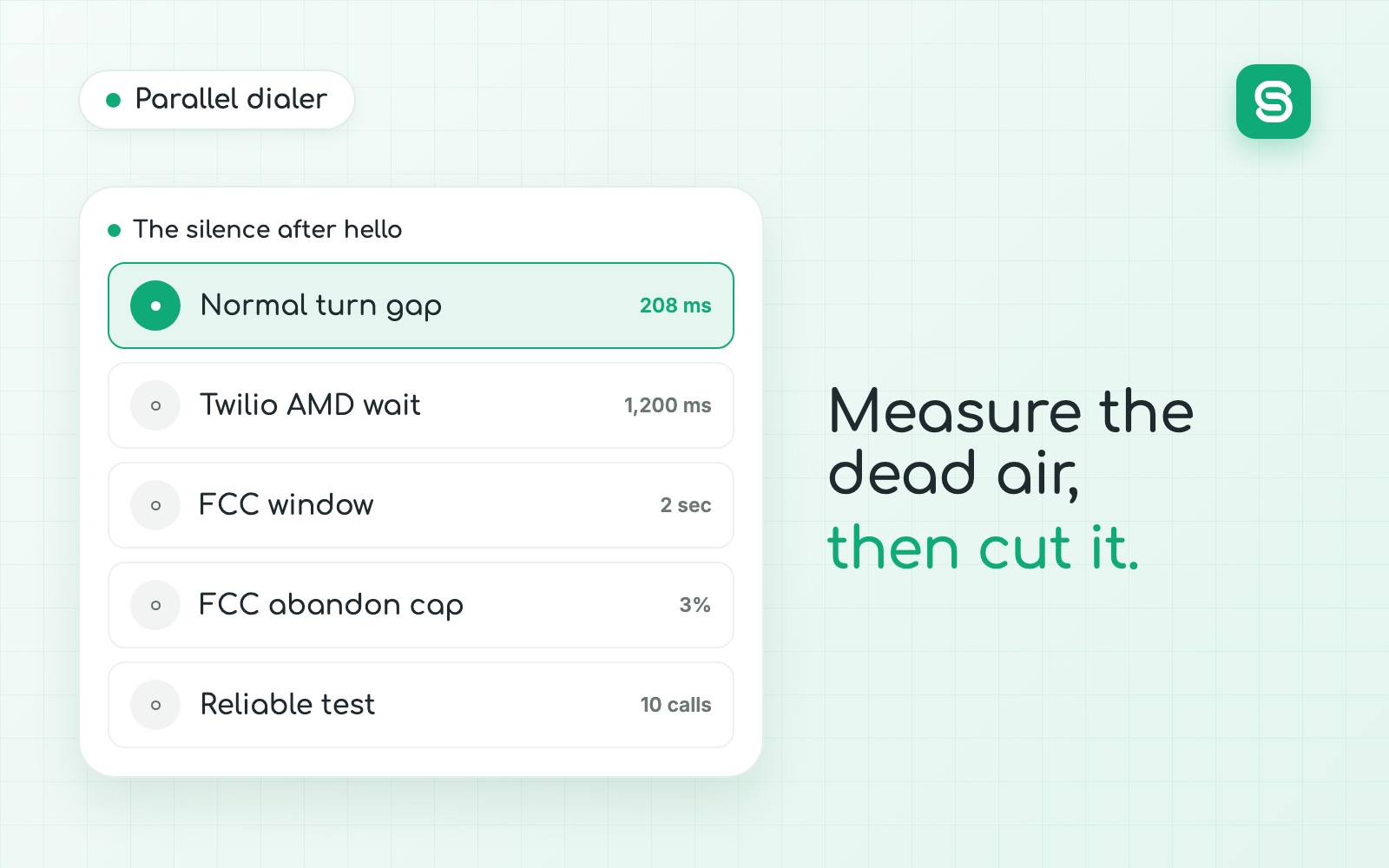
The reference study was published in 2009 in the Proceedings of the National Academy of Sciences by Tanya Stivers and ten co-authors at the Max Planck Institute for Psycholinguistics. They timed answers to questions in ten languages, from Japanese to Danish. Every language showed the same pattern: speakers avoid overlap and keep silence between turns to a minimum. The mean gap was 208 milliseconds, and each language’s mean fell within about 250 milliseconds of it (viewed November 13, 2026).
Put that next to a sales call: one second of dead air is roughly five times the normal gap in conversation. The prospect does not time it. They feel it: something is off.
Three things make that silence costlier on the phone than in person.
The UK regulator says it bluntly: Ofcom treats silent calls as more harmful than abandoned calls with a message, partly because recipients may find them threatening or malicious. Dead air is not a silent call, since your voice does arrive. But while it lasts, the prospect cannot tell the difference.
There is a delayed cost too. A prospect who hung up on silence learned something about your number. Next time it shows up on their screen, they hesitate. That is one of the ways a list wears out without anyone saying a rude word, which we cover in our article on the burned prospect list.
Dead air hands them a reason to hang up before you have said a word.
Where does dead air come from?
Dead air does not have one cause. It has four, and they add up. Knowing them tells you who to talk to: the vendor, IT, the sales manager, or the rep.
- 01
The answering machine detection wait.
To know whether a human or a voicemail picked up, the software listens to the start of the call. It decides “human” when it hears short speech followed by silence. It has to wait for that silence: that is the first link, and often the longest. - 02
The handoff to the rep.
Once the verdict is in, the prospect’s call has to be bridged to the rep’s seat. Depending on how the tool is built, that connection goes through one or more technical layers, at the vendor or at a carrier. - 03
The network.
The rep’s voice has to cross the internet, the carrier and the prospect’s cellular network. Busy Wi-Fi, a VPN, a wireless headset: every detour adds delay. - 04
The rep.
They hear the connect tone, read the contact’s name, open their mouth. If the mic is muted or they are still typing notes from the last call, this link can outlast all the others.
The timeline below puts them end to end. Pick how the prospect answers, set each link, then hit “Play the scene”: the timeline runs in real time, so you feel the gap instead of reading it.
The pickup timeline, millisecond by millisecond
Set each link in the chain and see what the prospect hears between their “Hello?” and your first syllable.
Dialing mode
The prospect picks up and says
Without detection, you hear the ringing and the “Hello?” yourself: no verdict to wait for, no handoff.
Your voice arrives more than 2 seconds after the prospect started speaking. In the UK, that is the window Ofcom gives the information message on an abandoned call when detection is used.
- Prospect speaks
- Detection wait
- Handoff
- Reaction
- Network
- Your voice reaches them
- Line dropped
- 2 s after speech starts (Ofcom)
- 2 s after the greeting ends (FCC, FTC)
What answering machine detection does during the silence
Detection listens and keeps time. Twilio, one of the main programmable voice providers, documents its defaults: speech that lasts longer than 2,400 milliseconds tips the verdict toward a machine, and 1,200 milliseconds of silence after speech is needed before the speech counts as finished (Twilio answering machine detection docs, viewed November 13, 2026). The same documentation notes that in synchronous mode, the call is blocked until detection completes.
In other words, with those settings, a prospect who says “Hello?” and stops talking is only recognized as human after at least a second of silence. That is not a flaw in Twilio; it is how any detection that listens works. You can shorten the wait, at the price of more mistakes. How detection works, where it fails and how to tune it is in our guide to answering machine detection.
The business greeting trap
“Hello?” takes under a second. “Durand Logistics, this is Mark Miller speaking” often runs past two seconds without a pause. To an engine that times speech, that is what a voicemail greeting looks like. With the defaults above, that greeting can be classified as a machine and the line dropped.
For Mark, that is a silent call: he answered, introduced himself, and got hung up on. Ofcom names exactly this mechanism, saying detection can generate silent calls by mistaking a person for an answering machine and disconnecting. Try the third greeting in the timeline: the dead air becomes infinite.
That is one more reason to point a parallel dialer at direct dials and cell phones rather than main lines. Our article on direct dial vs. mobile vs. switchboard also shows the pickup gap between those number types.
The double pickup
A parallel dialer calls several numbers for one rep. If two people answer within the same second, only one can be served. What the second one hears depends on the tool: silence then a hang-up, a message, or a hold. It is rare on a list with a low answer rate, more frequent when the list answers well and the line count is high. With Skipcall, the connection happens with no lag; as soon as one contact answers, the other calls are stopped automatically and show up on their end as a missed call they can return.
That is a concrete reason not to push the number of lines past what your list justifies. Our guide on how many lines a parallel dialer should run gives the method to set it from your answer rate.
The network and the headset
The network adds less than people think, unless it is bad. ITU-T Recommendation G.114, as summarized by Cisco, rates one-way delay of 0 to 150 milliseconds as acceptable for most user applications, and above 400 milliseconds as unacceptable for general network planning (Cisco, Understanding Delay in Packet Voice Networks, viewed November 13, 2026). On a good connection, the network weighs less than detection. On hotel Wi-Fi or behind a VPN, it can catch up with the other links.
To check yours in a minute, our free VoIP speed test measures latency, jitter and packet loss from your browser. The causes and fixes for each symptom are in our guide to VoIP call quality problems.
On a good connection, the network weighs less than detection.
Do parallel dialers cause dead air?
Not necessarily, but they create the risk, and it is worth saying plainly. As soon as a tool dials several numbers for one rep, it has to figure out who picked up before connecting. That takes time. The real question is not “is there dead air?” but “how many milliseconds, and can we cut them?”
The table compares the four ways to dial on that one dimension.
| Mode | Where dead air can come from | What keeps it down |
|---|---|---|
| Manual dialing | Network and rep reaction; the rep hears the ring and the "Hello?" | Nothing to detect: the rep is already on the line. |
| Power dialer One call at a time | Same links as manual, if the rep listens to the call. | The rep speaks on "Hello?", just like dialing by hand. |
| Parallel dialer Several numbers for one rep | Detection wait, handoff, network, reaction. A double pickup is possible. | Dialing only when the rep is free, fast detection, a short handoff, a line count that fits the list. |
| Predictive dialer More calls than reps | Every parallel link, plus calls placed with no rep free. | Abandonment rate tracked continuously, as the FCC and FTC 3% cap requires. |
The decisive difference between parallel and predictive is the last row. A predictive dialer places more calls than it has free reps, betting on the answer rate: when the bet is wrong, the prospect picks up and nobody comes. A parallel dialer only dials for a rep who is already available. The full comparison is in parallel dialer vs. predictive dialer.
So two parallel tools can produce very different gaps depending on how they detect and connect. The only honest answer to “does your dialer have dead air?” is a measurement, done by you, on your lines.
What dead air does not change
Well-controlled dead air does not lower your answer rate: prospects pick up before they hear it. What it can lower is the share of pickups that turn into conversations and, over time, the prospect’s willingness to answer your number again. Measure the two separately: pickups per dial, then conversations per pickup.
Dead air also does not explain a bad list or a weak opener. A prospect who hangs up at your third sentence did not hang up because of dead air. Before you blame the dialer, look at when calls end: in the first two seconds, or later.
What do the FCC and FTC rules say about abandoned calls?
Two federal rules put numbers on what happens after the pickup: the FCC’s TCPA rules and the FTC’s Telemarketing Sales Rule. They line up on the 2 seconds and the 3%, and differ on scope. What follows summarizes the texts as read on November 13, 2026; it is not legal advice.
| Rule | Time window | Abandonment cap | What else it requires |
|---|---|---|---|
| FCC (TCPA rules) 47 CFR 64.1200(a)(6) and (a)(7) | 2 sec after the completed greeting | 3% of calls answered live, per campaign, per 30 days | Prerecorded ID and opt-out message, 15 seconds or 4 rings before hanging up an unanswered call, compliance records |
| FTC (Telemarketing Sales Rule) 16 CFR 310.4(b)(1)(iv) and (b)(4) | 2 sec after the greeting | 3% per campaign or per 30-day period | Same ring and message conditions for the safe harbor; most business-to-business calls exempt |
| UK (Ofcom) Policy statement of December 20, 2016, in force since March 1, 2017 | 2 sec after speech starts when detection is used, otherwise after pickup | No tolerated rate; daily rate used to prioritize cases | Information message with no marketing, at least 15 seconds of ringing, 6 months of records; a repeat offending call within 72 hours without a guaranteed live agent is aggravating |
The FCC rule: 2 seconds and 3%
The FCC rule fits in one sentence: a call is “abandoned” if it is not connected to a live sales representative within two seconds of the called person’s completed greeting. Sellers and telemarketers may not abandon more than 3% of telemarketing calls answered live by a person, measured over a 30-day period for a single calling campaign (47 CFR 64.1200(a)(7), viewed November 13, 2026). If a campaign runs longer, the rate is calculated separately for each 30-day period.
When no live rep is available, within those same two seconds the caller must play a prerecorded message that says the call was for telemarketing purposes, names the business, and gives a number the person can call during business hours to make a do-not-call request. That message can come with an automated opt-out mechanism. The seller or telemarketer must keep records proving compliance.
That last line deserves attention from anyone running a parallel dialer into the US. Under paragraph (a)(6), no person or entity may “disconnect an unanswered telemarketing call prior to at least 15 seconds or four (4) rings.” A parallel dialer that drops the other lines as soon as someone answers may end calls that are still ringing. We are not offering a reading of how the rule applies to that case: if you place telemarketing calls to US numbers, have your counsel review your setup.
The FTC rule: the same numbers, a narrower scope
The FTC’s Telemarketing Sales Rule mirrors the FCC: a call is abandoned if the telemarketer does not connect it to a sales rep within two seconds of the person’s completed greeting. The safe harbor requires technology that keeps abandonment at 3% or less of calls answered by a person, measured per campaign or per 30-day period; at least 15 seconds or four rings before hanging up an unanswered call; a prompt recorded message with the seller’s name and phone number when no rep is free; and records (16 CFR 310.4, viewed November 13, 2026).
The big difference for B2B teams is scope. The TSR exempts most calls between a telemarketer and a business (16 CFR 310.6(b)(7)), with a few exceptions such as the retail sale of nondurable office or cleaning supplies. The FCC rules have their own scope and their own nuances for business lines and cell phones, and state laws add more. For the broader picture, see is cold calling legal and our breakdown of the TCPA changes taking effect November 25, 2026.
How the UK compares: no tolerated rate
If you also call into the UK, the bar is stricter. Ofcom acts under the “persistent misuse” powers of the Communications Act 2003, with penalties of up to £2 million. Its policy statement of December 20, 2016, in force since March 1, 2017, separates silent calls (the person hears nothing, is cut off on pickup, or hears background noise not aimed at them) from abandoned calls with an information message, and calls silent calls its top priority (Ofcom, Persistent Misuse policy statement, archived copy viewed November 13, 2026, since Ofcom’s site blocks automated access; we found no more recent version).
Three points bear directly on dead air. When the message depends on technology recognizing a voice, it should play no later than two seconds after the person begins to speak, not after the greeting ends as in the US. Answering machine detection is named as a cause of silent calls. And Ofcom says it cannot create a safe harbor: the old 3% figure was a prioritization criterion, not a tolerated rate.
Ofcom counts the 2 seconds from when the person begins to speak, not from the end of the greeting.
How do you measure dead air on your own calls?
With three teammates, a second phone and twenty minutes. It is the only measurement worth having, because it includes your lines, your network, your headsets and your reps.
Recruit three or four teammates
Each one lends their personal cell phone, on their own carrier. Add their numbers to a small test list in your dialer. Different carriers mean different networks, which gets the test closer to real life.
Record on the prospect's side
The teammate who answers puts the phone on speaker next to a second device recording the room. Your dialer’s call recording is not enough: depending on the tool, it may only start at the connection and so never contain the gap.
Play it like a real call
The teammate answers, says “Hello?” once and stops. The rep talks as soon as they are on, as on a live call. Ten calls per setup: same line count, same network, same headset.
Read the waveform
Open the recording in a free audio editor such as Audacity. The waveform shows two blocks: the “Hello?” and your voice. The flat stretch between them is the dead air. Note the end of the first block and the start of the second.
Keep the median, change one setting
The median of ten values holds up better than an average that one bad call can skew. Then change a single setting (lines, network, headset) and run it again. Change two, and you will not know which one mattered.
Use the sheet below. Copy the blank version, paste it into a spreadsheet, and fill in one row per call.
The dead air measurement sheet
One row per test call. Ten calls per setup, then take the median of the last column.
How to read it: across these three calls on the first setup, the median gap is 2.13 s. The next round (call 11) changes a single setting: the network.
Example written for this article: setups and timings are fictional. Replace them with your own measurements.
Call	Date	Line called (teammate)	Mode (lines)	Network (Ethernet / Wi-Fi / cellular)	Headset	End of “Hello” (s)	Rep first syllable (s)	Gap (s)	Prospect said “Hello?” again (yes / no)	Note
1
2
3
4
5
6
7
8
9
10
Median
Two columns are worth more than the timings. “Prospect said Hello? again” tells you whether the gap was noticed, which a waveform cannot. And the setup column points to the guilty link as soon as the median moves between rounds.
To track the problem after the test, pull the answered calls that lasted under three seconds from your call history. Many of them are prospects who hung up before hearing anyone, or right after. Their share of all pickups is your day-to-day dead air indicator.
How do you reduce dead air?
Go after the longest link, then the next one. Each fix has a different owner, and some have a price.
Two fixes come with a warning. Turning detection off removes its wait, but your reps then hear every voicemail, which defeats the point of parallel dialing. And dropping to one line is a power dialer. That is not a failure: on a highly qualified list it is sometimes the right call, as our parallel dialing best practices explain.
A dialer that only dials when the rep is free cannot tell whether they are ready.
Protect your numbers from silent pickups
A call where the prospect answers and hears nobody leaves a mark: a missed call they will not return, sometimes a spam report. Repeated, those calls drag down the number’s reputation until the prospect’s phone shows “Spam Likely.” Causes and fixes are in our guide to a caller ID marked as spam.
What should you say in the first second after dead air?
Your name, theirs and your company in one sentence, with no question about the line. The prospect is wondering whether a machine called them. The only good answer is a sentence no machine would say.
Compare two openings after the same second and a half of silence.
The recovery that makes it worse
Hello? … Hello?
Yeah, hi, can you hear me?
Yes. Who is this?
So, let me introduce myself, I'm Jason with Ternary, and the reason I'm calling is we help companies like yours to…
Not interested, thanks.
Three mistakes in two lines. “Can you hear me?” confirms that something was wrong and makes the prospect do the work. “Let me introduce myself” sounds read off a script. And the reason for the call arrives after a generic phrase. The prospect got three chances to decide this was a call center.
The recovery that proves a human is there
Hello? … Hello?
Hi Mark, Jason Reed with Ternary. Sorry for the second of silence, that was me getting on.
Oh. Okay?
I'm calling because you opened a second warehouse in Columbus in September, and I had a question about how your reps split coverage between the two. Got thirty seconds?
Thirty seconds, sure.
Saying the prospect’s first name first is what reassures fastest: a robocall dialing at random does not know it. Owning the gap in half a sentence defuses the suspicion instead of ignoring it. And the reason for the call is specific. Both dialogues are examples written for this article.
What to say depending on what they said during the gap
Prospects do not always sit silent through dead air. What they say tells you what they think, and so what your first sentence has to fix.
| What the prospect says | What they think | Your first sentence |
|---|---|---|
| "Hello? … Hello?" | The line is dead, or it is a robot. | "Hi Mark, Jason Reed with Ternary. Sorry for the second of silence, that was me." |
| "Is anyone there?" | About to hang up. | "Yes, hi Mark, Jason Reed with Ternary. I'm calling for a specific reason." |
| "Is this a robocall?" | Recognized an auto-dialer. | "No, it's really me, Jason, a human who was a beat late. I'm calling because…" |
| "Ugh, another call center…" | Filed you under mass telemarketing. | "Fair. I'm not calling at random: you opened a warehouse in Columbus in September." |
| A pause, then "Yes?" | Waiting, not hostile. | No apology: "Hi Mark, Jason Reed with Ternary. I'm calling because…" |
| "Who is this?" | Wants an identity first. | Name, company, reason, in that order and in one sentence. |
Only apologize for the gap if it was long or noticed. After a short pause and a neutral “Yes?”, an apology draws attention to a problem the prospect had not spotted.
Write the line before the session
The first sentence on a parallel call cannot be improvised: you do not know who will answer until the name pops up. Write an opener that works for any contact on the list, with a slot for the first name and one for the reason. Our parallel dialer script starts from exactly that shift: the prospect spoke first, so your sentence has to pick up a conversation already under way. For what comes next, our cold call openers give tested wording.
After the first sentence, give the prospect room. A rep who felt the gap tends to fill it by talking fast and long. Do the opposite: a short question, then silence on your end. Our article on the talk-to-listen ratio covers the habits. And if the answer is a flat “not interested,” our guide to the not interested objection takes over.
Mistakes to avoid
The volume you gain is lost at the pickup.
Where the tool helps, and where it replaces nothing
No tool replaces the measurement. A tool can, however, be built so the links it controls stay short, and so it only dials when a rep is free.
Skipcall’s parallel dialer dials up to four numbers at once, and only when a rep is free to take the call. AI screens out voicemail greetings, with a stated 95% accuracy, along with invalid numbers and automated switchboards. The engine that hands the call to the rep was built in-house rather than bought as a carrier component, so the connection happens with no lag. As soon as one contact answers, the other calls are stopped automatically and show up on their end as a missed call they can return. For lists where every pickup counts, or for main lines, the power dialer dials one number at a time, so you hear the ring and the “Hello?” yourself. Both modes record and transcribe calls (recording and transcription), so you can replay your reps’ first sentence.
The measurement method in this guide applies to Skipcall like any other dialer. Run it on your first calls: you can start with a single license and no commitment, or book a demo first. The Starter plan, which includes the parallel dialer, starts at $70 per month per license; details are on our pricing page.
Before you choose, three more reads: how much a dialer costs, calling from your CRM vs. a dedicated dialer, and, if you also sell into Europe, our overview of European parallel dialers. For the whole method, from list to meeting, our cold calling guide walks through every step.
What to remember
- Dead air starts when the prospect stops talking, not when the phone rings. The dial-to-ring delay costs the prospect nothing.
- Four links add up: detection wait, handoff, network, rep reaction. Detection is usually the longest.
- Conversation leaves about 200 ms between turns. A full second of silence on the phone always registers.
- Regulators count in seconds: under FCC and FTC rules, 2 seconds after the completed greeting with a 3% abandonment cap per campaign over 30 days; in the UK, 2 seconds after speech begins when detection is used, with no tolerated rate.
- Parallel dialing creates the risk, not the outcome. Measure dead air with ten test calls per setup and keep the median.
- Fix the longest link first: detection tuning, line count, wired network, headset, rep readiness, no main lines on parallel.
- The first sentence recovers the rest: their first name, yours, your company, the reason. Never “Can you hear me?”




