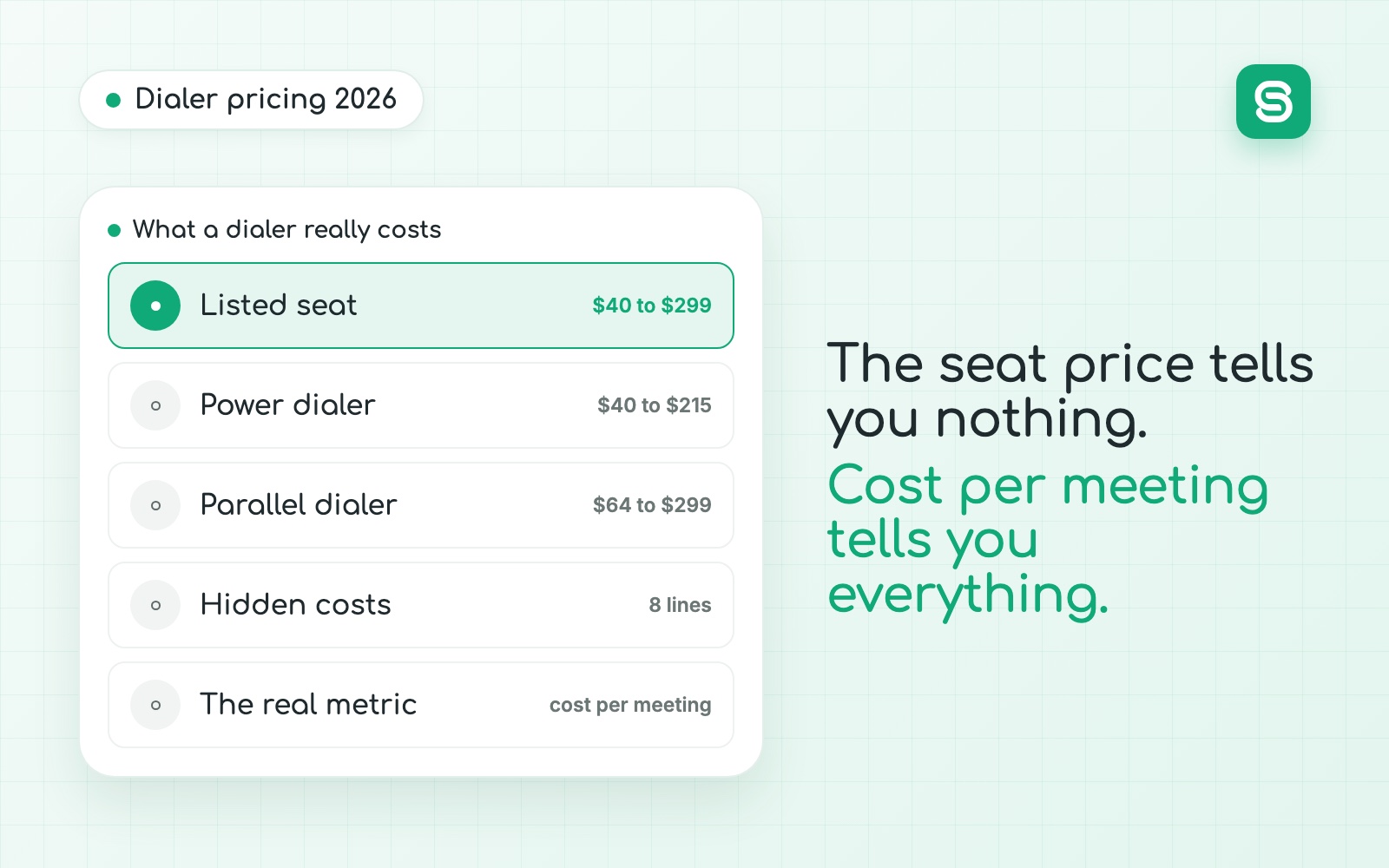
You buy a dialer at the price of a seat. You pay for it at the price of an invoice. In between sit phone numbers, minutes, a seat minimum, a contract term and sometimes enrichment credits that appear nowhere on the pricing page.
This guide runs both numbers: what dialers cost today, from public prices read vendor by vendor on November 13, 2026, and what they will actually cost you, per rep, per conversation and per meeting.
How much does a dialer cost in 2026?
It depends first on the dialing mode. “Dialer” is not one product but a family of tools that dial numbers for you, with very different mechanics and prices.
If the terms blur together, the mechanics are covered in parallel dialer vs power dialer and in what is a predictive dialer. Here we stick to money.
Three things stand out from the pricing pages we read on November 13, 2026.
The first matters most. For a large part of the market, there is no public price. You can only compare after a sales call, usually after you have told them your team size, which shapes the number you get. The second changes the math for small teams: a $50 seat with a three-license minimum costs a solo rep $150 a month. The third is a reminder that listed prices exclude taxes and sometimes fees.
You buy a dialer at the price of a seat. You pay for it at the price of an invoice.
The five ways dialers are billed
Before you compare amounts, identify the model. Two plans with the same headline price can produce very different invoices depending on what gets counted.
- 01
Per seat, per month.
The most common model: a fixed price per rep. Predictable, and it favors reps who dial several hours a day. Read what the seat includes: minutes, numbers, parallel mode, transcription. An all-in seat at $150 can cost less than a $50 seat plus four add-ons. - 02
Per minute.
You pay for talk time, sometimes from the first ring. Good for irregular usage, expensive in parallel mode if every line ringing into the void counts. Always ask when a billable minute starts. - 03
Per line or per mode.
The price climbs with the number of simultaneous lines, or parallel mode is an add-on on top of the seat. That is how CloudTalk prices it: power mode is $15 per user on its lower plans and included on Expert, parallel mode is $39 per user on top. - 04
Credits.
A pool of credits per seat, consumed by minutes, texts, enrichment or AI actions. The headline looks low; consumption decides the bill. Trellus, for example, says a connected minute to a US or Canadian number uses about 1.5 credits, which works out to roughly 1,300 or 2,000 minutes per seat per week depending on the plan, with credits reset every Monday. - 05
Flat system fee.
One annual price for the whole system, based on simultaneous calls rather than users. That is the PBX model: 3CX, for instance, prices a flat annual license with “no per user/per month” fee. Rarely the right fit for an outbound dialer, but you will meet it if you start from an existing phone system; our 3CX review covers what it does for sales calling.
In practice, most plans mix two models: a seat that includes a volume, then per-minute charges or credits beyond it. The included volume is what to read first, with your own usage in mind.
The dial rate we use here sits in the middle of the ranges shown on our product pages. Yours depends on your list: rerun the math with your numbers in the calculator below.
What do dialers cost in 2026? Public prices by vendor
Here is what the official pricing pages showed on November 13, 2026. Prices are per seat per month, before taxes, in US dollars.
| Plan | Mode | Public price per seat per month | Conditions shown |
|---|---|---|---|
| CloudTalk Starter and Expert cloudtalk.io/pricing | Power add-on (included on Expert), parallel add-on | Starter $25 plus $15 for power; Expert $49 ($69 monthly); $39 more for parallel mode | 3-license minimum on Expert; 5 lines by default, up to 10 on request; 11% US/Canada recovery fee |
| Aircall Professional aircall.io/pricing | Power dialer | $50 annual | 3-license minimum; extra number $6; unlimited US and Canada calling (terms apply), international by quote |
| Ringover Business ringover.com/pricing | Power included, parallel add-on | $49 billed annually, $69 month to month | 12-month commitment on the annual price, 3-user minimum; Parallel Dialer listed as an add-on, price not shown |
| Trellus trellus.ai/pricing | Power, or power + parallel | $99.99 or $149.99 | No seat minimum; weekly calling credits; 5 or 8 extra numbers included |
| PhoneBurner phoneburner.com/pricing | Power dialer | $140 to $183 annual, $165 to $215 monthly | Recording storage 30 days, 90 days or unlimited by plan; numbers are an add-on, price not shown |
| Salesfinity Gold salesfinity.ai/pricing | Parallel, up to 5 lines | $249 annual, $299 monthly | International calling +$50; $0 setup; Enterprise $299 on a 12-month plan |
| Five9 Core five9.com/products/pricing | Contact center with dialer | $159 | Per concurrent user, 50-seat minimum; higher tiers by quote |
| Skipcall Starter, Intermediate, Expert | Power and parallel, 4 lines | From $70, $140 and $240 | 400, 1,000 or unlimited conversations; 1, 1 and 2 numbers |
And the vendors that publish no price, as of November 13, 2026: Orum (quote only, “Minimum 9-Seat”; see our Orum alternative page), Nooks (custom quote), Kixie (plans listed without amounts), Koncert (“Contact us for pricing”), Convoso (by quote), and JustCall’s SalesPro plan, which includes a predictive dialer up to 10 lines (by quote, 2-license minimum).
Why the spread is so wide
The $49 and $50 plans are business phone systems (main line, numbers, inbound routing) with a power dialer included. The dialer is one feature among many. The $140-and-up plans are built for outbound: calling sessions, contact queues, voicemail detection, number health, and sometimes data and email sequencing in the same seat.
The top of the table is often buying more than dialing: lists, cell phone numbers, a sequencer. Salesfinity’s own pricing page frames it that way, with a calculator comparing its seat to a dialer, a sequencer and a data tool bought separately. If you already pay for those tools elsewhere, you will pay twice. If you do not, the expensive seat can replace three subscriptions. That is why a seat price never compares on its own.
The top of the table is often buying more than dialing.
For a feature-level tour of these tools, our roundups of the best parallel dialers and the best power dialers with no minimum seats go plan by plan. If your reps also call Europe, our roundup of European parallel dialers compares vendors on hosting, caller ID and euro billing.
The hidden costs of a dialer: what the pricing page leaves out
Eight lines come back quote after quote. None of them is dishonest. They just live somewhere other than the big number.
Two more costs never show up on an invoice but weigh on cost per meeting: admin time (list imports, duplicate cleanup, CRM field mapping) and numbers flagged as spam, which crush connect rates until someone notices.
The flagged-number problem
The more calls a number makes, the more likely carriers and call-blocking apps label it as spam. CloudTalk’s pricing page (viewed November 13, 2026) suggests roughly one number per 70 calls a day per rep and does not charge to replace a flagged number. Others do charge. This matters in parallel dialing, where one rep dials hundreds of numbers a day: our phone number rotation calculator gives you an order of magnitude, and our guide to a caller ID marked as spam covers the fix when it is too late.
The enrichment line
A dialer is useless without numbers, and the best numbers for B2B outbound are direct dials and cell phones. Finding them costs money, per number or per credit, depending on the provider and its match rate. Budget this line separately: our phone enrichment pricing tool compares providers and what a “number found” is actually worth.
US-only line items: texting registration and caller ID
Selling into the US adds a few small lines that European buyers never see, and they rarely sit next to the seat price.
None of these is large on its own. Across a team dialing several hundred numbers a day, branded calling billed per call can, however, cost as much as a seat. Ask whether it applies to every dial or only to connected calls.
How much does a dialer cost per rep per month?
Total cost per rep is the real invoice divided by the number of people who actually dial. Not by the number of seats billed.
That math stays incomplete until you look at what the bill produces. A $200 dialer that takes a rep from 2 to 7 conversations an hour costs far less per conversation than a $30 phone line they dial by hand.
The line no vendor puts in the quote: rep time
The most expensive seat on the market is still a small line next to payroll. A rep who dials two hours a day spends about 40 hours a month on the phone. Even with a cautious assumption of $35 of loaded cost per hour, those 40 hours are worth $1,400 a month, several times the price of any seat in the table.
The practical consequence: the best dialer is not the cheapest one, it is the one that turns the most hours into conversations. A $50 difference in seat price is recovered with a handful of extra conversations. Our article is a parallel dialer worth it for 1 to 3 reps runs that math step by step.
The best dialer is not the cheapest one, it is the one that turns the most hours into conversations.
What budget to plan by team size
The budget is not built the same way for a founder dialing alone and a floor of ten reps. What changes from one profile to the next is less the seat price than the terms around it.
Whatever the profile, the same discipline applies: one measured month on your own lists beats any comparison table, this one included. Log dials, conversations and meetings, then hold them up against the invoice. If a vendor offers no trial, ask for a first month with no commitment: the answer tells you how confident they are in the result.
The right metric: cost per conversation and per meeting
Cost per conversation is the month’s bill divided by the conversations it produced. Cost per meeting is the same bill, plus rep time, divided by meetings booked. Those are the only two numbers that let you compare a $49 seat and a $249 seat.
Conversations depend on three things: hours spent dialing, dials per hour (where the mode matters), and the share of dials that become a conversation (where the list matters).
These numbers come from a fully anonymized sample of 86,168 outbound calls placed with Skipcall from November 2025 to November 2026 by a B2B prospecting team calling mostly French companies. One team and one market: a benchmark, never an industry average. US connect rates may differ; our article on how many cold calls it takes to book a meeting covers the other published ratios.
The last link, the share of conversations that become meetings, depends on your offer, your market and your pitch. No dialer changes it directly. That is why it shows up as an editable assumption in the calculator below.
The real dialer cost calculator
Enter your team and the lines of your quote. The calculator shows the real monthly bill broken down line by line, the cost per conversation and the full cost per meeting, then compares all three modes on the same assumptions.
Real dialer cost calculator
Enter your team and your quote: the real monthly bill, the cost per conversation and per meeting, for all three modes.
Your output (editable assumptions)
Real monthly bill · Power dialer
$408/ month
Listed seat price: $300 · 26% outside seats
- Seats$300
- Minutes$0
- Numbers$18
- Enrichment$90
- Setup (over 12 months)$0
Ceiling reached: at this conversation length, your reps cannot hold more conversations per hour. The dialer dials less, and the gain shows up as time.
All three modes, same assumptions
Two things to look at first. The share “outside seats”: if it is above a third of the bill, the seat price is no longer the right point of comparison. Then the ceiling message: on a parallel dialer, your reps can hit the maximum number of conversations they can hold in an hour. Past that point, dialing faster books no more meetings, and the gain shows up as freed-up hours.
This calculator focuses on the tool’s bill. For a full program view (salaries, share of time spent calling, meeting show rate, customer acquisition cost), use our free cost per meeting calculator. If you are working on the other side of the equation, our playbook on how to reduce cost per meeting in an SDR program covers the levers beyond tooling.
Those results rest on assumptions you can edit in the calculator: 22, 70 and 175 dials an hour by mode (the middle of the ranges on our product pages), 11% of dials becoming a conversation (the anonymized sample above), four-minute conversations plus a minute and a half of notes, 15 meetings per 100 conversations, and $35 of loaded cost per rep hour. The last three are written for the example. Change them: the order of the modes can change with them, especially if your conversations run long or your list is highly qualified.
Power, parallel or predictive: which costs least per conversation?
The cheapest mode per seat is rarely the cheapest per conversation. Here is how each one behaves when you move from the listed price to the real cost.
- Public prices read: $40 to $69 bundled with or added to a phone plan, up to about $215 at dedicated vendors.
- What it changes: it removes manual dialing and record hunting. Our product pages describe a move from 20 to 25 dials an hour by hand to 60 to 80 with a power dialer.
- Where the cost slips: seat minimums and annual contracts on phone platforms.
- Who it fits: teams dialing one to two hours a day, short qualified lists, strategic accounts where every call gets prepared.
- Public prices read: about $64 (as an add-on) to $299 per seat.
- What it changes: several lines at once, and the rep only gets the person who answers. Conversations per hour can then hit the limit of the rep’s time, not the dialer’s.
- Where the cost slips: minutes billed from the first ring, number consumption, paid add-ons (voicemail detection, extra lines, international calling).
- Who it fits: teams dialing many numbers for few pickups, with broad lists.
- Public prices read: $159 per seat for Five9’s public Core plan, with a 50-seat minimum; by quote at most others.
- What it changes: it dials for a group of agents, predicting pickups. It assumes several people dialing at the same time.
- Where the cost slips: integration, supervision, and the risk of a prospect answering with no agent free, which the federal 3% abandonment rule caps.
- Who it fits: high-volume B2C call centers, rarely B2B prospecting teams.
The compliance and listening-quality questions around predictive dialing are covered in what is a predictive dialer. If you call today from inside your CRM, the cost comparison with a dedicated tool is in our article on CRM calling vs a dedicated dialer. To find the mode that fits your team in two minutes, take our which dialer quiz.
The conversation ceiling, or why more lines do not mean cheaper
A rep can only hold so many conversations an hour. With four-minute conversations and a minute and a half of notes, that is just under eleven an hour. When the dialer delivers more, each extra line adds cost (minutes, numbers, list wear) without adding meetings.
That is the argument our parallel dialer page makes for stopping at four lines: beyond a certain point the difficulty is no longer opening lines, it is never keeping the person who picked up waiting, and four lines for one available rep are enough to fill an hour with conversation. If you read a quote with ten lines, ask how many conversations per hour it assumes and whether your reps can hold them. The other questions to ask on that point are in our guide to parallel dialer buyer questions.
Once the ceiling is reached, each extra line adds cost without adding meetings.
How to read a dialer quote
A complete quote answers fourteen questions. Most pricing pages cover four or five. The rest get asked on the call with the vendor, and the answers get requested in writing.
The 14 questions to ask before you sign
Check them off during the call with the vendor. Every empty box is a line on the bill you do not know yet.
Seats
Calling
Numbers
Add-ons and data
Onboarding and exit
0 of 14 answered
QUESTIONS FOR THE VENDOR (dialer quote)

SEATS
[ ] Is the listed price monthly or annual billing, and what is the month-to-month price?
[ ] What is the seat minimum, and is a seat billed if that rep does not dial?
[ ] How long is the contract, and what notice do we need to cancel or drop seats?

CALLING
[ ] Which minutes are included, to which countries, landlines and cell phones?
[ ] With parallel dialing, do unanswered lines that ring count against our minutes?
[ ] What happens past the included usage: dialing pauses, per-minute billing, a forced upgrade?

NUMBERS
[ ] How many numbers are included, and what does each extra number cost?
[ ] Is replacing a number flagged as spam billed?
[ ] Who handles caller ID registration and branded calling, and is it extra?

ADD-ONS AND DATA
[ ] Are parallel mode, voicemail detection and transcription included or add-ons?
[ ] Is enrichment billed per number found or per lookup?
[ ] How long are recordings kept, and is storage beyond that billed?

ONBOARDING AND EXIT
[ ] Are there setup, training or CRM integration fees?
[ ] Can we take our numbers, recordings and history when we leave, and at what cost?
The exchange below shows what that conversation looks like when it is run well. It is written for this article, with a fictional vendor.
Surfacing the hidden costs during the demo
Before we talk discounts: is that seat price billed annually or month to month?
That's the annual price. Month to month is about 25% more.
Got it. In parallel mode, do the lines that ring and don't connect count against our minutes?
Yes, minutes start at the first ring, but the allowance is generous.
Generous at how many dials a day? We'll be around 300 per rep.
At that volume you'd want the additional minutes pack.
Can you put the price of that pack, the cost of an extra number, any recovery fees and recording retention in the written quote?
In four questions, the buyer surfaced three lines on the invoice: the annual versus monthly gap, a minutes pack and the price of numbers. None of it was false on the pricing page. None of it was there.
Mistakes that blow up a dialer budget
One last, quieter mistake: measuring ROI in dials. A dialer that doubles dials but not conversations returned nothing. The right dashboard counts conversations, then meetings, and divides the invoice by each. To turn that into a document finance will approve, see how to build a sales dialer business case.
How much does Skipcall cost?

Skipcall is billed per seat, with a volume of conversations included. The power dialer and the parallel dialer up to four lines are included from the Starter plan, from $70 per user per month; Intermediate is from $140 and Expert from $240. A Business VoIP plan from $25 covers the company phone system, without a dialer. All prices are on our pricing page, with month-to-month billing available.
- Starter: 400 conversations, 1 number, 200 texts, 100 AI automations.
- Intermediate: 1,000 conversations, 1 number, 500 texts, 100 AI automations.
- Expert: unlimited conversations, 2 numbers, 1,000 texts, 100 AI automations.
- On all three: power dialer, parallel dialer up to 4 lines, AI answering machine detection, recording, transcription and AI call summaries, tasks, pre-CRM, sequences, HubSpot, Pipedrive, Salesforce and Attio integrations, mobile and web apps, API.
- Phone number enrichment for contacts you already have, in credits. Skipcall has no contact database and does not sell lists.
- Any conversation longer than 10 seconds counts toward the plan.
- One seat per person, matched to the role: a VoIP plan for people who do not dial in volume, an Expert seat for someone prospecting all day.
- Calls start in Skipcall and the CRM record is updated after each call.
Read the included conversations against the calculator above: if your reps go past 1,000 conversations a month, Expert becomes the simplest plan to budget. The app is hosted in the European Union.
What to remember
- A dialer seat costs about $40 to $299 per month on public prices read on November 13, 2026. Several major vendors publish no price.
- Identify the model before the amount: per seat, per minute, per line, credits or flat system fee. The same usage can cost twice as much.
- Eight lines are missing from the pricing page: numbers, calling, seat minimums, contracts, setup, add-ons, enrichment, storage and fees.
- The seat is small next to rep time. The right dialer turns the most hours into conversations.
- Compare on cost per conversation, then per meeting, with your own numbers and a realistic ceiling on conversations per hour.
- Get everything in the written quote: included volumes, overages, seat minimums, fees, cancellation.




