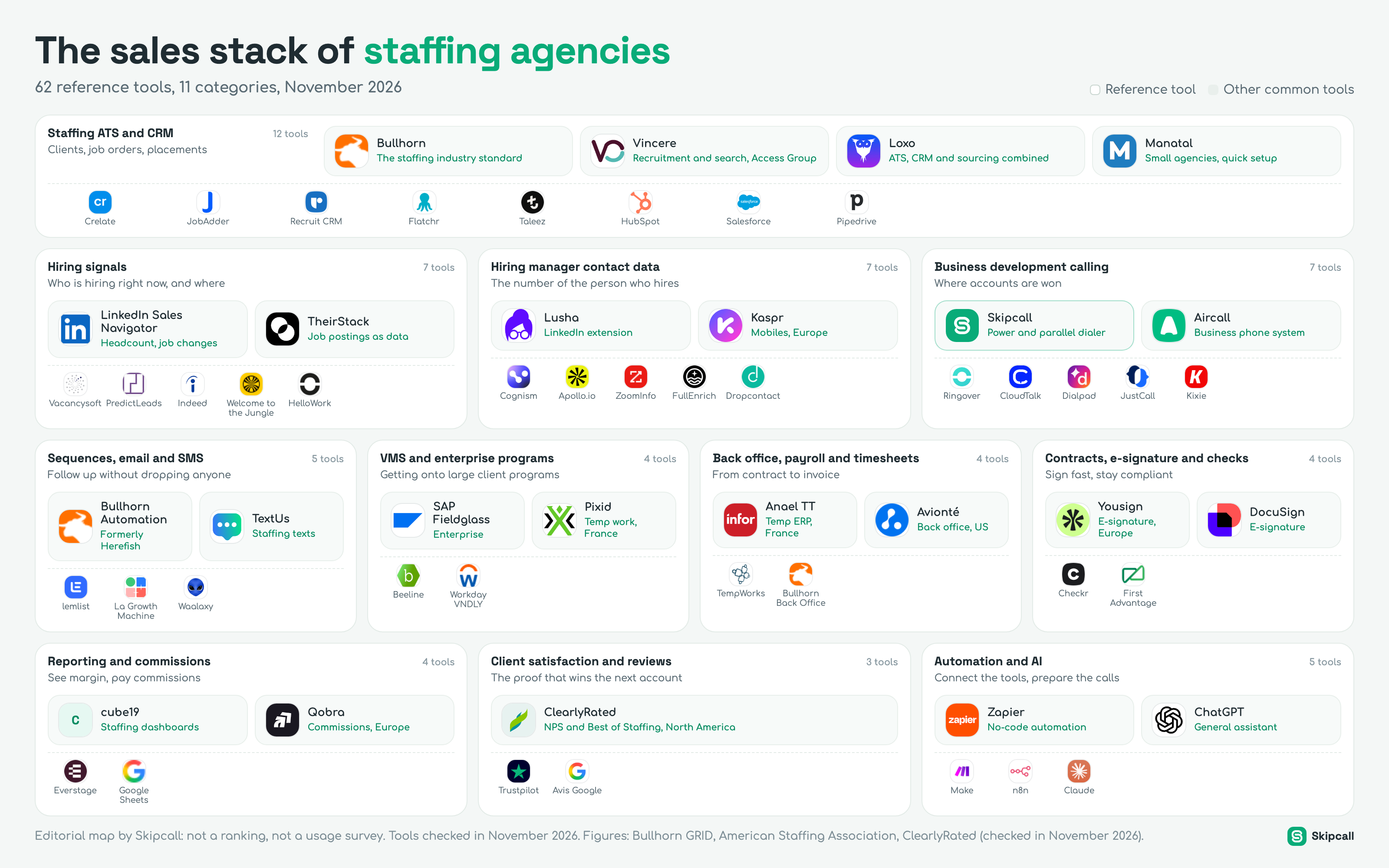
A staffing agency sells twice. It sells candidates on working with it, and it sells companies on finding those candidates faster and better than they would on their own. This article is about the second sale: the one that brings in accounts, job orders and assignments. It decides the agency’s revenue, and it is the one most often run on the wrong tools.
Here is the map of the software behind that sale, sorted into eleven categories: from the staffing ATS to spotting companies that are hiring, from business development calling to large client programs, all the way to the back office that turns an assignment into an invoice and the surveys that measure client satisfaction. Below the map, each category gets its own section: what it does in an account manager’s day, when to add it, how to choose, what tools cost when vendors publish a price, and the traps agencies fall into most often.
The sales stack of staffing agencies
62 reference tools, 11 categories, November 2026
Staffing ATS and CRM
12 toolsClients, job orders, placements
 BullhornThe staffing industry standard
 VincereRecruitment and search, Access Group
 LoxoATS, CRM and sourcing combined
 ManatalSmall agencies, quick setup
 Crelate
 JobAdder
 Recruit CRM
 Flatchr
 Taleez
 HubSpot
 Salesforce
 Pipedrive
Hiring signals
7 toolsWho is hiring right now, and where
 LinkedIn Sales NavigatorHeadcount, job changes
 TheirStackJob postings as data
 Vacancysoft
 PredictLeads
 Indeed
 Welcome to the Jungle
 HelloWork
Hiring manager contact data
7 toolsThe number of the person who hires
 LushaLinkedIn extension
 KasprMobiles, Europe
Cognism
 Apollo.io
 ZoomInfo
 FullEnrich
 Dropcontact
Business development calling
7 toolsWhere accounts are won
 SkipcallPower and parallel dialer
 AircallBusiness phone system
 Ringover
 CloudTalk
 Dialpad
 JustCall
 Kixie
Sequences, email and SMS
5 toolsFollow up without dropping anyone
- Bullhorn AutomationFormerly Herefish
 TextUsStaffing texts
 lemlist
 La Growth Machine
 Waalaxy
VMS and enterprise programs
4 toolsGetting onto large client programs
 SAP FieldglassEnterprise
 PixidTemp work, France
 Beeline
 Workday VNDLY
Back office, payroll and timesheets
4 toolsFrom contract to invoice
 Anael TTTemp ERP, France
 AviontéBack office, US
 TempWorks
- Bullhorn Back Office
Contracts, e-signature and checks
4 toolsSign fast, stay compliant
 YousignE-signature, Europe
 DocuSignE-signature
 Checkr
 First Advantage
Reporting and commissions
4 toolsSee margin, pay commissions
- Ccube19Staffing dashboards
 QobraCommissions, Europe
 Everstage
 Google Sheets
Client satisfaction and reviews
3 toolsThe proof that wins the next account
 ClearlyRatedNPS and Best of Staffing, North America
 Trustpilot
 Avis Google
Automation and AI
5 toolsConnect the tools, prepare the calls
 ZapierNo-code automation
 ChatGPTGeneral assistant
Make
 n8n
 Claude
How to read this map
The map follows the path of a client account, from the first signal to the invoiced assignment. It reads in three layers.
- 01
Spot:
At the top and on the left, the tools that tell you who to call: the agency’s ATS and CRM, which holds every client’s history, hiring signals, which show which companies need people right now, and hiring manager contact data, which gives you the number of the person who hires.
- 02
Open the account:
In the middle, business development calling and sequences. This is where the first meeting, the first job order and the first placement happen. With enterprise clients, add getting onto their VMS.
- 03
Deliver and retain:
Around them, everything that turns an order into a well-run assignment and a client who refers you: the back office, contracts and checks, margin and commission reporting, satisfaction measurement and automation.
The large tiles mark the reference tools in each category, the ones an agency will almost certainly meet when comparing. The small tiles list other common tools. This is not a ranking: we do not have usage data per tool, and we do not make it up.
Staffing ATS and CRM: the heart of the business
This is the first tool an account manager opens in the morning and the last one they close at night. A staffing ATS is not the ATS of a company hiring for itself: it manages two databases at once, candidates on one side and client companies with their job orders on the other, and it links them through submittals, interviews and placements. For sales, it tells you which accounts ordered last year, which ones have gone quiet for three months, which manager signed the last assignment and which rep owns the account.
Bullhorn is the industry standard for mid-size and large agencies. Vincere, acquired by Access Group in January 2022, is strong with recruitment and search firms. Loxo combines ATS, CRM and sourcing. Manatal targets small agencies that want to get started quickly. Crelate, JobAdder and Recruit CRM round out the international field. In France, Flatchr and Taleez are the most cited, with a caveat: they are first built for companies hiring for themselves. Some agencies run business development in HubSpot, Salesforce or Pipedrive and keep the ATS for candidates.
Bullhorn
- Best for
- Mid-size to large staffing and recruitment agencies
- Price
- Starter at $99 and Core at $165 per user per month according to a third-party survey from July 2026; higher plans on quote
- Watch out
- Automation, messaging and analytics are paid add-ons
Vincere
- Best for
- Recruitment and search firms, UK, Europe and Asia-Pacific
- Price
- On quote
- Good to know
- Part of Access Group since January 2022
Loxo
- Best for
- Firms that want ATS, CRM and sourcing in one tool
- Price
- Not published consistently, ask the vendor
- Watch out
- Check temp and contract handling if you run a temp desk
Manatal
- Best for
- Small agencies and solo recruiters getting started
- Price
- Per-seat plans published, check the vendor page
- Watch out
- Lighter on temp payroll and back office
How to choose. Start from your model. A temp or light industrial agency needs short assignments, timesheets and contracts in volume: its ATS has to talk to the back office. A direct hire or search firm lives on one-off placements and fees: it needs detailed tracking of accounts and searches. Either way, ask for a demo on your own data and look at three screens: a client account, the list of open job orders and an account manager’s dashboard.
Hiring signals: knowing who is hiring before other agencies do
This is the category that most clearly separates a staffing agency from a SaaS company. A company that posts a job has, by definition, a hiring need: it is the best buying signal in this business. The whole game is to see it before other agencies do, and to know which one to call first.
Job boards such as Indeed show these signals one by one. To turn them into an account list, you need tools that treat job postings as data. TheirStack describes itself as a job postings and technographics database, with history back to 2021, and can push new postings into a CRM through webhooks. PredictLeads covers wider signals than hiring (funding, new customers, product launches). In the UK, Vacancysoft serves recruitment agencies directly: its APSCo partner listing says more than 40 of the 50 largest UK recruitment firms use it.
In staffing, a published job ad is a purchase order that has not found its supplier yet.
How to use them. A signal is only worth something if it triggers a fast call. Set a routine: every morning, the list of companies in your verticals and territory that posted or reposted a role the day before, sorted by number of open roles, then a call to the hiring manager in the department that is hiring, not only to HR. For scripts and openers, our guide to cold calling for staffing agencies covers the approach, and the most common staffing objections each come with an answer.
Hiring manager contact data: the number of the person who hires
A signal gives you a company; you then need a person and a number. In a small business, that is often the owner or the site manager. In a mid-size or enterprise account, it is the operations manager of the hiring department, then HR or procurement if the company centralizes its suppliers. Contact data tools give you their emails and, above all, their direct dials and mobile numbers.
Lusha and Kaspr are the favorites of account managers because they work from LinkedIn, while you look at a profile. Kaspr, acquired by Cognism in 2022, is strong in Europe. Cognism and ZoomInfo target larger teams, on quote. Apollo.io combines a contact database with sequences. FullEnrich queries several databases in turn to raise the share of numbers found, and Dropcontact is widely used in France for emails.
How to choose. Run a test on 100 contacts from your real target: site managers in your territory, plant managers in your vertical. Count the numbers found, then the numbers that actually reach the right person. Our which data provider quiz suggests two or three names based on your market and budget, and the phone enrichment pricing comparison turns list prices into a cost per conversation.
Business development calling: where accounts are won
Staffing is a phone business. A site manager who needs three forklift drivers on Monday does not read a prospecting email; they answer the agency that calls at the right time with two available people. Yet many agencies give their account managers a softphone or a cell phone and let them dial one number after another.
When only about 5 calls in 100 reach a conversation, the number of numbers an account manager can work through per hour decides how many accounts they open. Three families of tools share this category. Business phone systems (Aircall, Ringover, CloudTalk, Dialpad, JustCall, Kixie) provide lines, a softphone and call history for the whole agency. Power dialers run through a list without manual dialing. Parallel dialers call several numbers at once and only hand the rep the call that connects.
Best for: agencies whose accounts open over the phone and that want a power dialer, a parallel dialer of up to 4 lines, recording, transcription, AI summaries and CRM sync in one tool.
Skipcall is our product: a business development calling platform with a power dialer, a parallel dialer of up to four simultaneous lines, recording and transcription with AI summaries, sequences and CRM integrations with HubSpot, Pipedrive, Salesforce and Attio. If your ATS is Bullhorn or another staffing system, you import call lists by CSV; Skipcall’s open API exposes call data (outcomes, recordings, transcripts) so you can push it elsewhere. Plans start from $70 per license per month on annual billing, with no long-term commitment. The Skipcall for staffing agencies page covers the use cases.
Sequences, email and SMS: following up without dropping anyone
An account is rarely won on the first call. You need to follow up, send two anonymized profiles, call back after a lost order, check in when an assignment ends. Sequencing tools orchestrate those touches: the account manager enrolls a contact, and the tool schedules the steps (email, text, call task, LinkedIn message).
In the Bullhorn ecosystem, automation runs through Bullhorn Automation, formerly Herefish, acquired in January 2020, and texting through TextUs, which has powered Bullhorn Messaging since late 2020. Outside Bullhorn, agencies use lemlist, La Growth Machine or Waalaxy to combine email and LinkedIn.
- Each account manager works more than a few dozen accounts in active prospecting.
- You want to re-engage clients whose last assignment ended more than three months ago.
- Several people work the same accounts and must not step on each other.
- A generic email (“we have candidates available”) produces nothing: the sequence has to start from a real need.
- Business texting has rules too: identify the sender and make opting out easy. In the US, check the TCPA before texting cell phones.
- A call task that leaves the rep dialing by hand loses most of the gain.
Skipcall also runs sequences that mix calls, emails and texts: call steps play out in the dialer instead of sitting as tasks.
VMS and enterprise programs: getting onto large client programs
With an enterprise client, the sale does not end at the meeting. The company often manages its staffing suppliers in a VMS (vendor management system): it onboards agencies there, publishes job orders, receives timesheets and invoices. For an agency, getting onto the client’s VMS becomes a step in the sale, and the rest of the relationship runs through it.
SAP Fieldglass runs the global programs of very large enterprises; Beeline and Workday VNDLY share much of the rest of the market. In France, Pixid is the reference platform for enterprise temp work, with historical clients in construction and automotive, and it has now moved into the US through VectorVMS. Agencies do not buy these tools: the client picks them, and the agency complies.
What it changes for sales. Three things. First, getting listed: you need to know the procurement team and the dates of supplier reviews, which takes months of preparation. Second, service quality is measured: time to submit, fill rate, document compliance. Third, account managers must keep talking to operations managers, because the VMS tells you who orders, not why.
Back office, payroll and timesheets: from contract to invoice
The back office is not a sales tool, but it wins and loses clients. A wrong invoice, a late timesheet, a contractor paid incorrectly: these are the first reasons clients get unhappy, and they show up in the next supplier review.
| Tool | Market | What it covers | Price |
|---|---|---|---|
| Avionté AviontéBOLD | US | Front and back office; back office sold on its own since June 2024, used by nearly 800 agencies according to the vendor | On quote |
| TempWorks Staffing suite | US | ATS, CRM, onboarding, timesheets, payroll and tax compliance | On quote |
| Bullhorn Back Office From the 2013 EASY Software acquisition | International | Time, billing and payroll, linked to the Bullhorn front office | On quote |
| Anael TT Infor, formerly Cegid | France | Clients, quotes, three-party contracts, scheduling, timesheets, payroll and invoicing | On quote |
How to choose. Payroll for contractors, tax filings and multi-state rules call for software built for staffing. Check the link with your ATS (a won job order should become an assignment without retyping) and with your enterprise clients’ VMS programs (timesheets need to flow into them). Ask each vendor for a reference agency of your size and vertical, and talk to its payroll team, not only its sales team.
Contracts, e-signature and checks: sign fast, stay compliant
In staffing, signing speed is a sales argument. A client who orders on Tuesday for a Thursday start expects contracts ready, signed and compliant. E-signature (DocuSign, or Yousign in Europe) has cut whole days out of that process.
- 01
The job order:
the client describes the need (role, duration, pay rate, start date). The account manager logs it in the ATS, or receives it through the client’s VMS.
- 02
The client agreement:
the master services agreement or the assignment terms between the agency and the client, signed electronically before the start.
- 03
The worker paperwork:
the contractor’s assignment terms, tax forms and onboarding documents, signed and stored with the placement.
- 04
The checks:
employment eligibility, background checks, licenses. US agencies rely on screening providers such as Checkr or First Advantage, which absorbed Sterling; UK agencies run right-to-work checks.
Requirements differ by state and country. This is general information, not legal advice: confirm required documents and timing with counsel or your staffing association.
Reporting and commissions: see margin, pay commissions
An agency owner looks at margin more than at call counts. Sales reporting in staffing links three numbers: open job orders, placements or starts, and the gross margin they produce. Without a tool, those numbers live in three systems and get stitched together in a spreadsheet at month end.
cube19, now sold by Bullhorn as its staffing analytics offer, assembles these numbers into dashboards for owners, managers and account managers. For commissions, Everstage is common internationally and Qobra in Europe; many agencies still start in Google Sheets. Our SDR variable pay simulator helps design a commission plan before tooling it, and Skipcall’s dashboard tracks calling activity per rep.
Client satisfaction and reviews: the proof that wins the next account
In a market where every agency promises “qualified candidates, fast,” proof beats promises. Measuring client satisfaction, then showing it, gives you an argument competitors cannot copy.
In North America, ClearlyRated measures the NPS of agencies’ clients, candidates and employees and gives out the Best of Staffing award every year; its statistics are published by ClearlyRated itself. Elsewhere, agencies rely on Google reviews for each branch and on Trustpilot. Whatever the tool, the habit is the same: ask for a review after every successful assignment, answer every negative review, and quote the best ones in your proposals.
Automation and AI: connect the tools, prepare the calls
Agencies have a lot of repetitive work between tools: creating the account in the ATS when a signal comes in, alerting the account manager when a role is reposted, following up with a client whose assignment is ending. Zapier, Make or n8n connect tools without development. Assistants such as ChatGPT or Claude prepare a call by summarizing a company and its open roles, or draft a first version of a proposal.
The stack by agency size
Not every agency needs all eleven categories. Buying order follows team size and the share of enterprise programs in revenue.
| Profile | Must have | Add next | Not yet |
|---|---|---|---|
| Boutique agency 1 to 3 people | A simple ATS, LinkedIn Sales Navigator, a contact data tool, a business development calling tool | A hiring signal routine, e-signature | VMS programs, commission software, analytics |
| Regional agency 5 to 15 account managers | A full staffing ATS linked to the back office, power or parallel dialer, sequences | Automated signals, dashboards per branch, satisfaction surveys | A separate sales CRM, unless you have a dedicated BD team |
| Multi-branch group 50 people and more | Integrated ATS and back office, enterprise VMS programs, margin analytics | An enterprise team with its own tooling, commission software | Different tools per branch: data has to stay shared |
All three profiles have one thing in common: the phone. A boutique agency spends a large part of its days on it; a group makes it the channel of its local account managers. Either way, the question is not whether you have a phone, but whether reps work through enough numbers per hour for business development to pay off. Our cost per meeting calculator puts a number on what a client meeting really costs depending on how you call.
What a staffing agency sales stack costs
Staffing software vendors rarely publish prices. The example below only uses public prices and one third-party survey flagged as such, for a small agency with three account managers.
This figure does not include the back office or e-signature, which are often billed per agency or by volume. It mostly gives an order of magnitude: a complete prospecting stack costs less per month than the margin on a single assignment of a few weeks. The real cost is elsewhere, in the time lost when tools do not talk to each other.
How data should flow between tools
A stack is only worth what moves from one tool to the next without retyping. Here is the path a client account should follow, from signal to invoice.
- 01
The signal:
a new or reposted role at a company in your territory lands in a list, or directly creates a task in the ATS.
- 02
The account:
the company already exists in the ATS (you see its history) or gets created there, with the hiring manager.
- 03
The number:
the hiring manager’s contact details are enriched, checked and sorted (mobile, direct dial, switchboard) before the call.
- 04
The call:
the account manager calls from the dialer; the outcome, recording and summary come back to the record.
- 05
The job order and the assignment:
the order becomes a job order, then an e-signed agreement, then timesheets and an invoice in the back office.
- 06
Retention:
a review request goes out after the assignment, margin flows into reporting, and a follow-up is scheduled before the assignment ends.
Every arrow in this flow is a place where agencies lose information. For a developer, Skipcall’s open API exposes contacts, call outcomes, recordings and transcripts, which lets you bring them into an ATS without a native integration.
The most common mistakes
Audit your stack in one afternoon
Once a year, and before every contract renewal, take an afternoon with your sales leader and whoever administers your tools.
- 01
List:
every tool, its owner, its cost per truly active user, and the contract end date.
- 02
Link:
for each tool, the metric it is supposed to move (accounts opened, job orders, time to sign, margin, NPS).
- 03
Trace:
what the tool writes into the ATS, and what still gets retyped by hand.
- 04
Cut:
tools with no owner, no usage or a duplicate. Two contact data tools with no head-to-head test is usually one too many.
- 05
Measure:
the cost of the stack divided by the number of accounts opened in the year. That is the number to bring down.
The market in a few numbers
A shrinking market pushes agencies to go after accounts rather than wait for orders. Bullhorn’s GRID survey had already measured it: winning new clients was the top priority for 40% of respondents in 2023 and 44% in 2024. In its 2025 edition, Bullhorn also reports that staffing firms using AI were twice as likely to have grown revenue in 2024. That is a correlation published by a vendor, not proof of cause and effect.
To go further, our B2B SaaS sales stack map covers the categories every sector shares, the recruiting track of our academy trains reps on calls, and our pages for recruitment firms and recruiters show how Skipcall is used there. Calling candidates, which is not the subject of this article, has its own guides: cold calling for recruiters and the recruiting objections that come with it.