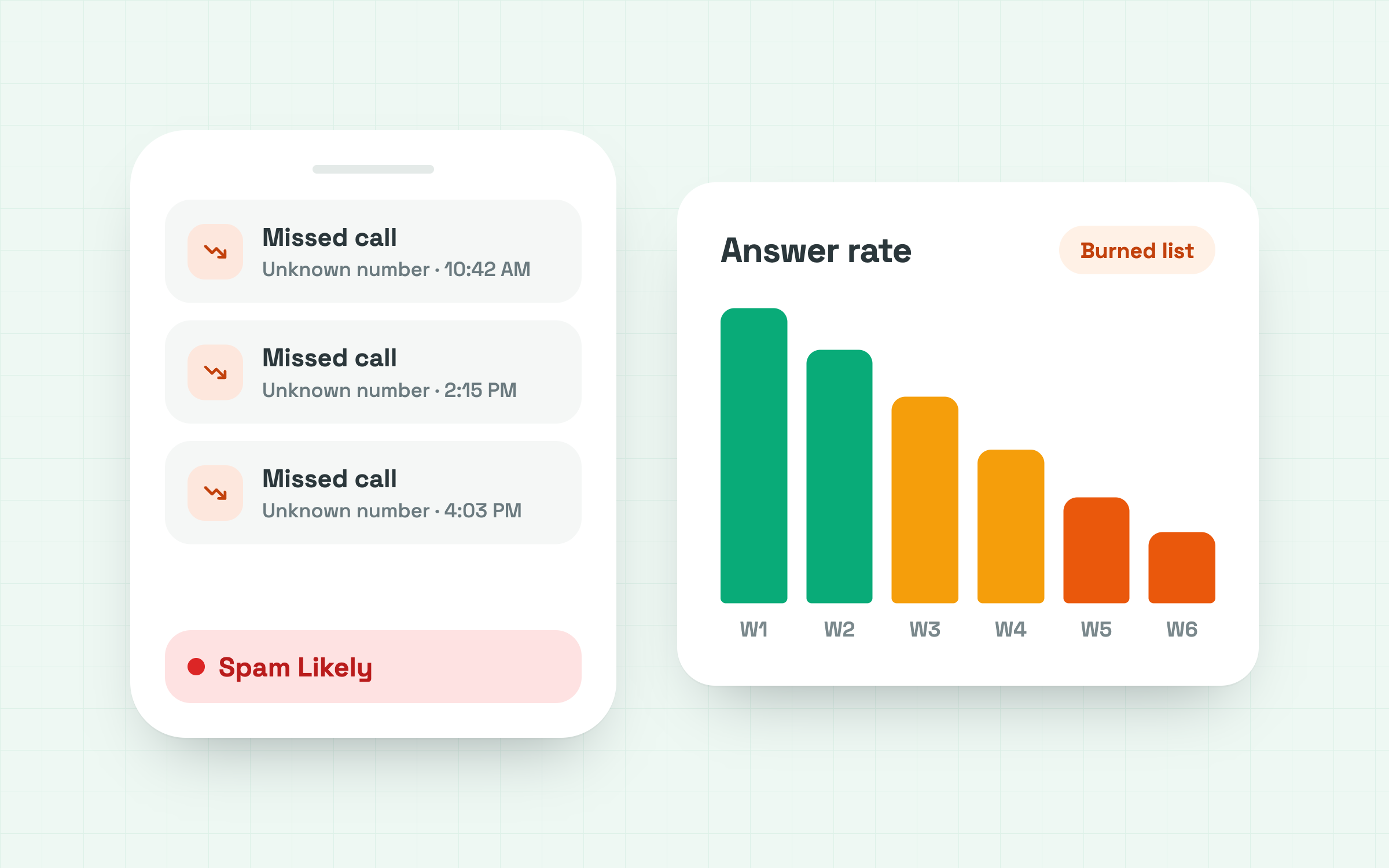
An aggressive dialer burns a call list in five steps: it cancels calls from prospects who would have answered, leaves missed calls in bursts, gets your numbers flagged as spam, drags down the answer rate of the whole list, and burns contacts you won’t be able to call again for a long time. You don’t see the cost on campaign day. It shows up three weeks later, when the same list stops answering.
This article walks through each mechanism with numbers, then lays out a healthy call cadence: line count, attempts per contact, number rotation, calling windows and list hygiene. With a checklist and the warning signs to watch.
What is a burned call list?
A burned call list is one where a growing share of contacts no longer produces conversations: they stop answering your numbers, they’ve asked not to be called again, or they’ve reported you. The list is the same size in your CRM. Its value has melted.
The difference with a list that is simply worked out matters. A worked-out list was called through to the end: every contact had a fair shot, at a reasonable pace, and those who didn’t answer can be contacted again in a few months. A burned list was worked too hard, too fast: contacts didn’t just ignore your calls, they learned to avoid them.
How does an aggressive dialer burn a list?
1. Reachable prospects lost
A multi-line dialer places several calls at once for one rep and hands them the first person who picks up. The other lines are cancelled while they are still ringing. Some of those prospects would have answered if their phone had kept ringing: they were available, and their attempt was used up with no conversation.
Our article on how many lines to dial at once runs the full math. The average number of reachable prospects lost per conversation is (n × p − q) ÷ q, where n is the line count, p the human answer rate and q = 1 − (1 − p)^n. At a 10% answer rate, it is 0.16 on 4 lines and 0.54 on 10 lines.
A reachable prospect lost isn’t lost forever. But you’ll have to call them again, with one more attempt, after they’ve seen a missed call, and nothing guarantees they’ll pick up next time.
2. Missed calls in bursts
Every prospect whose line gets cancelled, whether they would have answered or not, sees the same thing: a missed call from an unknown number. In our model at a 10% answer rate, a rep on 4 lines leaves about 40 per hour; on 10 lines, more than 140. And if the list is worked in a loop, the same prospect may see several in the same week.
What the prospect does next has a cost. If they call back, they usually reach a rep who is already on another call: the callback gets lost or goes to voicemail, and the prospect who made the effort is annoyed. If they don’t call back, they remember the number. The same number ringing three times and stopping before they can answer doesn’t make anyone want to pick up the fourth time.
3. Spam reports and flagged numbers
Caller ID apps such as Hiya and carrier spam filters rely on reports from the people called and on how numbers behave. A number that dials a lot, with many very short calls and repeated missed calls to the same people, looks exactly like an abusive robocaller. Once labeled, it shows up as “Spam Likely” or gets filtered before it rings. The diagnosis and the fix are in our guide to caller ID marked as spam, and the iPhone side of the story is in how iPhone call screening affects cold calling.
4. Answer rates drop across the whole list
This is the most expensive effect, because it also hits contacts who were never called badly. A number labeled as spam gets fewer answers from every contact it calls afterwards, not just the ones who reported it. The next campaign starts with a lower answer rate, and the temptation is to make up for it by opening even more lines. That is exactly the loop that burns a list: fewer answers, more lines, more missed calls, more reports. Our cold call connect rate benchmarks give the reference points for tracking this metric.
- Missed calls in bursts Every conversation cancels the other lines while they ring. The prospect sees a missed call from an unknown number.
- Callbacks to a busy rep The prospect calls back and reaches a rep already on another call, or voicemail.
- Distrust and spam reports The same number ringing and stopping several times looks like abusive cold calling.
- Number flagged as spam Caller ID apps and carrier filters show “Spam Likely” or block the call.
- Answer rates drop The whole list answers less, including contacts who were never called badly.
- More lines get opened To keep the same number of conversations, the team adds pressure. That is what finishes the list off.
And the loop starts again, faster.
5. Contacts burned for a long time
A prospect who has seen three missed calls from the same number in a week won’t say “call me back next month”. They’ll say “stop calling me”. That request has to be honored, and depending on where your prospects are, it can carry legal weight too. A burned contact isn’t a contact to follow up later: it’s a lost contact, and one more line to remove from the list.
What about the rules?
Calling-frequency, calling-hour and consent rules differ by country and, in the United States, by state. Check the rules that apply to the people you call before you set your cadence: our cold calling compliance checker covers the main countries, the federal side in the US is summarized in our article on the latest TCPA rule changes, and our guide is cold calling legal covers the basics. Whatever the rules say, the cadence below is about protecting the list, not just staying within the law.
What are the signs your list is burning?
A list doesn’t burn overnight. The signs show up in your call data well before the team says “this file doesn’t work anymore”. The cards below list them in the order they usually appear.
- “Who just called me?” callbacks
- Measure
- Callbacks from numbers dialed that day, and how many reach a busy rep
- What it means
- Too many missed calls left behind by the dialer
- What to do
- Lower the line count, have someone or a clear voicemail answer callbacks
- The same contact sees several missed calls
- Measure
- Attempts per contact over 7 and 30 days
- What it means
- The list is being worked in a loop
- What to do
- Cap attempts at 4 per 30 days, vary days and times
- Answer rate drops on one number
- Measure
- Answer rate per caller ID, week after week
- What it means
- The number is reported or filtered
- What to do
- Check its reputation, rest it
- Answer rate drops across the list
- Measure
- Answer rate per segment and per campaign
- What it means
- Worn-out numbers or over-contacted prospects
- What to do
- Space out attempts, rotate numbers
- “Stop calling me” requests rise
- Measure
- Do-not-call requests per 100 conversations
- What it means
- The cadence feels like harassment
- What to do
- Remove those contacts for good, ease the pressure
- “Spam Likely” shows up
- Measure
- Prospect feedback, number reputation checks
- What it means
- The number has been labeled
- What to do
- Follow the flagged caller ID diagnosis
What call cadence protects a prospect list?
A healthy cadence comes down to five settings. None of them is spectacular. Together, they make the difference between a list you can work for months and a list burned in two weeks.
Line count. Keep lines times human answer rate under 0.4: 4 lines at a 10% answer rate, 3 lines at 15%, 2 lines at 20%. Under that threshold, you lose at most one reachable prospect every five conversations. And don’t go above 4 lines until the list is cleaned. The full reasoning is in our article on how many simultaneous lines to run, and our parallel dialing best practices cover the session settings that keep a list healthy.
Attempts per contact. Four attempts at most over 30 days, spaced out on different days and at different times, beat eight calls in one week. Watch out: with a multi-line dialer, a line cancelled mid-ring counts as an attempt for the prospect, who saw the missed call. Our B2B sales cadence playbook shows how to mix phone, email and LinkedIn between calls.
Number rotation. Spreading calls over several numbers keeps a single number from absorbing every missed call and every report. The phone number rotation calculator sizes the pool for your volume. Each number must really be assigned to you and able to take callbacks: rotation is there to spread the load, not to dodge reports.
Calling windows. Calling when prospects answer reduces the attempts needed to get a conversation. Our best time to call tool helps you pick the windows.
List hygiene. A clean list answers more, which lets you open fewer lines for the same number of conversations. Before every campaign, run the file through a CSV cleaner for duplicates and formats, check numbers with the phone number validator (and, to know whether a line is still assigned, our guide to checking if a phone number is still active), and remove every contact who asked not to be called.
The pre-campaign checklist
- Your human answer rate over the last two weeks is known, by time slot.
- The line count follows lines × answer rate ≤ 0.4, with 4 lines at most.
- The file is deduplicated, number formats are fixed and invalid numbers are removed.
- Opted-out contacts are removed, and the do-not-call list is up to date in the CRM.
- Every contact has had fewer than 4 attempts over the last 30 days, cancelled lines included.
- Caller IDs are rotated, really assigned to you, and their reputation has been checked.
- Inbound callbacks are handled, by a teammate or a voicemail that says who you are.
- Calling windows are chosen, and the rules for the area you call have been checked.
- Answer rate per caller ID is tracked every week.
How do you fix a list that’s already burned?
A burned list can be partly recovered, rarely fully. Start by pausing the worst-hit segments for several weeks. Permanently remove contacts who asked not to be called. Check the reputation of every number you used and rest the ones that are labeled. Then reach out through another channel, an email or a LinkedIn message that explains who you are, before calling again from a clean number, at a slow pace. For the numbers themselves, follow the method in our guide to caller ID marked as spam.
The bottom line
An aggressive dialer doesn’t just make more calls. It cancels calls from prospects who would have answered, leaves them missed calls, turns some of them into people who won’t pick up again, and turns some of your numbers into numbers nobody answers. The cadence that protects a list is well known: few lines, few attempts per contact, rotating numbers, the right windows and a clean file. It makes slightly fewer dials per hour and far more conversations over time.
At Skipcall, that is why our dialer opens up to 4 lines at once: protecting our customers’ lists matters more than the number of dials per hour.