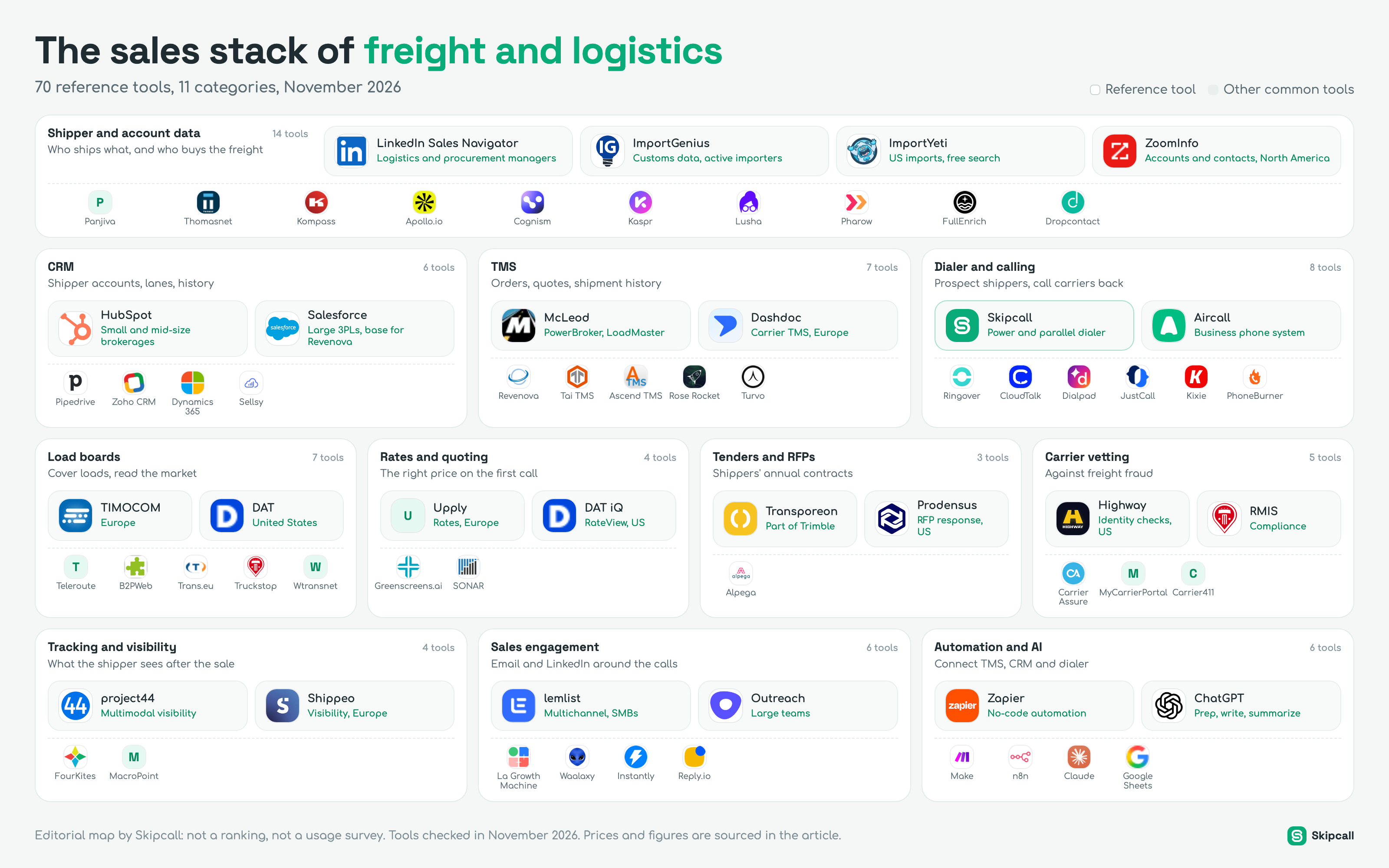
Selling freight is unlike any other B2B sale. The product changes every day, because its price moves with diesel, the season and the capacity available on each lane. The customer rarely signs a three-year contract: a shipper runs a bid once a year, then tenders loads one by one. And the rep spends a large part of the day on the phone, with shippers to win on one side and, for a brokerage, carriers to find on the other.
The tools follow the job. A freight sales team uses a CRM and a phone system like any other sales team, but also load boards, a TMS, rate intelligence, RFP platforms and, when it brokers freight, carrier vetting. Here is the map of those tools, sorted into eleven categories, with the reference names in North America and Europe. It is the freight edition of our B2B SaaS sales stack map.
The sales stack of freight and logistics
70 reference tools, 11 categories, November 2026
Shipper and account data
14 toolsWho ships what, and who buys the freight
 LinkedIn Sales NavigatorLogistics and procurement managers
 ImportGeniusCustoms data, active importers
 ImportYetiUS imports, free search
 ZoomInfoAccounts and contacts, North America
- PPanjiva
 Thomasnet
 Kompass
 Apollo.io
Cognism
 Kaspr
 Lusha
 Pharow
 FullEnrich
 Dropcontact
CRM
6 toolsShipper accounts, lanes, history
 HubSpotSmall and mid-size brokerages
 SalesforceLarge 3PLs, base for Revenova
 Pipedrive
 Zoho CRM
 Dynamics 365
 Sellsy
TMS
7 toolsOrders, quotes, shipment history
 McLeodPowerBroker, LoadMaster
 DashdocCarrier TMS, Europe
 Revenova
 Tai TMS
 Ascend TMS
 Rose Rocket
 Turvo
Dialer and calling
8 toolsProspect shippers, call carriers back
 SkipcallPower and parallel dialer
 AircallBusiness phone system
 Ringover
 CloudTalk
 Dialpad
 JustCall
 Kixie
 PhoneBurner
Load boards
7 toolsCover loads, read the market
 TIMOCOMEurope
 DATUnited States
- TTeleroute
 B2PWeb
 Trans.eu
 Truckstop
- WWtransnet
Rates and quoting
4 toolsThe right price on the first call
- UUpplyRates, Europe
- DAT iQRateView, US
 Greenscreens.ai
 SONAR
Tenders and RFPs
3 toolsShippers' annual contracts
 TransporeonPart of Trimble
 ProdensusRFP response, US
 Alpega
Carrier vetting
5 toolsAgainst freight fraud
 HighwayIdentity checks, US
 RMISCompliance
 Carrier Assure
- MMyCarrierPortal
- CCarrier411
Tracking and visibility
4 toolsWhat the shipper sees after the sale
 project44Multimodal visibility
 ShippeoVisibility, Europe
 FourKites
- MMacroPoint
Sales engagement
6 toolsEmail and LinkedIn around the calls
 lemlistMultichannel, SMBs
 OutreachLarge teams
 La Growth Machine
 Waalaxy
 Instantly
 Reply.io
Automation and AI
6 toolsConnect TMS, CRM and dialer
 ZapierNo-code automation
 ChatGPTPrep, write, summarize
Make
 n8n
 Claude
 Google Sheets
How to read this map
The map follows the life of a freight deal, from finding the shipper to keeping them. It reads in four steps, and each step has its tools.
- 01
Find the shipper:
Spot the companies that ship on your lanes, then the person who buys the freight: logistics manager, supply chain director, procurement or plant manager. That is the job of shipper data and enrichment.
- 02
Open the conversation:
Call, follow up, get a first quote request. The CRM keeps the memory, the dialer creates the conversations, sequences keep the contact warm between two calls.
- 03
Quote and win:
Give a credible rate on the first call, then answer the annual bid. Rate intelligence, load boards and RFP platforms come in here.
- 04
Deliver and retain:
Move the freight without incident, prove delivery, vet the carriers you hand the load to. The TMS, visibility and carrier vetting protect the revenue you already won.
In each category, the large tiles mark the reference tools: the ones a buyer will almost certainly run into when comparing. The small tiles list other common tools. This is not a ranking: we have no usage data per tool, and we do not make it up. When a tool is mainly present in North America or in Europe, the tile or the text says so.
Who sells what in freight
Before talking about tools, it helps to know who uses them, because a carrier’s stack does not look like a broker’s. Four kinds of companies sell transportation, and each relates to the phone differently.
The market is fragmented, which is why prospecting matters so much. FreightWaves reported in late October 2026 that there were 10% fewer freight brokerages than a year earlier: as the market consolidates, every shipper account is more contested. The public FMCSA census dataset on data.gov, often used to count brokers and carriers, was frozen on May 14, 2026 and will no longer be updated, so treat any broker count built on it as a snapshot.
Shipper and account data: who ships what
A freight rep’s first job is to know who ships on their lanes. A company importing containers through the Port of Savannah, a plant shipping to customers across the Midwest, a distributor restocking fifty stores: each has different freight needs, and the buyer is never the same person. In a small company it is often the owner or the logistics manager; in a large one, a transportation procurement lead who runs a formal bid.
Freight has a data source most industries do not: customs records. ImportGenius, ImportYeti and Panjiva, now part of S&P Global Market Intelligence, use import declarations to show which companies import what, in what volume and through which ports. That is a prospect list qualified by real activity, not just by industry code. Directories such as Thomasnet for North American manufacturers, or Kompass internationally, complete the picture.
LinkedIn Sales Navigator
- Best for
- Finding the logistics, supply chain or procurement lead at an account
- Contact data
- None: it finds people, not their phone numbers
- Watch out
- Titles vary widely: also search for traffic manager, transportation, distribution
ImportGenius
- Best for
- Forwarders and brokers targeting importers
- What it shows
- Search by product, company or HS code, filter by route and volume
- Watch out
- It shows the company, not the decision-maker: you need a second tool for contacts
ImportYeti
- Best for
- A free first pass on US importers
- Price checked
- Free search; Professional plan at $130 a month per a comparison site (November 2026)
- Watch out
- Coverage centered on US ocean imports
ZoomInfo
- Best for
- Enterprise accounts and North American coverage
- Published price
- Quote only
- Watch out
- Annual contracts; negotiate credits and seats separately
Once the account and the person are known, you still need a number that reaches them. That is the job of enrichment tools: Lusha and Apollo.io cover the US broadly, Cognism and Kaspr are strong in Europe, and waterfall tools such as FullEnrich query several sources in a row. To compare what a number really costs with each one, use our phone enrichment pricing comparison, and to see where each provider finds mobile numbers, the coverage map by country. If you buy from several providers, merge your exports so you do not pay twice for the same contact.
CRM: shipper accounts and their lanes
A freight team’s CRM tracks more than contacts and opportunities. It has to hold what makes a shipper relationship: the lanes awarded, monthly volumes, bid dates, the rates quoted and past service failures. Without that, a rep calls a shipper without knowing that one of your trucks showed up late at their dock last week.
| CRM | Best for | Entry price checked (Nov. 2026) | Watch out |
|---|---|---|---|
| HubSpot Sales Hub Small and mid-size brokerages | Brokers and carriers who want a simple CRM with email and sequences | Professional at $90 per seat per month on annual billing, per HubSpot | Lanes and volumes require custom properties or objects |
| Salesforce Sales Cloud Large 3PLs and groups | Complex processes, many branches, consolidated reporting | Starter at $25 per user per month | TMS integration often costs more than the licenses |
| Revenova A TMS built on Salesforce | Brokers who want CRM and execution in one environment | From $2,500 per company per month according to G2 | Not a CRM on its own: you are buying a full TMS |
| Pipedrive Pipeline first | Small teams that want a visual pipeline, fast | Lite at $14, Growth at $39 per seat per month on annual billing | Not built for lane-level rate tracking |
Zoho CRM and Microsoft Dynamics 365 follow companies already invested in those vendors, often through their ERP. Freight-specific platforms bundle CRM features into the TMS, which can work for small brokerages that do not want two systems.
Before calling a shipper, the rep should know what that shipper already gave you, at what rate, and what went wrong.
How to choose. Start from the question a rep asks before every call. If the answer lives in the TMS, your CRM has to read it, or you need one system that does both. Skipcall integrates with HubSpot, Pipedrive, Salesforce and Attio: the call starts in Skipcall and the CRM record is updated after every call, with the outcome, the recording and the summary. For a rep’s view on CRMs, read our best CRM for SDRs guide.
TMS: the history of every load
The TMS (transportation management system) is not a sales tool in the strict sense: it handles orders, carrier assignment, documents, tracking and billing. But it is the memory of the customer relationship. It holds every quote sent, every load tendered, every rate accepted or rejected. A rep without access to it sells blind.
In North America, brokers mostly choose between McLeod Software (PowerBroker for brokers, LoadMaster for carriers), Tai TMS, Ascend TMS, Rose Rocket, Turvo and Revenova. In Europe, Dashdoc equips carriers and forwarders and connects to shipper platforms such as Shippeo and Transporeon, while Alpega sells a TMS next to its load boards.
- Quote history by customer and by lane, so no rate is ever quoted blind.
- The volume each shipper actually tenders to you, to compare with what they ship in total.
- Service failures and late loads, to know about before calling.
- Fast quoting, when the TMS embeds a market rate source.
- A TMS with no link to the CRM: reps copy data by hand, then stop doing it.
- Entry prices that vary widely; a 2026 roundup lists Tai TMS from $995 a month and G2 lists Revenova from $2,500, while Ascend TMS offers a low-cost entry with no setup fee.
- Go-live promises: Rose Rocket publicly states 90 days, worth checking against your own case.
When to add it. A carrier or broker still running on spreadsheets moves to a TMS once it passes a few dozen loads a week. On the sales side, the real question is not which TMS to buy, but how its data flows into the CRM: ask the vendor for its connectors and API before you sign.
Dialer and calling: the industry’s main channel
Freight is one of the industries where the phone carries the most weight. A shipper rarely hands a lane to someone they have never spoken to, and rates get negotiated live. A broker calls both sides: shippers to win loads, carriers to find capacity. No public study measures calls per rep in the industry; training guides and broker accounts published in 2026 most often cite 50 to 100 dials a day for a rep prospecting shippers. Some calling vendors claim 100 to 300, which looks inflated next to the other sources.
Three families of tools live here. Business phone systems (Aircall, Ringover, CloudTalk, Dialpad, JustCall) equip the whole company, operations included, inbound and outbound. Power dialers (PhoneBurner, Kixie) move through calls one at a time. Parallel dialers call several numbers at once for teams whose job is to create conversations.
Skipcall
Best for: freight sales teams that prospect shippers by phone and want a power dialer, a parallel dialer, recording and CRM sync in one tool.
Skipcall is an outbound calling platform: a parallel dialer on up to four lines, a power dialer, voicemail detection with prerecorded voicemail drop, recording and transcription, AI call summaries, sequences, SMS and a mobile app for reps on the road. Its enrichment fills in phone numbers for contacts you already have, imported from a file or synced from your CRM; Skipcall has no contact database and does not sell lists. It is our product. Plans with the dialers start from $70 per user per month (pricing). Skipcall is an outbound tool: it does not include an IVR or inbound call queues. A brokerage whose dispatchers take calls from drivers and customers keeps a business phone system for operations.
Shipper calls and carrier calls: two different jobs
Inside a brokerage, the phone serves two jobs that look alike but are not. Treating them as one is a common reason why dialer projects disappoint.
| Shipper sales calls | Carrier sales calls | |
|---|---|---|
| Goal What a good call produces | A quote request, a meeting or an invite to the next bid | A truck covered at the right rate, today |
| List Who you call | Prospects found through shipper data, plus existing accounts | Carriers that run the lane, from the load board and your own carrier base |
| Timing When it happens | Planned sessions, often in the morning | All day, triggered by each new load |
| What matters The metric to watch | Conversations per hour and meetings set | Time to cover and margin per load |
Shipper prospecting is where a parallel or power dialer pays off: the list is long, most numbers do not answer, and the goal is to reach as many decision-makers as possible in a focused block of time. Carrier sales is closer to a dispatch workflow: fewer numbers, called because of a specific load, often with an existing relationship. Many brokerages keep carrier calls on their business phone system or in the TMS and use a dialer for shipper prospecting, which is also how most of them split headcount between account reps and carrier reps.
What to ask on the first shipper call. A good first call in freight is short and specific. Ask which lanes they ship most, how many loads a week, how they buy today (one or two core carriers, a routing guide, spot tenders), when their next bid is, and what went wrong recently with their current providers. Each answer goes into the CRM as a field, not a note, because it drives the next call: a shipper with a bid in four months goes into a nurture sequence, a shipper with a broken lane today gets a quote within the hour. If the answer is “we are happy with our carriers”, ask for a single backup lane; most shippers will test a new provider on one lane before they commit more.
Load boards: covering loads and reading the market
The load board is the most freight-specific tool on the map. It connects whoever has a load with whoever has an empty truck. Operations use it to cover a load or fill a backhaul; sales reps use it to read the market: which lanes lack capacity, where rates are rising, which loads come back every week.
DAT
- Market
- United States
- Best for
- Volume and rate data; most brokers and carriers run it
- Price checked
- DAT One Standard $59, Select $259, Office $339 a month after a mid-2026 increase, per price trackers
Truckstop
- Market
- United States
- Best for
- Often preferred for flatbed; also owns RMIS for carrier compliance
- Price checked
- 2026 sources disagree; check the checkout page before comparing
TIMOCOM
- Market
- Europe, German vendor
- Best for
- Carriers and forwarders on international European lanes
- Price
- Quote only
Teleroute
- Market
- Europe, Alpega group (with Wtransnet and 123cargo)
- Best for
- European coverage and access to the group's other boards
- Price
- On demo
Reviewers often note that some loads only appear on one board, which is why many carriers run both DAT and Truckstop. In Europe, Trans.eu is one of the few boards that publishes its prices, and B2PWeb is a common choice for French domestic freight.
Rates and quoting: the right price on the first call
A shipper who asks for a rate on the phone expects a quick and credible answer. Too high and they hang up; too low and the margin disappears, or no carrier takes the load. Rate intelligence gives the rep an objective benchmark, lane by lane.
In the US, DAT iQ RateView draws, according to DAT, on $1 trillion in transactions, and added a Shipper Spot Rate in September 2025. Greenscreens.ai offers dynamic truckload pricing built into the McLeod and Tai TMS platforms, and FreightWaves SONAR supplies high-frequency market data used by brokers’ sales and carrier teams. In Europe, Upply, backed by Geodis, publishes a monthly French road freight barometer and a quarterly European benchmark with Ti and the IRU; its Q1 2026 benchmark reported a 6.2-point rise in the European road freight confidence index, to 16.9.
- 01
Prepare your lanes:
Before a calling session, note the market rate on the five or six lanes you are going to pitch, with the month’s trend.
- 02
Give a range on the first call:
A range backed by a market source beats “let me get back to you”. The shipper judges how serious you are by that answer.
- 03
Confirm in writing within the hour:
Send the detailed quote while the conversation is fresh, and log it in the CRM with the date and that day’s market rate.
- 04
Call back when the market moves:
A rate change on a quoted lane is a legitimate reason to call again.
The trap. Quoting from memory. A rate that was right in spring is wrong after a diesel spike or in peak season. Date every quote, and never reuse a rate without checking the lane trend.
Tenders and RFPs: shippers’ annual contracts
Mid-size and enterprise shippers buy freight through bids, usually once a year, lane by lane. The rep who is not invited to the RFP waits a year. That is why each account’s bid calendar is first-rate sales information, and belongs in the CRM.
The rep who is not invited to the RFP waits a year.
What the phone changes here. An RFP is often won before it is published. Calling the transportation manager three months before the bid, learning what is not working with current providers, asking to be on the invite list: this is classic prospecting, and it takes accurate numbers and regular follow-ups. Plan those touches with our sales cadence generator.
Carrier vetting: fighting freight fraud
For a brokerage, handing a load to an unknown carrier is a sales risk as much as an operational one. Freight fraud in the US has grown so much that a whole tool category now exists around it: identity, insurance, operating authority and history checks. Highway’s Q2 2026 Freight Fraud Index reports that fraud is shifting away from fabricated identities and toward compromised trust, meaning legitimate accounts taken over.
- Highway verifies carrier identity and compliance and publishes a quarterly fraud index.
- RMIS, part of the Truckstop group, automates carrier compliance; Truckstop says 18 of the top 20 US brokers rely on it.
- Carrier Assure grades carriers from A to F using FMCSA data and its own reviews.
- MyCarrierPortal and Carrier411 cover onboarding and carrier monitoring.
- Verify authority and insurance for every new carrier, not only the first load.
- Watch for changed contact details, emails and bank accounts on known carriers.
- In Europe, boards run their own member checks; know what they cover before relying on them.
- Log every check in the TMS so you can show it to the shipper.
Why it is a sales topic. A stolen or double-brokered load is a lost shipper. Shippers know it and now ask in their RFPs: how do you vet your carriers? The rep who can describe the process, tools included, reassures. The one who hesitates loses the lane.
Tracking and visibility: what the shipper sees after the sale
Visibility platforms track trucks and shipments in real time and share estimated arrival times with the shipper. They are not sales tools, but they have become a condition of the sale: many large shippers require their carriers and brokers to connect to their platform, and ask about it in the RFP.
| Platform | Market | What the rep should know |
|---|---|---|
| project44 Multimodal visibility | Global, widely used by large shippers | Ask your accounts if they use it: an existing TMS connection becomes an argument |
| FourKites Visibility, North America | US and international | Common in US shipper RFPs |
| MacroPoint Descartes group | United States | Widely used by brokers to track their carriers |
| Shippeo Visibility, Europe | Europe, French vendor | European TMS such as Dashdoc already push vehicle assignment and proof of delivery to it |
The sales reflex. For each account, record in the CRM which visibility platform the shipper requires. If your TMS already connects to it, say so on the first call: it is often what moves a carrier or broker from the curious list to the invited list.
Sales engagement: keeping in touch between calls
In freight, email and LinkedIn do not replace the phone; they prepare and extend it. An email after a missed call, a rate sheet sent after a conversation, a LinkedIn connection before the first call: sequencing tools chain those steps so nothing falls through.
The right mix. A successful freight sequence has more calls than emails. Skipcall sequences chain calls, voicemail drops, SMS and email from the same place the rep dials, so nobody juggles two tools.
Automation and AI: connecting TMS, CRM and dialer
A freight stack has more pieces than a SaaS stack, so more joints. Zapier, Make and n8n connect tools that do not talk directly; a shared spreadsheet is often the last resort. Assistants such as ChatGPT and Claude help prepare a call, draft an RFP response or summarize a long bid package.
- 01
From the TMS to the CRM:
Every week, push volume and revenue per shipper into the CRM. The rep sees who is slowing down before the shipper leaves.
- 02
From the CRM to the dialer:
Accounts with an upcoming bid, shippers with falling volume and newly spotted importers make up the week’s call list.
- 03
From the dialer back to the CRM:
Each call’s outcome, recording and summary land on the record. Skipcall does it for HubSpot, Pipedrive, Salesforce and Attio, and its API exposes contacts, calls and metrics to other tools.
The stack by team size
Not every freight company needs all eleven categories. Here are three typical setups, from regional carrier to logistics group.
| Profile | Sales team | Core | Add next |
|---|---|---|---|
| Regional carrier 1 to 3 reps | The owner plus one or two reps | TMS, one load board, simple CRM, a power dialer | Rate intelligence once quotes multiply |
| Growing brokerage 5 to 15 reps | Shipper reps and carrier reps | CRM connected to the TMS, shipper data and enrichment, parallel dialer, load boards | Carrier vetting, sequences, rates built into the TMS |
| Large 3PL or logistics group 50+ reps | Enterprise accounts, mid-market shippers, bid desk | Enterprise CRM, TMS, RFP platforms, visibility, calling with recording | Conversation analytics, automation, consolidated reporting |
What the stack costs per rep
Many freight tools are quote-based, which makes budgets hard to compare. Here is what can be computed from public prices checked in November 2026.
When you compare quotes, ask every vendor the same three questions: the price per active user on annual billing, what is billed on top (setup, integrations, data credits, extra seats for operations staff who only need read access), and the notice period before renewal. Load boards and TMS contracts often renew automatically for a full year; put the renewal dates in your calendar the day you sign, so the annual audit happens before the deadline and not after it.
That core looks small next to the cost of a rep. The real hidden cost of a freight stack is not in the licenses: it is the time lost copying information between the TMS, the CRM and the phone. Measure how much time your team actually spends on non-selling work with our selling time calculator, then what each meeting costs you with the cost per meeting calculator.
The most common mistakes
Audit your stack in one afternoon
A freight stack builds up in layers: the legacy load board, the TMS picked by operations, the CRM added by a sales director, the phone system inherited from an old office setup. Once a year, and before each contract renewal, take stock.
- 01
List every tool:
Its owner, its annual cost, the number of active users and the renewal date.
- 02
Map the data flows:
What does each tool write into the CRM, and what gets copied by hand? Every manual copy is information that will eventually go missing.
- 03
Tie each tool to a metric:
Conversations per day, quotes sent, bids won, active lanes per shipper. A tool that moves no metric is a candidate for removal.
- 04
Measure the phone:
Numbers dialed, connect rate by number type, conversations per hour. That is often where the biggest gain hides.
For more on your industry, see our page on outbound calling for transport and logistics, and for the bigger picture of sales tools, our B2B SaaS sales stack map and our sales tech stack guide.