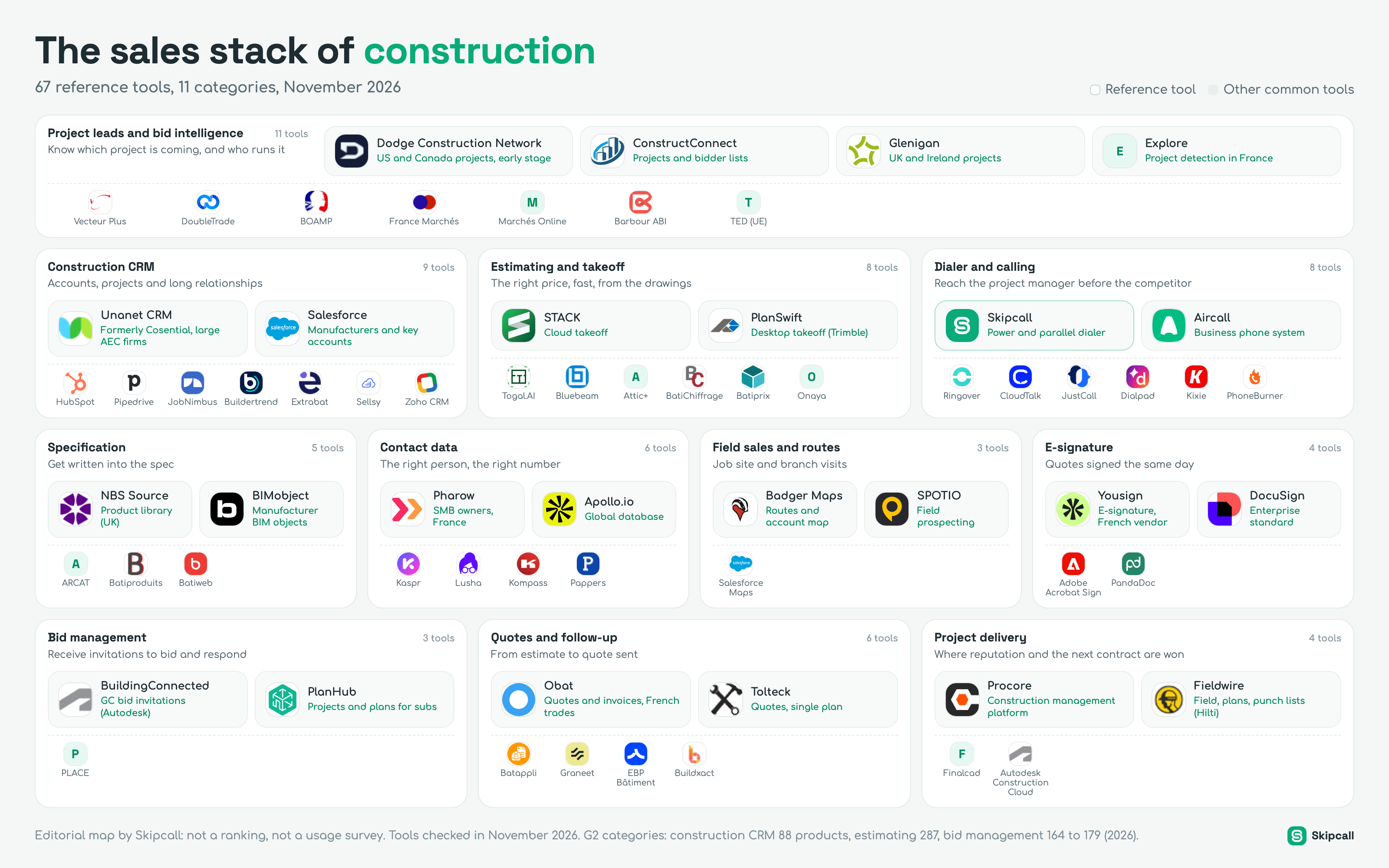
In construction, a sale does not start when a prospect fills in a form. It starts months earlier, when a permit is filed, an owner puts a project out to bid or an architect writes the spec for a trade package. Construction sales teams therefore rely on tools you rarely see anywhere else: project lead services, estimating from drawings, specification libraries and bid platforms. Here is the map of those tools, sorted into eleven categories.
The map serves three kinds of sellers: contractors and subcontractors looking for work, building product manufacturers who need to be specified, and distributors, supply houses and rental companies that keep job sites running. Below the map, each category gets its own section: what the tool changes in a rep’s day, when it becomes worth buying, how to choose it, what it costs when the price is public and the trap to avoid. The last part puts it all in order: the stack by company size, the sales cycle of a project, the rules for calling in the US and the UK, and a way to audit your own stack in an afternoon.
The sales stack of construction
67 reference tools, 11 categories, November 2026
Project leads and bid intelligence
11 toolsKnow which project is coming, and who runs it
 Dodge Construction NetworkUS and Canada projects, early stage
 ConstructConnectProjects and bidder lists
 GleniganUK and Ireland projects
- EExploreProject detection in France
 Vecteur Plus
 DoubleTrade
 BOAMP
 France Marchés
- MMarchés Online
 Barbour ABI
- TTED (UE)
Construction CRM
9 toolsAccounts, projects and long relationships
 Unanet CRMFormerly Cosential, large AEC firms
 SalesforceManufacturers and key accounts
 HubSpot
 Pipedrive
 JobNimbus
 Buildertrend
 Extrabat
 Sellsy
 Zoho CRM
Estimating and takeoff
8 toolsThe right price, fast, from the drawings
 STACKCloud takeoff
 PlanSwiftDesktop takeoff (Trimble)
 Togal.AI
 Bluebeam
- AAttic+
 BatiChiffrage
 Batiprix
- OOnaya
Dialer and calling
8 toolsReach the project manager before the competitor
 SkipcallPower and parallel dialer
 AircallBusiness phone system
 Ringover
 CloudTalk
 JustCall
 Dialpad
 Kixie
 PhoneBurner
Specification
5 toolsGet written into the spec
 NBS SourceProduct library (UK)
 BIMobjectManufacturer BIM objects
- AARCAT
 Batiproduits
 Batiweb
Contact data
6 toolsThe right person, the right number
 PharowSMB owners, France
 Apollo.ioGlobal database
 Kaspr
 Lusha
 Kompass
 Pappers
Field sales and routes
3 toolsJob site and branch visits
 Badger MapsRoutes and account map
 SPOTIOField prospecting
- Salesforce Maps
E-signature
4 toolsQuotes signed the same day
 YousignE-signature, French vendor
 DocuSignEnterprise standard
 Adobe Acrobat Sign
 PandaDoc
Bid management
3 toolsReceive invitations to bid and respond
 BuildingConnectedGC bid invitations (Autodesk)
 PlanHubProjects and plans for subs
- PPLACE
Quotes and follow-up
6 toolsFrom estimate to quote sent
 ObatQuotes and invoices, French trades
 TolteckQuotes, single plan
 Batappli
 Graneet
 EBP Bâtiment
 Buildxact
Project delivery
4 toolsWhere reputation and the next contract are won
 ProcoreConstruction management platform
 FieldwireField, plans, punch lists (Hilti)
- FFinalcad
 Autodesk Construction Cloud
How to read this map
The map follows the life of a construction project, from the first plans to closeout. Read it in three steps.
- 01
Spot:
At the top sit project leads and bid intelligence. Their job is to tell the rep which projects are coming, what stage they are at and who is running them: owner, architect, engineer, general contractor.
- 02
Price and persuade:
In the middle are the CRM, estimating and calling, then specification, contact data, field routes and e-signature. This is where the rep gets on the bid list, sends a number and books the meeting.
- 03
Bid, sign and deliver:
At the bottom are bid management, quoting and project delivery. A job delivered well is the best source of the next contract: the sale does not end at signature.
In each category, the large tiles mark the reference tools, the ones a buyer will almost certainly run into. The small tiles list other common tools. This is not a ranking: we have no usage data per tool, and we do not make it up. The map deliberately mixes North American, British and French tools, because most categories exist in every country, with different vendors in each.
Project leads and bid intelligence: know which job is coming
This is the category that sets construction apart from almost every other industry. A software company looks for companies that resemble its ideal customer; a construction company looks for projects. The right prospect is not a business, it is a job that is going to happen, at a specific time, with specific people involved.
There are two sources. Public work is published: SAM.gov for US federal opportunities, state, county and city procurement portals, and in the UK the Find a Tender service and Contracts Finder. Private work and early detection require a dedicated service that spots projects at the planning or permit stage and tells you who is involved.
Dodge Construction Network
- Market
- US and Canada
- What it does
- Tracks projects from early planning through construction; includes The Blue Book Network
- Price
- Quote only
ConstructConnect
- Market
- US and Canada
- What it does
- Project information, bidder lists and award data
- Price
- Quote only
Glenigan
- Market
- UK and Republic of Ireland
- What it does
- Projects from pre-planning to completion, league tables, an API
- Good to know
- Part of Hubexo; Planning Portal partnership announced in October 2025
Barbour ABI
- Market
- UK
- What it does
- Project leads with contact details; claims more than 1.6 million projects
- Good to know
- Offers free trial leads
Dodge and ConstructConnect compete head to head, and each publishes comparison pages that favor itself: test both on your own territory and trades rather than trusting either page. In the UK, Glenigan estimated in January 2026 that the top 100 projects due to start on site that year would generate £39 billion of work. In France, the same job is done by services like Explore, Vecteur Plus and DoubleTrade, which is why they appear on the map too.
When to add it. As soon as your backlog depends on projects you do not know about yet. A contractor that lives on repeat clients can start with free public bid alerts; a company that wants to break into new owners or new general contractors needs early detection, before the invitation to bid goes out.
How to choose. Ask for a trial on your region and your trades, and count three things: relevant projects per month, how much lead time they give you before the bid, and the quality of the contacts attached. A lead service that tells you about a project once the bid is already public is only replacing a free alert.
Construction CRM: track projects, not just companies
A construction CRM has to answer a question generic CRMs handle badly: who is involved in which project, at which stage. The same job involves an owner, an architect, an engineer, a general contractor and subcontractors, and those people change from one phase to the next. The architect who designed this building is already working on three others, and is often the real long-term relationship, more than the end client.
Those counts, taken from G2’s software categories, show how much specialized software construction has: its own CRMs, its own estimating tools and its own bid platforms. Unanet CRM, formerly Cosential, targets mid-size and large architecture, engineering and construction firms; it held a 4.0 out of 5 rating on 261 G2 reviews when we checked in November 2026. JobNimbus is built for roofing and exterior contractors, Buildertrend for home builders and remodelers. Salesforce dominates among building product manufacturers with large key account teams, while HubSpot, Pipedrive and Zoho CRM remain common at smaller firms.
| CRM | Best for | What sets it apart | Watch out for |
|---|---|---|---|
| Unanet CRM Formerly Cosential | Mid-size and large AEC firms | Projects, references and proposals in one place | Custom pricing; some users find it hard to customize |
| Salesforce Manufacturers and key accounts | Manufacturers selling through contractor and distributor networks | Deep customization; Salesforce Maps for field teams | Implementation and admin often cost more than licenses |
| HubSpot, Pipedrive General CRMs | Smaller contractors, distributors, rental companies | Fast to set up, visual pipeline | You have to build the project object and stakeholder roles yourself |
| JobNimbus, Buildertrend Trade software with CRM | Roofers, exterior contractors, home builders | CRM lives next to estimates, scheduling and jobs | Less suited to a team prospecting at volume |
How to choose. Run the test on a real project: create it, attach five stakeholders with their roles, then move it from planning to bid. If the CRM forces you to duplicate records or bury everything in notes, it will not last six months. Check as well what lands on the record without typing: Skipcall integrates with HubSpot, Pipedrive, Salesforce and Attio, and every call is logged with its outcome after the call.
In construction, today’s customer is a project; tomorrow’s relationship is the architect who drew it.
Estimating and takeoff: the right number, fast
In most industries, pricing is a back-office task. In construction, it is the heart of the sale. A subcontractor responding to an invitation to bid is judged first on the number and on how fast it comes back. Slow takeoffs lose bids; wrong takeoffs lose money on the job.
Takeoff tools read the drawings, measure areas, lengths and counts, then feed an estimate. STACK runs fully in the cloud; PlanSwift, from Trimble, is desktop software; Togal.AI promotes automatic area detection with AI; Bluebeam is widely used to mark up and measure PDF drawings. ProEst was acquired by Autodesk and folded into Autodesk Construction Cloud. In France, Attic+, BatiChiffrage, Batiprix and Onaya cover the same ground, which is why they sit on the map.
- Numbers out faster, so more bids handled every week.
- Alternates priced in minutes when the GC asks for an option.
- One shared cost database, so every estimator prices the same way.
- Migrating existing cost databases and assemblies, which teams routinely underestimate.
- AI area detection, strong on simple plans, weaker on dense MEP drawings.
- The link to the quoting tool: a takeoff you have to re-key loses half its value.
The trap. Buying the most powerful takeoff software for a team that prices three bids a month. The right tool depends on your bid volume and the complexity of your trade: a drywall sub does not have the needs of a concrete contractor bidding public work.
Dialer and calling: reach people in the field
Construction decision-makers do not sit at a desk. An owner-operator spends the day between job sites, a project manager between site meetings, a supply house buyer at the counter or on the phone. They read little email during the day and pick up their cell between visits. For a team selling into construction, the phone is not one channel among many: it is often the only one that gets an answer the same day.
| Family | What the tool does | Lines dialed at once | Built for |
|---|---|---|---|
| Business phone systems Aircall, Ringover, CloudTalk, Dialpad, JustCall | Lines, softphone, call history, inbound calls | One, by hand | The whole company, inbound and outbound |
| Power dialers PhoneBurner, Kixie, Skipcall | Dials the next number as soon as the previous call ends | One, automatically | Reps working through a list of customers or projects |
| Parallel dialers Skipcall | Dials several numbers at once and connects the rep to whoever answers | Up to four with Skipcall | Teams prospecting at volume |
Two uses dominate in construction. The first is prospecting a list of projects or companies: the lead service surfaced fifty jobs, and the rep has to reach fifty people before the competition does. The second is follow-up: quotes sent, bids pending, contractor accounts that have not ordered in two months. In both cases, the time lost dialing, waiting and landing in voicemail is the difference between twenty and sixty useful calls in a morning.
Skipcall
Best for: teams that sell to construction companies and want to call their project, customer and quote lists with a power dialer or a parallel dialer, with recording and automatic CRM updates.
Skipcall is an outbound calling platform: a parallel dialer with up to four lines, a power dialer, recording and transcription, AI call summaries, sequences, a mobile app for reps on the road, and integrations with HubSpot, Pipedrive, Salesforce and Attio. Its enrichment fills in phone numbers for the contacts you already have, imported from a file or synced from your CRM; Skipcall does not sell a contact database. Plans with the dialers start from $70 per license per month (pricing). It is our product.
Specification: get written into the spec
For a building product manufacturer, the most important sale is often made to someone who never buys anything. The architect, the specifier or the engineer writes the specification: if your product is named in it, the contractor who builds the job has every reason to buy it. This is specification selling, a sale in its own right, with its own tools.
NBS, which is part of Hubexo like Glenigan, keeps the NBS Chorus and NBS Source brands in the UK in 2026 and uses the Lattira name internationally. ARCAT provides manufacturer BIM objects, CAD details and CSI-formatted specifications in the US.
How to measure it. Specification is slow: a product written into a spec today gets ordered twelve or eighteen months later. Track in the CRM the specifiers you met, the projects where your product is specified, then the revenue that follows. Without that link, specification stays a cost line nobody can defend.
The architect buys nothing, but decides what will be bought.
Contact data: the right person, the right number
A lead service gives you the company and sometimes the project manager’s name. You still have to find the right person and a number that actually reaches them. Construction is full of small owner-operated firms, where the owner’s number is often their cell and they make the call.
Apollo.io, Lusha and Kaspr provide business contact details, with coverage that varies by country and trade; in the UK and Europe, Pharow (France), Kompass and public company registers fill gaps. The only reliable test is your own list: run a hundred real contacts through two or three providers and count the numbers that reach the right person.
The trap. Buying a generic “construction” list. A list of every construction business in a state mixes concrete subs, engineering firms, plumbers and developers. Start from your trades, your territory and the company size you know how to serve, then clean the result with the CSV cleaner before you import it.
Field sales and routes: visit the right sites
Reps for manufacturers, distributors and rental companies spend much of their week on the road: contractor offices, job sites, architecture firms, supply house counters. Route tools put accounts on a map, plan the day and flag who has not been visited in a while. Badger Maps and SPOTIO are the references; Salesforce Maps does the same for teams already on Salesforce. Buyer’s guides put Badger Maps at roughly $58 to $69 per user per month depending on the source.
- 01
Morning, call before you drive:
A short calling session confirms the day’s meetings and adds one or two stops along the route.
- 02
On the road, visit in order:
The route tool lays out the planned visits and suggests nearby accounts that have not been seen.
- 03
Between visits, follow up from your phone:
Quote follow-ups and callbacks run from the dialer’s mobile app, and every call lands in the CRM.
- 04
Evening, finish the CRM:
All that is left is what the tools could not log on their own: the agreed next step and the follow-up date.
E-signature: quotes signed the same day
A verbal yes is not a signed contract. Between the agreement on the phone and the signed proposal, the customer can receive a competing number. E-signature shortens that gap: the customer signs on their phone, from the job site. DocuSign remains the enterprise standard; Adobe Acrobat Sign and PandaDoc are common alternatives; Yousign, a French vendor, serves many European firms.
Add it when: your quotes sit for days without an answer, or customers ask to sign remotely instead of scanning a printed page.
Most construction quoting tools now include online signature. Check whether yours is enough before adding one more tool.
Bid management: receive invitations and respond
For a subcontractor, a large share of revenue arrives through invitations to bid from general contractors. In North America, those invitations largely run through platforms: the GC invites its subs, shares drawings and levels the bids it receives.
| Platform | For whom | What it does | Price checked (Nov. 2026) |
|---|---|---|---|
| BuildingConnected Autodesk | General contractors and subcontractors | Bid invitations, drawings, bid leveling (BuildingConnected Pro), bid tracking for subs (Bid Board Pro), sub qualification (TradeTapp) | Free for subs receiving invitations; paid plans quote-only |
| PlanHub US | Subcontractors and suppliers | Project and plan access, bid responses | Free tier; paid plans listed from about $1,999, with a billing period that differs by source |
| Public portals SAM.gov, Find a Tender | Firms bidding on public work | Official notices and bid documents | Free |
In France, public bids go through buyers’ platforms such as PLACE for central government, which is why it appears on the map, and private work is still largely handled by email and phone.
The sales reflex. An invitation received is not a bid won. A call to the GC’s project manager or estimator, with a real technical question before you submit, puts you in the mind of the person who will compare the numbers. It is a short, useful call that most competitors never make.
Quotes and follow-up: from estimate to proposal sent
The quoting tool is often the first software a construction business buys, before a CRM. It turns the estimate into a presentable proposal and handles deposits, progress billing and the final invoice. For the sales team, it holds something valuable: the list of quotes sent and not yet signed.
Buildxact
- For whom
- Residential builders and remodelers
- What it does
- Estimating, takeoff and quotes in one tool
- Markets
- Australia, US, UK and others
JobNimbus
- For whom
- Roofing and exterior contractors
- What it does
- CRM, estimates and job tracking
- Good to know
- 14-day free trial
Obat
- For whom
- French trades and small contractors
- Price checked
- €49, then €20 per extra user, month to month
- Good to know
- AI voice quoting add-on billed separately
Tolteck
- For whom
- French trades wanting one simple plan
- Price checked
- €19 excl. VAT per month billed yearly, €25 month to month
- Good to know
- A single plan, no tiers
The French tools are on the map because many European construction firms use them; the logic is the same everywhere. Prices above come from comparison sites published in 2026 and from vendor pages where they show them, and may have changed since November 2026.
Project delivery: where the next contract is won
Project management is not a sales tool in the strict sense. It still belongs on the map, because in construction, reputation is built on the job site. An owner happy with the schedule, the daily reports and the punch list calls the contractor back for the next project, and tells others.
Procore is the broadest construction management platform: financials, scheduling, quality, bidding and field work. Fieldwire, acquired by Hilti, focuses on the field: current plans on mobile, tasks, punch lists and reports. Autodesk Construction Cloud brings Autodesk’s tools together, BuildingConnected included; Finalcad is widely used in France for field execution.
The stack by company size
The map shows everything a construction sales organization could buy. No company needs all of it at once. Here is how a stack usually grows.
Owner-operator or small trade
- Leads
- Free public bid alerts for your area and trade
- Selling
- A quoting tool with e-signature, the owner's cell phone
- Next
- A standing rule to call every unsigned quote
Mid-size contractor or distributor
- Leads
- A project lead service for your region
- Selling
- CRM with a project object, takeoff software, power dialer
- Next
- Route planning for reps on the road
Manufacturer or general contractor
- Leads
- Early detection plus bid platforms
- Selling
- Key account CRM, specification, contact data, parallel dialer
- Next
- Project delivery linked to the CRM, specification tracking
Order matters more than count. A firm that buys a CRM before it has a steady source of projects fills an empty tool. A firm that buys a lead service with nobody to call the projects pays for alerts it never reads. Start with the source of projects, then with what turns a project into a conversation: the phone and the CRM.
The sales cycle of a construction project
A construction sale does not follow the buyer’s calendar; it follows the project’s. Each stage has its decision-maker and its tool.
| Project stage | Who decides | What the rep does | Main tool |
|---|---|---|---|
| Planning and permits Months before the job | Owner, developer | Spots the project, maps the stakeholders | Project leads |
| Design Concept to bid documents | Architect, engineer, specifier | Gets the product or solution specified | Specification, CRM |
| Bidding Public or private bid | Owner, general contractor | Prices the job, asks questions, submits | Estimating, bid platforms, phone |
| Negotiation and award Buyout | Owner, GC buyer | Adjusts, follows up, gets it signed | Quotes, phone, e-signature |
| Construction and closeout Delivery | Project manager, owner | Delivers, documents, sets up the next job | Project delivery, CRM |
Construction also has its own seasonality: public budgets are set at the start of the fiscal year, bid volumes bunch up in certain months, and winter weather and holidays slow both sites and decisions. A sales team that prospects continuously, rather than reacting to published bids, smooths out those dips.
The rules for calling: B2B is open, but not everywhere the same
Two practical precautions. First, a one-person trade often uses the same cell for family and business: call about their business, during working hours, and record any opt-out request at once. Second, keep a record of where every number came from. Our cold calling compliance checker shows the rules that apply by country, contact type and time of day.
What a good first call to a contractor sounds like
Tools only create the opportunity to talk. What happens in the first thirty seconds decides whether that opportunity turns into a bid invitation, a site visit or a polite no. Construction buyers hear from many suppliers and subs, and they screen fast. A call that starts from their project, not from your product, gets a hearing.
Three habits separate the reps who get on bid lists from the ones who leave voicemails all week.
Ask one real question. Who is handling the estimate, when are bids due, which alternates are they looking at. A question with a useful answer earns the next call; a pitch earns a hang-up. Write the answer in the CRM against the project, not just the company, so the next rep who calls knows where things stand.
Call when people pick up. Field people are easiest to reach before they leave for the site and once they are back in the truck at the end of the day; office-based estimators keep more regular hours. Test your own windows rather than trusting a generic rule: your call history will show when your contacts actually answer. For a sense of scale, Gong’s analysis of more than 300 million cold calls put the average connect rate at 5.4%, and 13.3% for the top quarter of reps, which is why the number of dials per hour matters so much.
Never leave a call without a next step. A date to call back once the drawings are out, the name of the estimator, a site visit, a sample drop-off. A call that ends with “send me something” and nothing else is usually a call that ends there.
A call that starts from their project, not from your product, gets a hearing.
If your team works long lists of contractors, a power dialer or parallel dialer removes the dead time between those conversations, and call recordings let a manager coach the first thirty seconds that make the difference.
Common mistakes
How to audit your sales stack in an afternoon
- Where do our projects come from today, and how many do we see before the bid goes out?
- How long between receiving an invitation to bid and sending our number?
- How many unsigned quotes have had no follow-up in two weeks?
- How many calls does each rep make per day, and how many turn into a conversation?
- Which tools write to the CRM on their own, and which force someone to retype?
- The list of tools, their owner and their cost per active user.
- Overlaps to merge and licenses to cut.
- The metric each tool is supposed to move.
- The missing category that holds revenue back the most.
To see what a meeting booked by phone costs your team, the cost per meeting calculator gives an estimate in two minutes, and our cold call connect rate benchmarks put your numbers in context. To see the same map for software companies, read our B2B SaaS sales stack map, or our guide to building a sales tech stack. The Skipcall page for construction covers the use cases for the industry.