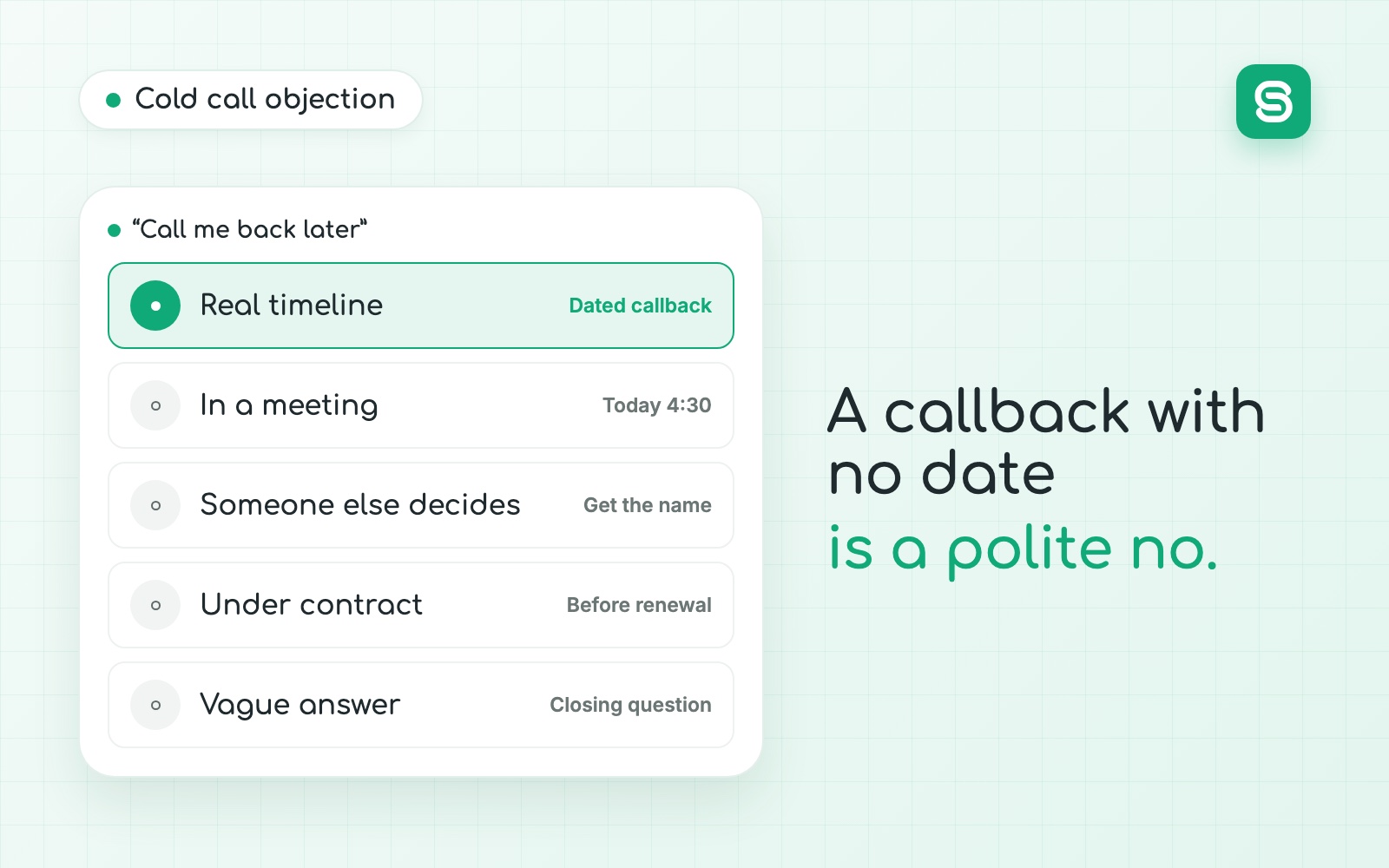
“Call me back later.” It is the friendliest thing a prospect can say, and one of the most expensive for a rep. Friendly, because it closes nothing. Expensive, because it almost always ends up in the CRM as “call back in Sept,” and by September nobody remembers why.
This guide covers the thirty seconds after that line, while you are still on the call: figuring out what it means, responding, getting a real date, and writing the right note. The callback itself, when the day comes, has its own guide: how to call a prospect back.
What does “call me back later” actually mean?
Same words, different situations. On a cold call they cover at least six realities, and each one calls for a different response. Treating them all the same way, meaning you jot down a date and hang up, gives a live project and a polite no exactly the same care.
The first three are good news: there is a project, or at least a reachable person. The fourth is a dated opportunity. The last two are rejections that do not say their name, and treating them as real postponements fills your calendar with callbacks that lead nowhere. The outright no has its own guide: the “I’m not interested” objection.
Treating them all the same way gives a live project and a polite no exactly the same care.
So the job is not to “overcome” the objection the way you would handle “it’s too expensive.” It is to figure out which of the six you are facing. The full set of objections and responses is in our guide to cold call objections; here we stay with the one that sounds most like a yes.
At the start of the call or after your pitch?
When the line comes matters as much as the line. In the first ten seconds, before you have said why you are calling, “call me back later” is about the prospect’s schedule or their urge to hang up: they know nothing about your offer yet. Two minutes in, the same words are about your offer: they heard it, and they are hesitating.
The first case has a complete, ready-to-use script: the “bad time” objection. The second gets the same question as every other case, with closer attention to the second sentence of the answer.
Why taking the postponement at face value costs so much
The reflex makes sense: the prospect was polite, you do not want to push, you log “call back in Sept” and move to the next dial. Three things get lost in that reflex.
There is a deeper reason to push for a specific day and time rather than a month. In psychology, planning of the form “when situation X arises, I will do Y” is called an implementation intention. The meta-analysis by Peter Gollwitzer and Paschal Sheeran, published in 2006 in Advances in Experimental Social Psychology (volume 38, pages 69 to 119), pooled 94 independent tests and found a positive effect of medium-to-large size (d = .65) on reaching goals. We reread the abstract on November 12, 2026.
This research is not about sales, and a later analysis by Sheeran, Listrom and Gollwitzer puts the effect lower once publication bias is corrected. The idea still holds: a commitment that spells out when and where is kept more often than a general intention. “Tuesday, September 8 at 11 a.m. Eastern, right after your leadership meeting” is an implementation intention. “September” is not.
The last two figures come from Gong Labs’ analysis of cold call opening lines, published April 19, 2018 and viewed November 12, 2026. They are not about postponements as such, but they show something useful here: a rep who hands the prospect an exit (“is this a bad time?”) books fewer meetings. The “yes, call me back later” you invited yourself is the hardest one to turn around. Our cold call openers avoid that trap from the first sentence.
The one question that sorts it in ten seconds
One question is enough, as long as you ask it after accepting the postponement, not instead of it.
It works for three reasons. It starts with a yes, so the prospect has nothing to defend. It serves their interest (“the right moment”), not yours. And it can only be answered with a fact: an event, a person, a date, or the absence of all three, which is also an answer.
Depending on how you talk, three variants get the same result:
- “Happy to. What’s happening on your end between now and then?”
- “No problem. Is ‘later’ about a project, a budget, or just your week?”
- “Got it. So I don’t call you for nothing: what will make that moment better than now?”
The answer puts you on one of six branches. The tree below gives, for each one, what it means and the line that comes next.
The "call me back later" decision tree
One question, six possible answers. Pick what the prospect tells you.
"Call me back later."
"Sure. So I call at the right moment: what will have changed by then?"
They answer
They answer: A specific event
The prospect"We lock the budget in late August."
Real timeline. The project exists, and the date depends on an event you can name.
"Got it. If I call you Tuesday, September 8 at 11, right after that review, does that work?"
OutcomeDated callback, reason on file
They answer: No time right now
The prospect"I'm walking into a meeting."
Bad moment of the day. Nothing to do with your offer: they cannot talk right now.
"I'll let you go. Today at 4:30 or tomorrow at 9, which is easier?"
OutcomeCallback within 24 hours, time set
They answer: Someone else
The prospect"You'd have to talk to our VP of Sales."
Not the decision-maker, or not alone. The postponement is a way not to say it.
"Thanks, that helps. What's their name, and can I mention that we spoke?"
OutcomeNew contact, same account
They answer: A vague answer
The prospect"I don't know, we'll see."
Probably a polite brush-off. No date, no event: nothing will change by then.
"I'd rather not bother you for nothing. Honestly, is this on your list this year, yes or no?"
OutcomeClosing question
They answer: A contract in place
The prospect"We're locked in through December."
Window closed for now, but with a known end date.
"Noted. How far ahead of the renewal do you usually decide? I'll call you then."
OutcomeDated callback before renewal
They answer: A no
The prospect"Actually, we're not interested."
No interest. "Later" was a soft way to say no.
"Thanks for telling me straight. I'll note not to follow up. Have a good day."
OutcomeRecord closed, no callback
Two cautions. First, do not ask in a tone that challenges: it should sound like someone filling in a calendar, not an interrogation. Second, listen to the whole answer. The best clues often come in the second sentence (“…and I’d need to loop in Mark”). How to catch them is covered in our guide to active listening in sales.
A postponement that becomes a booked callback
Look, now's not a good time. Call me back later.
Sure. So I call you at the right moment: what will have changed by then?
We lock next year's budget at the end of August. Until then I can't commit to anything.
That's clear. Is that budget yours to own, or does it also go through your CFO?
I build it, he signs off.
Then how about Tuesday, September 8 at 11 a.m. Eastern, right after that review?
Tuesday the 8th, 11, yes.
Great. I'll send a quick confirmation shortly. Is this the best number to reach you?
In under a minute, the rep has a date, a time, a line, a reason, and the name of the approval path. They did not pitch, and that is on purpose: a prospect who just said “not now” will not listen to a pitch.
18 word-for-word responses, by variant
“Later” comes in different shapes, and each shape needs a different adjustment. The eighteen exchanges below are grouped by variant. For each: the reflex reply, the one that moves forward, and why.
”I’m in a meeting” / “Now’s not a good time”
The most honest postponement: they cannot talk. The right goal is not a callback next month, it is a callback in a few hours.
“I'm walking into a meeting, call me back later.”
“No problem, I'll try you next week.”
“I'll let you go. Today at 4:30 or tomorrow at 9, which is easier?”
“I'm driving right now.”
“This will be really quick, just two minutes.”
“Then I won't keep you. I'll call at 2, will you be in by then?”
“It's really not a good time.”
“When would be a better time for you?”
“Understood. In one sentence: I'm calling about [topic]. I'll call Thursday at 9:30 a.m., does that work?”
”Call me next week”
A week is short: often a real postponement, sometimes a way to buy time. Pin down the day and time on the spot.
“Call me back next week.”
“Sounds good, I'll call you next week.”
“Happy to. Tuesday or Thursday? ... Thursday, 10 or 2?”
“Next week I'll have a clearer picture.”
“Okay, I'll let you get back to me.”
“What will be clearer next week? ... Got it, I'll call Wednesday at 11, right after that.”
“Just email me a time for next week.”
“Will do.”
“I can give you one right now, it's simpler: Tuesday at 9:30? I'll send the invite right after.”
”Call me after Labor Day” / “after the holidays”
Seasonal postponements are often sincere: vacations, quarter close, back-to-school, year-end. But “September” with no reason turns into “October,” then “January.” The same responses work for “call me after the holidays”: swap Labor Day for the first full week of January, and ask the same question about what happens then.
“Call me after Labor Day.”
“Got it, I'll call you in September.”
“Sure. What happens after Labor Day? ... Then I'll call Monday the 14th at 10, once things settle.”
“After the summer, we'll see.”
“Perfect, enjoy your summer!”
“Enjoy it. So I don't call for nothing: will this be on your plate in the fall, or is it too early to say?”
“In September we'll have a new VP of Sales.”
“I'll call you in September then.”
“Good to know. I'll call you mid-September, and you can tell me whether I should talk to them directly. Do you know who it is yet?”
”Call me back in a few months” / “in six months”
Six months is long. Either there is a real deadline (contract, budget, a move), or it is just far enough away to feel polite.
“Call me back in six months.”
“No problem, I'll make a note.”
“Sure. What happens in six months? ... Your contract ends in March, so you'll decide in January or February? I'll call mid-January.”
“Maybe in a few months.”
“Okay, I'll reach out in May.”
“Let me ask you straight so I don't bother you for nothing: is this something for you this year, yes or no?”
“We're under contract, call me back later.”
“When does your contract end?”
“Makes sense. How far ahead of the renewal do you usually start looking at options? I'll call you then.”
By the day the contract ends, the choice was made long ago.
”Call me after budget season”
The budget postponement is usually sincere and usually wasted: reps call after the budget is set, when the time to get into it was before.
“Call me when we have budget.”
“Sounds good, keep me posted.”
“Sure. When does budget get decided, and who builds it? ... If it helps, I can send you a cost estimate for your team before then, to drop into your planning.”
“No budget this year, call me next year.”
“I'll call you in January.”
“Understood. Does your fiscal year start in January? Then planning happens in the fall: I'll call early October, before it's locked.”
“I need to run it by finance first.”
“Okay, I'll call you in two weeks.”
“Of course. What will finance want to see? ... I'll put that on one page, and call you Thursday the 16th at 10 to hear how it landed.”
What a finance leader wants on that one page is covered in our guide on how to cold call CFOs.
”Just send me an email and I’ll get back to you”
The postponement that takes the rep out of the loop: the prospect will call back. In practice, they almost never do.
“Send me an email, I'll get back to you.”
“I'll send over a deck.”
“Happy to. So it's actually useful: what should be in it to make another conversation worth it? ... I'll send it, and call you Tuesday at 11 to go over it.”
“I'll look at your email and call you.”
“Great, I'll wait to hear from you.”
“Thanks. So I don't chase you for nothing, how about ten minutes Thursday at 2: if it's not a fit, you can tell me then.”
“Leave me your info and I'll call you.”
“My number is (555) 010-xxxx.”
“Sure, I'll text it to you. And so it doesn't get lost in your week, I'll try you Monday at 10: if you call me first, even better.”
To rehearse these lines out loud before using them live, our objection handling practice tool serves them at random, and our cold call role play scenarios give a two-person session format.
How to lock in a specific day and time
The postponement becomes a pipeline step the moment it has a date, a time and a line. Five moves, in this order, are enough.
- 01
Anchor the date to the event.
The callback lands right after the event the prospect named, or before the decision if it is a renewal. “After your board meeting on the 4th” beats “early September." - 02
Offer two slots yourself.
"Tuesday at 10 or Thursday at 2?” Do not ask “when are you free?”: an open question gets a vague answer. Prefer hours when the prospect is at their desk; our benchmarks on the best time to cold call B2B help you choose. - 03
Confirm the line and the time zone.
”Should I call this number, or your direct line? And that’s 11 Eastern?” A perfect callback to a main line that never connects, or at the wrong hour for Denver, is not a callback. - 04
Have them say it back.
”So Tuesday the 8th, 11 a.m., on your cell?” Wait for a spoken yes. A commitment said out loud by the prospect carries more weight than “mm-hm.” - 05
Confirm in writing within the hour.
A short text or email restates the date, time and reason. The callback now lives on both sides.
And if the prospect will not commit to a time? Offer a half-day (“morning of the 8th?”) and log it as is. If they will not even do that, you are probably on the dodge branch: ask the closing question rather than pushing.
The proportions in that example are assumptions to illustrate the math, not a measurement. Run your own numbers with our call attempts calculator.
What to write in the record before you hang up
The note gets written while the prospect’s words are still exact: before you hang up, or within thirty seconds after. Not at the end of the day. Six fields are enough.
The six-field callback note
Write it in the contact record before you hang up, while the prospect’s words are still exact.
- 1WhenDay, date, time, time zone, and who calls whom
Filled-in exampleTue, Sept 8, 11:00 a.m. ET. I call her direct line.
- 2Why that dateThe event that makes the callback useful
Filled-in exampleFY27 budget gets locked at the late-August leadership meeting.
- 3Their wordsOne sentence from the prospect, word for word
Filled-in example"We lose an hour a day just dialing numbers."
- 4SituationTeam, current tool, deadline
Filled-in example4 reps, wants 6. Phone contract runs through Dec 31.
- 5Who decidesName and role of the person who signs
Filled-in exampleShe recommends, the CFO (Mr. Reynolds) signs.
- 6Until thenWhat you promised to send or do
Filled-in exampleConfirmation email today. Nothing else before the 8th.
Example written for this article: fictional company and contact.
CALLBACK AGREED
When: [day, date, time, time zone] / [line to call]
Why that date: [event the prospect named]
Their words: "[sentence, word for word]"
Situation: [team, current tool, deadline]
Who decides: [name, role]
Until then: [what I promised] / [next planned touch]
Postponement no.: [1, 2, 3]
The most important field is “their words.” One sentence from the prospect, captured verbatim, is what makes the callback sound natural: “You mentioned you lose an hour a day just dialing. Did the budget go through?” A note in the third person (“interested in saving time”) does not have the same effect. Same principle as paraphrasing: the prospect recognizes what they said.
The “postponement no.” field feeds the rule in the next section. A prospect’s second postponement is not handled like the first. This note is the short form of a call summary; when a call gives you more to work with, start from our sales call summary templates.
If your calling tool records and transcribes conversations, the exact sentence can be found afterward. In Skipcall, calls are recorded, transcribed and summarized by AI, so you can pull the quote without typing during the call. The rest of the note, the date, the reason and what you promised, is still worth entering yourself: you are the one who knows what was agreed.
A note that says “call back in Sept” is useless on the day.
How many postponements before you stop?
There is no magic number, and we will not invent one. There is a logic: every postponement should bring something new. A postponement that brings nothing is a dodge.
| Situation | What it tells you | What you do |
|---|---|---|
| First postponement, specific reason | Normal. The project exists or could. | Dated callback, reason logged, written confirmation. |
| Second postponement, new reason E.g. budget passed, but a hire is pending | The deal is moving, slowly. | New dated callback tied to the new event. |
| Second postponement, same reason or none | "Later" is not moving. Likely a dodge. | Closing question: "Is this something for you this year?" |
| Third postponement | Not a priority, whatever they say. | Clean close, number left, callback only if they come back. |
| Agreed callback, prospect unreachable | Something came up, or interest faded. | A few attempts at varied times, one text, then a closing message. |
The closing question is not a threat, it is a courtesy. It gives the prospect permission to say no, which many would not do on their own.
The closing question, on a second vague postponement
Ah, call me in January instead, things are crazy right now.
No problem. In June it was the budget; what's changed since?
Nothing specific, it's just busy.
Let me ask you straight so I don't bother you for nothing: is this something for you this year, yes or no?
Honestly, no. It's not a priority.
Thanks for telling me. I won't follow up. If it comes back on the table, you have my number.
That no is a good outcome. It frees a slot on your callback list for someone with a real project, and it leaves a better impression than a fifth unrequested call. How to space attempts when a prospect does not pick up is covered separately in our guide on how to follow up on a cold call.
What to do between the call and the callback
As little as possible, but done well. The prospect asked for time; filling it with nudges means you did not listen. Two touches are enough in most cases.
The confirmation, within the hour
A text if the callback is soon, an email if it is far off or if you promised a document. Three things: date and time, reason, your name.
More templates, for a callback with no date or after “just email me,” are in our text templates after a sales call and our follow-up email after a call. In the US, texting prospects comes with its own rules; check them before you send, and check message length with our SMS character counter.
The useful touch, only if promised
For a postponement of several months, one touch in between is acceptable, provided you announced it on the call (“I’ll send the estimate when it’s ready”) or it brings information about the event they named. A case study from their industry, a rule change that affects their project, an article that answers the question they asked you. Never a “just checking in.”
What not to send
- The general brochure, which answers nothing they said.
- An automated weekly nudge sequence to someone who asked for six months.
- A webinar invite unrelated to why they postponed.
If you work several channels, our guide to multichannel prospecting shows how each channel sets up the call instead of replacing it.
The long postponement: six months or more
A six-month or one-year postponement is the most fragile. The prospect changes jobs, the company changes priorities, your contact forgets the call. Three rules keep it alive without nagging.
In between, one touch per quarter at most, and only if it has substance. The goal is not to stay top of mind at any cost; it is that on the callback day, the prospect remembers you as the person who understood their situation, not the one who emailed every two weeks.
Mistakes to avoid
One organizational mistake too: keeping callbacks in your head or a notebook. A rep is out for a week, and their Tuesday callbacks are gone. The callback has to live in a shared tool, with an owner.
Better twenty dated callbacks and eighty records closed cleanly.
Where the tool helps, and where it replaces nothing
No software asks the sorting question for you. A calling tool can, however, make sure an agreed callback never gets lost.
In Skipcall, a callback becomes a task dated to the day and hour, tied to the contact, with a title and a note. On the day, it shows up in the “Today” tab; if the time passes, it moves to “Overdue,” with a counter that stays visible in the navigation. A counter shows how many times the contact has already been called on that task, which feeds the postponement rule directly. Every task has an owner, and unassigned tasks stay visible to the whole team: if a rep is out, a teammate picks it up. You call straight from the task, without hunting for the number. We are also building an MCP connector for Skipcall; what that kind of connector can do for call prep is covered in our article on MCP for cold calling.
For higher volumes, sequences work through a list with the power dialer or the parallel dialer, and the outcome of each attempt is logged on the record, then synced to HubSpot, Pipedrive, Salesforce or Attio. The confirmation text goes out from the same number as the call, through the built-in SMS inbox.
Three free tools round out the method. The sales cadence generator plans attempts when an agreed callback does not pick up. The call attempts calculator estimates how many tries to plan. The when to call tool helps pick the slot to offer.
And on the day of the callback?
Everything above prepares one moment: the call on Tuesday the 8th at 11. That moment has its own rules: reread the note in thirty seconds, open on the promise kept rather than “just following up,” reuse the prospect’s words, handle the second postponement. They are laid out in our guide on how to call a prospect back.
If the callback turns into a discovery conversation, our cold call discovery questions take over. If it lands on a front desk, our gatekeeper script helps you reach the right person. And after a full block of callbacks, take fifteen minutes for a cold call review: that is where you see which responses held up.
For the whole method, from list to meeting, our cold calling guide walks through every step.
What to remember
- “Call me back later” has six meanings: real timeline, bad moment, someone else decides, contract in place, polite dodge, disguised no.
- One question sorts them: “What will have changed by then?”, asked after you accept the postponement.
- You set the day and time, anchored to the event they named, on the right line, in their time zone, said back out loud, confirmed in writing within the hour.
- The note gets written before you hang up, in six fields, with one sentence from the prospect word for word.
- Every postponement should bring something new. The same vague postponement a second time calls for a closing question.
- In between, little but useful: one confirmation, and one touch in between only if promised.
- Call before the decision, never on the renewal date.




