Most calling sessions end the same way. You take the headset off, check how many meetings you booked, decide it was a good day or a bad one, and move on. The next morning you make the same calls, with the same lines and the same gaps. The cold call review is the fifteen minutes that break that loop.
What is a cold call review?
A cold call review is a short, structured look at your own calls, done by you, right after a prospecting session. It has one goal: decide what you will do differently next session. It is not a recap of the day, a coaching session or a stats report.
It is different from three nearby rituals, each with its own article on this blog.
The review comes after all of these. It turns a session, whatever its format, into a decision. Without it, role play works on imagined situations, and coaching works on whatever the manager had time to hear. With it, every rep shows up with their own material: a real call, a precise moment, an instruction they chose.
Why alone, and not with a manager?
Because the review has to happen daily, or close to it, and no manager can give fifteen minutes per rep per session. More importantly, the person who made the call is the only one who remembers what they were thinking while they made it. They know they hesitated before the second question, that they had already decided the prospect was not interested, that they wanted off the call before the objection came. None of that is in the recording.
The manager has a role, once a week, on material the rep has already sorted. We cover it further down.
Why fifteen minutes, and why right away?
Fifteen minutes, because that is what a rep will actually keep doing every day. Right away, because your memory of the call fades fast, and the review leans on that memory as much as on the recording.
What the research says about forgetting
The forgetting curve comes from Hermann Ebbinghaus, who measured, in experiments on himself in 1879 and 1880, how long it took him to relearn lists after different delays. In 2015, Jaap Murre and Joeri Dros ran the experiment again: their participant learned lists and relearned them after 20 minutes, 1 hour, 9 hours, 1 day, 2 days, 6 days and 31 days. Their results, published in PLOS ONE (accessed November 12, 2026), are close to the original data: forgetting is fastest right after learning, then slows down.
A sales call is not a list of syllables, and we are not transposing any number. But the direction is clear, and everyone has lived it: by evening you remember that a call “went badly,” not the exact line that made it turn. Right after the session, you still know where you lost the thread, and why.
By evening you remember that a call went badly, not the exact line that made it turn.
Why not longer
A one-hour review produces one good review, then none. The routine that lasts is the one that costs little. Fifteen minutes after a one-to-two-hour session is a little over ten percent of your phone time, and it is the only part of that time spent getting better.
The short window also forces you to choose. You cannot replay everything in fifteen minutes, so you decide which calls matter. That choice is already half the work.
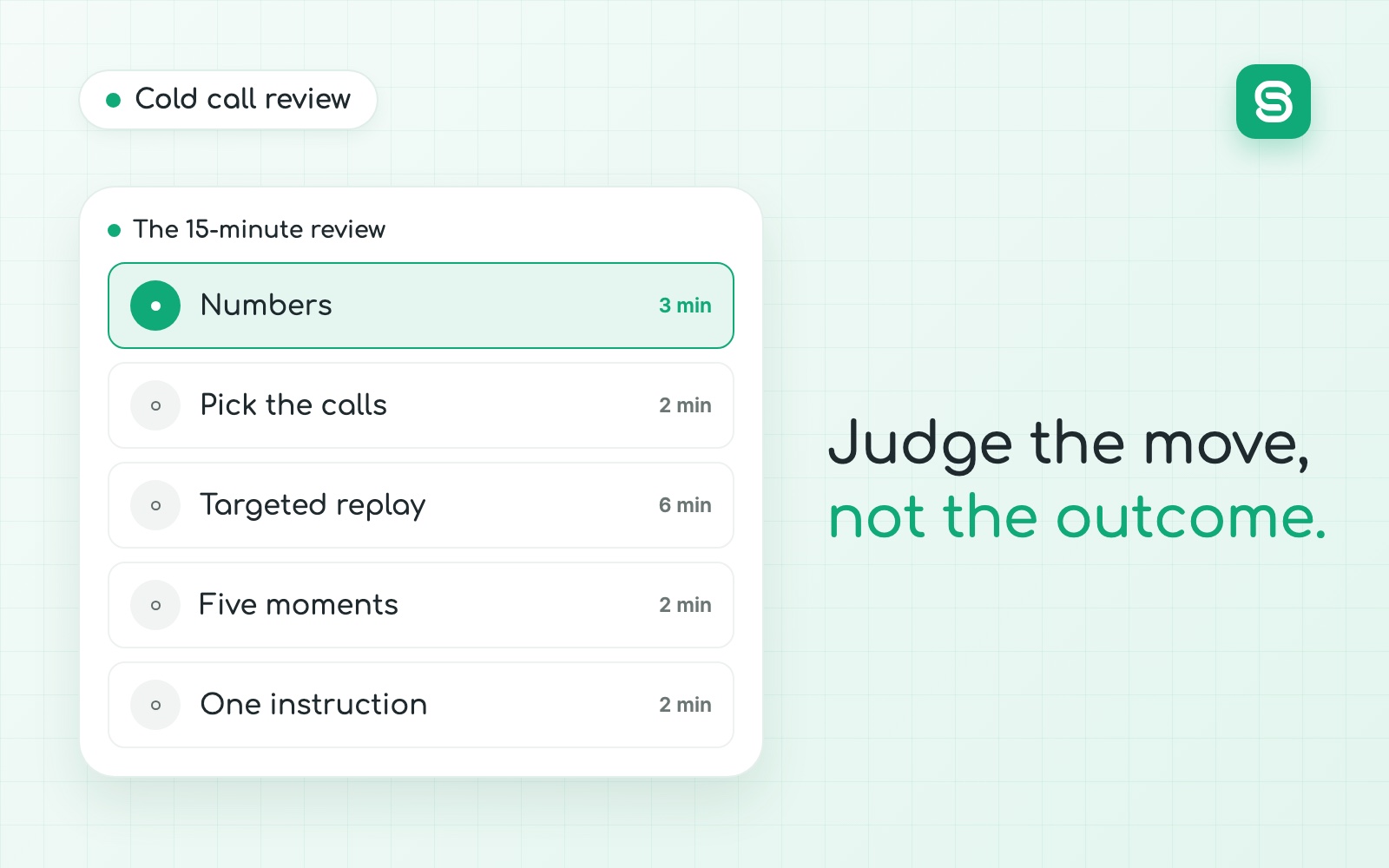
The 15-minute review, minute by minute
Here is the full routine. All you need is a headset, your calling tool open, and the review sheet in this article, or a sheet of paper.
- 01
Minutes 0 to 3: the numbers.
Write down dials, pickups, conversations, meetings and session length. Work out the three ratios. Do not comment yet: just spot the ratio that moved away from your recent sessions. That ratio decides which calls you replay. - 02
Minutes 3 to 5: picking the calls.
Scan the session’s call list, or the summaries. Pick three calls at most using the rule in the next section: the best one, a call that started well and went wrong, the one that turned. Note roughly where to listen in each. - 03
Minutes 5 to 11: targeted replay.
Replay passages, not whole calls. Two minutes per call. If you have the transcript, read first and replay only the lines you marked: the text tells you what was said, the audio tells you how. - 04
Minutes 11 to 13: the five moments.
For the most useful call, grade the opener, first question, turning point, objection and close as held, shaky or lost. One call is enough for the sheet. The other two are there for contrast. - 05
Minutes 13 to 15: the instruction.
Write one thing to change next session, in the form “when…, I…”. Add how you will know you did it. Then close the review, even if there is more to say.
The routine fits easily into a rep’s day. If you do not have a set structure yet, our article on the SDR daily routine shows where to put calling blocks and prep time.
Which calls should you listen to, and which should you skip?
Three calls at most, picked for what they can teach you, not for how they ended. Everything else shows up in the numbers.
How to find those three calls fast
You already know your best call. For the other two, duration is a good clue. A call that ran clearly longer than your usual rejections and then ended with no next step is often one that started well. Our article on how long a cold call should last helps you place your durations.
The ratio that moved also steers the pick. If pickups rarely become conversations, take two short calls cut off in the first thirty seconds: the problem is in the opener. If conversations rarely become meetings, take two long calls with no next step: the problem is in discovery or the close.
What not to replay
| Call type | Why to skip it | Where to read it instead |
|---|---|---|
| Voicemails | There is no sales move to judge, unless your message never changes | The voicemail count in the session numbers |
| Disconnected or wrong numbers | That is a list problem, not a talk track problem | The pickup rate, and the quality of the list |
| Hang-ups under five seconds | The prospect did not hear your opener, they refused the call | The time slot and the targeting, not the recording |
| Every call in the session | You will get nothing out of it in fifteen minutes, and the routine will not last | Three chosen passages are enough |
A good call you cannot explain is just luck.
What should you listen for in a call, and in what order?
Five moments, in the order they happen. For each, one simple question and a three-way verdict: held, shaky, lost. Order matters: a call lost at the opener has no first question to grade, and there is no point working on the close of a call the prospect left at second twenty.
The opener
Did you say who you are, where you are calling from and why, without apologizing for the interruption? Listen to your own voice: pace, tone, first sentence. The prospect decides very quickly whether to listen. Lines that hold up are in our guide to cold call openers.
The first question
Was your first question about their situation, or about your product? And above all: did you leave the silence after it? Plenty of reps ask a good question and then answer it themselves. Questions that open the conversation are collected in cold call discovery questions.
The turning point
The moment the prospect stops listening. You can hear it: shorter answers, a flat “yeah, yeah,” a faster pace, “look, I’ve got to go.” Find the line right before it. It is almost always yours: a pitch too early, a closed question, jargon. Our article on active listening in sales covers these voice cues in detail.
The objection
Did you ask a question before answering? “Just send me an email,” “we already have a tool,” “no time” each hide several situations. A direct answer only addresses the one you imagined. Responses that work are in cold call objections, and the brush-off has its own article: the “call me back later” objection.
The close
Did you propose a precise next step with a date, and did the prospect accept it out loud? “I’ll follow up” with no date is not a close. “I’ll send an invite for Thursday at 2, does that work?” is. If the next step is a callback, our guide on how to call a prospect back shows how to set it so it actually happens.
One cue runs through all five moments: who is talking. If the passage you replay has you stringing together three or four sentences before the prospect gets a word in, the turning point is close. Our article on the talk-to-listen ratio explains how to measure it without chasing the wrong target.
The same passage, heard two ways
Here is a sample passage worth replaying, and what you hear depending on whether you judge the outcome or the move.
A call that started well
You mentioned your reps spend late afternoons updating the CRM. Roughly how much time does that take each week?
Honestly, I don't know. A lot. It's a real issue for us.
That's exactly it, our tool syncs everything automatically so your team never types a thing, and we also have a mode that dials several numbers at once...
Yeah, yeah. Look, just send me something by email and I'll take a look.
The rep sends the email. No meeting.
Judged on the outcome, this call is a failure: no meeting. Judged on the moves, it is more interesting. The opener held, and so did the first question: the prospect called it “a real issue.” The turn is clear: it comes at the third line, when the rep answers with two features instead of digging into “a lot.” The “yeah, yeah” that follows is the signal. The “send me an email” objection is only the consequence.
The instruction that comes out of this is not “handle the email objection better.” It is: “when the prospect admits a problem, I ask a second question before I mention the product.”
The objection is often just the consequence of a turn that happened thirty seconds earlier.
What numbers should you check after a session?
Four counts and a duration, plus the three ratios that come from them. They do not grade the session: they tell you where to look in the calls.
Decide once and for all what counts as a “conversation.” A simple definition: an exchange with the right person, past the opener, where the prospect answered at least one question. Without a stable definition, the ratio moves with your mood. Detailed definitions and the traps behind each metric are in our articles on call metrics worth tracking and SDR metrics and KPIs.
Unanswered calls: a pattern to read, not to replay
Dials that nobody picks up are not worth replaying, but they are worth sorting. Once a week, group them by time slot and by list. If one hour of the day or one segment picks up clearly less than the rest, across several sessions, the fix is not in your talk track: move the session or rework the list. Our article on the best time to cold call B2B prospects helps you pick the slots to test.
Why compare yourself to yourself, not to an average
An industry average blends lists, targets, time slots and tools that have nothing to do with yours. A pickup rate depends as much on the list as on the rep. Your own history keeps the same target and the same method: it is the only baseline that isolates what you changed.
On a single session, the numbers are small and swing a lot. One more or one fewer meeting out of six conversations moves the ratio by several points. Read the trend across sessions in the call log, and use today’s number only to pick which calls to replay. To estimate how many dials you need to hit a meeting goal, our prospecting calculator runs the math from your own ratios.
The call review sheet to fill in online
The sheet below follows the three blocks of the review: the numbers, with the ratios worked out for you, the five moments to grade, and the instruction for tomorrow. The button copies the completed sheet as plain text: paste it into a note, a spreadsheet or your log. Nothing is sent and nothing is saved.
Cold call review sheet
Fill it in right after the session. The ratios compute themselves, and the button copies the completed sheet.
1The session numbers
Four counts and a duration. Leave blank what you do not have.
2The replayed call, moment by moment
One verdict per moment. Judge the move, not the outcome of the call.
-
Opener
Did I say who was calling and why in under fifteen seconds, without apologizing?
-
First question
Was my first question about their situation, and did I leave the silence after it?
-
Turning point
Did I hear the moment they mentally checked out, and did I react?
-
Objection
Did I ask a question before answering, instead of arguing?
-
Close
Did I propose a dated next step, accepted out loud?
3One thing to change tomorrow
A situation and a move. Not an intention.
Nothing is sent: the sheet stays in your browser.
This sheet is the routine. For a detailed, criterion-by-criterion rating of a single call, with a score, use our free sales call scorecard. The two work together: the sheet every day, the full scorecard once a week on the call you want to bring to your manager.
Held, shaky, lost: how to decide
| Verdict | What you hear | What you do with it |
|---|---|---|
| Held | The move is there, and the prospect responds the way you hoped | Write down the exact line: that is what you want to repeat |
| Shaky | The move is there, but misplaced, too long or recited | A candidate for the instruction if no moment is lost |
| Lost | The move is missing, or it made the prospect check out | Priority: the instruction targets the first lost moment |
The priority rule is simple: the instruction targets the first lost moment in the order of the call. If the opener is lost, do not work on the close. If nothing is lost, take the first shaky moment.
How do you turn a review into an instruction for the next session?
In one sentence, in the form “when [situation], I [move],” with a success check you can observe. An instruction is not an intention. “Listen better” or “be more punchy” cannot be checked. “When the prospect says ‘send me an email,’ I ask what they would want to read in it” can be checked on three calls.
Why only one instruction
Because on a live call, you have room for one extra thing to think about on top of the conversation. Three instructions dissolve by the second call. One, repeated across a whole session, becomes a habit within days.
There is a deeper reason. In 1996, Avraham Kluger and Angelo DeNisi published a meta-analysis in Psychological Bulletin of 607 effects of feedback on performance, covering 23,663 observations. The average effect is positive, but more than a third of feedback interventions lowered performance. Their explanation: feedback gets less effective the more it pulls attention away from the task and toward the self (paper summary, accessed November 12, 2026).
Applied to a call review, that gives a practical rule: an instruction about a specific move (“I count two seconds”) keeps attention on the task. A verdict about yourself (“I’m terrible at objections”) moves it to the person, which is exactly the kind of feedback that risks lowering performance.
An instruction is about a move, never about you.
Checking the instruction at the next review
The next review opens with one question: did I hold yesterday’s instruction? Three possible answers.
- 01
Held, and the numbers follow.
Keep it for one or two more sessions so it becomes a habit, then move to the next one. - 02
Held, but nothing moves.
Keep it a few more sessions: a ratio from one session is too noisy to judge. If nothing moves after a week, the problem is somewhere else. - 03
Not held.
Do not swap the instruction. Make it easier to hold: a sticky note on the screen, a line written out in advance, a single type of situation.
The four-week call log
One review fixes one call. A log fixes a way of prospecting. One line per session is enough: the date, the four numbers, the moment most often lost, the instruction, and whether you held it.
| Week | What you work on | What you check at the end |
|---|---|---|
| Week 1 | Hold the routine every day, without aiming for progress. The instruction targets the first lost moment | Did you review every session? Which moment comes back lost most often? |
| Week 2 | One instruction for the whole week, on that moment | Did the ratio tied to that moment move compared with week 1? |
| Week 3 | If that moment is fixed, move to the next one in call order. If not, rewrite the instruction | Are the grades for the moment you worked on going from lost to shaky, then held? |
| Week 4 | Replay your best call from week 1 and your best from week 4, back to back | What sounds different. That is the clearest proof, far more than the ratios |
The week-four comparison is the most useful exercise of the month. You cannot hear yourself improve day to day. You hear it very clearly three weeks apart.
Deliberate practice: what holds up, and what to qualify
The idea of working on one specific move, with feedback, rather than “putting in the hours,” owes a lot to Anders Ericsson, Ralf Krampe and Clemens Tesch-Römer’s work on deliberate practice, published in 1993 in Psychological Review. They describe demanding activities designed to improve one specific point. A replication published in 2019 in Royal Society Open Science by Brooke Macnamara and Megha Maitra did not reproduce all of the original results and found a noticeably smaller effect of practice (replication paper, accessed November 12, 2026).
We take one modest lesson from this: call volume alone does not make you better. Working on one move at a time, with feedback, is more likely to change something than running session after session without looking back. We do not promise more than that.
How does a manager use the team’s call reviews?
They do not redo the review for the rep. They work from what the rep has already sorted, once a week, in twenty minutes or less per person. The full weekly system, with the scorecard calibration and the coaching log, is in our sales coaching program guide.
The rep brings
Their instruction for the week, their call log, and one call passage that shows it: either the instruction held or the instruction missed. The rep picks the passage.
Listen together
The chosen passage, once. The rep says first what they hear. The manager adds one observation at most, on the same moment of the call.
Read the log
The moment most often lost during the week, and the ratio that goes with it. No session-by-session commentary: you are looking for the trend.
Set the next instruction
Keep it, rewrite it or move to the next moment. The rep decides; the manager checks that it can be observed.
This weekly check-in beats randomly listening to two calls per rep: the manager only hears what matters, chosen by the person who knows what happened. For a manager’s other rituals, see live call coaching during calls, and how to improve SDR performance for the full diagnostic.
The calling tool’s dashboard helps prep this meeting. In Skipcall, the dashboard classifies every attempt (real conversations, voicemails, invalid numbers, calls that never connected) and shows volume, pickup and qualification rates per rep: the numbers for the sheet are already there.
No manager? Run it as a peer review
If nobody can run that check-in, pair up. Two reps swap one passage each every week. One plays it and states their instruction, and the other answers a single question: “Did you hear the move I was going for?” Ten minutes each, no score, no general advice. The pair keeps the benefit of an outside ear without turning the replay into an evaluation.
How do transcripts and AI summaries speed up the review?
By reading before you listen. Replay is the longest part of the review and the easiest to shorten: you can skim text far faster than you can listen to audio, and it lets you jump straight to the passage that matters.
- 01
Read the summaries to choose.
Each call summary tells you what was asked, promised and left open. In two minutes you spot your best call and the one that started well, without replaying anything. - 02
Read the transcript to locate.
In the call you picked, look for where the prospect’s answers get shorter. Mark the line right before: that is what you will replay. - 03
Listen only to the marked passages.
The text tells you what was said; the audio tells you how. Tone, pace, hesitation and silence only live in the recording. That is why you replay.
In Skipcall, recording starts with the call, the transcript is ready as soon as it ends, and an AI-generated summary captures the essentials. All of it is attached to the contact record, and search runs on the text of every call: you can find an objection or a competitor’s name without replaying calls one by one. The summary is also pushed as a note into HubSpot, Pipedrive, Salesforce or Attio. Details are on the recording and transcription page. A review and a call summary do different jobs: the review makes you better, the summary keeps your team and your CRM informed. For the second, use our sales call summary template.
On how accurate transcripts really are and what a summary can and cannot tell you, see our article on AI call transcription and summaries. For analysis across a team and dozens of calls, see conversation intelligence for sales.
What prompts should you give an AI assistant to review a transcript?
Precise ones, that ask for quoted passages rather than general impressions. A chat assistant is good at spotting patterns in text, but it judges poorly what it cannot hear: tone, silence, hesitation. Use it to locate moments, not to decide for you.
Before pasting a transcript into an outside tool, check what your company policy allows: a recorded conversation contains the prospect’s personal data. At the very least, strip out names, phone numbers and addresses.
Our AI sales prompt generator offers more ready-to-use prompts. Skipcall is also preparing an MCP connection that will let an AI assistant read your transcripts and summaries directly, with no copy-paste: we explain what that protocol will change for call prep in our article on MCP for cold calling.
The mistakes that make a call review useless
If the review is hard for another reason, because hearing your own voice is painful or every session takes effort, our article on call reluctance covers that separately. A short review focused on one move often helps: it swaps a global verdict on yourself for a precise task.
Recording calls to review them: the legal picture in brief
Reviewing your calls means recording them, and call recording is regulated. In the United States, federal law and most states allow recording when one party to the call consents, but several states require the consent of everyone on the call, and calls that cross state lines can bring the stricter rule into play. Calls to other countries follow their own laws, such as the GDPR in Europe.
Our guide to call recording laws for businesses covers the rules, and our call recording laws by state tool gives the state-by-state picture. To write the disclosure line to say or play at the start of a call, use our call recording notice generator. In Skipcall, recording, retention and deletion settings can be configured to match your internal policy.
What to remember
- The review is an individual exercise, done by the rep, within the hour after the session, in fifteen minutes.
- Four numbers steer the replay. The ratio that moved tells you which calls to replay: calls cut off early for the opener, long calls with no next step for discovery and the close.
- Three calls at most: the best one, one that started well and went wrong, the one that turned. The rest lives in the numbers.
- Five moments, in order: opener, first question, turning point, objection, close. Held, shaky or lost. The instruction targets the first lost moment.
- One observable instruction, in the form “when…, I…”, checked at the next review. Never a verdict about yourself.
- A four-week call log shows the progress that daily ratios hide, especially when you replay your best call from week 1 next to your best from week 4.
- Transcripts save time, not judgment: read first, then replay only the passages you marked.
To place the review in the full method, from the list to the close, go back to our cold calling guide.




