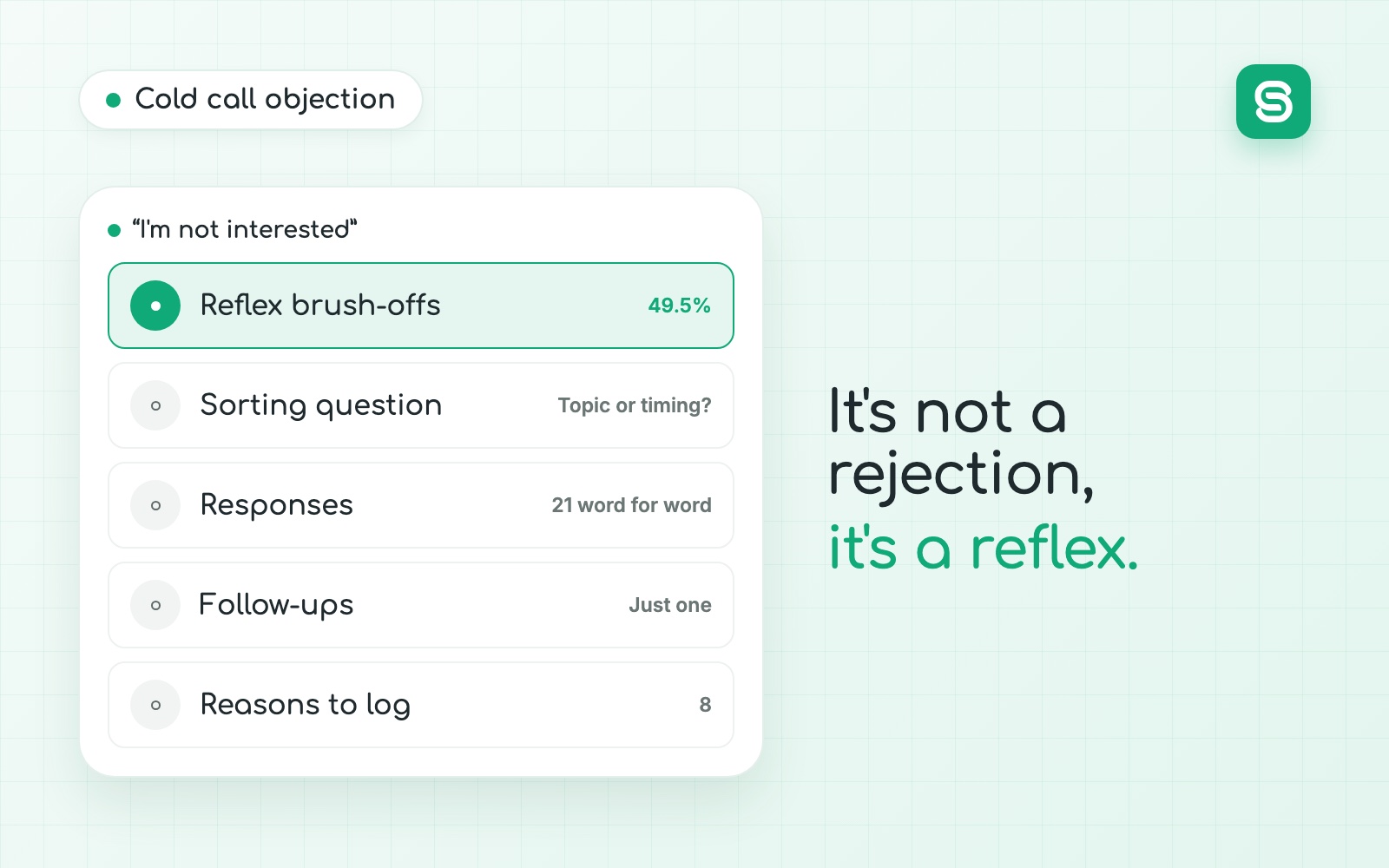
“I’m not interested.” Three words, often said before you finish your first sentence. It is the most common objection in phone prospecting and the most misread one: reps treat it as a decision, when the prospect has not had anything to decide on yet.
This guide covers the twenty seconds after that line. It does not replace our overview of cold call objections, which handles all the others: it zooms in on this one, the most frequent, with the question to ask, the word-for-word responses, and the point where you should stop.
What does “I’m not interested” really mean on a cold call?
Most of the time it does not mean “your product doesn’t interest me.” It means “I don’t want to be interrupted,” “I don’t know who you are,” or “this isn’t my area.” The prospect picks up, hears an unfamiliar voice and a sales tone, and answers before understanding anything. It is a response to the format of the call, not to its content.
The largest analysis available on the topic comes from Gong. In a post published July 31, 2024, the company says it analyzed more than 300 million cold calls (accessed November 13, 2026) and sorts objections into three families. Dismissive objections, where “not interested” sits alongside “call me in six months” and “send me some information,” make up 49.5% of the total. Gong writes that they are not real objections.
The same post adds that the top five objections account for 74% of all the objections reps run into. In other words, a rep who has a handful of responses down covers most of what they will hear, and “not interested” belongs to the largest family in the analysis.
Why it’s a reflex, not a rejection
Put yourself in the prospect’s chair. They are in the middle of something, the phone rings, an unknown number. They answer, hear “Hi, this is Jake with…” and know within a second it is a sales call. At that point they know nothing: not the topic, not what is in it for them, not how long it will take. The only thing they know is that someone wants their time.
“I’m not interested” is the shortest, most polite exit available. It needs no explanation, hurts nobody, and almost always works, because most reps either hang up or launch into a pitch that confirms the reflex. Prospects have learned that this line ends calls. They use it the way you close a pop-up ad.
It is a response to the format of the call, not to its content.
That changes the rep’s job. You are not “overcoming” a rejection the way you would answer “it’s too expensive.” You are giving the prospect, in one sentence, the information they were missing to make a real decision, and then letting them make it. If they say no with that information in hand, it is a real no.
When the line lands tells you almost everything
The same words mean different things depending on when they come. That is the first signal to read, even before tone.
On a cold call, it is usually the first case. You fix it with your opener, not with a rebuttal. The third looks more like a classic objection, and the right move is a question that brings the real reason to the surface.
Why you shouldn’t hang up or argue
When reps hear “I’m not interested,” two reflexes dominate, and both are expensive.
The first reflex underestimates what a conversation is worth. In a fully anonymized Skipcall sample of 86,168 outbound calls placed over 12 months (November 2025 to November 2026) by a B2B prospecting team calling mostly French companies, 17.9% of calls were picked up and about 11% turned into a conversation longer than 30 seconds. That is roughly 9.1 dials per conversation. The full breakdown is in our cold calling statistics. The market differs from a US list, but the order of magnitude is the point: every live conversation is scarce.
The one-third share and the three-in-ten figure are assumptions to illustrate the math, not measurements. What matters is the logic: each conversation you get has already cost about nine dials, and dropping it over a reflex is the most expensive way to waste time.
The second reflex, arguing, fails for a simpler reason: it answers a question the prospect never asked. They said they did not want to give you time; you take more of it. In the same analysis, Gong advises agreeing first, then getting the prospect to their real objection. That is exactly what the clarifying question does.
Each conversation you get has already cost about nine dials.
The clarifying question that sorts it out
One question, asked after you accept the line, is enough to know what you are dealing with. It changes with the moment.
These work for three reasons. They open with agreement, so the prospect has nothing to defend. They serve the prospect’s interest (“so I don’t waste your time”), not yours. And they offer a simple either-or, topic or timing, that forces an answer based on a fact rather than a second reflex.
Depending on how you talk, these variations get the same result:
- “No problem. Is that because you’ve already got this covered, or because it’s just not a priority right now?”
- “Fair enough. Do you mean not at all, or not right now?”
- “I believe you. Let me just tell you why I called, and if it’s not relevant, I’ll hang up. Deal?”
The tree below walks through the three moments and the most common prospect answers. In three clicks it shows what the answer means, the exact line to say with a button to copy it, and where the conversation likely goes next.
What did that “not interested” actually mean?
Three clicks: when they said it, what they answer, then the exact line to say.
“I'm not interested.”
Step 1. When did they say it?
Step 1. When did they say it?: In the first five seconds
Step 2. You say this, then they answer
“Totally fair, you don't even know why I'm calling yet. Can I tell you in one sentence, and you tell me if it's worth thirty more seconds?”
They answer
They answer: “Go ahead, make it quick.”
Step 3. Your reply
Pure reflex. They said no to the interruption, not to you. You get one sentence, and that sentence decides the rest.
“Thanks. I call sales leaders running teams of [5 to 15] reps who prospect by phone. A lot of them tell me their reps spend more time dialing than talking. Is that true for you too, or not at all?”
The prospectKind of, yeah. Mondays especially.
YouWhat happens on Mondays?
OutcomeConversation open
They answer: “No, I really don't have time right now.”
Step 3. Your reply
A bad moment in disguise. The “not interested” was about their day, not your topic.
“I'll let you go. In a word, it's about [reason]. Should I call tomorrow at 9 or Thursday at 2 Eastern, when it's calmer?”
The prospectThursday, I guess.
YouThursday at 2 Eastern, on this number. Thanks, have a good one.
OutcomeCallback within 48 hours
They answer: “That's not something I handle.”
Step 3. Your reply
Wrong person. They are not against it, they are just not the one.
“Thanks for telling me, I won't bother you with it again. Who handles it on your side? Can I mention you pointed me their way?”
The prospectTalk to Megan Brooks, she runs the sales team.
YouThanks. Is she easier to catch in the morning or the afternoon?
OutcomeNew contact, same account
Step 1. When did they say it?: Right after your reason for calling
Step 2. You say this, then they answer
“Got it. So I don't waste your time: is it the topic that doesn't fit, or the timing?”
They answer
They answer: “We already have a tool for that.”
Step 3. Your reply
Already covered. Not a rejection of the topic: they solved it. The question is whether they are happy with it.
“Most teams I call do. On a scale of 1 to 10, where would you put it today?”
The prospectA seven, it does the job.
YouWhat would make it a nine?
OutcomeDiscovery on the current setup
They answer: “Timing. We have other priorities.”
Step 3. Your reply
Not a priority right now. The topic exists, it just comes after something else.
“Appreciate the honesty. What's the team focused on right now? I could call back once that's done. Early [month]?”
The prospectWe're hiring two reps, they start in March.
YouThen I'll call Tuesday, March 9 at 10 Eastern, once they're on board.
OutcomeDated callback tied to an event
They answer: “The topic. We just don't do that here.”
Step 3. Your reply
Real lack of interest, often a targeting mistake. Pushing will not change it.
“Then I called you for the wrong reason, thanks for saying so. I'll note that this isn't relevant for you. Have a good day.”
The prospectNo problem, you too.
You(Record closed with the reason “not a fit.”)
OutcomeRecord closed, reason logged
Step 1. When did they say it?: After a pitch or a question
Step 2. You say this, then they answer
“Okay. Just so I understand: what makes you say that?”
They answer
They answer: “It's too expensive for us.”
Step 3. Your reply
A real objection hiding behind the stock phrase. This one you can work with: it has an object.
“Thanks for being straight with me. Too expensive compared to what: your current budget, or what it would bring in?”
The prospectCompared to what we pay now.
YouRoughly what do you pay today, per rep?
OutcomeReal objection, worth handling
They answer: “We handle that in-house.”
Step 3. Your reply
Homegrown solution. They compare you to what they already do, not to nothing.
“Makes sense. Who takes care of it today, and roughly how much of their week does it take?”
The prospectOne rep, about half a day a week.
YouIf they got that half day back, what would they do with it?
OutcomeDiscovery on the hidden cost
They answer: “Take me off your list.”
Step 3. Your reply
An explicit do-not-call request. Not an objection anymore: a request to honor.
“Understood. I'm taking you off our call list right now. Sorry to have bothered you, have a good day.”
The prospectThanks.
You(Do-not-call request logged on the record.)
OutcomeDo-not-call request logged
Two cautions. First, tone: ask the question in a calm, slightly slower voice, the way you would ask for a detail, not the way you would push back. Second, the limit: one follow-up. If the prospect repeats “no, really, I’m not interested” after your question, you have your answer. Listening all the way through the sentence that follows your question is half the job; the techniques are in our guide to active listening in sales.
A first-seconds reflex that turns into a conversation
Hi Lauren, this is Jake Miller with [company].
Look, I'm not interested.
Totally fair, you don't even know why I'm calling yet. Can I tell you in one sentence, and you tell me if it's worth thirty more seconds?
Go ahead.
I saw you're hiring three inside sales reps. I call sales leaders in that spot, because new reps usually raise the question of how much of their day goes to dialing. Is that on your radar, or not at all?
Actually, yeah. They spend their mornings leaving voicemails.
Whole mornings? Walk me through what that looks like today.
In this exchange, written for the article, the rep pitched nothing. They earned one sentence, tied it to a fact about the company (a hiring push), and ended with a question that is easy to say no to. What follows is discovery, not a demo; our cold call discovery questions take it from there.
21 responses to “I’m not interested,” by situation
“Not interested” comes in several forms, and each one needs a different adjustment. The twenty-one exchanges below are grouped by situation. For each: what the prospect says, the reflex reply, the reply that moves forward, and why. All are written for this article; swap the brackets for your own topic.
The first-five-seconds reflex
The prospect has not heard why you called. Your only goal is one sentence, not a meeting.
“I'm not interested.” (before any pitch)
“But you don't even know what I'm offering!”
“Totally fair, you don't even know why I'm calling yet. Can I tell you in one sentence, and you tell me if it's worth thirty more seconds?”
“No thanks, not interested.”
“Okay, sorry to bother you.”
“I believe you. I'm calling for a specific reason: [fact about the company]. If it's not relevant, I'll let you go right away.”
“We're not buying anything.”
“I'm not selling anything, I just want to chat.”
“And I'm not going to sell you something over the phone. I just want to know whether [topic] is on your radar or not at all. One question settles it.”
“I don't have time for this.” (right after hello)
“It'll be quick, just two minutes.”
“Understood, I won't keep you. One sentence so you know why I called, then you decide. Fair?”
”We already have a vendor”
This is the most honest version of “not interested”: the prospect has dealt with the topic. They are not rejecting the need, they are saying it is covered. Gong files this kind of answer under existing-solution objections, the smallest family in its analysis.
“We already have a tool for that.”
“Sure, but ours is way better.”
“Most teams I call do. On a scale of 1 to 10, where would you put it today?”
“We're really happy with our provider.”
“You could still compare, though, right?”
“Good, that's rare. What do you like most about them? That way I'll know whether we have anything different to tell you, or not.”
“We just signed with someone.”
“Oh, too bad. Have a good one.”
“Congrats, that's a big project. How long is the contract? I could call a few months before it's up, so you can compare then.”
“We've used [competitor] for years.”
“Did you know they raised their prices?”
“It's a solid tool. What I hear from teams that have used it a long time is mostly [specific, verifiable limit]. Is that true for you, or not at all?”
”We do it in-house”
The prospect is comparing you to what they already do, not to nothing. The answer is to make the cost of the homegrown solution visible, without judging it.
“We handle that in-house.”
“You're probably losing a lot of time.”
“Makes sense. Who takes care of it today, and roughly how much of their week does it take?”
“We built our own tool.”
“That must be expensive to maintain.”
“Nice, that's a real investment. What does it do really well, and what do you wish it did that it doesn't yet?”
This case has its own full script, with variations and follow-ups: the “we do it in-house” objection.
The wrong person
The prospect is not against it; it is just not theirs. “Not interested” sometimes stands in for “I’m not the one who decides.”
“That's not something I handle.”
“Could you transfer me to the right person?”
“Thanks for telling me, I won't bother you with it again. Who handles it on your side? Can I mention you pointed me their way?”
“Not my call, try corporate.”
“Do you have a number for corporate?”
“Thanks. At corporate, is it usually sales leadership or procurement that picks this kind of tool? Do you know who I should call?”
“I'm not the decision-maker.”
“No problem, I'll call your manager.”
“Appreciate the honesty. Day to day, does [topic] affect you? If so, I'd value your take before I reach out to [the person who decides].”
If the decision-maker sits behind a front desk or an assistant, our gatekeeper script takes it from there.
Bad timing in disguise
The “not interested” is about the prospect’s day, not your topic. The tell: they say it fast, sound rushed, and often add a detail about what they are doing.
“Not interested, I'm slammed.”
“It'll be really quick.”
“I'll let you go. In a word, it's about [reason]. Should I call tomorrow at 9 or Thursday at 2 Eastern, when it's calmer?”
“Right now? Not interested.”
“When would be a better time?”
“I heard the ‘right now.’ Is it the topic that doesn't fit, or just the timing?”
“I'm driving, not interested.”
“It'll be short, let me explain.”
“Then I won't keep you, drive safe. Can I call at 2, once you're there?”
The full case of a prospect who just says “bad time” has its own script: the bad-time objection.
A real lack of interest
Sometimes the no is a real no: the prospect understood, and the topic does not apply, or not this year. Here, the reply that moves forward is the one that closes well.
“No, that's not relevant for us.” (after your reason)
“Are you sure? A lot of companies like yours...”
“Then I called you for the wrong reason, thanks for saying so. Just for my list: is that because you don't prospect by phone, or something else?”
“It's not a priority this year.”
“I'll call you next year, then.”
“Appreciate you being straight. What's the team focused on right now? If that changes, I'd rather know than call you for nothing.”
“I told you, I'm not interested.” (second time)
“I understand, but just let me explain...”
“You're right, and thanks for answering. I'll note this isn't relevant for you. Have a good day.”
The second time, it is a decision.
Variations that hide another question
Two lines often come attached to “not interested” and need their own answer.
“Not interested. Send me some info if you want.”
“I'll send that right over.”
“Happy to. So it's actually useful: are you more concerned with [aspect A] or [aspect B]? I'll send just that part.”
“Not interested. And how did you get my number?”
“We have databases.”
“Fair question, and you have every right to ask. Your number came from [exact source]. If you'd rather not be called again, I'll note it right now.”
The detailed answer to that question, with the possible sources and what you should be able to say, is in our “how did you get my number?” script. And the industry-specific answers, which change the words more than the method, are grouped by vertical: for example SaaS cold call objections or staffing.
Does “not interested” change with the prospect’s role?
The words stay the same; what sits behind them changes with the job title. Knowing who you are calling tells you which branch of the tree is most likely before you even ask the question, and which one sentence is worth saying.
Two more cases come up often. An assistant or front-desk person who says “he’s not interested” is screening, not deciding; they rarely know what the call is about, and the gatekeeper approach applies rather than the objection playbook. And a user who says “not interested” may simply not be the buyer: they can still tell you how the team works today, which is the material you need for the person who signs.
The practical habit is to write your one-sentence reason per role before a session, not per prospect. Five roles, five sentences. When the “not interested” lands, you are not improvising: you already know which sentence to say and which question will sort the no fastest.
Five roles, five sentences. When the “not interested” lands, you are not improvising.
What never to say after “I’m not interested”
Some lines turn a reflex into a final no. They all make the prospect wrong or take their time without a reason.
| Line to drop | Why it fails | Say this instead |
|---|---|---|
| "But you don't even know what I'm selling." | It is true, but it accuses the prospect. | "Totally fair, you don't know why I'm calling yet." |
| "Why?" On its own, no context | It sounds like a challenge and demands a justification. | "Is it the topic, or the timing?" |
| "I totally understand, but..." | The "but" cancels the "I understand." They only hear what follows. | "Got it." Then a question, no "but." |
| "Just two minutes." | It asks for time before giving any reason to grant it. | "One sentence, then you decide." |
| "I'm not selling anything." | The prospect knows it is false. Trust drops. | "I'm not going to sell you something over the phone." |
| "A lot of companies like yours..." After a real no | It challenges an informed decision. | "Thanks for telling me. I'll note this isn't relevant for you." |
Two behaviors close the call even faster than lines. The monologue first: running the full pitch after “not interested” confirms exactly what the prospect feared. Then sarcasm or hurt pride, even slight (“oh, okay then…”), which carries over the phone far more than people think.
When should you let go, and how do you do it cleanly?
You let go as soon as the no is informed, repeated, or comes with a request to stop. One follow-up per call is the rule; past that you are not handling an objection anymore, you are pushing.
| Signal | What it tells you | What you do |
|---|---|---|
| No repeated after your question | The prospect has decided, even without the full picture. | Thank them, close the record with the reason. |
| No after your reason for calling "That's not relevant for us" | Real lack of interest or a targeting miss. | One question about why, for the list. Then exit. |
| Tone rising, clipped answers | The call is hurting the relationship. | Immediate, polite exit, no last attempt. |
| "Take me off your list" | A do-not-call request, not an objection. | Confirm it, log it on the record right away. |
| "Not interested" on the second call After an earlier reflex | The first no may not have been just a reflex. | Closing question, then close the record if the no holds. |
A clean exit has three parts: thank them, confirm what you will do, leave a door open. “Thanks for being straight with me. I’ll note this isn’t relevant for you and I won’t follow up. If that changes, we’re easy to find. Have a good day.” It costs five seconds and leaves the prospect with a better impression than most of the calls they get.
A real no, closed cleanly
I'm not interested.
Got it. So I don't waste your time: is it the topic that doesn't fit, or the timing?
The topic. We don't do any outbound by phone, everything goes through distributors.
Then I called you for the wrong reason, thanks for explaining. I'll note this isn't relevant for you. Have a good day.
Thanks, you too.
That no is a good outcome. It frees time for a prospect who actually has the need, and the reason given (“everything goes through distributors”) is valuable to whoever builds the lists.
When the prospect asks not to be called again
“Don’t call me again,” “take me off your list”: this is no longer an objection, it is a request. For telemarketing calls to residential lines, the FCC rule at 47 CFR 64.1200(d)(3) (accessed November 13, 2026) requires the caller to record the request at the time it is made and to honor it within a reasonable time that may not exceed ten business days. Business lines are treated differently under these rules, and mobile numbers used for work blur the line, so most B2B teams simply honor every request the same way.
What to log after a “not interested”
One reason, picked before you hang up, plus the prospect’s sentence word for word. “Not interested” is not a reason: it is the line you heard. The reason is what the clarifying question revealed.
Eight reasons to log after a “not interested”
One reason per record, picked before you hang up. It decides whether, when and who you call next.
- REFLEX Reflex Said no before hearing why you called.Next actionCall again with a different opener, reason for the call in sentence one.When2 to 4 weeks
- BAD_TIME Bad timing Busy, in a meeting, driving.Next actionCall back at the slot you offered and they accepted.WhenWithin 48 hours
- WRONG_PERSON Wrong person “That's not something I handle.”Next actionCall the person they named, mentioning who pointed you there.WhenThis week
- HAS_VENDOR Has a vendor A provider or tool already in place.Next actionLog the tool and renewal date, call before it.WhenBefore renewal
- IN_HOUSE Done in-house A person or homegrown process.Next actionLog who owns it, come back on a signal (hire, departure).When3 to 6 months
- NOT_PRIORITY Not a priority Other projects come first.Next actionDated callback right after the event they named.WhenAgreed date
- NOT_A_FIT Not a fit The topic does not apply to the company.Next actionClose the record, flag the targeting miss to whoever builds the list.WhenNone
- DNC Do not call “Take me off your list.”Next actionInternal do-not-call list right away, no more calls or texts.WhenNever
Timings suggested by this article; match them to your sales cycle. A do-not-call request never reopens.
“NOT INTERESTED” REASON (one per record)
[ ] REFLEX: Reflex. Call again with a different opener, reason for the call in sentence one. (2 to 4 weeks)
[ ] BAD_TIME: Bad timing. Call back at the slot you offered and they accepted. (Within 48 hours)
[ ] WRONG_PERSON: Wrong person. Call the person they named, mentioning who pointed you there. (This week)
[ ] HAS_VENDOR: Has a vendor. Log the tool and renewal date, call before it. (Before renewal)
[ ] IN_HOUSE: Done in-house. Log who owns it, come back on a signal (hire, departure). (3 to 6 months)
[ ] NOT_PRIORITY: Not a priority. Dated callback right after the event they named. (Agreed date)
[ ] NOT_A_FIT: Not a fit. Close the record, flag the targeting miss to whoever builds the list. (None)
[ ] DNC: Do not call. Internal do-not-call list right away, no more calls or texts. (Never)

Their words: “[prospect's sentence, word for word]”
This list does three jobs. It decides what happens next on each record: a callback at the agreed slot, a new contact, a call before renewal, or nothing at all. It protects do-not-call requests, which must never come back into a list. And it measures targeting quality: if “not a fit” outnumbers everything else, the problem is not the objection, it is the list.
“Not interested” is not a reason: it is the line you heard.
In Skipcall, these reasons can become tags on contacts in the pre-CRM, combined with the last call outcome to isolate a precise group: every “has a vendor” in a campaign, for example, to call before renewal. If your calls are recorded, transcribed and summarized by AI, the prospect’s exact words are there afterward, without typing them during the call.
How do you hear “I’m not interested” less often?
Fix the first ten seconds, not the rebuttals. Most reflexive “not interested” answers are triggered by an opener that sounds like every sales call the prospect has already turned down. Change the opener and the reflex fires less often.
- 01
State the reason for the call in the first sentence.
The prospect decides within seconds whether to listen. A sentence that says why you are calling them, today, gives them something to decide on. The 2018 Gong analysis cited above ties stating the reason for the call to a 2.1 times higher success rate. - 02
Anchor the reason in something specific to them.
A hiring push, a new location, a funding round, a visible tool change. “I saw you’re hiring three reps” cannot be said to everyone, and the prospect can tell. Our guide to buying signals in a call list helps you find them. - 03
Drop “did I catch you at a bad time?”
It is an invitation to say no. Replace it with the reason for the call, then a short ask: “Give me thirty seconds, and you tell me if it’s worth a conversation." - 04
End with a question that is easy to say no to.
"Is that on your radar, or not at all?” A question that accepts the no in advance lowers the guard, and the answer is more honest. - 05
Clean the list with the logged reasons.
If a campaign keeps piling up “not a fit,” the problem is upstream. Fix the targeting before you rewrite the script.
Our cold call openers give you ready-to-adapt opening lines: the reason-for-calling sentence takes ten minutes to write from them.
One last lever reps often miss: dead air at pickup. When a prospect says “hello” and hears nothing for a second or two, they know it is an automated call before you speak, and “not interested” comes faster. We explain where that dead air on cold calls comes from and how to cut it.
How to practice handling “not interested”
The clarifying question is easy to read and hard to say at the right moment, in the right tone, right after a curt no. You learn it like a reflex, through repetition.
Learn three lines, not twenty-one
Pick one response per moment (before your reason, after your reason, after a pitch) and say them out loud until they come without thinking. The other twenty-one are a reserve, not a script to recite.
Get the objection thrown at you at random
Our objection handling practice tool draws objections at random and lets you answer out loud against the clock. The goal is to respond within two seconds, with the question rather than a rebuttal.
Run the scene with a partner
A teammate plays the prospect with a secret brief (reflex, has a vendor, wrong person, real no). You have to guess which one with a single question. Our cold call role-play scenarios give you the full session format.
Listen back to your real calls
Take three calls where you heard “not interested” and listen to what you said right after. You will hear your tone, how long you talked, and when you jumped back in. Our method to review a calling session structures this.
Mistakes to avoid
Hanging up on a reflex throws away a conversation that cost about nine dials.
And one management mistake: counting “not interested” answers as individual failures. A rep who hears it a lot often has a poorly targeted list or an opener to rework. The reasons logged on each record let you tell the two apart.
Where the tool helps, and where it replaces nothing
No software asks the clarifying question for you, and none turns a real no into a yes. A calling tool can, however, get you more conversations, keep track of every reason, and make sure a do-not-call request or an agreed callback never gets lost.
In Skipcall, the power dialer works through a list one call after another, and the parallel dialer dials up to four lines at once, with AI answering machine detection: you spend more time in conversations and less on voicemail. Every call can be recorded, transcribed and summarized by AI, so you can replay a “not interested” and the answer that followed. An agreed callback becomes a dated task tied to the contact. Records then sync with HubSpot, Pipedrive, Salesforce or Attio.
Full plan details are on our pricing page. If you are weighing calling from your CRM against a dedicated tool, our comparison of CRM calling vs a dedicated dialer lays out the criteria.
Key takeaways
- “I’m not interested” is a reflex first: in the opening seconds, the prospect is rejecting the interruption, not an offer they have not heard.
- Timing matters: before your reason for calling, right after it, or after a pitch, the line means different things.
- One question sorts it out: “Can I tell you in one sentence?” before your reason, “topic or timing?” after. One follow-up only.
- Each situation has its reply: reflex, has a vendor, in-house, wrong person, bad timing, real lack of interest.
- A real no gets respected, and a do-not-call request takes effect right away, with no way back.
- One reason per record, picked before you hang up, with the prospect’s sentence word for word.
- You hear it less when the reason for the call comes in the first sentence, anchored in something specific to the prospect.
For the full method, from list to meeting, our cold calling guide walks through every step.




