A callback is not a second cold call. The prospect has already talked to you, sometimes asked you to call back, and expects one simple thing: that you remember what they said. Most callbacks fail in the first sentence, because the rep dials without reading the record and opens with “just checking in.”
Why a callback is not a second cold call
On the first call, the prospect does not know you. You have a few seconds to earn the conversation, and cold call openers are built for exactly that. On a callback, the situation is reversed: they already gave you time, sometimes information, sometimes a date. Your first job is to prove that time was not wasted.
It is also the easiest call to blow. A rep working through a list treats a callback like any other dial: the name pops up on screen, and they improvise. The prospect hears within three seconds that nobody remembers them.
Your first job is to prove the time they gave you was not wasted.
What this guide covers, and what it leaves to others
This guide is about the moment you call back: the prep, the first sentence, the timing, what to do when nobody picks up, and the note that follows. Two neighboring topics have their own guides.
- How to respond on the first call when the prospect says “call me back later”: that is our article on the call me back later objection.
- How many follow-ups to plan over several weeks and across which channels: that is what how to follow up on a cold call covers.
The 30-second prep before you dial
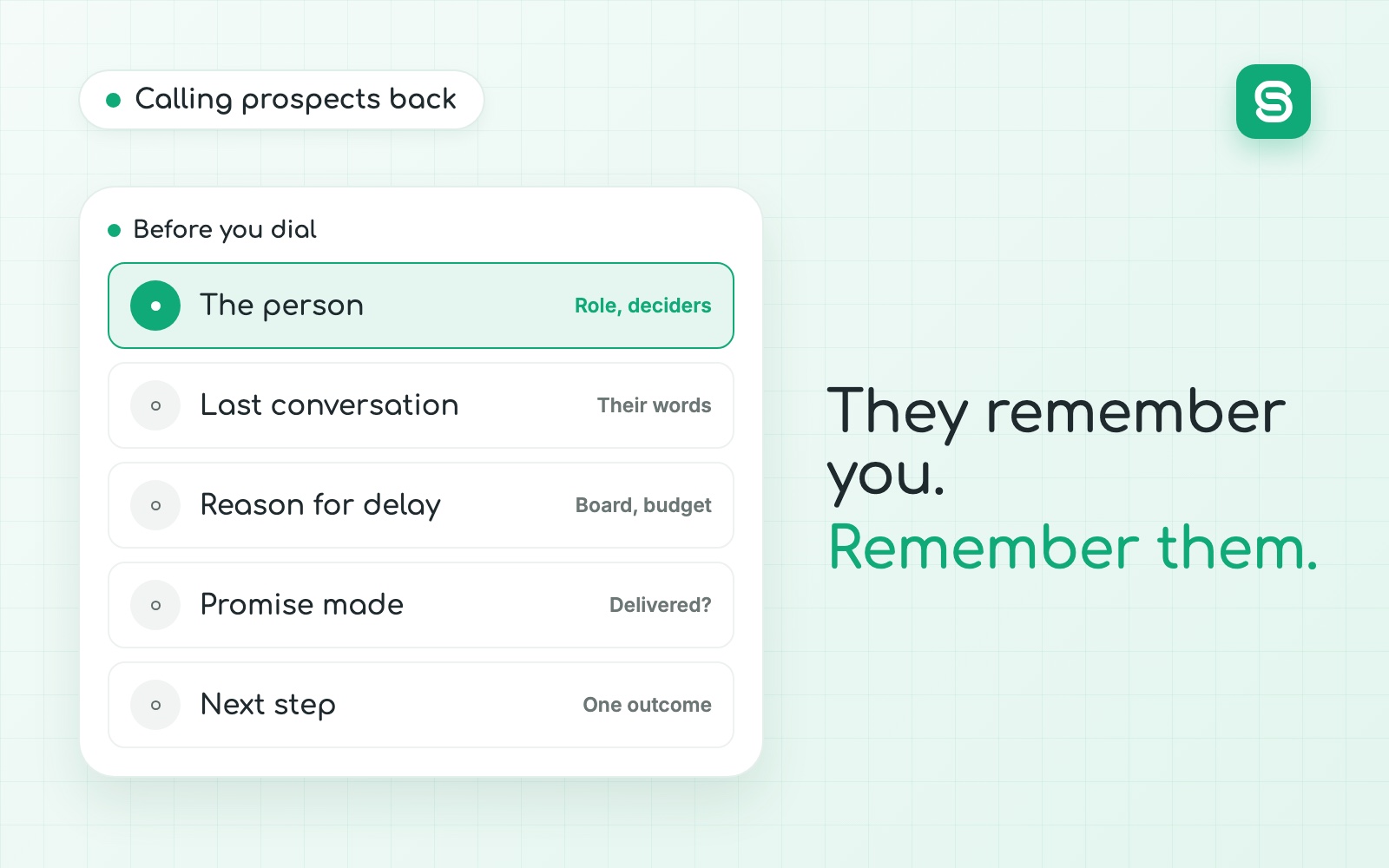
Thirty seconds is what it takes when the context is in one place. It takes ten minutes when you have to dig through your inbox, a spreadsheet and the CRM. The checklist below has five lines. Tick them on one of today’s callbacks, then copy it and pin it next to your screen.
The 30-second prep
Five things to check before you dial. Tick them on one of today’s callbacks.
0 of 5 · ready to dial
One line still empty? Say so in a sentence at the start of the call instead of making it up.
CALLBACK PREP (30 seconds)
[ ] The person: name, role, other people mentioned
[ ] The last conversation: date, length, their own words
[ ] The reason for the delay: why it was not the right time
[ ] The promise made: what I committed to, and whether I delivered
[ ] The next step: the single outcome I want from this call
First sentence: "[First name], [my name] from [company]. We spoke on [date], you told me [their words]."
Each line is there for a reason.
- 01
The person.
Their name, their role, and above all the other people mentioned last time: the partner, the CFO, the buying committee. If someone else took over the decision in the meantime, that is where the conversation needs to go. - 02
The last conversation.
The date, the length, and two or three words they used. “Monday mornings rebuilding the activity report” beats “reporting issue.” Those are the words you will reuse in your first sentence. - 03
The reason for the delay.
Budget locked, a board meeting coming, vacation, a project underway, or plain lack of time. The reason tells you which question to ask: you do not call back someone waiting on budget the same way you call back someone who was swamped. If the delay hid an objection (“the real issue is the integration with our CRM”), prepare your answer before you dial. - 04
The promise made.
Did you promise a document, a number, an answer to a technical question? Check that it is done. Calling back without delivering kills the call before it starts. - 05
The next step.
One outcome only: a meeting, a demo with the decision-maker, a trial, or a clear no. Without a specific goal, the callback ends with “let’s touch base,” which means nothing.
Calling back without delivering kills the call before it starts.
Where to find that context in seconds
A prospect’s context is usually scattered: a note in the CRM, a sent email, a shared file, the rep’s memory. To fit in 30 seconds, it has to be attached to the contact record.
| What you need | Where to find it | What to avoid |
|---|---|---|
| What they said | The last call summary, then the transcript for their exact words | Replaying 20 minutes of recording before every callback |
| Why they pushed it | The note taken at the end of the call, or the transcript | "Call back" with no reason |
| What you promised | The dated task and the history of sent emails | A verbal promise written down nowhere |
| How many attempts so far | The call history on the record, or the task counter | Counting from memory |
| Who else is involved | Contacts linked to the same account in the CRM | Discovering the partner's name on the third call |
In Skipcall, every call lands on the contact record automatically with its date, length, recording, transcript and an AI-generated summary, and the note goes to HubSpot, Pipedrive, Salesforce or Attio. Details are on the contacts and pre-CRM page. The principle, with its limits, is covered in our article on AI call transcription and summaries. Skipcall’s upcoming MCP connector will also let you ask an AI assistant for that context before you dial: we explain what it will change in our guide to MCP for cold calling.
An automatic summary does not replace your own note, though. It tells you what was said. It does not tell you what you heard in their voice or what you plan to do next time. The two work together: the summary for the facts, your note for the intent.
What to say when you call a prospect back
The first sentence of a callback has three parts, always in this order: who you are, which conversation you are referring to (with a date and one of the prospect’s words), and a question that moves things forward. The eight situations below cover most of a B2B rep’s callbacks. The exchanges are written for this article, not real calls, and are meant to be adapted to your own voice.
Who you are
First name, last name, company. No title, no tagline. They have heard you once already: your name is enough to bring the memory back.
Which conversation
A date and one of their words: “We spoke on the 3rd, you told me the board was meeting on the 14th.” That is the proof you remember.
The question that moves it forward
A specific question about what changed: “What came out of it?” Then stop talking. What happens next depends on their answer, not on your pitch.
The scheduled callback
This is the easiest callback, and the one most often wasted by treating it as a formality. The prospect set the date: they know why you are calling. No need to apologize, no need to repeat your pitch.
Scheduled callback: the right way
Hi Jennifer, it's Tom Miller from Vertigo. We spoke on November 3rd, and you asked me to call you today, after your leadership meeting on the 14th.
Oh right, yes.
What came out of it for the sales team reorganization?
It's approved, but the budget won't be released until January.
January. Would it be worth looking together in December at what you'd need, so you go into January with numbers in hand?
What works here: the date of the first call, the exact reason for the delay (the meeting on the 14th), and an open question about the outcome. The rep then repeats “January” before suggesting an intermediate step.
The callback after a vague “call me later”
“Call me back later” with no date is often a polite way to end the call. The callback needs to check whether the interest was real, without pretending a date was agreed on. The right move on the first call would have been to set that date, which is what our article on that objection covers. If it was not set, the callback starts by admitting it.
Vague delay: the right way
Hi Mark, Tom Miller from Vertigo. We spoke at the end of September, you were in the middle of quarter close and told me to reach back out later.
I'd rather ask you straight: is getting visibility on your reps' activity still on the list, or has it dropped down?
Honestly, it dropped. We're hiring first.
Hiring first. How many open roles?
The straight question gives the prospect permission to say no. That is exactly what makes them tell the truth, and here the truth opens a different conversation: hiring reps.
Returning a missed call from a prospect
Here the prospect took the initiative. They had a question, a free slot, sometimes a decision. Call back as fast as you can, and do not make them repeat why they called if you can guess.
Missed call: the right way
Hi Priya, Tom Miller from Vertigo. I saw your call ten minutes ago, I was in a meeting. Calling you right back.
I'm guessing it's about the proposal I sent Tuesday?
Yes, I have a question about the number of seats.
If they left a voicemail, listen to it before calling back and start by answering it. If they left nothing, your guess about the reason shows you are on top of the deal. If the guess is wrong, they correct it, and you have lost nothing.
The callback after an email or a document
“Did you get my email?” is the most common line, and the most useless: the answer is yes or no, and neither moves anything. The callback is about what is in the document, not whether it arrived.
Sent document: the right way
Hi David, Tom Miller from Vertigo. On Thursday I sent you the cost-per-meeting comparison you asked for.
The page that applied most to you was the one on a four-rep team. Does the number at the bottom match what you're seeing?
I skimmed it. That number looks low, we're closer to double.
The question is about one specific item in the document. Even if the prospect did not read it, they can answer, and their answer teaches you something.
The callback after leaving a voicemail
The prospect may have listened to your voicemail, or not. Do not ask whether they heard it. Restate the reason in one sentence, as if for the first time, with something new if possible.
After a voicemail: the right way
Hi Sarah, Tom Miller from Vertigo. I left you a message Tuesday about your reps' calls that never make it into the CRM.
I'm calling back because I now have a worked example from a team your size. Do you have a minute so I can tell you whether it applies?
The callback after a no-show
The prospect did not show up to the video call. They know it, they are often embarrassed, and they expect a reproach. The callback needs to remove the awkwardness in one sentence and offer a new slot right away. Our no-show follow-up call script has more variations.
No-show: the right way
Hi Kevin, Tom Miller from Vertigo. We were set for 10 this morning, I figured something came up.
Yeah, sorry, a meeting ran over.
Happens all the time. I can do Thursday at 9 or Friday at 2, still 20 minutes. Which works better?
The callback after an unanswered proposal
The proposal went out two weeks ago, and nothing. Silence usually has a simple reason: budget, a competitor, a decision-maker who is not convinced. The callback needs to surface that reason without asking “so, did you get a chance to look?”
Unanswered proposal: the right way
Hi Lisa, Tom Miller from Vertigo. I sent the proposal for the eight seats on October 28th.
Usually when I don't hear back after two weeks, something is in the way: price, timing, or someone else to convince. Which one is it on your side?
Timing, mostly. And my CFO wants to see a comparison.
Offering three possible reasons makes answering easy. The prospect picks one, and you know what to do next. For the substance of each blocker, see cold call objections.
Calling back an old lead, months later
Six months have passed. The prospect may have changed roles, tools or priorities. The callback does not pretend you spoke yesterday: it references the conversation, acknowledges the time that passed, and asks what changed. If the deal was lost, our script for reopening a lost deal goes further.
Old lead: the right way
Hi Robert, Tom Miller from Vertigo. We talked in April, you had just signed a one-year contract with another vendor.
I believe that contract is coming up for renewal. Looking back, what worked well, and what would you change?
Openers to drop, and what to say instead
| Weak opener | Why it fails | Say this instead |
|---|---|---|
| "Is this a bad time?" | It invites a yes and hands them the exit before the reason for your call | "We spoke on the 3rd, you asked me to call you today." |
| "Do you remember me?" | It puts the prospect on the spot and forces them to fake it or admit they forgot | Give the context yourself: the date and one of their words |
| "Just checking in." | It contains no reason to listen | A specific question about what changed since the last call |
| "Did you get my email?" | Yes or no moves nothing forward | A question about what is in the document |
| "Sorry to bother you again." | You frame your own call as a nuisance | Bring something new, without apologizing |
| "So, have you thought about it?" | It invites a "not yet" that ends the discussion | Offer the possible reasons for the silence and let them pick |
All these lines have one thing in common: they are about the rep (their email, their call, their need to check in), not the prospect. The line that works is about them, in their words.
The line that works is about them, in their words.
When to call a prospect back
The right time depends on who set it. There are three cases.
What the research says about callback speed
One study comes up again and again: the Lead Response Management Study by InsideSales.com and MIT, presented in 2007 by Dave Elkington and James Oldroyd. It covers three years of data from six companies, more than 15,000 web-generated leads and more than 100,000 call attempts. We reread it on November 12, 2026.
Two caveats. These are inbound leads (someone who just filled out a form), not cold prospects. And the data is from 2007. So the study supports one specific thing: when a prospect just called you or raised their hand, call them back now. It says nothing about a callback scheduled for a fixed date. To model the effect of response time on your own leads, our speed-to-lead calculator does the math.
Time windows, when no time was set
Cognism’s Cold Calling Report 2026, accessed November 12, 2026, puts the best window between 10 and 11 a.m., with a second good window between 2 and 3 p.m., and weaker results before 9 a.m., after 4 p.m. and between noon and 1 p.m. The same report says it took 1.55 attempts on average to reach a prospect on 2025 data. Those are cold-call averages: a prospect expecting your call picks up more easily. The breakdown by day and hour is in our guide to the best time to cold call B2B.
What to do when the prospect misses the callback
They said “call me Thursday at 10,” you call Thursday at 10, and you get voicemail. It happens all the time, and it is not a no. What matters is that they know you kept your word.
- 01
Leave a 20-second voicemail.
Your name, the agreed time, the reason in one sentence, and when you will try again. They were expecting you: the message proves you were on time. - 02
Back it up with a short text.
Plenty of decision-makers read a text between meetings without ever checking voicemail. One line is enough, with the new time you suggest. - 03
Try a different window.
The next day, at another time. A prospect stuck in meetings every morning may pick up late in the afternoon. - 04
Set the next task right away.
Before moving to the next contact, date the next attempt. Otherwise the missed callback drops off the list.
What matters is that they know you kept your word.
Voicemail after a missed callback
Hi [First name], it's [my name] from [company].
I'm calling as planned this [day] at [time] about [topic, in their words].
I'll try you again [tomorrow at 2 p.m.]. If another time works better, my number is [number].
Talk soon.
Text after a missed callback
Hi [First name], [my name] from [company]. Called as planned about [topic]. I'll try again [tomorrow 2pm] unless another time works better.
Should you leave a voicemail every time? No. Gong Labs data published in 2024 and accessed November 12, 2026 shows that leaving voicemails lifts email reply rates from 2.73% to 5.87%, but that after three or more voicemails the rate falls to 2.2%, and that the connect rate on later dials drops (5.17% against 7.18%). One or two voicemails help; more hurt. The attempt-by-attempt decision is in should you leave a cold call voicemail.
How to organize your callbacks in the day
A forgotten callback costs more than a failed cold call: the prospect gave you a yes, and now sees you did not follow through. Organization matters as much as your opener.
Create the task before you hang up
The commitment happens during the call, so the task gets created during the call or within the minute after. A good callback task has four parts: the day, the time, the linked contact, and one line of context. “Call back Jennifer” is not enough. “Call Jennifer on the 15th at 10, after the leadership meeting on the 14th, reorg budget” stands on its own.
Before you hang up, repeat the time out loud: “So I’ll call you Thursday the 15th at 10. Want me to send a calendar invite?” The prospect commits a second time, and you know the date is real. If it stays vague, propose a day and time yourself.
A forgotten callback costs more than a failed cold call.
In Skipcall, tasks are attached to the contact and assigned to an owner. A “Today” view lists the day’s callbacks with their scheduled time, an “Overdue” view isolates the ones past their deadline, a counter shows how many times the contact has been called on that task, and you dial straight from the list.
Block time for callbacks
Callbacks with a fixed time go at that time. The others are grouped in a dedicated block instead of being squeezed between two cold calling sessions. A typical day looks like this.
Start of day
Today’s callbacks and overdue ones. Check your promises: did the documents go out? Now is the time to send them, not during the call. Also sort your contacts by last call date: the ones nobody has called back in three weeks jump out.
Fixed-time callbacks
Put them on your calendar like meetings. A cold calling session pauses for them, not the other way around.
Open callback block
Late morning or early afternoon, in the windows when your prospects pick up. Thirty seconds of prep before each one, a note right after.
End of day
Every missed callback has a new dated task, every completed one has its note. No contact stays on “call back” without a date.
Running callbacks back to back without losing context
An automated dialing mode such as a power dialer works through a list one call after another. It is useful for an open callback block, on one condition: keep a few seconds between calls to read the context. A callback is not chained like a cold call. For high-volume prospecting sessions, a parallel dialer dials several numbers at once, but it serves first calls better than callbacks, where every conversation has its own history.
How many times should you call a prospect back?
There is no solid study on how many attempts a scheduled callback deserves. The numbers that circulate (“80% of sales happen after the fifth follow-up”) have no traceable source, as we checked for our cold calling statistics. So here is the rule we use, presented as a practice, not a law.
| Attempt | When | What you do |
|---|---|---|
| 1 | At the agreed time | Call; if no answer, a 20-second voicemail and a text |
| 2 | The next day, in another window | Call without a voicemail; dated task for the next one |
| 3 | Three to five days later | Call; if no answer, a last message that leaves the door open |
| After that | In one to three months | The contact moves to long-term follow-up, with a new reason to call |
Last message that leaves the door open
Hi [First name], it's [my name] from [company].
I've tried to reach you a few times since [agreed date] about [topic].
I don't want to keep calling for nothing: if this is no longer a priority, a quick "no" by text is all I need.
If it still is, call me at [number] and I'll work around your schedule.
If the answer is no, log it on the record with the reason and close the task. A clear no that is written down nowhere means a teammate calls the same prospect again next month.
To work out how many attempts make sense from your own pickup rates, our call attempts calculator does the math. The full cadence, calls and other channels over several weeks, is in the follow-up guide mentioned above.
8 mistakes that ruin a callback
The first mistake causes almost all the others. One habit fixes it: never dial a callback without running the checklist. Listening during the call matters just as much: reusing the prospect’s exact words is a core active listening technique.
The callback note template to copy
The note after a callback sets up the next one. Write it within the minute after you hang up, while the details are fresh. It also serves the teammate who picks up the deal if you are out.
Callback note
CALLBACK on [date] at [time], [length]
Contact: [name], [role]. Others involved: [names, roles]
What changed since last time: [in their words]
Reason for another delay, if any: [budget / committee / timing / other]
What I promised: [document, number, answer] by [date]
Step secured: [meeting on ... / demo / trial / no / nothing]
Next action: [call / email] on [date] at [time], task created: [yes / no]
What I heard in their voice: [hesitation, interest, frustration]
The last line is the one people skip, and the one that helps the next callback most. The full structure of a sales call summary, including what an AI summary should send to the CRM, is in our sales call summary template.
Key takeaways
- A callback picks up a conversation. The prospect first judges whether you remember them. Your product comes after.
- Thirty seconds, five lines. The person, the last conversation, the reason for the delay, the promise made, the next step. If a line is empty, ask honestly.
- Three parts in your first sentence. Your name, a date and one of the prospect’s words, then a question about what changed.
- The right time depends on who set it. On the dot for a scheduled callback, within minutes for a missed call, in a varied window otherwise.
- If they miss it, prove you were on time. A 20-second voicemail and a text, then a dated task. No more than two voicemails.
- Three attempts over a week, then a last message that leaves the door open, and long-term follow-up.
- A dated task, never a sticky note. Attached to the record, visible to the team, with one line of context.
- An eight-line note after every callback. It is what makes the next callback easy.




