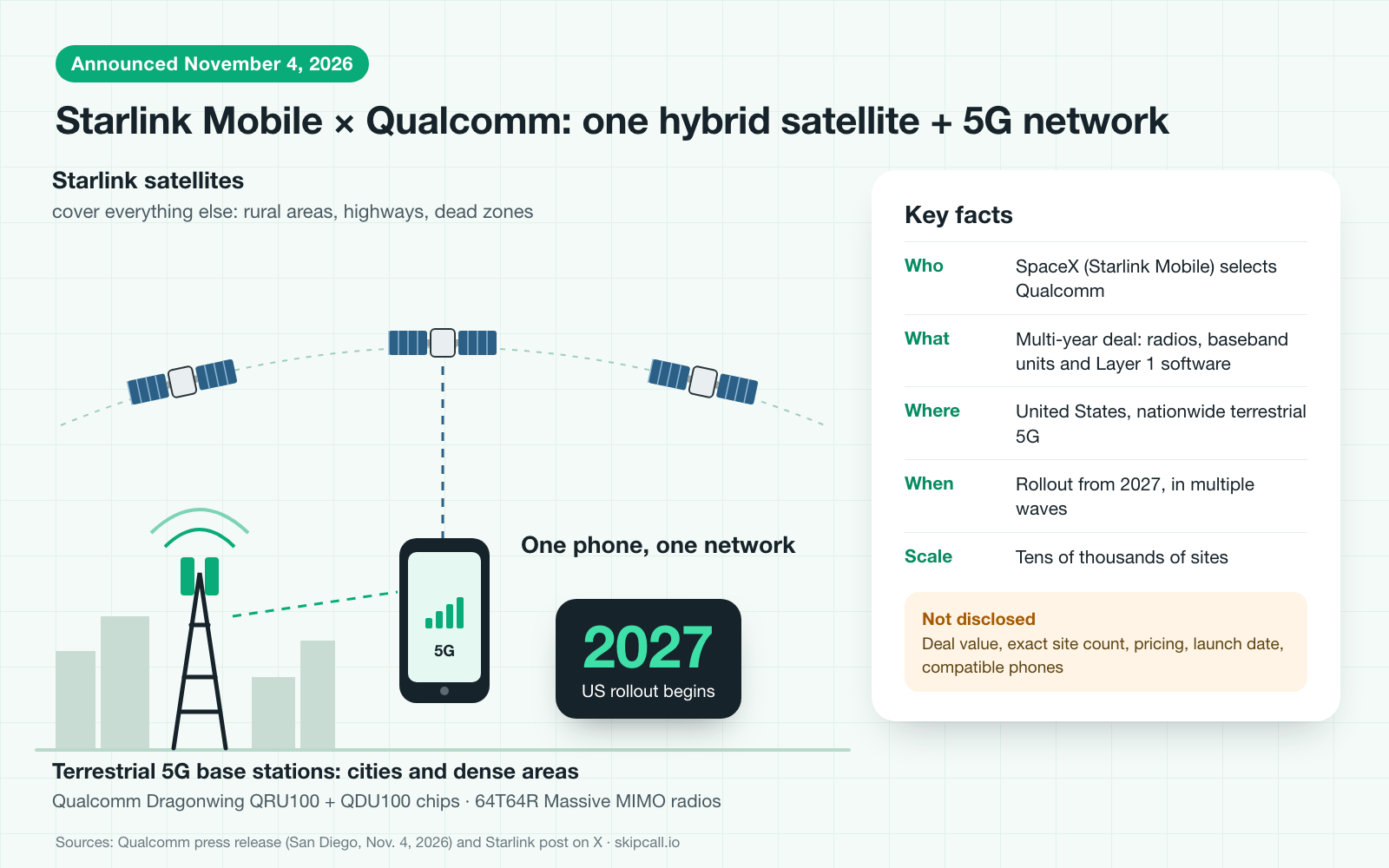
The SpaceX Qualcomm deal, announced on November 4, 2026, makes Qualcomm the supplier of chips and radio software for Starlink Mobile’s terrestrial 5G base stations in the United States. SpaceX plans to start installing them in 2027 across tens of thousands of sites, to run alongside its satellites as one nationwide mobile network.
Qualcomm broke the news in a press release from San Diego titled “SpaceX selects Qualcomm to accelerate Starlink Mobile’s nationwide 5G network.” Starlink followed on X the same day, saying Starlink Mobile is building the first fully integrated nationwide satellite and terrestrial network in the US, with 5G base stations running on Qualcomm chips starting in 2027.
We have already covered the bigger questions: whether phone carriers could disappear because of Starlink Mobile, how Starlink Mobile stacks up against AT&T, Verizon and T-Mobile, and why the FCC’s direct-to-device overhaul favors SpaceX. This article sticks to the announcement itself: what it contains, what it leaves out, and why it matters.
What did SpaceX and Qualcomm announce on November 4, 2026?
In one sentence: SpaceX is buying the processing core of its future 5G cell sites from Qualcomm, over several years, for a nationwide US network that begins rolling out in 2027. Here are the facts as published.
| Question | Answer | Source |
|---|---|---|
| Who? | SpaceX, for its Starlink Mobile brand, and Qualcomm Technologies | Qualcomm press release, Nov. 4, 2026 |
| What? | Dragonwing QRU100 and QDU100 platforms, commercial-grade Layer 1 software | Qualcomm press release |
| For what? | Base stations of Starlink Mobile’s nationwide terrestrial 5G network | Qualcomm press release, Starlink post on X |
| Where? | United States | Qualcomm press release |
| When? | Rollout begins in 2027, in multiple waves | Qualcomm press release, Durga Malladi (Qualcomm) |
| How many? | Tens of thousands of sites over the agreement | Qualcomm press release, Reuters |
| How long? | Multi-year agreement | Qualcomm press release, Reuters |
| How much? | Not disclosed | Reuters |
Qualcomm called it “our biggest 5G deal yet,” according to Reuters. On the SpaceX side, Starlink Senior Vice President Michael Nicolls is quoted in the release: “We shouldn’t live in a time where phone calls are still dropping whether you’re at home or on-the-go.” He added that the partnership will speed up development of Starlink’s base station architecture.
What is a hybrid satellite and terrestrial network?
A hybrid network puts cell towers and satellites under one operator: towers carry most of the traffic where people live and work, satellites take over where no tower reaches. The phone does not switch carriers when it moves from one to the other.
That is not how satellite-to-phone works today. In the US, Starlink is a supplier to T-Mobile: when a T-Mobile customer leaves terrestrial coverage, the phone can send texts and use select apps through Starlink satellites, on T-Mobile’s spectrum. Satellite is a safety net sold by the carrier, with limited capacity and mostly outdoors. Our guide to direct-to-cell explains the mechanics, and can you make phone calls with Starlink covers what works today.
Starlink Mobile flips that model. SpaceX wants to be the carrier, with two layers:
- A terrestrial layer of conventional 5G base stations. This is where capacity, speed and indoor coverage come from, and it is what the Qualcomm deal covers.
- A satellite layer, the Starlink constellation, covering highways, rural areas, water and dead zones. On October 6, 2026, the FCC partly authorized SpaceX’s plan for 15,000 next-generation satellites built to talk directly to phones.
The key word is “integrated”: one network and one plan, something no US carrier offers today.
Why did SpaceX choose Qualcomm?
Because Qualcomm sells ready-made building blocks for the hardest part of a base station, radio signal processing, which lets SpaceX move fast without reinventing it. SpaceX keeps control of everything above that layer.
A 5G base station is built in layers. Layer 1, the physical layer, turns data into radio waves and back. It is the most compute-heavy and latency-sensitive part. Layers 2 and 3 schedule users, manage connections and handle mobility, up to the core network.
The split announced on November 4 is clear:
- QRU100 provides integrated processing inside the radio units mounted on the tower.
- QDU100 handles high-performance, latency-sensitive Layer 1 processing.
- Qualcomm ships commercial-grade Layer 1 software, already proven in other networks.
- SpaceX builds Layer 2 and Layer 3 up to the core network, according to Durga Malladi, Qualcomm’s EVP and GM for technology planning, edge solutions and data center.
The radios are 64T64R Massive MIMO: 64 transmit and 64 receive paths. They steer beams toward individual users, squeezing more capacity out of the same spectrum. That matters for SpaceX, which holds far less spectrum than AT&T, Verizon or T-Mobile. Qualcomm also stresses performance per watt: across tens of thousands of sites, power is a major operating cost.
For Qualcomm, Reuters notes, the deal widens its footprint in telecom infrastructure, where it competes with Marvell, Broadcom and Intel for chips inside cell site equipment. Qualcomm also framed it as a step toward AI-native 6G infrastructure.
SpaceX had the satellites, the spectrum and the ambition. What it lacked was cell sites on the ground. The Qualcomm deal is the first concrete building block of that layer.
Which spectrum will the ground network use?
The press release names no band. It describes a “multi-band” network deployed in multiple waves. What SpaceX holds or is waiting on is public, though.
- 2 GHz AWS-4 and H-block, bought from EchoStar for about $17 billion in September 2025 and approved by the FCC on May 12, 2026. SpaceX describes this mid-band spectrum as its US capacity layer. Telecompetitor reports that a Qualcomm representative said the 64T64R radios will run at 2 GHz.
- Unpaired AWS-3, bought from EchoStar and from Tristar. The FCC approved the Tristar transfer on October 21, 2026.
- 800 MHz, up to 14 MHz bought from Grain Management, announced October 8, 2026. Low-band spectrum travels farther and penetrates buildings better, but the deal still needs FCC and Justice Department approval. The FCC accepted the applications for filing on November 10, 2026, without approving them: see SpaceX and the 800 MHz band.
What is the Starlink Mobile timeline?
Only one date is official in the deal: base station rollout starts in 2027. The rest can be reconstructed from earlier announcements.
- September 2025. SpaceX agrees to buy EchoStar’s AWS-4 and H-block licenses for about $17 billion.
- March 2026. At MWC, SpaceX renames its direct-to-cell service Starlink Mobile.
- May 12, 2026. The FCC approves the EchoStar license transfer.
- August 4, 2026. On its first earnings call as a public company, SpaceX says it intends to build terrestrial components and win customers from the big three.
- October 6, 2026. The FCC partly authorizes 15,000 next-generation direct-to-cell satellites.
- October 8, 2026. SpaceX announces the 800 MHz purchase from Grain Management, pending approval.
- October 29, 2026. The FCC votes to propose its direct-to-device overhaul.
- November 4, 2026. Qualcomm announces the base station deal; Starlink posts about it on X.
- 2027. Base station rollout begins, per Qualcomm. Next-generation satellites are also expected that year, according to trade press.
- Early 2028. The horizon Gwynne Shotwell has given for service on SpaceX’s own spectrum. It is not a commercial launch date.
What do we still not know?
The announcement names a supplier and a start year, but leaves open nearly every question a future customer would ask. As of November 5, 2026, none of the following has been published:
- The deal value. Neither company disclosed financial terms.
- The exact number of sites. Only “tens of thousands,” with no detail on the first wave.
- Which cities and which towers. No tower company is named. Reuters reports SpaceX is exploring deals with tower firms, with nothing announced.
- The bands used in each wave, beyond the 2 GHz indication for the 64T64R radios.
- Launch date, pricing and plans. Telecompetitor noted on November 4 that Starlink had not opened a waitlist or added Starlink Mobile to its website.
- Compatible phones. The release is about base stations, not devices.
- The 800 MHz outcome, still in front of the FCC and the Justice Department.
- A wholesale partner. The Washington Post reported on November 2 that SpaceX was in talks with EchoStar about running a carrier through Boost Mobile. Nothing is confirmed.
What does it mean for AT&T, Verizon and T-Mobile?
For the big three, the deal turns a theoretical threat into a dated industrial project. Until now, Starlink Mobile was mainly T-Mobile’s satellite supplier. With a ground layer, it becomes a potential competitor in their core business.
All three carriers have reportedly declined to host SpaceX as an MVNO, so SpaceX has to build. Mike Dano of Ookla said the deal “reinforces the likelihood that Starlink Mobile could become a credible fourth nationwide mobile network provider.” For the wider picture, including Grok’s role on the voice side, see Elon Musk’s phone play.
What does it change for business phone lines?
Nothing this year: these are cell sites that start going up in 2027. But the announcement confirms a trend worth acting on now.
The mobile network is becoming one access path among several. A phone may soon move between a ground cell and a satellite without changing carriers. The layer a sales team depends on does not move with it: business numbers, call history, call recording, CRM logging. No network, satellite or terrestrial, provides those.
Three habits still hold:
- Keep your business numbers on a cloud phone system, so they work over office Wi-Fi, a second carrier or a Starlink dish. Our guide to business VoIP phone service explains how, and VoIP over Starlink covers the satellite case.
- Do not put every rep on one carrier. A split across two networks, or an eSIM backup, removes a single point of failure.
- Treat satellite as a dead-zone backup for field reps, not as your phone system.
At Skipcall, we build calling software for sales teams, with business numbers in 23 countries that work over any internet connection. We do not sell satellite service or mobile plans, and we have no relationship with Starlink. If you want to see how cloud-hosted business numbers work, our business VoIP page has the details.
The bottom line
On November 4, 2026, SpaceX chose Qualcomm to power the terrestrial 5G base stations of Starlink Mobile in the United States: Dragonwing QRU100 and QDU100 platforms, Layer 1 software, 64T64R Massive MIMO radios, and a rollout starting in 2027 across tens of thousands of sites. It is the first concrete building block of the hybrid satellite and terrestrial network Starlink describes as a national first. Deal value, exact site count, pricing, launch date and compatible phones are still unknown. For your team, the rule has not changed: never let your business numbers depend on a single network.
Sources: Qualcomm press release, “SpaceX selects Qualcomm to accelerate Starlink Mobile’s nationwide 5G network,” San Diego, November 4, 2026 (via Business Wire); Starlink post on X, November 4, 2026; Reuters (November 4, 2026); Yahoo Finance (November 4, 2026, Durga Malladi quotes, Washington Post report of November 2); Telecompetitor (November 4, 2026, Mike Dano of Ookla); FCC actions of May 12, October 6, October 21 and October 29, 2026.