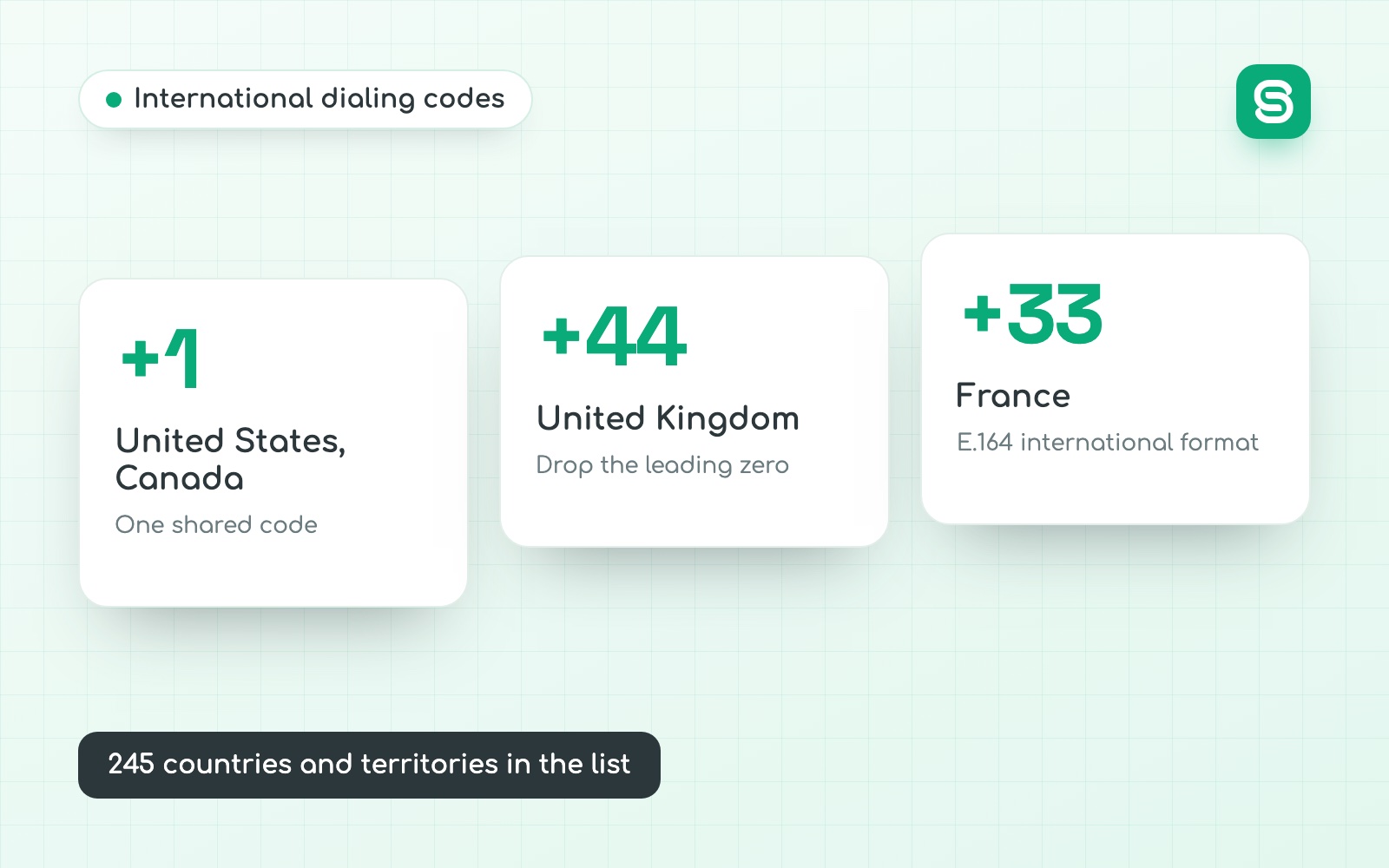
International dialing codes are the one-to-three-digit country calling codes that identify a country in a phone number: +1 for the United States and Canada, +44 for the United Kingdom, +52 for Mexico. To call internationally, dial the plus sign, then the country code, then the number, dropping the leading 0 when the country uses one. The list below gives the code for 245 countries and territories, checked against the official list of the International Telecommunication Union (ITU).
You are probably here for one of these reasons:
The full list of international dialing codes by country
Type a country name or digits: the list filters as you type. The shortcuts fill the search with the most requested codes, and those codes have their own detailed cards further down. The buttons sort by numbering zone, meaning the first digit of the code. For each country you get the country calling code, the exit code to dial out of that country, and the trunk prefix to drop when you call it from abroad.
245 countries and territories shown
- Afghanistan +93
- Åland Islands no separate entry in the ITU list +358
- Albania +355
- Algeria +213
- American Samoa +1
- Andorra +376
- Angola +244
- Anguilla +1
- Antigua & Barbuda +1
- Argentina +54
- Armenia +374
- Aruba +297
- Ascension Island +247
- Australia +61
- Austria +43
- Azerbaijan +994
- Bahamas +1
- Bahrain +973
- Bangladesh +880
- Barbados +1
- Belarus +375
- Belgium +32
- Belize +501
- Benin +229
- Bermuda +1
- Bhutan +975
- Bolivia +591
- Bosnia & Herzegovina +387
- Botswana +267
- Brazil +55
- British Indian Ocean Territory +246
- British Virgin Islands +1
- Brunei +673
- Bulgaria +359
- Burkina Faso +226
- Burundi +257
- Cambodia +855
- Cameroon +237
- Canada +1
- Cape Verde +238
- Caribbean Netherlands +599
- Cayman Islands +1
- Central African Republic +236
- Chad +235
- Chile +56
- China +86
- Christmas Island no separate entry in the ITU list +61
- Cocos (Keeling) Islands no separate entry in the ITU list +61
- Colombia +57
- Comoros +269
- Congo - Brazzaville +242
- Congo - Kinshasa +243
- Cook Islands +682
- Costa Rica +506
- Côte d’Ivoire +225
- Croatia +385
- Cuba +53
- Curaçao +599
- Cyprus +357
- Czechia +420
- Denmark +45
- Djibouti +253
- Dominica +1
- Dominican Republic +1
- Ecuador +593
- Egypt +20
- El Salvador +503
- Equatorial Guinea +240
- Eritrea +291
- Estonia +372
- Eswatini +268
- Ethiopia +251
- Falkland Islands +500
- Faroe Islands +298
- Fiji +679
- Finland +358
- France +33
- French Guiana +594
- French Polynesia +689
- Gabon +241
- Gambia +220
- Georgia +995
- Germany +49
- Ghana +233
- Gibraltar +350
- Greece +30
- Greenland +299
- Grenada +1
- Guadeloupe +590
- Guam +1
- Guatemala +502
- Guernsey no separate entry in the ITU list +44
- Guinea +224
- Guinea-Bissau +245
- Guyana +592
- Haiti +509
- Honduras +504
- Hong Kong SAR China +852
- Hungary +36
- Iceland +354
- India +91
- Indonesia +62
- Iran +98
- Iraq +964
- Ireland +353
- Isle of Man no separate entry in the ITU list +44
- Israel +972
- Italy +39
- Jamaica +1
- Japan +81
- Jersey no separate entry in the ITU list +44
- Jordan +962
- Kazakhstan +7
- Kenya +254
- Kiribati +686
- Kosovo +383
- Kuwait +965
- Kyrgyzstan +996
- Laos +856
- Latvia +371
- Lebanon +961
- Lesotho +266
- Liberia +231
- Libya +218
- Liechtenstein +423
- Lithuania +370
- Luxembourg +352
- Macao SAR China +853
- Madagascar +261
- Malawi +265
- Malaysia +60
- Maldives +960
- Mali +223
- Malta +356
- Marshall Islands +692
- Martinique +596
- Mauritania +222
- Mauritius +230
- Mayotte no separate entry in the ITU list +262
- Mexico +52
- Micronesia +691
- Moldova +373
- Monaco +377
- Mongolia +976
- Montenegro +382
- Montserrat +1
- Morocco +212
- Mozambique +258
- Myanmar (Burma) +95
- Namibia +264
- Nauru +674
- Nepal +977
- Netherlands +31
- New Caledonia +687
- New Zealand +64
- Nicaragua +505
- Niger +227
- Nigeria +234
- Niue +683
- Norfolk Island no separate entry in the ITU list +672
- North Korea +850
- North Macedonia +389
- Northern Mariana Islands +1
- Norway +47
- Oman +968
- Pakistan +92
- Palau +680
- Palestinian Territories code marked “reserved” in the ITU list +970
- Panama +507
- Papua New Guinea +675
- Paraguay +595
- Peru +51
- Philippines +63
- Poland +48
- Portugal +351
- Puerto Rico +1
- Qatar +974
- Réunion no separate entry in the ITU list +262
- Romania +40
- Russia +7
- Rwanda +250
- Samoa +685
- San Marino +378
- São Tomé & Príncipe +239
- Saudi Arabia +966
- Senegal +221
- Serbia +381
- Seychelles +248
- Sierra Leone +232
- Singapore +65
- Sint Maarten +1
- Slovakia +421
- Slovenia +386
- Solomon Islands +677
- Somalia +252
- South Africa +27
- South Korea +82
- South Sudan +211
- Spain +34
- Sri Lanka +94
- St. Barthélemy no separate entry in the ITU list +590
- St. Helena +290
- St. Kitts & Nevis +1
- St. Lucia +1
- St. Martin no separate entry in the ITU list +590
- St. Pierre & Miquelon +508
- St. Vincent & Grenadines +1
- Sudan +249
- Suriname +597
- Svalbard & Jan Mayen no separate entry in the ITU list +47
- Sweden +46
- Switzerland +41
- Syria +963
- Taiwan +886
- Tajikistan +992
- Tanzania +255
- Thailand +66
- Timor-Leste +670
- Togo +228
- Tokelau +690
- Tonga +676
- Trinidad & Tobago +1
- Tristan da Cunha +290
- Tunisia +216
- Türkiye +90
- Turkmenistan +993
- Turks & Caicos Islands +1
- Tuvalu +688
- U.S. Virgin Islands +1
- Uganda +256
- Ukraine +380
- United Arab Emirates +971
- United Kingdom +44
- United States +1
- Uruguay +598
- Uzbekistan +998
- Vanuatu +678
- Vatican City +39
- Venezuela +58
- Vietnam +84
- Wallis & Futuna +681
- Western Sahara no separate entry in the ITU list +212
- Yemen +967
- Zambia +260
- Zimbabwe +263
No country matches. Try the country name or the digits of the code.
Three notes on reading the list.
What is a country calling code?
A country calling code is the first part of a number written in international format. Recommendation ITU-T E.164, which sets the worldwide numbering plan, defines the country code as the combination of one, two or three digits identifying a specific country, countries in an integrated numbering plan, or a specific geographic area.
The rest is the national significant number: usually an area or carrier code, then the subscriber number. The whole thing, country code included, stays within 15 digits. That is the maximum the ITU recommends, not counting the international prefix.
digits in a country code, per Recommendation E.164
digits at most for the full number, country code included
countries and territories under the single code +1
Do not confuse it with two other prefixes that are not part of the number itself. E.164 says so in plain words: national and international prefixes are not part of the international number.
How do you dial an international number, step by step?
The method is the same for every country. The visual shows one French number written three ways, then dialed from two different countries.
- exit code
- plus sign
- country code
- trunk prefix
- national number
Example number. On a cell phone, the + works everywhere: the phone sends the right exit code by itself.
- 01
Start with + or with your exit code.
On a cell phone, press and hold 0 to get the +. On a landline, dial the exit code of the country you are in: 011 from the United States and Canada, 00 from most other countries.
- 02
Dial the country code of the country you are calling.
Find it in the list above. Check that it is the country and not a nearby territory: Guadeloupe is not on France’s +33, it is +590.
- 03
Drop the trunk prefix, if there is one.
That is the leading 0 in the UK, France, Germany, India or Australia. If the trunk prefix column of the list says “None”, drop nothing.
- 04
Dial the rest of the number and place the call.
Spaces, dots and dashes do not matter. If the number is written with parentheses, as in +44 (0)20…, the digits in parentheses are not dialed from abroad.
The plus sign: why you should use it everywhere
The + is not decoration. Recommendation ITU-T E.123, which describes how to write phone numbers, makes it the international prefix symbol: it should precede the country code and reminds the caller to dial the international prefix, which differs from country to country.
In practice, a cell phone sends the + to the network as is, and the network turns it into the right exit code. A contact saved with + therefore works whether you are in Boston, Toronto or Tokyo. A contact saved as 011 44… stops working the moment you leave a country whose exit code is 011.
A contact saved with + works whether you are in Boston, Toronto or Tokyo.
Exit codes, depending on where you call from
00 dominates, but it is not universal. Here is the split in our list.
the exit code of 27 countries and territories, including the US, Canada and the +1 Caribbean
for 191, including every European Union member state
for Russia, Kazakhstan, Belarus, Tajikistan and Turkmenistan
for Australia; 010 for Japan, 119 for Cuba
In a few countries several exit codes coexist because each long-distance carrier has its own. Brazil, South Korea, Colombia and Singapore work that way. If you call from one of them on a landline, ask your carrier for the code. From a cell phone, the + settles it.
The leading zero: drop it, or not
This is the most common mistake, in both directions. Some people keep the 0 of a UK number after +44; others strip the first digit of an Italian number that needs it.
In the United States, Canada and the other +1 countries, the trunk prefix is 1, the same digit as the country code. A US number is written +1 followed by ten digits.
What is E.164 format, and why use it?
E.164 is the name of the ITU recommendation that defines the international telephone numbering plan. By extension, “E.164 format” means a number reduced to the essentials: the +, the country code and the national significant number, with no spaces or punctuation. The US number (212) 555-0123 becomes +12125550123.
That format has three practical benefits for a business.
For display, Recommendation E.123 asks for spaces between groups of digits in an international number, and reserves parentheses for digits that are not always dialed. That is where “+44 (0)20 …” comes from: easy to read, but a source of errors when pasted into a tool. In a file, prefer the form without parentheses.
If you have a list to straighten out, our phone number validator detects the country, fixes the format and flags impossible numbers. And to find out whether a line still exists, the article on how to tell if a phone number is still active walks through the methods.
How do people abroad call a US number?
The question comes up as soon as you give your number to a contact overseas. The answer is the mirror image of calling out.
So the number to print on a signature or a website for international contacts is the one that starts with +1. A number shown as ten digits only tells a caller abroad nothing about which country to reach.
Country code +1, +44, +52, +91, +61: the most looked-up codes
These are the codes US callers look up most often. Each card gives the country, what to dial from the United States and what to do with the first digit of the number. All of it comes from the list above.
North America
- +1 United States and Canada From the US: 1, then the ten-digit number, like domestic long distance. Code shared by 25 countries and territories.
- +52 Mexico From the US: 011 52, then the full number, nothing to drop.
UK and Ireland
- +44 United Kingdom From the US: 011 44, then the number without the leading 0. Same code: Guernsey, Isle of Man and Jersey.
- +353 Ireland From the US: 011 353, then the number without the leading 0.
Western Europe
- +49 Germany From the US: 011 49, then the number without the leading 0.
- +33 France From the US: 011 33, then the number without the leading 0.
- +34 Spain From the US: 011 34, then the full number, nothing to drop.
- +39 Italy From the US: 011 39, then the full number, nothing to drop. Same code: Vatican City.
- +351 Portugal From the US: 011 351, then the full number, nothing to drop.
- +31 Netherlands From the US: 011 31, then the number without the leading 0.
Asia and Pacific
- +91 India From the US: 011 91, then the number without the leading 0.
- +86 China From the US: 011 86, then the number without the leading 0.
- +81 Japan From the US: 011 81, then the number without the leading 0.
- +63 Philippines From the US: 011 63, then the number without the leading 0.
- +61 Australia From the US: 011 61, then the number without the leading 0. Same code: Cocos (Keeling) Islands and Christmas Island.
Latin America and Middle East
- +55 Brazil From the US: 011 55, then the number without the leading 0.
- +972 Israel From the US: 011 972, then the number without the leading 0.
- +971 United Arab Emirates From the US: 011 971, then the number without the leading 0.
How do you call the UK, Mexico, India, Germany, Italy or Australia from the US?
Six examples beat one rule. The numbers are made up; the way to dial them from the United States is the real one.
From a cell phone, replace each 011 with +: the result is the same, and a contact saved that way keeps working outside the United States.
How should you write your own number for international callers?
On an email signature, a website or a business card, your number will be read by people outside your country. Recommendation ITU-T E.123 gives a simple rule: the + in front of the country code, then spaces between groups of digits.
- 01
Write the number with +.
+1 212 555 0123 dials from any country. (212) 555-0123 only works inside the +1 zone.
- 02
Avoid the (0) in parentheses.
+44 (0)20 1234 5678 makes sense to a reader, but a tap on the number or a paste into a tool can dial the extra 0.
- 03
Separate with spaces in the international form.
E.123 asks for spaces only in an international number. Dots, dashes and parentheses are national habits.
- 04
On a website, put the compact format in the link.
The visible text can keep its spaces; the clickable link holds the number with none: +12125550123.
If the number you publish is your personal cell phone, the question changes: our guide to a business number on a personal phone compares dual SIM, eSIM and an app.
How are world numbering zones organized?
The first digit of a country code is not random: it points to a broad part of the world. That is why European codes start with 3 or 4 and African codes with 2.
Countries that joined the world plan early often have a short code of one or two digits. Spare codes are now assigned on a three-digit basis: E.164 states it explicitly.
Which country codes are shared by several countries?
A country code does not always match one country. In the ITU list, several countries can share a numbering plan, and some territories are reached through the code of a neighboring or parent country.
+1: 25 countries and territories
+1 is the best-known case. The ITU list attaches 25 entries to it, with the note “integrated numbering plan”: the United States and Canada, but also the Bahamas, Barbados, Bermuda, Jamaica, the Dominican Republic, Puerto Rico, Trinidad and Tobago, Guam and the Virgin Islands.
The practical consequence: a +1 number is not necessarily a US number. The three digits that follow, the area code, say where the line is. And a call to a +1 number in the Caribbean is not billed as a domestic call by every carrier, even though it is dialed like one.
+7: Russia and Kazakhstan
Russia and Kazakhstan share +7, again in an integrated plan. Both also have the same trunk prefix, 8, and the same exit code, 810.
Territories reached through another country’s code
US territories: on +1, with their own area codes
Puerto Rico, Guam, American Samoa, the Northern Mariana Islands and the US Virgin Islands each have their own line in the ITU list, all under +1. From the US mainland you dial them like any long-distance number: 1, the area code, then seven digits. Whether your plan bills them as domestic is a question for your carrier.
Codes that are not countries
The ITU also assigns codes to global services. You will not find them in the country list, but they exist: +800 for International Freephone, +808 for the shared-cost service, +870 for Inmarsat and +881 for global mobile satellite systems, +882 and +883 for international networks, +888 for disaster-relief telecommunications, and +979 for the International Premium Rate Service.
How can you tell which country an incoming call is from?
When an unknown number shows up with a +, read the first digits and look them up in the list: type “351” and you get Portugal. Two precautions avoid misreading.
Missed calls from abroad: think before you call back
A missed call from a number you do not recognize, with a code you have no reason to hear from, is a reason for caution, because a call back may be billed at an international or premium rate.
For a business, the risk is wider than one unlucky callback. One-ring calls and lines hijacked to dial premium numbers are covered in our guide to VoIP security and toll fraud, with the settings that block them.
If your concern is the opposite one, your own calls showing up as spam on other people’s phones, our article on caller ID marked as spam explains where the label comes from and how to remove it.
What time should you call another country?
Knowing the code is not enough: you also need to land in the other person’s working hours. A call placed at 10 a.m. in New York arrives at 4 p.m. in Paris in winter. Before you dial, check the local time in the country, and for a country spread over several time zones, in the city.
When the team itself is spread over several countries, ringing hours and numbers are set per person: see our guide to a phone system for a remote team. For the rhythm of a calling day, the article on the best time to cold call in B2B gives the windows that work.
How much does an international call cost?
There is no worldwide rate. The price depends on your carrier, your plan, the country you call and sometimes the type of line, landline or mobile. One rule applies to every carrier across a whole region.
per minute plus VAT at most, for a call from your home EU country to another EU country
Source : European Commission, page updated June 23, 2026
per text plus VAT at most, under the same conditions
Source : European Commission
the cap applies since May 15, 2019, to EU member states plus Iceland, Liechtenstein and Norway
Source : European Commission
That cap protects consumers in Europe. It covers a call from your home country to another EU country, not roaming, which follows other rules. Outside the EU, the price is whatever your carrier’s rate sheet says.
Forwarding a line to a foreign number follows the same logic: the forwarded leg is an international call, billed to the line that forwards. The details are in our guide to call forwarding vs. call transfer.
The most common mistakes, and how to avoid them
How do you convert a list of numbers to international format?
For a team that calls several countries, the most profitable rule is also the simplest: one format, the one with +. Here is the method we recommend.
- 01
Add a country column if it is missing.
Without the country, you cannot guess the code of a number written in national format. The country of the head office or the address is usually enough.
- 02
Strip everything that is not a digit, except a leading +.
Spaces, dots, dashes, parentheses and notes like “ext. 12” go into another column.
- 03
Add the country code and drop that country's trunk prefix.
Use the trunk prefix column of the list: 0 for the UK, nothing for Spain, 1 for the United States.
- 04
Check the length and the result.
A number longer than 15 digits is wrong. Run the file through a validator to catch impossible numbers.
- 05
Enforce the format at the door.
Forms, imports and manual entry must all produce the same format, or the cleanup has to be redone every month.
Three free tools on this site help prepare a multi-country list: the CSV cleaner, which converts a whole column of numbers to international format, B2B phone data coverage by country, which shows where contact data is most reliable, and the local vs. toll-free number tool to pick a number type by use.
Why won’t my international call go through?
Most failed international calls come from the number as it was typed, not from the network. Run these checks before you blame the line.
- 01
Read the number digit by digit.
Is there a + or an exit code at the start, and only one of them? Is the country code the right one for the country, not a neighboring territory?
- 02
Look at the digit right after the country code.
If the country uses a trunk prefix and you see it there (+44 0…, +33 0…, +49 0…), remove it. If the country has none, make sure you did not remove a real digit.
- 03
Count the digits.
More than 15 digits after the + means something was added: an extension, a second prefix, a pasted character.
- 04
Check where you are calling from.
On a landline or a desk phone system abroad, the exit code is the local one, and some office systems also need a digit to get an outside line. On a cell phone, use the +.
- 05
Then check your plan.
Some plans block international or premium destinations by default. Your carrier can tell you whether the destination is open on your line.
If the call connects but the voice is choppy or delayed, the number is no longer the issue: the diagnosis is in our guide to VoIP call quality problems.
The vocabulary, in six terms
Do you need a local number to call another country?
It is not required, but it often helps. A prospect picks up more readily when the number on the screen carries their own country code, and they can call you back at a local rate. Our article on local presence dialing explains what it changes, and what the rules allow.
Getting a number in another country usually means providing documents, which vary by country. Our tool on business phone number requirements by country lists them, and the guide on how to get a virtual phone number walks through the process. If you add one number per country, our article on a multi-line phone system for a small business helps decide who answers what.
Where does the data on this page come from?
A list of country codes is only worth something if it is exact. Here is how this one was built, so you can check it.
- 01
Country codes come from the ITU list.
On November 11, 2026 we read the “List of Recommendation ITU-T E.164 assigned country codes”, Annex to ITU Operational Bulletin No. 1114, which gives the position on December 15, 2016. The ITU updates this list through amendments published in its bulletin.
- 02
Prefixes come from libphonenumber.
Exit codes and trunk prefixes are read from the metadata of libphonenumber, the Google library used by this site’s validator.
- 03
A script compares the two, country by country.
It checks that every code appears in the ITU list, that it is identical in libphonenumber, and that no country appears twice. Result: 245 countries and territories, 206 distinct codes, no discrepancy.
- 04
Name differences are flagged.
The 2016 list uses older designations, such as “Swaziland” for Eswatini. The code itself has not changed. For +970, the Palestinian Territories, the ITU list only says “reserved”.
The rules quoted here, one to three digits for the country code and 15 digits at most, are read in the November 2010 edition of Recommendation E.164.
Sources: ITU list of assigned country codes, Recommendation ITU-T E.164, Recommendation ITU-T E.123, European Commission, intra-EU calls.
What to remember
- An international number is written + country code + national number, 15 digits at most.
- The + stands for the exit code, which is 011 in North America and 00 in most other countries.
- You drop the leading 0 in 113 countries and territories, not in the 101 that have no trunk prefix.
- +1 and +7 are shared; a +1 number is not always a US number.
- In a file, use one format: the one with +, no spaces or parentheses.
- Before you call, check the local time, your carrier’s rate and the rules of the country.