Your reps are losing hours to manual dialing, and you already know a dialer would fix it. The problem is the person who signs the purchase order. “Reps will make more calls” doesn’t survive a CFO, and a vendor’s “10x ROI” slide survives even less. What gets approved is a sales dialer ROI case built like a finance document: your own baseline, assumptions with sources, a conservative scenario first, and the risks named before anyone asks.
What is sales dialer ROI?
Sales dialer ROI is the return a dialer generates for every dollar it costs, over a set period, usually the first year. The formula is the standard one:
The cost side is easy. The value side is where business cases fall apart, because a dialer doesn’t create revenue on its own. It changes one thing: how many live conversations a rep has per hour spent calling. Everything else (meetings, pipeline, revenue) flows from that, through rates the dialer doesn’t control.
So the value can be counted three ways, and finance trusts them in this order:
Most vendor pages lead with the third. That’s why their ROI figures look like 10x or 30x, and why a skeptical CFO throws them out. A case built on the first or second way, with the third as upside, gets signed.
If you’re still deciding which kind of dialer to buy, start with what a power dialer is and our comparison of parallel dialer vs. power dialer. This article assumes you’ve picked a category and need to justify the spend.
What goes into a dialer business case?
A business case that gets approved fits on one page, and reads in the order a finance team thinks: what does the problem cost us, how do you know, what are you assuming, what does it cost, what do we get back, and what could go wrong. You can enlarge the diagram or download it to drop into your deck.
- 01
The problem, in dollars.
Not “reps waste time dialing” but “we pay $792 for every meeting our SDRs book, and 60% of their calling hour is spent finding, dialing and logging numbers.” One sentence, one number. - 02
A measured baseline.
Two weeks of real data from your phone system and CRM: calling hours, dials, live conversations, meetings booked. This is the block that makes the rest credible. - 03
Assumptions, each with a source.
Answer rate, conversations per meeting, loaded rep cost, adoption haircut. Next to each, where it comes from: your data, a named benchmark, or “estimate, tested in the pilot.” - 04
Total cost, year one.
Licenses plus everything the pricing page leaves out: rollout hours, extra contact data, numbers, CRM admin. Our guide to what a dialer really costs lists the hidden lines. - 05
Return, payback and ROI.
Three scenarios: conservative, base, upside. The conservative one goes first and carries the recommendation. - 06
Risks and a pilot.
What could make the numbers wrong, and a 30-day test with a go or no-go threshold set in advance.
Which assumptions should your business case use?
Every number in the model is either measured, sourced or labeled as an estimate. Here are the ones our worked example uses, and where each comes from. Replace them with yours.
| Assumption | Value in our example | Source or rationale |
|---|---|---|
| Team | 5 SDRs | Example team size |
| Dialing hours per rep | 40 a month (2 hours a day) | Time actually spent calling, not time "on the phone" |
| Human answer rate | 10% of dials | Inside the range of our connect rate benchmarks |
| Manual work per dial | About 70 seconds | Find the record, dial, log the outcome. Measure yours |
| Conversation length | 3 minutes, notes included | Same model as our parallel dialer articles |
| Conversations per meeting | 10 | Deliberately conservative |
| Loaded cost per SDR | $9,500 a month (about $55 an hour) | $80K median OTE ÷ 70% wage share of employer costs |
| Adoption haircut | Count 50% of the modeled gain | Reps never use a new tool perfectly |
Three of these deserve a closer look, because they’re the ones a CFO will challenge.
The loaded cost of an SDR
The Bridge Group’s 2025 SDR report, based on 351 B2B companies, puts median SDR on-target earnings at $80K, split $55K base and $25K variable. Salary isn’t what the company pays, though. According to the Bureau of Labor Statistics’ Employer Costs for Employee Compensation release for June 2026, wages and salaries account for 70.0% of private industry employer costs, and benefits for the remaining 30.0%. So $80,000 ÷ 0.70 ≈ $114,000 a year, or about $9,500 a month and $55 per working hour (at 173 hours a month). That doesn’t count tools, management time or office space, so it’s a floor.
The answer rate
Published answer rates for B2B cold calls range widely, depending on list quality, number type and calling window. Our cold call connect rate benchmarks gather more than 60 of them. In a 100% anonymized sample of 86,168 calls placed on Skipcall by one B2B team, 17.9% of calls were answered and about 11% turned into a conversation longer than 30 seconds. We use 10% here because it sits in the cautious part of that range.
The good news for your business case: as you’ll see in the sensitivity section, the ROI of a power dialer barely moves with the answer rate. The ratio between manual and automated dialing does the work.
The manual work per dial
This is the assumption that drives the result, and the one you should measure rather than borrow. Sit with two reps for an hour, or pull timestamps from the CRM: the time between hanging up one call and the next one ringing is your manual overhead. Seventy seconds is typical when a rep looks up the record, clicks or keys the number, waits, then types notes and a disposition before moving on. If your team already uses click-to-call with good CRM views, it may be closer to 30 seconds, and the case weakens. Our selling time calculator helps you put a dollar figure on that overhead across the week.
How many conversations per hour does a dialer add?
This is the heart of sales dialer ROI. A dialer doesn’t make prospects more likely to answer. It removes the dead time between dials (and, for a parallel dialer, waits on several lines at once), so the same hour holds more live conversations.
With the assumptions above, here’s what one rep gets from 40 dialing hours a month in each mode:
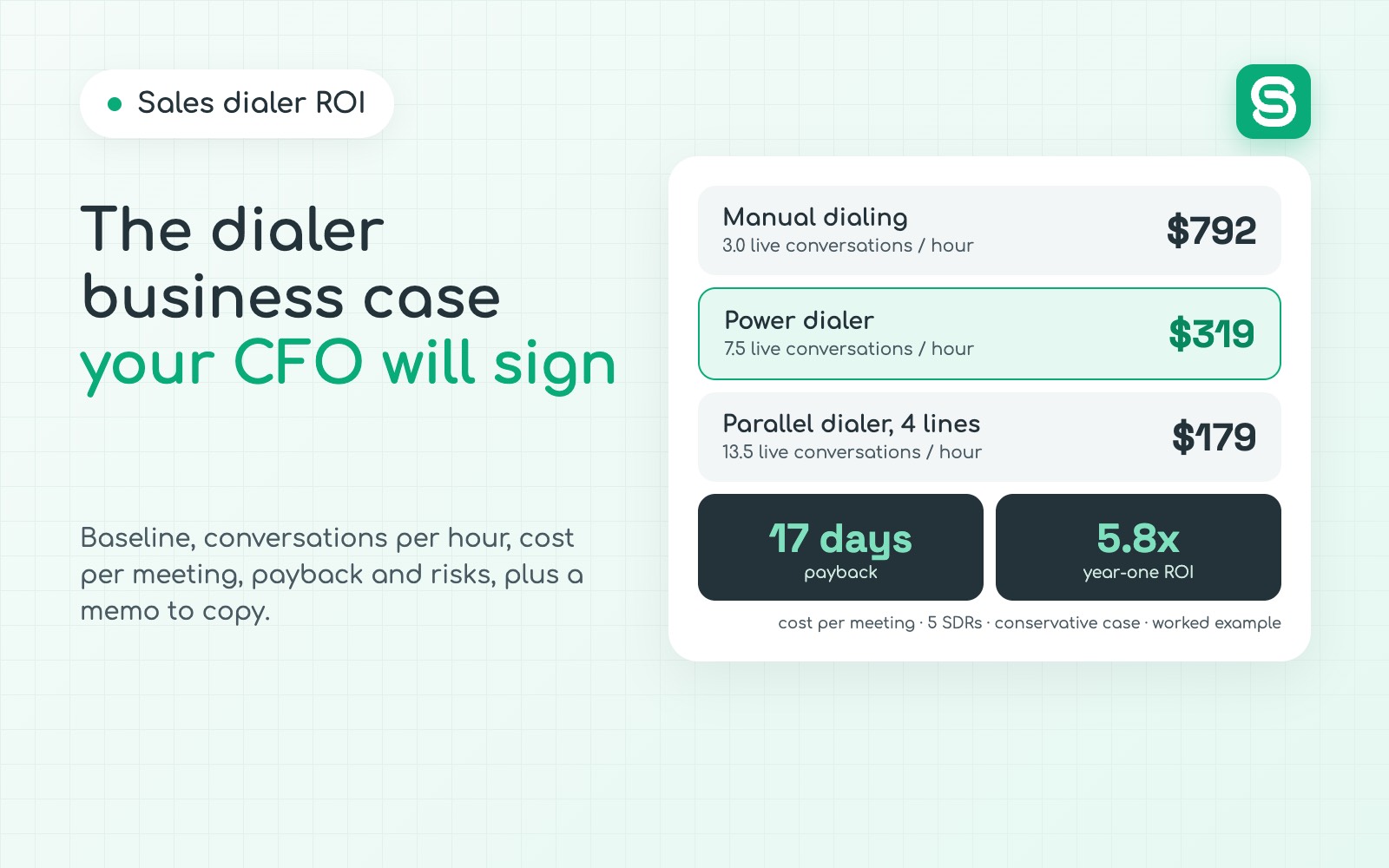
Over 40 hours, that’s 120, 300 and 540 conversations, so 12, 30 and 54 meetings. At $9,500 a month plus the license, cost per meeting falls from $792 to $319 with a power dialer and to $179 on four lines. If you want to rerun cost per meeting with your own salaries and volumes, our cost per meeting calculator does it in a few fields, and our playbook on how to reduce cost per meeting covers the levers beyond the dialer.
One detail makes the baseline believable: 12 meetings a month per rep on manual dialing is close to the Bridge Group’s median quota of 10 meetings held per SDR per month. Your CFO can see that your “before” isn’t a straw man.
A dialer doesn’t make prospects answer more. It gives back the minutes between the ones who do.
How do you put a dollar value on the gain?
You now know the dialer adds conversations. Here are the three ways to turn that into dollars, applied to the same team of five, from the most conservative to the most generous.
Capacity: hours freed at loaded cost
To book the same 60 meetings a month the team books today, each rep needs 16 dialing hours instead of 40 (because 7.5 conversations an hour instead of 3). That’s 24 hours freed per rep, 120 hours a month for the team.
This value is “soft”: nobody’s salary goes down. Its strength is that it’s easy to audit, and that the freed hours have an obvious use (more dialing, more follow-ups, better list research). Say in the memo what the hours will go to.
Avoided hires: the hard-dollar version
If your plan for next year requires more meetings, the dialer’s value becomes cash. Say the target is 96 meetings a month. On manual dialing at 12 meetings per rep, you need 8 SDRs, so 3 hires. With a power dialer, even at half the modeled gain (21 meetings per rep instead of 30), 5 reps cover it.
This is the most persuasive version when it’s real. It only works if the target is in the approved plan, and if your account executives can absorb the extra meetings. Our sales rep ROI calculator helps you show what each hire would have cost and returned.
Incremental pipeline: the upside, never the headline
Keep the same hours and book more meetings instead. At half the modeled gain, the team books 45 extra meetings a month. Give each one an expected value with your own funnel rates. With illustrative rates of 80% of meetings held, 50% of held meetings becoming an opportunity, a 25% win rate and a $15,000 average deal:
That number is real in expectation, but finance will discount it hard. It lands one or two sales cycles later, it depends on AE capacity, and it multiplies four rates that each carry error. Put it in the upside scenario and let the conservative one carry the recommendation. For the timing effect, our sibling guide on sales cycle length shows how to estimate when that pipeline actually closes.
How long is the payback period for a dialer?
Payback answers the CFO’s favorite question: how fast do we get the money back? For per-seat software, the answer comes from two numbers: one-off costs and monthly net gain.
Notice what decides the payback: not the license, which is a rounding error next to $47,500 a month of SDR cost, but the rollout time and the haircut. That’s why the honest version of the case spends more words on adoption than on price.
Run your own numbers: dialer ROI calculator
Change any field below. The calculator uses the same method as this article: capacity view, 173 working hours a month, and only half of the freed time counted as value. With JavaScript off, it shows our worked example.
Dialer ROI calculator
Conservative method: only half of the freed-up time is counted as value. Nothing is sent anywhere.
Meetings per month60 → 150
Cost per meeting$792 → $319
Hours freed for the same meetings120 h a month
Conservative value of that time$3,295 a month
Payback on the rollout cost17 days
Year-one ROI5.8x
Three tips to fill it in. Use measured conversations per hour for “today,” not a guess. For “with the dialer,” start from 7.5 for a power dialer or 13.5 for a four-line parallel dialer at a 10% answer rate, then scale by your own answer rate. And put every one-off cost in the last field, including the hours your RevOps person will spend on the CRM integration.
If you’re not sure which dialing mode fits your team, our dialer quiz narrows it down in a minute.
What if the assumptions are wrong?
Every business case is wrong in some way. The question finance asks is: wrong by how much, and does the decision change? A sensitivity table answers it before they ask.
| Scenario | What changes | Payback | Year-one ROI |
|---|---|---|---|
| Conservative | 20 dialing hours a month, manual work already fast (30 s per dial), only 25% of the gain counted | About 9 months | 0.1x |
| Base | 40 hours, 70 s of manual work, 50% counted | 17 days | 5.8x |
| Upside | 60 hours, 70 s of manual work, 100% counted | 5 days | About 19x |
| No case | 10 hours a month, 30 s of manual work, 25% counted | Never | Negative |
Same team of five, same $70 license and $1,650 rollout cost. Model built for this article.
Three lessons come out of this table, and they belong in your memo:
That last point surprises people. A lower answer rate makes everything slower, but it makes manual dialing slower too, so the ratio between them holds. Where the answer rate does matter is for the parallel dialer, whose advantage grows when fewer people pick up. Our article on whether a parallel dialer pays off for 1 to 3 reps runs that math for small teams.
Which risks should the business case name?
A CFO who finds a risk you didn’t mention stops trusting the rest of the page. Name them first, with what you’ll do about each.
- List size. A power dialer uses about 2.5 times more contacts per hour than manual dialing, a four-line parallel dialer about 5 times more. Size your addressable market before you promise more meetings, or you’ll burn through your list.
- Data cost. More dials need more phone numbers for the accounts you already target. Budget enrichment or list costs as a recurring line.
- AE capacity. Extra meetings only become revenue if someone can run them. Check calendars before counting pipeline.
- Adoption. Reps keep old habits for weeks. That’s what the haircut is for.
- Number reputation. Higher call volume from the same numbers raises the odds of carrier spam labels. Plan for it with our guide to caller ID reputation.
- Compliance. TCPA, state telemarketing rules, the Do Not Call Registry and call recording consent. A dialer doesn’t make you compliant; your process does. Start with is cold calling legal and have counsel review your setup, especially for calls to cell phones.
- Prospect experience. On a parallel dialer, cancelled lines leave a missed call. Keep the line count reasonable.
- CRM data quality. A dialer logs everything, including messy dispositions. Agree on call disposition codes before go-live.
What will your CFO ask?
Prepare these answers before the meeting. Each one maps to a block of the memo.
The last question is often the one that tips the decision. Tool sprawl is a known pain: in Salesforce’s State of Sales, published in February 2026 from a survey of 4,050 sales professionals in 22 countries, 51% of sales leaders say disconnected systems are slowing down their AI initiatives. A dialer that consolidates calling, recording and notes into one place is easier to approve than one more tab.
The business case memo template
Copy this template, replace the bracketed figures with yours, and attach your baseline export. It fits on one page.
Dialer business case: one-page memo
Template written for this article. Replace every [bracket] with your own figures.
TO: [CFO / VP Finance]
FROM: [Sales leader]
DATE: [date]
RE: Approval for a sales dialer, [number] seats, [vendor]

1. THE PROBLEM
Our [5] SDRs book [60] meetings a month at a cost of [$792] per meeting.
In each calling hour they hold [3.0] live conversations. Measured over
[dates], about [60]% of a calling hour goes to finding, dialing and
logging numbers.

2. BASELINE (attached: CRM and call log export, [dates])
- Dialing hours per rep per month: [40]
- Dials per hour: [30]   Live conversations per hour: [3.0]
- Conversations per meeting booked: [10]
- Loaded cost per rep: [$9,500] a month ([$80K] OTE / 0.70)

3. ASSUMPTIONS
- With the dialer: [7.5] live conversations per hour (source: [vendor pilot / model])
- Adoption haircut: we count [50]% of the modeled gain
- Answer rate unchanged at [10]%

4. COST, YEAR ONE
- Licenses: [5] x [$70] x 12 = [$4,200]
- Rollout time: [30] hours x [$55] = [$1,650]
- Other (data, numbers, admin): [$...]
- Total: [$5,850]

5. RETURN
- Conservative (capacity): [120] hours freed a month, [50]% counted
= [$3,295] a month. Payback: [17] days. Year-one ROI: [5.8]x.
- Hard-dollar alternative: reaching [96] meetings a month without
[3] planned hires ([$342,000] a year loaded).
- Upside (not in the recommendation): [45] extra meetings a month,
expected bookings [$67,500] a month at our current funnel rates.

6. RISKS AND MITIGATION
- List size: [x] months of addressable contacts at the new pace
- Number reputation: [plan]
- AE capacity: [current utilization]
- Compliance: legal review of dialing setup before go-live

7. ASK
Approve [2-3] seats for a 30-day pilot starting [date].
Go / no-go metric: meetings booked per calling hour at least [+50]%
versus the control group. Full rollout only if the metric is met.
Two habits make this memo land. Keep the ask small (a pilot, not the full team) so the downside is obvious and bounded. And put the conservative number in the subject of your email, not the upside: “17-day payback” gets opened.
How to prove the ROI with a 30-day pilot
A pilot turns every assumption in your memo into a measurement. Run it like an experiment, not a free trial of features.
Pick the groups
Two or three reps on the dialer, two or three on the current process, working comparable lists (same segment, same titles, same time zones). Rotate the lists halfway if you can.
Freeze the metric
Write down the go or no-go threshold before anyone dials: for example, meetings booked per calling hour at least 50% higher than the control group, with show rate no lower.
Set up properly
CRM integration, disposition codes, voicemail drops, caller ID. A badly configured pilot measures the setup, not the tool.
Run and log
Same calling blocks for both groups. Track calling hours, dials, live conversations, meetings booked and meetings held every week.
Read the result
Compare per calling hour, not per rep. Update the memo with measured figures and send the decision, whichever way it goes.
Measure meetings held, not just booked. A faster dialing pace can lower meeting quality if reps rush the conversation. If held meetings per calling hour go up, the case is proven. The SDR metrics guide has definitions you can paste into the pilot plan.
Power dialer ROI vs. parallel dialer ROI
Which one should the case recommend? Run both through the same model and compare on cost per meeting and on list usage, not just on conversations.
| For one rep, 40 dialing hours a month | Power dialer | Parallel dialer (4 lines) |
|---|---|---|
| Live conversations per hour | 7.5 | 13.5 |
| Meetings per month | 30 | 54 |
| Cost per meeting | $319 | $179 |
| Dials per month | About 3,000 | About 6,270 |
| New contacts used per month (4 attempts each) | About 750 | About 1,570 |
Power dialer ROI wins when: your list is small or strategic, your reps research each account, or your answer rate is already high (warm leads, existing customers).
Parallel dialer ROI wins when: your addressable market is large, your answer rate is low, and you have the data budget to feed about 1,500 new contacts per rep per month.
Many teams end up with both, used by list: power dialing for target accounts, parallel dialing for broad segments. If your current option is a free tool, our sibling article on free power dialers explains what you give up, and what a batch dialer is covers the middle ground.
For reference, Skipcall’s licenses start at $70 per month (Starter, power and parallel dialer, 400 conversations), $140 (Intermediate, 1,000 conversations) and $240 (Expert, unlimited conversations), per license and billed annually; the full grid is on the pricing page. In the model above, the power dialer rep fits Starter and the parallel dialer rep needs Intermediate, which is the license we used in the cost per meeting. Calls are recorded, transcribed and summarized by AI, and logged to HubSpot, Pipedrive, Salesforce or Attio through the CRM integration.
Key takeaways
Sources
- The Bridge Group: 2025 SDR Models and Metrics report
- Bureau of Labor Statistics: Employer Costs for Employee Compensation, June 2026 (released September 9, 2026)
- Salesforce: State of Sales, 7th edition (February 2026)
- Skipcall: 100% anonymized sample of 86,168 calls placed on Skipcall by one B2B team




