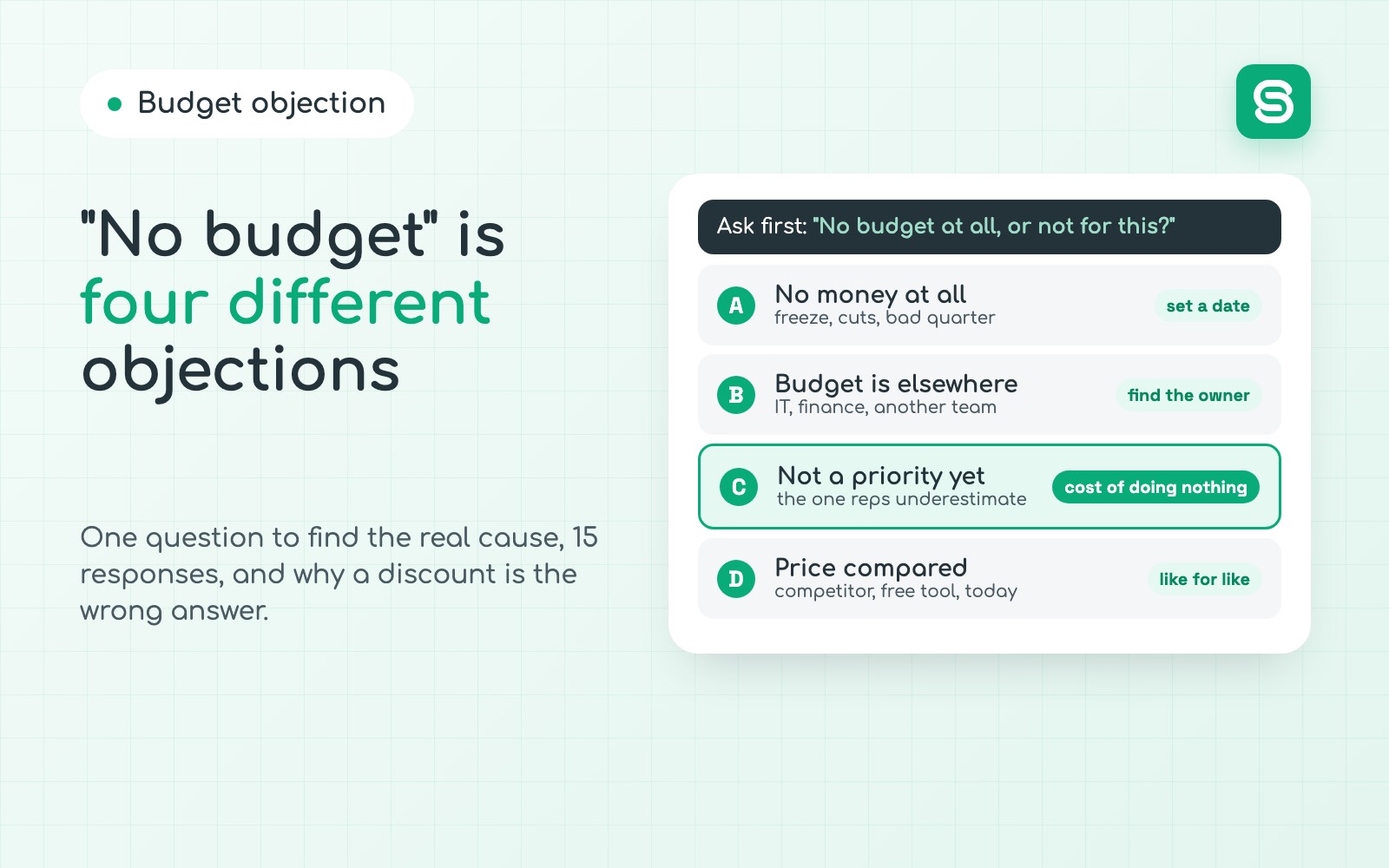
You’ve had a good conversation. The operations director in Dallas agreed the problem is real, nodded along to your example and even asked a question about onboarding. Then: “Honestly, we just don’t have the budget for this right now.” Most reps do one of two things next. They fold (“totally understand, I’ll follow up next quarter”), or they panic and offer 20% off. Both lose the deal. The budget objection is one sentence, but it hides four different problems, and each needs a different answer. This guide shows you how to tell them apart in ten seconds and what to say for each.
What does “we don’t have the budget” really mean?
Taken literally, “we don’t have the budget” means the company has no money to spend on your category this year. That’s sometimes true. But in B2B, it’s rarely the whole story. Companies with payroll, rent and a software stack spend money every week. The real question is never “do they have money?” but “why isn’t this on the list of things they spend it on?”
There are four answers to that question, and they sound almost identical on the phone.
Cause C is the one reps underestimate most. When a buyer says “no budget,” they often mean “not enough pain to fight for budget.” That’s why the status quo is your toughest competitor. After analyzing more than 2.5 million recorded sales conversations, Matthew Dixon and Ted McKenna write in Harvard Business Review that 40% to 60% of deals end up lost to customers who express an intent to purchase but never act. A polite “we don’t have the budget” is one of the ways that indecision sounds on the phone. Stalling is the norm, not the exception: in its State of Business Buying 2024, Forrester found that 86% of B2B purchases stall during the buying process, with 13 people involved in the typical decision.
Budget objection on a cold call vs. late in the deal
Where the objection shows up changes what it means.
| When you hear it | What it usually means |
|---|---|
| Cold call, first 30 seconds they don't know your price yet | A reflex to end the call. They can't know you're over budget. Treat it like "not interested" and earn ten more seconds. |
| Discovery call problem discussed, no price yet | Often cause C: the problem hasn't been sized. Go back to impact before talking money. |
| After the demo or proposal they know the price | More often real: cause A, B or D. Sort it with the clarifying question, then negotiate scope or terms. |
On a cold call, the budget line is mostly a brush-off, close cousin of “I’m not interested.” Our guide to the not interested objection covers how to handle reflex objections in the first seconds, and the broader list of cold call objections gives you the LAER framework for any of them. The rest of this article focuses on the budget objection once a real conversation has started.
Why shouldn’t you answer the budget objection right away?
Because you don’t yet know which of the four problems you’re solving. If you answer a cause-B objection (“the money is in IT’s budget”) with a cause-D answer (“let me show you the ROI”), you’ve just made a great case to someone who can’t spend the money. If you answer a cause-A objection (a real freeze) with a discount, you’ve given away margin for a deal that still can’t close this quarter.
There’s also a timing lesson in the data. Gong analyzed 11,331 opportunities and found that win rates were highest when pricing was discussed on the first call, and the same pattern held for budget. Deals where money comes up early, as a normal topic, go better than deals where the rep avoids it until the proposal. A budget objection late in the cycle is often a sign that the money conversation was postponed too long.
What question sorts the budget objection in ten seconds?
Acknowledge, then ask. Keep the acknowledgment short and genuine, not a scripted “I totally understand how you feel.”
The sorting question: three versions
Pick the one that sounds like you. Then stop talking.
Standard:
"That's fair, and I'd rather know now. Can I ask: is it that there's no budget at all right now, or that there isn't budget set aside for this specifically?"

When you suspect someone else owns the money:
"Got it. If you did decide this was worth fixing, whose budget would it typically come out of?"

When you suspect a price comparison:
"Understood. When you say budget, are you comparing this to something specific, another tool or what you spend today?"
Then listen for the signals in the answer.
| If you hear… | It's probably… |
|---|---|
| "We've frozen all new spend until Q2" | Cause A: no money at all, with an end date |
| "That would have to go through IT" or "my VP holds that budget" | Cause B: budget is elsewhere |
| "We have other priorities right now" or "it's not urgent" | Cause C: not a priority yet |
| "We pay half that for [tool]" or "we can do it in Excel" | Cause D: price compared |
15 responses to “we don’t have the budget,” by real cause
Below are 15 responses, grouped by cause. Don’t memorize them word for word; pick one or two per cause that sound like you, and practice until they come out naturally. Each response ends with a question, because the goal is to keep the buyer talking, not to win the argument.
No money at all: responses 1 to 4
A real freeze is a timing problem, not a “no.” Your job is to find out when it ends, keep the deal alive and, if possible, find a smaller version that fits now.
1. Find the end date.
“That’s helpful to know. Is this a freeze until a specific date, like the next quarter or the new fiscal year, or is it open-ended?”
2. Shrink the scope.
“Would it help if we started smaller? For example, three seats for the team that feels this most, instead of the whole floor. That usually fits under a manager’s spending limit.”
3. Ask about the approval threshold.
“Out of curiosity, is there an amount under which you can approve something yourself, without going through the full budget process?”
4. Prepare the next cycle together.
“When budgets open again, what would you need to have in hand to get this approved quickly? I can help you put that together now, so you’re first in line.”
Budget is elsewhere: responses 5 to 8
Here the money exists, but your contact doesn’t control it. Your job is to find who does, and to help your contact make the case to them.
5. Find the budget owner.
“Makes sense. If this moved forward, whose budget would it come out of? Would it be worth bringing them into our next call?”
6. Look for budget in the cost of the problem.
“You mentioned the team loses about 40 hours a week to this. Is that time paid out of your budget? Sometimes the money to fix a problem is already being spent on living with it.”
7. Replace a line, don’t add one.
“What are you using today for this, even partly? Sometimes the budget is already there, in a tool or a contractor this would replace.”
8. Arm your champion.
“If I put together a one-page summary with the cost of the problem, the price and the payback, would that help you take it to [budget owner]? What would they want to see on it?”
When the decision involves several people, don’t rely on one contact to carry your case. Our guide to multithreading in sales shows how to reach the other stakeholders without going over your contact’s head, and the MEDDIC framework gives you the checklist for mapping who controls the money.
Not a priority yet: responses 9 to 12
This is the cause reps underestimate most, and the one where the real objection is value, not money. Your job is to make the cost of doing nothing visible, in the buyer’s own numbers.
9. Size the problem.
“Fair enough. Can I ask what this problem costs you today? Roughly how many people does it affect, and how many hours a week?”
10. Compare with what’s ahead of it.
“What’s at the top of the list right now? I’m curious how this compares with those projects in terms of what’s at stake.”
11. Ask what happens if nothing changes.
“If nothing changes on this for the next six months, what does that look like for the team? For your number?”
12. Ask what would make it a priority.
“What would have to happen for this to move up the list? Is there a number or an event that would change it?”
When a buyer says “no budget,” they often mean “not enough pain to fight for budget.” Money follows priority, not the other way around.
Price compared: responses 13 to 15
The buyer has a reference point. Your job is to find it, then compare like for like: features, service, total cost over a year and the risk of switching.
13. Find the comparison.
“Too expensive compared to what? Another vendor, what you pay today, or a number you had in mind?”
14. Compare like for like.
“That’s a fair comparison to make. Can we look at what’s included in each? In my experience the gap usually comes down to [what’s included: seats, support, setup, usage]. Is that the case here?”
15. Bring it back to cost per result.
“Let’s look at it per [meeting booked / hour saved / rep]. If the other option costs half but delivers a third of the result, which one is really cheaper?”
If the comparison is with a free option (“we’ll just use the phone in our CRM,” “our reps dial from their cell”), the conversation is about the hidden cost of the free tool: rep time, missing data, no recordings. Our comparison of CRM calling vs. a dedicated dialer lays out that trade-off honestly, including when the free option is the right one.
How do you answer “it’s too expensive”?
“It’s too expensive” is the price objection, the close cousin of the budget objection. The difference matters. A budget objection says “we can’t fund this.” A price objection says “it isn’t worth this much to us” or “someone else charges less.” One is about money available, the other about value for money.
- “We don’t have the budget for this.”
- About money available, ownership or timing.
- Solved by finding the money, the owner or the moment.
- Typical fix: smaller scope, dated callback, budget owner on the next call.
- “It’s too expensive” or “the other vendor is cheaper.”
- About perceived value, or a reference price.
- Solved by showing value and comparing like for like.
- Typical fix: cost of the problem, cost per result, adjusted scope or terms.
Three moves work for “it’s too expensive.” First, ask “compared to what?” and wait; responses 13 to 15 above apply directly. Second, if they haven’t seen the price yet (it happens on cold calls more than you’d think), say so: “I haven’t shared a price yet, so let’s first see if it solves the problem; if it doesn’t, the price doesn’t matter.” Third, if they have seen it, move from the sticker price to the cost per result, using the calculator below.
What should you never say to a budget objection?
Why an instant discount costs more than it looks
Discounting feels cheap because the number is small: 10% off. But the 10% doesn’t come out of the price; it comes out of your margin, which is much thinner. In their classic Harvard Business Review article Managing Price, Gaining Profit, McKinsey’s Michael Marn and Robert Rosiello showed that, based on the average economics of 2,463 companies, a 1% improvement in price raised operating profit by 11.1%, assuming no loss of volume. The lever works in both directions: every point of price you give away hits profit far harder than it hits revenue.
To run this with your own prices and margins, our free discount margin calculator shows how much extra volume any discount requires, and how much a small price increase is worth.
When a concession makes sense: trade it, never give it. A lower first-year price in exchange for a two-year term, a faster signature, a smaller scope, annual payment upfront or a reference call. If the buyer won’t give anything back, the concession wasn’t what stood between you and the deal.
How do you build a quick ROI case with the prospect?
The most convincing ROI case is the one the buyer builds with you. When the numbers come from them, they can’t dismiss them as vendor math. On the phone, it takes four questions and about two minutes.
- 01
How many people does the problem affect?
”How many people on your team deal with this every week?" - 02
How much time does each one lose?
"Roughly how many hours a week does it take each of them? Even a ballpark." - 03
What does an hour cost?
"What would you say an hour of their time costs, salary and benefits included? Fifty dollars? More?" - 04
Do the math out loud.
"So that’s about [figure] a week, or [figure] a year. Our price is [figure] a year. Does that math look right to you?”
Here’s the same calculation in a mini calculator. Change the figures with the prospect’s answers; the example values are there to show the mechanics.
Cost of the problem vs. your price
Problem cost per year$86,400
Price as a share of that cost10%
Payback4.7 weeks
48 working weeks a year. Example values; replace them with the prospect's own numbers, out loud, together.
For the loaded hourly cost, salary data from the Bureau of Labor Statistics helps you suggest a realistic figure if the buyer doesn’t know: our inside sales guide lists the BLS medians for sales roles. For a full business case with ramp time and quota, the sales rep ROI calculator and the LTV:CAC calculator go further.
Then put it in writing, so your contact can forward it to whoever holds the budget.
ROI recap email after a budget objection
Template written for this article. Use the buyer's own numbers, never yours.
Subject: The numbers we talked about today

Hi [First name],

Thanks for walking through the numbers with me. Here they are, so you have them in one place:

The problem today
- [Number] people affected, about [hours] hours a week each
- At roughly $[hourly cost] an hour, that's about $[weekly cost] a week, or $[annual cost] a year

The fix
- [Offer], $[annual price] a year
- Payback: about [weeks] weeks, based on the figures you gave me

What we agreed
- [Next step: call with budget owner / smaller pilot / check-in date]

If any of these numbers look off, tell me and I'll update them. Happy to join a call with [budget owner] if that helps.

[Your name]
Does the budget objection change with the buyer’s role?
The words are the same, but what sits behind them changes with who says them. A CFO who says “no budget” is telling you something different from a sales manager who says it. Adjust the follow-up question to the role.
The CFO or finance leader
When finance says “no budget,” it’s usually a statement about priorities across the whole company, not about your line item. They think in payback, cash and risk. Skip the feature talk. Ask: “What payback period would a project like this need to clear to get funded?” Then answer in that unit. If they say twelve months and your math shows eight weeks, you’re having a different conversation. Our guide on how to cold call CFOs covers the vocabulary that lands with finance.
The VP of Sales or another department head
A department head usually has a budget, but it’s committed: headcount, tools, events. “No budget” often means “not without cutting something I already fought for.” Ask what this would replace, or whether it could come out of a line that’s underused. Response 7 above works well here. For the specifics of selling to sales leaders, who grade your pitch while they hear it, see how to cold call a VP of Sales.
The founder or small business owner
In a small company, the person on the phone is the budget. “No budget” from an owner is personal: it’s their money. It’s also the most honest version of the objection, so respect it. Smaller scope, monthly terms or a pilot with a clear exit work better here than ROI decks. Our guide on how to cold call founders and small business owners explains how to sell to someone who decides alone.
Procurement
When procurement says the price is over budget, it’s often a negotiation step, not a verdict. Their job is to get a better price, and they’ll say it to every vendor. Don’t panic and don’t cut the price in the first call. Ask what they need to see to move forward, and keep your champion involved: procurement rarely kills a deal the business really wants.
When is the budget objection real, and when should you let go?
Sometimes there’s really no money, the problem really isn’t urgent and no amount of reframing will change that. Pushing past that point damages the relationship and wastes your time. Let go when these three are true at once.
- 01
The account fits.
It’s the right size, the right industry, the right use case. Worth keeping warm. - 02
The problem is real but not urgent.
They agree it exists, but the cost isn’t high enough today to beat other priorities. - 03
There's no money and no date.
No budget now, and no event (new fiscal year, funding round, new leader) that will change it soon.
Then close the loop cleanly: “It sounds like the timing isn’t right, and I’d rather not chase you. You mentioned your fiscal year starts in February. Would it make sense for me to check back in early January, before budgets are set?” Log the reason in your CRM in plain words, with the date. Our guide to the call me back later objection covers how to lock in a specific callback, and how to call a prospect back shows the 30-second prep that makes the next call start where this one ended.
How do you prevent the budget objection in the first place?
Most budget objections are born in discovery. If the problem was never sized, the price arrives with nothing to compare it to, and any price looks expensive. Three habits cut budget objections sharply.
The B in BANT stands for budget, and it’s often asked as a yes/no question at minute four of a discovery call. That’s too early and too blunt. Frameworks like CHAMP deliberately move money later, after challenges and authority, for the same reason: budget is a conclusion, not a starting point.
How do you practice handling the budget objection?
Reading 15 responses doesn’t make them come out naturally on a live call. Practice does. Two formats work well for sales teams.
| Format | How it works |
|---|---|
| Flashcards, alone 10 minutes a day | Our free objection handling practice tool shows an objection, starts a timer and lets you compare your answer with a model response. Run the budget cards until the sorting question is automatic. |
| Role play, in pairs 20 minutes a week | One rep plays a buyer with a hidden cause (A, B, C or D). The other has to find it with one question and pick the right response. Swap roles. |
| Call review, as a team 30 minutes a week | Pull three real calls where the budget objection came up. Did the rep ask the sorting question? Which cause was it? What happened next? |
Start with the objection handling practice flashcards, then move to pairs with the cold call role play scenarios, which include a scorecard and a 30-minute session plan.
Call review is where most of the learning happens, because it shows what reps actually say, not what they say they say. If your calls are recorded and transcribed, searching for “budget” across a week of calls takes seconds. Skipcall records and transcribes outbound calls and writes an AI summary of each call into your CRM, so budget objections, and what reps answered, are easy to find when you prepare a coaching session. It doesn’t score the answers for you; that part stays with the manager.
Key takeaways
Sources
- Harvard Business Review: Managing Price, Gaining Profit, Michael V. Marn and Robert L. Rosiello (September 1992)
- Harvard Business Review: Stop Losing Sales to Customer Indecision, Matthew Dixon and Ted McKenna (June 2022)
- Forrester: The State of Business Buying, 2024 (press release, December 4, 2024)
- Gong: the best time to talk price and budget (11,331 opportunities)




