Your first meeting with a new prospect is on the calendar for Thursday at 2 PM Eastern. The VP of Operations accepted the invite. You have 30 minutes, and you know two things about them. Most reps walk in with a list of 40 questions copied from a blog and come out with a pile of notes, no clear problem and a vague “let’s reconnect next week.” This discovery call template fixes that: one page, six timed blocks, the questions that go in each one, and a next step booked before you hang up.
What is a discovery call?
A discovery call is the first scheduled conversation between a seller and a prospect who has agreed to talk. It usually follows a cold call, an inbound demo request or a referral. Its job is to understand three things: the problem the buyer is trying to solve, what that problem costs them, and how they would make a decision to fix it. Your product comes in at the end, briefly, and only where it connects to what you heard.
The term gets used loosely, so it helps to separate it from the two calls it’s most often confused with.
| Call | What it is for |
|---|---|
| Cold call unscheduled, about 5 minutes | Earn interest, qualify lightly, book the discovery call. Our guide to cold call discovery questions covers this short version. |
| Discovery call scheduled, usually 30 minutes | Understand the problem, its cost and the buying process, then book the next meeting with the right people. |
| Demo scheduled, 30 to 60 minutes | Show how the product solves the problem discovery uncovered, to the people who will decide. |
If you’re looking for the five-minute qualification you run on a live cold call, read our 30 cold call discovery questions instead. This article picks up where that call ends: the prospect said yes to a meeting, and now you need to run it.
What should a discovery call agenda include?
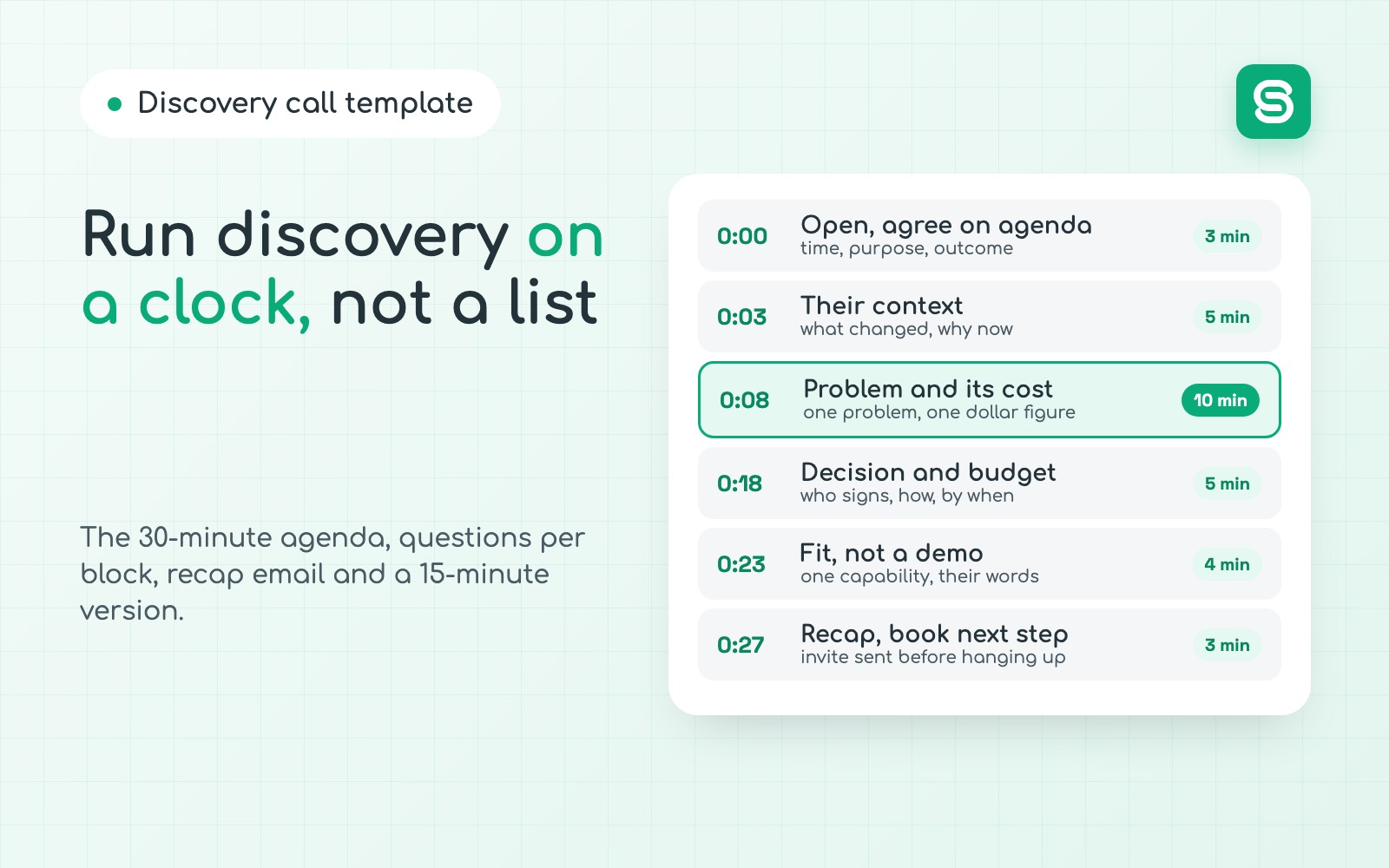
Every solid discovery call agenda has the same skeleton, whatever your market: an opening that sets expectations, a block on the buyer’s context, a long block on the problem, a block on how they buy, a short link to your solution and a closing that books the next step. What changes from one team to another is the time you give each block. The version below is built for a 30-minute B2B call. You can enlarge the diagram or download it.
Three choices in that agenda are deliberate.
How many questions should you ask?
Fewer than you might think, and spread out. Gong analyzed more than 519,000 recorded B2B sales calls and found that discovery calls with 11 to 14 questions had the highest success rate, 74%, against 46% for calls with 1 to 6 questions. Past that range, results dropped again: 67% for 15 to 18 questions. Gong itself notes this is a correlation, not a law, and its 2025 update found that won deals averaged 15 to 16 questions and lost deals around 20. The same research found that successful discovery calls uncover three to four business problems, not one. Two nuances matter more than the number. Top sellers spread their questions across the whole call, while average reps fire them all in the first ten minutes. And senior buyers have less patience: Gong found that successful meetings with C-suite executives had four questions on average, unsuccessful ones eight.
Talking less still matters. Gong’s original 2016 benchmark put the best-converting talk-to-listen ratio on first calls at 43:57; its 2025 data on 326,000 calls shows reps talk 60% of the time on average, 57% on won deals and 62% on lost ones. Our guide to the talk-to-listen ratio goes deeper on why the seller who talks less tends to learn more, and how to measure it on your own calls.
How do you prepare for a discovery call?
Preparation should take ten to fifteen minutes, not an hour. The goal isn’t to know everything about the account. It’s to walk in with two or three hypotheses you can test, so your first questions sound informed instead of generic.
- 01
Read what they told you.
The demo request form, the cold call notes, the email thread. Whatever the prospect already said, you don’t ask again; you confirm it. “You mentioned on the phone that your team doubled this year. Is that still the main driver?” - 02
Look up the person.
Their LinkedIn: role, time in seat, previous company. A VP who joined four months ago is often building a plan and has more room to change things than one who has been there eight years. - 03
Look up the company.
Headcount trend, recent funding or acquisition, job postings in the team you sell to, news from the last 90 days. Hiring 12 SDRs is a trigger. A layoff is a different one. - 04
Write two hypotheses.
”They’re scaling outbound and their reps are losing time dialing by hand.” “Their CRM data is messy after the acquisition.” You’re there to test them, not to pitch them. - 05
Send a one-line agenda the day before.
Three bullets in the invite: your situation, what you’re trying to fix, whether it makes sense to go further. Buyers show up more prepared, and no-shows tend to drop.
If the meeting came from a cold call, read your own notes from that call first. A good sales call summary written at the time saves you ten minutes of research and the embarrassment of asking a question the prospect already answered.
What questions should you ask on a discovery call?
Below are the questions for each block of the agenda. You won’t ask all of them. Pick two or three per block before the call, and keep the rest as backups when an answer is short. The order matters more than the exact wording: context before problem, problem before cost, cost before budget, decision before solution.
Opening: agree on the agenda (0:00 to 0:03)
The opening has one job: get the buyer to agree on what the next 30 minutes are for, including the possibility that it’s not a fit. Skip the ten minutes of weather small talk; a sentence or two of genuine rapport is enough. Our guide to building rapport on sales calls covers what works without sounding rehearsed.
- “Thanks for making the time. We have until 2:30, does that still work on your end?”
- “Here’s what I suggest: I’d like to understand how your team handles [area] today and what prompted you to take this call. Then I’ll share a bit about how we work with teams like yours, and we decide together whether a next step makes sense. If it doesn’t, I’ll tell you. Sound fair?”
- “Anything you want to make sure we cover?”
Context: what changed, and why now (0:03 to 0:08)
People rarely take a sales meeting when nothing has changed. Find the trigger and you’ve found the urgency.
- “What prompted you to take this meeting now, rather than six months ago?”
- “Walk me through how [process] works today, from start to finish.”
- “Who’s involved in that process day to day?”
- “What’s changed in the last quarter: headcount, targets, tools, leadership?”
Problem and impact: the ten minutes that matter (0:08 to 0:18)
This is the heart of the call. You’re moving from a general frustration to a specific problem with a cost. Both SPIN selling and the Sandler pain funnel are built for this block: problem questions first, then questions about consequences.
- “Where does that process break down most often?”
- “Can you give me a recent example? What happened?”
- “How often does that happen in a typical week?”
- “What does it cost you when it happens: in hours, in deals, in customers?”
- “Who else feels it? Does your CFO or your CEO know about it?”
- “What have you already tried to fix it? What happened?”
- “If nothing changes, where does that leave you at the end of next quarter?”
Decision and budget: how they buy (0:18 to 0:23)
Now you ask about the buying process. Pick whichever qualification framework your team uses: our comparison of BANT vs. MEDDIC helps you choose, and the BANT and MEDDIC qualification scorecard scores the answers live while you talk.
- “If you decided to fix this, how would that decision get made? Who would be involved?”
- “Who has the final say on a purchase like this one?”
- “Have you bought something similar in the last couple of years? How did that go, step by step?”
- “Is there budget set aside for this, or would it need to be found or approved?”
- “Is there a date that matters here: a renewal, a fiscal year start, a board meeting?”
- “What would make you decide to do nothing?”
The last question is the one most reps skip, and it’s the most useful. The status quo is your most frequent competitor: Matthew Dixon and Ted McKenna, after studying more than 2.5 million recorded sales conversations, write in Harvard Business Review that 40% to 60% of deals end up lost to buyers who say they intend to purchase but never act. If the budget question meets resistance, our guide to the budget objection sorts out what “we don’t have the budget” really means, and when a deal truly has several decision makers, multithreading is how you avoid depending on one contact.
Fit: one capability, tied to their problem (0:23 to 0:27)
This is not a demo. It’s a short explanation of how you’d approach the problem they described, using their words. One or two capabilities, no more, each tied to something they said.
- “You said your reps lose about 40 hours a week dialing manually. Here’s how teams like yours usually handle that…”
- “Does that match what you had in mind, or am I off?”
- “What would you need to see to know this would work for your team?”
The last question tells you what the next meeting needs to contain. Write the answer down word for word. If you need help putting your solution into a few sentences, our collection of sales pitch examples has short versions by situation.
Next step: recap and book it live (0:27 to 0:30)
- “Let me make sure I got it right. [Problem], which costs you about [figure] a [period]. You want it fixed by [date], and [names] would be part of the decision. Did I miss anything?”
- “The logical next step would be a [demo / working session] with [names], where we show [what they said they need to see]. How does Tuesday at 11 look?”
- “I’ll send the invite now, while we’re both here.”
The discovery call template to copy
Here’s the whole thing in one block: the agenda, the questions to pick from and the fields to fill in during the call. Copy it into your notes app, your CRM’s meeting template or a Google Doc before each call. Replace the brackets.
Discovery call template: 30 minutes
Template written for this article. Pick 2 or 3 questions per block before the call.
DISCOVERY CALL: [Company], [Name, title]
Date: [date]   Time booked: 30 min   Source: [cold call / inbound / referral]
My 2 hypotheses: 1) [ ]  2) [ ]

0:00 OPEN (3 min)
"We have until [time], does that still work?"
"I'd like to understand how you handle [area] today and what prompted this call. Then I'll share how we work with teams like yours, and we decide together if a next step makes sense. Sound fair?"
"Anything you want to make sure we cover?"
> Their addition to the agenda: [ ]

0:03 CONTEXT (5 min)
- What prompted you to take this meeting now?
- Walk me through how [process] works today.
- What changed in the last quarter?
> Trigger: [ ]
> Current process / tools: [ ]

0:08 PROBLEM AND IMPACT (10 min)
- Where does it break down most often? Recent example?
- How often? How many people?
- What does it cost: hours, deals, customers, dollars?
- Who else feels it?
- What have you tried? What happened?
- If nothing changes, where are you next quarter?
> Problem in THEIR words: [ ]
> Frequency: [ ]   Cost: [ ] per [week / month]
> Already tried: [ ]

0:18 DECISION AND BUDGET (5 min)
- How would a decision like this get made? Who's involved?
- Who has the final say?
- Last similar purchase: how did it go?
- Budget set aside, or to be found / approved?
- A date that matters? (renewal, fiscal year, board)
- What would make you decide to do nothing?
> Decision maker: [ ]   Others: [ ]
> Steps to buy: [ ]
> Budget: [set / to find / unknown]   Key date: [ ]

0:23 FIT (4 min)
"You said [their words]. Here's how teams like yours handle that: [1 or 2 capabilities]."
- Does that match what you had in mind?
- What would you need to see to know it would work?
> What they need to see: [ ]
> Their reaction: [ ]

0:27 RECAP AND NEXT STEP (3 min)
"So: [problem], costing about [figure], to fix by [date], with [names] involved. Did I miss anything?"
"Next step: [meeting] with [names] to show [what they need to see]. How does [day, time] look?"
> Next step: [what] on [date] with [who]   Invite sent: [yes / no]
> Exit: [advance / map the buyers / nurture / disqualify]
To turn that sheet into a CRM-ready summary after the call, the sales call summary template shows which field goes where.
How do you take notes during a discovery call?
Notes are where most discovery calls quietly fail. A rep who types everything misses half of what’s said; a rep who writes nothing forgets the exact figure the buyer gave. The template above solves most of it with fixed fields: you’re not writing a transcript, you’re filling in eight boxes.
If you record the call, you can listen more and type less. In the US, recording consent depends on the state: most allow one-party consent, but California, Florida, Pennsylvania, Washington and several others require everyone on the call to agree. Our free map of call recording laws by state shows which rule applies, and saying “this call is recorded for my notes, is that OK with you?” at the start covers you everywhere. For what AI summaries get right and wrong, see our analysis of AI call transcription and summaries.
How should you end a discovery call?
The last three minutes decide whether the 27 before them were worth anything. “Let’s reconnect next week” is not a next step; it’s a deal that will stall. By minute 27, you should know which of four exits you’re taking. Your notes answer three questions in a row.
Here’s what to say for each exit.
| Exit | What you say |
|---|---|
| Advance fit, problem, path to a decision | "The next step would be a working session with you and [names], where we show [what they need to see]. How does Tuesday at 11 look? I'll send the invite now." |
| Map the buyers real problem, no path yet | "It sounds like [name] would need to be part of this. Would it make sense to bring them into a 20-minute call next week, so you don't have to relay everything?" |
| Nurture fit, but no costly problem today | "Honestly, it doesn't sound like this is costing you enough to change anything right now. You mentioned the new fiscal year in February. Can I check back in mid-January?" |
| Disqualify not a fit | "Based on what you've told me, we're probably not the right fit, and I'd rather tell you now than waste your time. If it helps, teams in your situation often look at [category]." |
“Let’s reconnect next week” is not a next step. It’s a deal that hasn’t admitted it’s stalled yet.
The disqualify exit feels like a loss. It isn’t. Every meeting you book with a prospect who will never buy pushes back your real deals and inflates a pipeline that will slip anyway. A clean “not a fit” also leaves a good impression, and people change jobs: the VP you disqualified today may run a team that’s a perfect fit in two years.
What should a discovery call recap email say?
Send the recap within the hour, while the buyer still remembers the conversation. It does three jobs: it proves you listened, it gives your contact a ready-made summary to forward internally and it puts the next step in writing. If it takes you more than five minutes, your notes weren’t structured enough.
Discovery call recap email
Template written for this article. Under 200 words. Replace the brackets.
Subject: Recap of today's call + [next step] on [date]

Hi [First name],

Thanks for your time today. Here's what I took away, so you can correct anything I got wrong.

Where you are today
- [Current process, in their words]
- [Trigger: what changed]

The problem
- [Problem, in their words], about [frequency]
- Estimated cost: [figure] per [week / month / year]

What you want
- [Goal] by [date], ideally before [key date they gave]

How you'd decide
- [Names / roles] would be involved, [name] has the final say
- [Budget status, as they described it]

Next step
- [Meeting] on [day, date, time ET], with [attendees]
- Goal: show [what they said they need to see]
- I'll send [promised resource] by [date]

Did I miss anything?

[Your name]
Some buyers prefer a quick text to an email, especially owners of small businesses. Our SMS templates after a sales call include a short confirmation of the next meeting. And if the prospect goes quiet after the recap, the sales follow-up process guide gives you the cadence that doesn’t sound needy.
What does a 15-minute discovery call look like?
Not every deal needs 30 minutes. A small business owner who decides alone, a low-priced product, a prospect who already knows the category: in those cases, a 15-minute discovery call is enough, and asking for 30 can cost you the meeting. You keep the same order and cut the depth.
| Time | Block | What you keep |
|---|---|---|
| 0:00 to 0:01 | Open | Time check and the one-line agenda |
| 0:01 to 0:04 | Context | Why now, and how it works today |
| 0:04 to 0:09 | Problem and cost | One problem, one example, one number |
| 0:09 to 0:11 | Decision | "Is it your call, or does someone else weigh in?" |
| 0:11 to 0:13 | Fit | One capability tied to the problem |
| 0:13 to 0:15 | Next step | Recap in one sentence, book it live |
15-minute discovery call: the short version
Template written for this article. For single-decision-maker deals.
0:00 "We have 15 minutes. I'd like to understand what prompted the call and whether we can help. If not, I'll say so. OK?"
0:01 "What made you look into this now?" / "How do you handle it today?"
0:04 "Where does it hurt most? Give me a recent example." / "How often? What does it cost you?"
0:09 "Is this your call, or does someone else weigh in?" / "Budget set aside, or to find?"
0:11 "You said [their words]. Here's how we handle that: [one capability]. Does that fit?"
0:13 "So: [problem], costing [figure]. Next step: [what] on [day, time]. Sending the invite now."

> Problem: [ ]  Cost: [ ]  Decision: [alone / with ___ ]  Budget: [ ]  Next: [ ]
When 15 minutes isn't enough: enterprise deals with a buying committee, regulated industries, or any sale where the first meeting includes two or more of the buyer’s people. Book 45 to 60 minutes, spend the extra time on the problem block, and plan for a second discovery meeting with the people you didn’t meet.
How do you run discovery for SMB, mid-market and enterprise deals?
The template stays the same; what changes is depth, attendees and how much you can expect to learn in one call.
- Often one decision maker, sometimes the founder or the owner.
- 15 to 30 minutes is enough. Budget and decision questions can be direct.
- The next step is often a demo or a proposal, sometimes the close itself.
- Biggest risk: running a 45-minute discovery for a deal that should close in two calls.
- Several people decide, and your first contact is rarely the one who signs.
- One discovery call won’t map everything: plan for two or three, with different people.
- Procurement, security and legal each have their own steps; ask about them early.
- Biggest risk: treating an enthusiastic champion as the decision maker.
For enterprise accounts, a framework built for complex buying groups helps you see what’s missing. Our guide to the MEDDIC framework lists the six things to confirm, and the length of your cycle will depend directly on how fast you map them; our guide to sales cycle length shows how to measure it by segment.
Discovery call checklist: how do you grade your own call?
Run this checklist right after each discovery call, before you write the recap. It takes two minutes, and the “no” answers tell you what the next meeting must cover. Score one point per yes.
Discovery call checklist: 10 points
Checklist written for this article. Below 7, plan another discovery meeting before any demo.
[ ] 1. I confirmed the time and agreed on the agenda in the first 3 minutes.
[ ] 2. I know what triggered this meeting now (the "why now").
[ ] 3. I wrote the main problem in the buyer's own words.
[ ] 4. I have a recent, concrete example of the problem.
[ ] 5. I have a cost figure (hours, dollars, deals) the buyer agreed with.
[ ] 6. I know who makes the final decision, by name.
[ ] 7. I know the steps to buy (approvals, procurement, legal, security).
[ ] 8. I know the budget status: set aside, to find, or unknown.
[ ] 9. I talked less than the buyer did.
[ ] 10. The next meeting is in the calendar, invite accepted.

Score: __ / 10
To grade calls across a whole team, the sales call scorecard has a discovery grid you can print or fill in online, with listening exercises for coaching sessions.
What are the most common discovery call mistakes?
- 01
Pitching in the first ten minutes.
The buyer mentions a problem, and the rep jumps to the feature that solves it. You’ve stopped learning, and you’ve solved a problem you only half understand. - 02
Running through the list.
Twenty questions in a row feels like an audit. Ask, listen, then follow up on the answer: “Tell me more about that” beats the next question on your sheet. - 03
Asking about budget too early.
”What’s your budget?” at minute four, before any problem has a cost, gets a defensive answer or a made-up number. - 04
Assuming your contact decides.
A director who says “I’ll take it to my boss” has just told you they don’t decide. Ask how the last similar purchase was approved. - 05
Running over time.
Going to minute 38 on a 30-minute call tells the buyer the next meeting will run long too. - 06
Leaving without a date.
”I’ll send something over” with no booked meeting is how deals die quietly. Book the next step while you’re both still on the call.
Most of these mistakes come from listening badly rather than asking badly. Our guide to active listening in sales has seven techniques built for phone and video calls, including the summary-and-confirm move that closes the problem block.
Can you practice discovery before the real call?
Yes, and you should, especially for new reps. Pair two reps, give one a buyer profile with a hidden problem and a hidden decision maker, and let the other run the template. The “buyer” scores the call with the 10-point checklist. Fifteen minutes a week is enough to make the structure automatic. The cold call role play scenarios guide has a session format you can reuse, and the 30-60-90 day onboarding plan generator helps you place discovery practice in a new hire’s first month.
Where a dialer helps, and where it doesn’t
Discovery is a conversation, and no tool runs it for you. Where tools help is around it: getting the meeting in the first place, and keeping a clean record of what was said.
If your discovery calls come from outbound, Skipcall is built for that part: a power dialer and a parallel dialer on four lines to reach more prospects per hour, and call recording with AI transcription and summaries so the notes from the cold call are waiting for you when the discovery meeting comes up. It syncs with HubSpot, Pipedrive, Salesforce and Attio. It doesn’t run your video meetings or score your discovery calls for you.
Key takeaways
Sources
- Gong: discovery call tips, questions per call and success rate (519,000+ calls)
- Gong: selling to the C-suite, questions in successful vs. unsuccessful meetings
- Gong: essential discovery call techniques, 519,000 discovery meetings, 2025 update
- Gong: the talk-to-listen ratio, 2016 benchmark and 2025 data on 326,000 calls
- Gartner: 61% of B2B buyers prefer a rep-free buying experience (June 25, 2025)
- Gartner: 69% of B2B buyers turn to sales reps to validate AI-generated insights (May 20, 2026)
- Harvard Business Review: Stop Losing Sales to Customer Indecision, Matthew Dixon and Ted McKenna (June 2022)




