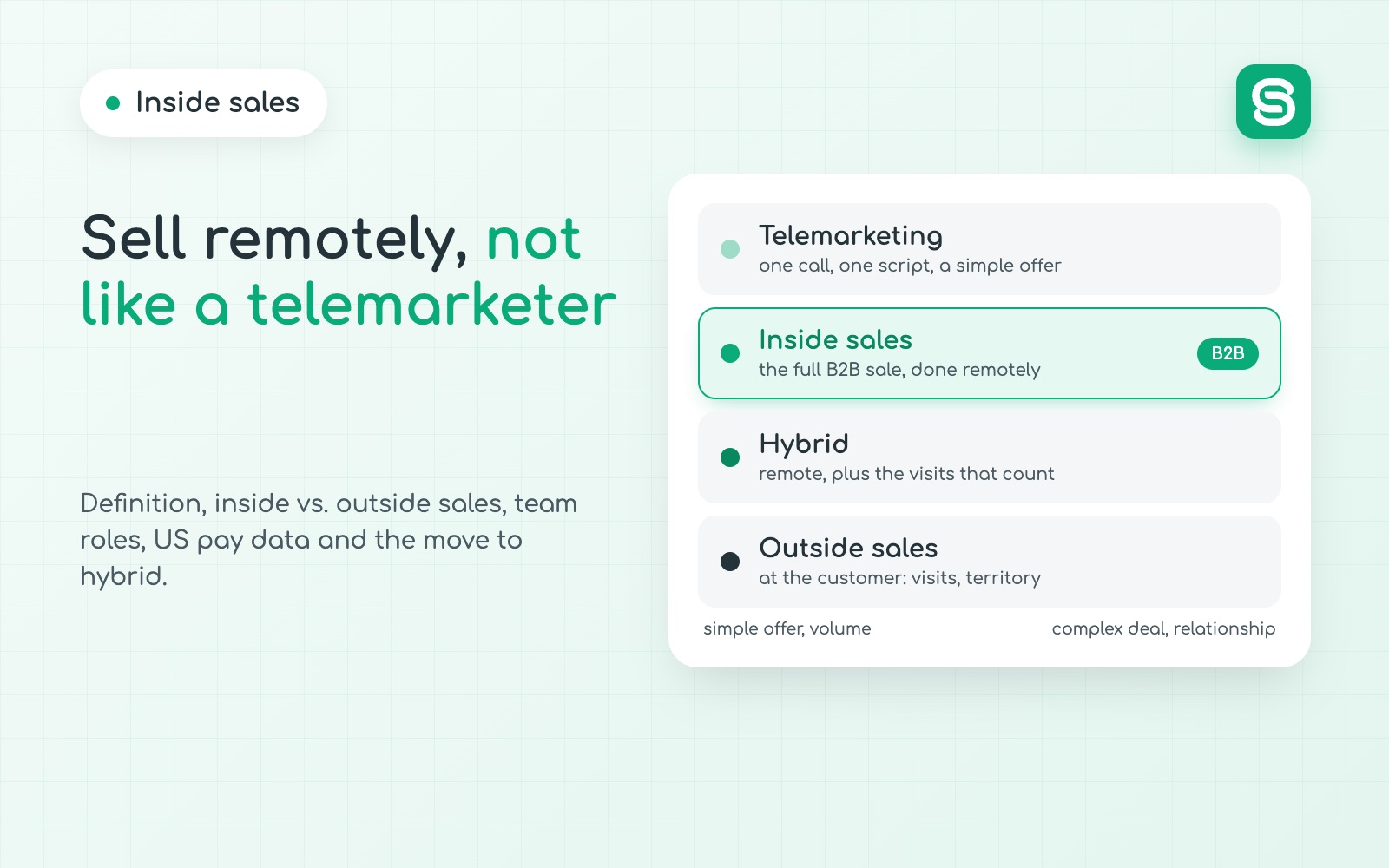
“Now hiring: Inside Sales Representative.” On Indeed or LinkedIn, that title can mean an hourly rep taking reorders for a distributor in Ohio, a SaaS account executive closing six-figure deals from a home office in Denver, or a first-job SDR booking meetings off a list. Same three words, three different jobs. That’s how companies end up hiring the wrong profile, paying the wrong way and measuring the wrong thing.
What is inside sales?
Inside sales means selling from the office, or from home, using remote channels. The term is American: US companies have long separated reps who sell “inside” from those who go “outside,” on the road, to customer sites. The split even has legal weight. Under the Fair Labor Standards Act, the outside sales exemption from overtime only applies to reps who are customarily and regularly engaged away from the employer’s place of business, according to the Department of Labor’s Fact Sheet #17F. The same fact sheet says that sales made by mail, telephone or the internet don’t count as outside sales, and that a home office used as a rep’s headquarters counts as one of the employer’s places of business. In plain terms: your remote reps are inside reps for wage-and-hour purposes.
In this guide, inside sales means a full B2B sale, run remotely, by reps trained to manage a sales cycle. If you hit an unfamiliar acronym (SDR, BDR, AE, CSM, SQL), our cold calling and sales glossary defines them all.
What an inside sales rep actually does
- 01
Prospects or works inbound leads.
Outbound calls to target accounts, fast callbacks on inbound demo requests, follow-ups by email and LinkedIn. On bigger teams, SDRs and BDRs own this part. - 02
Qualifies and runs discovery.
A call or Zoom to understand the problem, the stakes, budget, timeline and who signs. Most teams follow a written framework; our BANT vs. MEDDIC comparison helps you choose one, and the sales qualification scorecard gives you one ready to fill in. - 03
Demos remotely.
Screen-share demo over Zoom, Teams or Google Meet, sometimes in several sessions for different stakeholders. - 04
Proposes and negotiates.
Proposal, pricing and terms conversations, security questionnaires, legal redlines. - 05
Closes.
E-signature, then a clean handoff to onboarding or customer success.
Decoding the job titles
Titles overlap, and every company uses them its own way. Here’s what they most often mean in US job postings.
| Title | What it usually means |
|---|---|
| Inside sales rep (ISR) | A rep who sells remotely across the cycle. In distribution and manufacturing, often a quoting and reorder role supporting outside reps |
| Inside account manager | Manages and grows an existing book of accounts by phone and email |
| Telemarketer, call center agent | Scripted calls to sell a simple offer or set appointments, often to consumers, usually hourly |
| SDR, BDR | Opens B2B deals: books qualified meetings for the reps who close |
| Account executive (AE) | Runs the deal to signature, remotely or in person |
| Outside sales rep, territory manager | Field sales: travels to customers within a territory |
Inside sales vs. outside sales: what’s the difference?
Outside sales (field sales) happens at the customer: meetings in their office, ride-alongs, trade shows, plant tours. Inside sales does the same work remotely. The two models aren’t better or worse than each other; they differ in economics and in how the team is run.
Before getting into the details, here’s where each model sits. You can enlarge the diagram or download it.
| Criterion | Inside sales | Outside sales |
|---|---|---|
| Where the sale happens | Office or home, by phone and video | At the customer, within a territory |
| Meetings per day | Limited by the calendar, not the road | Limited by drive time and flights |
| Territory | All 50 states, often several countries | A region you can physically cover |
| Cost per meeting | The rep's time | Time, plus mileage, car allowance, flights, hotels, meals |
| Relationship | Frequent, shorter, heavily documented | Less frequent, in person, often more personal |
| Visibility for the manager | Calls, meetings and emails logged in tools | Visit reports, often self-reported |
| Profile you hire | Strong on the phone and in writing, organized | Autonomous, mobile, rooted in a territory |
What field sales still does better
It would be wrong to call field sales obsolete. In four situations, it keeps a clear edge.
Cost per meeting: field vs. remote
The economic gap shows up best on a calendar, then in the math. Swap these assumptions for your own; they’re here to show the mechanics, not to set a norm.
To rerun this with your own salaries, expenses and volumes, our cost per meeting calculator gives you the number in a few fields.
The math doesn’t capture everything. It ignores road fatigue, which drags down the quality of the last meeting of the day, and prep time, usually shorter remotely because everything is in the CRM. It also ignores what a visit brings outside the meeting itself: the walk through the warehouse, coffee with the buyer, the thing you overhear in the hallway. For a key account, that invisible part can justify the trip on its own.
That’s why the question is never “field or remote” in the abstract, but “for which customers, at which stage.” Once you’ve made that call, the practical challenge becomes running a team that sells without sharing a floor: our guide on building a calling culture on a remote team covers the rituals that work, and the virtual sales floor guide shows how to rebuild the buzz of a bullpen online.
The question is never field or remote in the abstract. It’s which customers, at which stage.
Pros and cons of inside sales
- More meetings per rep per day, because drive time disappears.
- No territory limit: all 50 states and beyond, without opening regional offices.
- Visible work: calls, meetings and emails leave a trail in your tools, which makes coaching and forecasting easier.
- A wider hiring pool, since where the rep lives matters less.
- Faster ramp: a new hire can listen to teammates’ calls in week one.
- An offer that can be understood and demoed remotely.
- Well-configured tools and a clean CRM: without them the manager is blind.
- A deliberate effort to keep a team culture and avoid isolation.
- Calendar discipline: remotely, nothing protects selling time.
- A field option for customers who insist on seeing someone.
None of these benefits happen on their own. A poorly equipped, poorly managed inside team gets the downside of both worlds: distance without visibility. That’s why the rest of this guide spends more time on structure, tools and measurement than on the channel itself.
Inside sales vs. telemarketing: what sets them apart
This is the most common mix-up, and the most expensive one when you hire. Both jobs happen on the phone. That’s about all they share.
| Criterion | Telemarketing | Inside sales |
|---|---|---|
| Goal | Sell a simple offer or set an appointment in one call | Run a full B2B sale across several conversations |
| Who gets called | Often consumers, or businesses for a standard offer | Companies, with several stakeholders |
| Method | A script followed almost word for word | A discovery framework adapted to each buyer |
| Length | One call, maybe a callback | Several weeks to several months |
| What gets measured | Calls per hour, sales or appointments per hour | Pipeline created, win rate, cycle length |
| Setup | Call center floor, often outsourced | In-house sales team, wired into the CRM |
When telemarketing is still the right call
Telemarketing isn’t a lesser job. It’s the right tool in three cases: a simple offer whose price and terms fit in one sentence, a one-off campaign (reactivating past customers, event invitations, satisfaction surveys), or large-scale list qualification before handing the useful contacts to reps. In those cases, a call center with a proven script beats an inside sales team, and costs less.
The mistake runs the other way: handing a sale that needs real discovery to a telemarketing floor. A script can’t listen for a problem it didn’t anticipate, and the buyer can tell by the second sentence.
A different legal frame in the US
The difference isn’t only about method. Consumer telemarketing is governed by the FTC’s Telemarketing Sales Rule (TSR) and the National Do Not Call Registry, on top of the FCC’s TCPA rules on autodialed and prerecorded calls. Most B2B calls are exempt from the bulk of the TSR, but not all of it: since the FTC amendments that took effect on May 16, 2024 (Federal Register, April 16, 2024), B2B telemarketing calls are covered by the TSR’s ban on misrepresentations and false or misleading statements.
For an inside sales team, three points matter most. Calls to cell phones, which is where most B2B contacts now answer, raise TCPA questions that business landlines don’t; see our guide to cold calling cell phones. Several states, including Florida, Oklahoma, Washington and Maryland, have their own telemarketing laws with narrower or no B2B carve-outs. And the rules keep moving: our article on the TCPA rule changes of November 2026 covers the latest. For the full picture, start with is cold calling legal?. This section is general information, not legal advice.
Who does what on an inside sales team?
At a small company, one person does it all: prospects, demos, negotiates and closes. That’s the inside sales rep in the broadest sense. As the team grows, the cycle gets split, because the same person can’t dial a hundred cold accounts a day and prep a complex negotiation. That split, popularized by Aaron Ross in Predictable Revenue in the early 2010s, became the standard model for B2B teams.
SDRs and BDRs open deals
The SDR (sales development representative) most often works inbound leads; the BDR (business development representative) prospects cold accounts. Both book qualified meetings for the reps who close. The line between them varies by company; we break it down in SDR vs. BDR, and the day-to-day of the job in SDR role and responsibilities.
Account executives close
The account executive (AE) takes the qualified meeting and runs the deal to signature: deep discovery, demo, proposal, negotiation. On an inside team, all of it happens remotely. SDR to AE is the classic promotion path; SDR vs. account executive maps out the move.
Account managers and CSMs grow the customer
After the close, the account manager or customer success manager (CSM) onboards the customer, prepares the renewal and spots expansion. In a hybrid model, this is often the person who flies out to key accounts once or twice a year.
The rule that holds the structure together
Every handoff needs a written criterion. What makes a lead worth calling? What counts as a qualified meeting? What does the AE pass to the account manager after the close? Without those definitions, every role blames the one before: the BDR books meetings the AE calls junk, the AE closes customers the CSM can’t make successful. To measure each link, our guide to sales KPIs gives the KPIs for each role and a one-page dashboard template.
Small team: one or two full-cycle inside reps, with protected prospecting blocks on the calendar. Splitting roles too early just creates handoffs for nothing.
What does an inside sales rep’s day look like?
A good remote day doesn’t let email fill it up. It’s built in blocks, protected on the calendar. Here’s a typical day for an inside AE, written for this article. One US-specific adjustment: if your rep sits in New York and half the territory is on Pacific time, the prospecting block moves to the afternoon, Eastern. Our guide to the best time to cold call helps you place it.
- 01
8:45 AM: prep.
Review today’s meetings, the CRM record for each account, the notes from the last conversation. Ten minutes per meeting, no more. - 02
9:15 AM: first meeting block.
Two or three discovery calls or demos on Zoom, with fifteen minutes between each to write up notes and the next step while they’re fresh. - 03
11:30 AM: follow-ups.
Deals waiting on someone: proposals with no answer, economic buyers to reach, technical questions to route. This is the block that shortens your cycle. - 04
2:00 PM: prospecting block.
An hour of outbound calls to accounts picked the day before, if the AE prospects. On a team with BDRs, this time goes to strategic accounts. - 05
3:30 PM: second meeting block.
Demos, negotiations, check-ins with customers close to signing. - 06
5:30 PM: CRM update and tomorrow's plan.
CRM up to date, every next step dated, tomorrow’s call list ready. The manager only sees what’s written down.
The reason for the blocks is simple. Remotely, nothing naturally breaks up the day: no drive, no lobby wait. Without protected blocks, the calendar fills with internal meetings and Slack threads, and selling gets pushed out. Salesforce’s State of Sales, published in 2024, found that reps spend 70% of their time on non-selling tasks; a remote team that doesn’t guard its calendar is the first casualty. The selling time calculator puts a dollar figure on those lost hours.
The skills that make a great inside sales rep
The job takes everything any good seller needs, plus four skills specific to selling remotely.
How much does an inside sales rep make?
There’s no single “inside sales rep salary” figure, because the title covers jobs that pay very differently. The most useful public data comes from the Bureau of Labor Statistics, which covers all industries but doesn’t separate inside from outside reps, and from the Bridge Group, which surveys B2B SaaS companies.
| Role | Pay figure | Source |
|---|---|---|
| Telemarketers all industries | $34,480 median annual wage | BLS, May 2023 |
| Wholesale and manufacturing sales reps except technical and scientific products | $72,080 median annual pay | BLS, May 2025 |
| Wholesale and manufacturing sales reps technical and scientific products | $104,920 median annual pay | BLS, May 2025 |
| SaaS SDR 351 B2B companies | $80K median OTE ($55K base, $25K variable) | Bridge Group, 2025 |
| SaaS account executive 170+ B2B SaaS companies | $190K median OTE, 53:47 base to variable | Bridge Group, 2024 |
Three takeaways. First, the gap between telemarketing and inside sales shows up in pay: these aren’t the same job. Second, what you sell moves pay more than where you sit: the BLS gap between technical and non-technical products is bigger than any inside vs. outside gap you’ll see in job postings. Third, OTE matters more than base in sales roles, so compare offers on both, and on how attainable the quota is. For company-specific numbers, RepVue publishes rep-reported quota attainment and OTE by employer, and Glassdoor collects self-reported pay by title and city. For SDR pay in detail, see our SDR salary in the US guide.
Hiring an inside sales rep: a job description to copy
A vague job post attracts every profile except the right one. The template below clears up the three ambiguities that sink inside sales hires: how much of the cycle the rep owns, who the customers are and how the job is measured.
Job description: Inside Sales Representative (B2B)
Template written for this article. Replace the brackets, delete what doesn't apply.
Title: Inside Sales Representative, B2B [or Account Executive]

The role
You sell [our product] to [company type, size, industry] entirely remotely: phone, Zoom, email.

What you'll do
- [Prospect your own accounts / Take qualified meetings booked by our SDRs].
- Run discovery and demos over video.
- Write and negotiate proposals through to signature.
- Keep the CRM current: every open deal has a dated next step.

How you're measured
- Closed-won revenue against quota, every quarter.
- Pipeline created and win rate.
- No dial quota.

Compensation
Base salary of $[amount], on-target earnings of $[amount], commission paid [monthly / quarterly]. [Exempt / Non-exempt] position.

What this role is not
A scripted telemarketing job, or a field role: [no / one or two] trips per month.
To go faster, our sales job description generator writes the full posting from a few answers.
What tools does an inside sales team need?
A remote team lives in its tools. Anything that doesn’t go through them doesn’t exist for the manager. The core stack has five pieces, plus two add-ons.
Vendors sell these pieces separately or bundled in platforms. Our guide to sales engagement platforms helps you choose, and our analysis of sales prospecting automation separates what can be automated from what has to stay human. For the company-wide phone system, main line included, see our comparison of the best small business phone systems.
For outbound calling, Skipcall combines a power dialer, a parallel dialer on four lines, voicemail detection, call recording and AI transcription, and syncs with HubSpot, Pipedrive, Salesforce and Attio. It’s built for outbound prospecting: it doesn’t handle a main line or inbound call queues.
When should you move from field sales to inside or hybrid?
According to McKinsey’s B2B Pulse 2024, based on nearly 4,000 B2B decision-makers in 13 countries, buyers now use about ten channels in their buying journey, up from five in 2016, and their interactions with suppliers split roughly into thirds: in person, remote with a human, and digital self-serve. In other words, field sales alone now covers only part of the relationship. So does remote alone.
That’s why most teams that change models go hybrid: remote by default, in person when it counts. Six signals tell you it’s time.
Can your offer be sold remotely? An 8-question scorecard
The signals above tell you to move. They don’t tell you how far. Before deciding, score your offer on the eight criteria below: 2 points for “yes,” 1 for “partly,” 0 for “no.” The scorecard was written for this article; have an executive, a field rep and a trusted customer fill it in separately, then compare.
Self-assessment: can we sell remotely? (out of 16)
Template written for this article. 2 = yes, 1 = partly, 0 = no.
[  ] 1. A buyer understands our offer in under ten minutes of screen-share demo.
[  ] 2. Our first meetings already happen on video, at the buyer's request.
[  ] 3. The product doesn't need to be seen, touched or tried on site to be bought.
[  ] 4. Three people or fewer make the decision on the buyer's side.
[  ] 5. Our average deal doesn't pay for a day of travel (drive or flight, expenses, time).
[  ] 6. Our customers are spread across more than one or two states.
[  ] 7. Our CRM is clean: every deal has an amount, a stage and a next step.
[  ] 8. We can sign, invoice and onboard a customer without meeting them.

Total: ..... / 16
12 to 16: inside sales by default, visits reserved for key accounts.
7 to 11: hybrid, with prospecting and discovery remote and a visit to close.
0 to 6: field first, backed by a remote prospecting pod.
Criterion 7 is a dealbreaker in practice: a remote team with a messy CRM loses sight of its pipeline. If you scored it 0, start there, whatever your total.
Which model fits which situation?
| Situation | Recommended model | Why |
|---|---|---|
| Simple offer, small deals, many customers | Inside sales | A trip costs more than the margin on the order |
| Software or services, cycle of a few weeks | Inside sales | The demo works very well on video |
| Large contracts, several decision-makers | Hybrid | Prospecting and discovery remote, a visit for the negotiation |
| Product that must be seen or touched | Hybrid or field | The physical demo is still decisive |
| Local, trust-based market | Field, backed by remote prospecting | Regular visits are part of the relationship |
Before hiring, check how many reps you actually need with our sales team size calculator. If you keep field reps for key accounts, the sales territory planner helps you redraw their territories once smaller accounts move to the inside team.
Which KPIs should you use to run an inside sales team?
The upside of remote selling is that almost everything can be measured. The trap is ending up measuring what’s easy (dials, emails sent) instead of what matters. One simple rule: each role gets one primary outcome KPI and two or three leading indicators that explain it.
| Role | Primary KPI | Leading indicators |
|---|---|---|
| SDR, BDR | Qualified meetings held | Live conversations, meeting conversion rate |
| Account executive | Closed-won revenue | Pipeline created, win rate, cycle length |
| Account manager, CSM | Net revenue retention on their book | Early renewals, expansion revenue |
Formulas, thresholds and the one-page dashboard are in the sales KPIs guide linked above; SDR activity benchmarks are in our SDR metrics and KPIs guide. One precaution specific to hybrid teams: count meetings held whether they’re on video or in person, and compare their conversion rates. It’s the only number that tells you where a visit is still worth the trip.
A case study: an industrial distributor goes hybrid
That last KPI is the one teams forget. Moving a customer to remote coverage can shrink their orders if nobody really owns them. Track it from month one, account by account.
How to move a field team to hybrid in 90 days
The switch almost always fails the same way: field reps are told they’ll “do more Zoom” from now on, without changing their tools, their quotas or how they’re measured. Here’s a five-step plan that avoids that trap.
Segment your accounts
Rank accounts by value and by how much they need an in-person presence. Smaller accounts and new prospects go remote; strategic accounts keep their visits.
Start with a remote prospecting pod
One or two SDRs or BDRs who open accounts by phone and book meetings for the field reps. It’s the lowest-risk first step: you add capacity, you take nothing away.
Equip and train
Clean CRM, phone system or dialer, video, sequences. Train field reps to demo remotely: it’s a different way of talking and of reading the buyer.
Change quotas and comp
A rep paid per visit keeps driving. Pay on closed-won revenue and margin, and count meetings held, in person or remote, the same way.
Measure and adjust
Compare conversion rates of remote and in-person meetings, segment by segment. Keep visits where they convert clearly better.
Training a field rep to sell remotely
A great field rep isn’t automatically a great inside rep. Their instincts rely on presence: reading a face, taking time, letting the relationship settle in. Remotely, those instincts need translating. Five exercises, practiced over a few weeks, make the difference.
- 01
Listen to your own calls.
One hour a week, the rep reviews two of their calls with their manager. They find out how much they talk, and how often they interrupt. It’s usually the most useful shock. - 02
Rehearse the demo on video.
A demo that works across a table doesn’t necessarily work on a shared screen. Cut it into short segments, with a question to the buyer every three or four minutes. - 03
Send the recap the same day.
After every meeting, a short email: what was understood, the next step, the date. It’s the handshake of remote selling. - 04
Date every next step.
In person, the next meeting gets set naturally on the way out. Remotely, you propose it before hanging up, calendar open. - 05
Turn your camera on, and ask for theirs.
Without faces, the rep loses half the signals. One sentence at the start of the call is often enough to get cameras on.
Call coaching is the fastest lever in this transition. Our sales coaching program lays it out week by week.
The most common mistakes
Key takeaways
Sources
- McKinsey: Five fundamental truths, how B2B winners keep growing (B2B Pulse 2024)
- U.S. Department of Labor: Fact Sheet #17F, overtime exemption for outside sales employees
- Bureau of Labor Statistics: Wholesale and Manufacturing Sales Representatives, Occupational Outlook Handbook
- Bureau of Labor Statistics: Telemarketers, Occupational Employment and Wages, May 2023
- The Bridge Group: 2025 SDR Models and Metrics report
- The Bridge Group: 2024 SaaS AE Metrics and Compensation report
- Federal Register: Telemarketing Sales Rule amendments (April 16, 2024)
- Salesforce: State of Sales, 6th edition (July 2024)




