Your best deal of the quarter has a champion who loves you. They took the first call, ran the demo internally and told you “this is a no-brainer.” Then they went quiet for two weeks. When you finally reach them, the news is short: “Finance wants to revisit it next year.” You never spoke to finance. You don’t know who in finance. That’s what a single-threaded deal looks like when it dies, and multithreading in sales is how you stop it from happening.
What is multithreading in sales?
The term comes from computing, where a multithreaded program runs several threads of work at once so that one blocked thread doesn’t freeze the whole program. In sales, each “thread” is a relationship with one person at the buying company. A single-threaded deal has one: usually the person who took the first meeting. A multithreaded deal has several, each with a reason to talk to you.
Multithreading is not the same thing as “adding more people to the email thread.” CC’ing six people on a follow-up email is broadcasting. A thread exists when that person has had a real conversation with you, knows why your solution matters to their part of the business and would answer your call.
It applies at two moments, and the playbook differs:
| Moment | What multithreading means | Main goal |
|---|---|---|
| Prospecting (before the first meeting) | Reaching several roles at a target account in parallel, each with a message for their job | Find the person who feels the pain now; use one conversation to open the next |
| Open opportunity | Expanding from your champion to everyone who can approve, block or use the purchase | Protect the deal, uncover objections early, shorten the cycle |
| Existing customer | Relationships beyond your day-to-day contact: executives, other teams | Survive champion turnover, drive renewal and expansion |
This guide focuses on the phone, because a call is the fastest way to turn a name on an org chart into a real thread. Email and LinkedIn support the calls; they rarely replace them. If you’re working the prospecting side for large accounts, our enterprise prospecting guide covers account selection and research in depth.
Why do single-threaded deals fail?
Because one person can’t carry a group decision alone, and you can’t see what happens in rooms you’re not in. Four failure modes come up again and again.
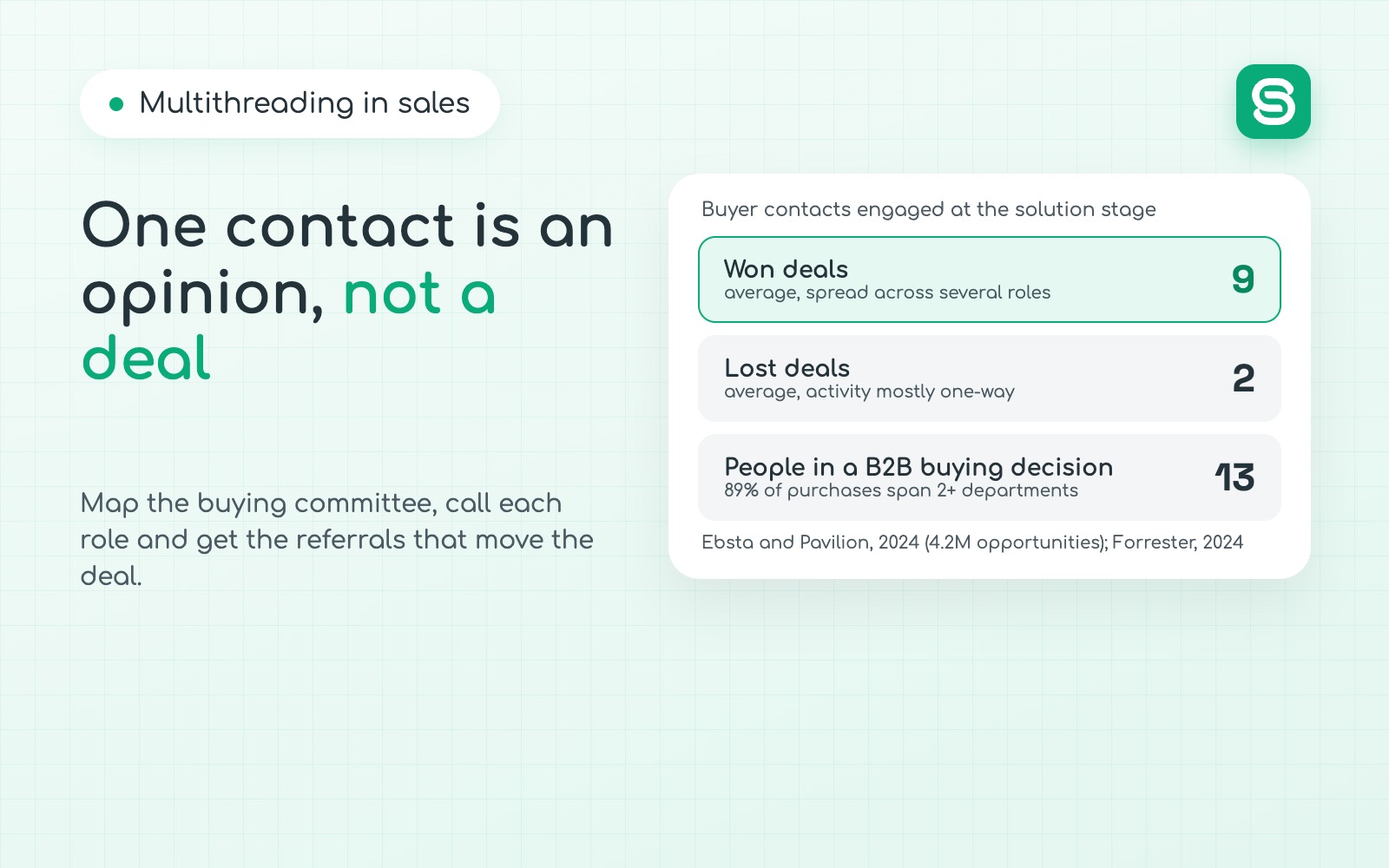
The data backs this up. The Ebsta and Pavilion 2024 B2B Sales Benchmarks, based on 4.2 million opportunities from 530 companies, found that successful deals had 9 contacts engaged by the time the solution was presented, while lost deals had just 2 on average. In lost deals, much of the seller’s activity went in one direction, without replies, to a handful of people.
Gong Labs reached a similar conclusion analyzing more than 50,000 sales opportunities: winning deals had at least three buyer contacts involved in meetings, while losing deals struggled to connect with more than one. Over email, winning deals averaged eight buyer contacts against three for losing deals.
A single-threaded deal isn’t a deal. It’s one person’s opinion about a deal.
How many people are on a B2B buying committee?
More than most reps plan for, and the number keeps growing. Three sources, three methods, the same direction.
Gartner’s research on the B2B buying journey puts the typical buying group for a complex B2B solution at six to ten decision-makers, and finds buyers spend only about 17% of their buying time meeting with potential suppliers. That 17% is shared across every vendor they evaluate. If you’re one of three, you get a sliver of it, and your champion has to carry your case the rest of the time.
Forrester’s State of Business Buying 2024, a survey of more than 16,000 business buyers, counts 13 people within an organization involved in the average decision, with 89% of purchases spanning two or more departments. It also found that 86% of B2B purchases stall at some point in the buying process. A stall is exactly what a second or third thread lets you see and fix.
The Ebsta and Pavilion H1 2024 update shows the trend from the seller’s side: stakeholders per deal grew from 5 to 8 compared with 2023, with relationships per deal up 37% in mid-market and 23% in commercial deals. Enterprise deals, already large, stayed flat.
The roles you’ll usually find
Titles vary, but the same roles show up in most B2B committees. One person can hold several roles, especially at smaller companies.
| Role | What they care about | What they can do to your deal |
|---|---|---|
| Champion | Solving a problem they own, and looking good doing it | Sell for you internally, give you access, warn you of risks |
| Economic buyer | Business outcome, budget, priority against other projects | Approve, delay or kill the purchase |
| End users and team leads | Daily workflow, ease of use, whether it saves them time | Provide proof of need; quietly resist adoption |
| Technical evaluator (IT, security) | Integration, data, security, maintenance burden | Veto on technical or security grounds |
| Finance | ROI, payback, cash timing, total cost | Push the purchase to next budget cycle |
| Procurement and legal | Terms, risk, vendor onboarding, price benchmarks | Add weeks to the cycle, reopen pricing |
How many threads does a deal need?
Enough to cover every role that can approve or block the deal. In practice, the right number depends on deal size. Ebsta’s 2023 B2B Sales Benchmark Report, built on 3.2 million opportunities from 364 companies, is one of the few sources that measured it.
| Deal size | Relationships where win rates peaked | What the data showed |
|---|---|---|
| Small | 1 to 3 | 29% average win rate; deals closed 8% faster with 3 to 6 relationships |
| Medium | 7 to 9 | 48% win rate, a 39% improvement on 4 to 6 relationships, and 10% faster |
| Enterprise | 10 to 12 | 42% average win rate; shortest cycles with 7 to 9 relationships |
| Any size, 16 or more | Too many | Average win rate down 87% |
Two lessons. First, multithreading isn’t only for enterprise: a mid-size deal with three or four contacts is under-threaded by this measure. Second, there’s a ceiling. Past a point, extra relationships mean extra meetings, extra opinions and slower consensus. The goal is coverage of roles, not a headcount.
Rule of thumb: one thread per role that can say no, plus your champion. For a $30K deal, that’s often the champion, their manager, one user, IT and finance: five people.
How do you map a buying committee?
Before you call anyone new, build a one-page map of the account. You can enlarge the figure or download it.
The two axes are what matter. Influence is how much weight a person carries in the decision, which isn’t always their title. Stance is how they feel about your deal today. The quadrant tells you what to do with each person:
- 01
Win them early (high influence, supporter).
Your champion and, ideally, the economic buyer. Give them the business case and the words to defend it. - 02
Convert or neutralize (high influence, skeptic).
Often IT, security or finance. Call them before the proposal, ask what would make them say no, and answer that directly. - 03
Mobilize as proof (lower influence, supporter).
Users who feel the pain daily. Their quotes and numbers make your champion’s case credible. - 04
Keep informed (lower influence, neutral).
Procurement and legal, until the paper stage. Ask early what their process requires, so it doesn’t surprise you later.
Where to find the names
Here’s a template to fill in after your discovery call. Keep it in the opportunity record so the whole team works from the same map.
Buying committee map: [Account name]
Template written for this article. One line per person; update it after every call.
Deal: [opportunity name], [amount], target close [date]
Business outcome the buyer wants: [in their words]

Name | Title | Role in deal | Influence (H/M/L) | Stance (+ / 0 / -) | Last real conversation | Next step
[Name] | [Title] | Champion | H | + | [date] | [action, date]
[Name] | [Title] | Economic buyer | H | ? | [never / date] | [intro via champion by date]
[Name] | [Title] | Technical evaluator | H | - | [date] | [security call on date]
[Name] | [Title] | Finance | M | 0 | [never] | [business case review]
[Name] | [Title] | End user | L | + | [date] | [quote for business case]
[Name] | [Title] | Procurement / legal | M | 0 | [never] | [ask process at verbal yes]

Who can say no that we haven't met? [names or roles]
What would make each skeptic say no? [one line each]
Score yourself honestly: a ”?” in the stance column for the economic buyer is the most expensive cell on the sheet. Frameworks such as MEDDPICC formalize exactly these questions (economic buyer, champion, decision process, paper process), and our MEDDIC guide explains the original version if your team uses that one.
How do you multithread an account by phone?
With a sequence of calls, one per role, each with a goal that makes sense for that person. Here’s a three-week template for an open opportunity in a mid-market deal.
Champion: discovery and the committee question
End your discovery call with three questions: “Who else will weigh in? Who has the final say? Who could stop this?” Write the answers into your map before you hang up.
Champion: build the map together, ask for two intros
A short follow-up call. Share your draft map, ask them to correct it, and ask for two introductions: usually a user and the technical evaluator. Offer to write the intro email for them.
End users and team leads: pain in their words
Ask how they work today, what it costs them in time, and what they’d need to see. Their numbers feed the business case; their enthusiasm gives your champion internal proof.
Technical evaluator: find the red flags early
Ask what would make them reject the solution. Send your security documentation right after the call. Our guide on how to cold call CTOs and CISOs covers the vocabulary and the objections to expect.
Finance: check the business case numbers
Walk through the ROI with someone who’ll challenge it. Correct your assumptions with theirs. Ebsta’s H1 2024 update found win rates 14% higher when a senior finance persona was engaged by mid-stage. Our guide on how to cold call CFOs gives you the language finance responds to.
Economic buyer: 15 minutes on outcome, budget and date
Before the proposal, not after. Ebsta measured win rates 42% lower when the C-suite was engaged late, and velocity 9.2 times higher when they were engaged early in a stage. Keep it short: the outcome, the budget, the date, and what would make them say no.
Procurement and legal: the paper process
Ask what their process requires (vendor forms, security review, standard terms) and how long it usually takes. Feed the answer into a dated close plan; our guide on sales cycle length includes a mutual action plan template.
Multithreading before the first meeting
In prospecting, there’s no champion yet, so the logic flips: you call several roles at a target account in parallel, each with a message tied to their job, and use whichever conversation opens first to reach the others. A typical spread for a sales tool, for example, is the VP of Sales, a sales manager and a RevOps lead. The VP of Sales guide covers the senior call; the manager and RevOps calls give you the operational details that make it credible.
Two rules keep account-level prospecting from turning into spam. Space the calls over a few days rather than hitting five people in one morning, and adapt the angle to each role instead of reading the same script five times. Our B2B sales cadence guide gives the touchpoint counts by deal size, and the sales cadence generator builds one for you. When you reach an assistant first, the gatekeeper script helps you get through without bluffing.
What to say to each role
Each person on the committee hears your pitch through their own job. The opener, the question that earns their attention and the proof they need all change.
| Role | Opening angle | Question to ask |
|---|---|---|
| Champion | "You told me X matters. Let's make sure the others see it too." | "Who would need to agree for this to happen this quarter?" |
| Economic buyer | The business outcome and the cost of doing nothing | "What has to be true for this to be a priority this year?" |
| End users | Their time and their daily frustration | "Walk me through how you handle this today." |
| Technical evaluator | Integration, security and what they won't have to maintain | "What would make you say no to a tool like this?" |
| Finance | Payback period and total cost, with the buyer's own numbers | "Which assumption in this business case would you challenge?" |
| Procurement, legal | Making their process easy | "What does your process need from us, and in what order?" |
For the most senior people, also see our guides on how to cold call CMOs and how to cold call HR directors. They cover what each persona is measured on and the objections they raise most often.
Referral scripts: “X suggested I call you”
An internal referral is the strongest opener you’ll ever have. It answers the first question every prospect has (“why are you calling me?”) in five words. The scripts below were written for this article. Each assumes the referral is real.
Referral call scripts for multithreading
Scripts written for this article. Replace the brackets; use only real referrals.
1. AFTER YOUR CHAMPION'S INTRO (warm referral)
"Hi [Name], this is [Your name] from [Company]. [Champion] suggested I give you a call. We've been looking at [problem] on their team, and [Champion] said you're the person who knows how [their area] really works. Do you have five minutes now, or is Thursday better?"

2. TOP-DOWN REFERRAL (an executive pointed you down)
"Hi [Name], [Your name] from [Company]. I spoke with [Executive] on Tuesday about [outcome], and [Executive] said you'd be the right person to tell me how [process] runs day to day. I'm not asking for a decision, just your view on whether this would actually help. Is now a bad time?"

3. BOTTOM-UP (a user pointed you to their manager)
"Hi [Name], [Your name] from [Company]. I've been talking with [User] and a couple of people on your team about [problem]. They mentioned it costs them about [time] a week. Before we go further, I wanted to hear from you: is that a priority for you this quarter, or not really?"

4. LATERAL (your champion went quiet, you call a peer)
"Hi [Name], [Your name] from [Company]. I've been working with [Champion] on [project] and haven't been able to reach [Champion] for a couple of weeks. I don't want to go around them, so I'll keep this short: do you know if the project is still on, and is there someone else I should be talking to in the meantime?"

5. ASKING YOUR CHAMPION FOR THE INTRO
"When you take this to [Economic buyer], what's the first question they'll ask? Would it help if I walked them through the numbers for 15 minutes, with you on the call? I can draft the email so you just have to forward it."

6. VOICEMAIL AFTER A REFERRAL
"Hi [Name], [Your name] from [Company]. [Referrer] suggested I reach out about [topic]. I'll try you again Thursday morning, and my number is [number]. Again, [Your name], [number]."
A few details make these scripts work. Name the referrer in the first sentence, not the third. Ask for a small thing: their view, five minutes, not a decision. And close the loop with the referrer afterward (“Thanks for the intro to Mike, we’re meeting Thursday”), which keeps your champion on your side. For more voicemail wording, our B2B voicemail scripts give twelve templates.
When the referral is weak
Sometimes all you have is “Dana mentioned your team handles vendor reviews” from a call where Dana barely engaged. Say exactly that. Prospects respond better to an honest, specific weak referral than to an inflated one. And if there’s no referral at all, a relevant reason works: “I’m calling because your team is hiring three SDRs, and I’ve been speaking with [Champion] about how you ramp them.”
What to do when your champion goes quiet or leaves
This is where multithreading pays for itself. If you built threads early, you have someone to call. If not, here’s the recovery order.
- 01
Call, don't email.
Three unanswered emails tell you nothing. One call to their direct line or mobile, with a voicemail, tells you whether they’re away, overloaded or avoiding you. - 02
Call the thread closest to them.
A peer or a user on their team, with the lateral script above. Be transparent: you’re not going around them, you’re checking the project is still on. - 03
Re-anchor on the business outcome.
If someone above has taken over, don’t restart the demo. Restate the outcome, what’s been agreed and the next date. - 04
If the champion left, follow them too.
A champion who changes jobs often brings the problem, and your solution, to the new company. Congratulate them and ask about their new team in a few weeks.
What if your champion says “just work through me”?
Some champions guard access. Sometimes it’s ego, sometimes they’ve been burned by a vendor who spammed their boss, and sometimes they’re quietly unsure the deal will survive scrutiny. The reason matters, because the answer differs.
| What you hear | What it often means | How to respond |
|---|---|---|
| "I make this decision, no need to involve others." | True in small companies; a warning sign in larger ones | Ask about the process, not the people: "Walk me through the last time you bought a tool like this. Who signed the PO?" |
| "Let me socialize it internally first." | They want control of the story, which is fair | Equip them, then propose a date: "Here is a one-page summary for your CFO. Can we put 20 minutes on the calendar with them for after?" |
| "Please don't contact my boss." | A past bad experience, or the deal is weaker than it looks | Agree, and ask what would make it OK: "Understood. What would you need to see before we bring them in together?" |
The common thread: never fight the champion for access. Make the next contact something that helps them win, propose it with them on the call, and give them the words. If a champion refuses every introduction for weeks on a deal above your mid-size threshold, treat that as data. The deal probably isn’t as real as the stage in the CRM says.
A worked example: threading a $30,000 deal
Multithreading after the sale
The same logic protects revenue after signature. Your day-to-day contact at a customer is a single thread too, and when they leave, renewals get reopened by someone who never chose you. Keep at least one executive relationship per account with a short business review every quarter or two, know the users who depend on your product most, and update the committee map at every renewal. When a contact changes jobs, it’s both a risk at the old account and an opening at the new one.
What are the risks of multithreading?
Multithreading done badly can hurt a deal as much as single-threading. The four risks below are the ones that come up most often.
How do you track multithreading in your CRM?
What isn’t in the CRM doesn’t exist in the pipeline review. Three habits make multithreading visible.
Tag every contact with their role in the deal
Most CRMs support contact roles on opportunities (Salesforce has Opportunity Contact Roles; HubSpot lets you associate contacts to deals with association labels). Use the same six roles as the map above. In Skipcall’s pre-CRM, tags do the same job for teams that prospect before a deal exists in the CRM.
Count threads, and track their quality
A contact you emailed once isn’t a thread. Count contacts with a real conversation in the last 30 days, by deal. Flag any deal above your mid-size threshold with fewer than three, and any deal entering the proposal stage without a conversation with the economic buyer.
Make the names searchable
Names and roles come up in calls long before they reach the CRM. Recording and transcribing calls, as Skipcall’s call recording and transcription does with an AI summary of each conversation, means “check with Mike in IT” becomes a line you can find, not a detail you forgot. Our sales call summary template shows what to capture after each call.
For managers, the most useful coaching question in a deal review isn’t “how’s the deal going?” but “who else have you spoken with this month, and what did they say?” A rep who can only quote the champion is telling you the deal is single-threaded, whatever stage it sits in. Ask it on every deal above your mid-size threshold, every week, and reps start multithreading before the review instead of after it.
A thread health check for pipeline reviews
Thread health check (out of 10)
Scorecard written for this article. 2 = yes, 1 = partly, 0 = no. Run it on every deal above your mid-size threshold.
[  ] 1. We've had a real conversation with the economic buyer, or have a dated meeting with them.
[  ] 2. At least three people at the account have spoken with us in the last 30 days.
[  ] 3. We know who could block the deal, and we've spoken with them.
[  ] 4. Our champion knows who else we're talking to, and agrees.
[  ] 5. Every contact has a role and a next step logged in the CRM.

Total: ..... / 10
8 to 10: well threaded. Keep the cadence.
5 to 7: at risk. Pick the missing role and book the call this week.
0 to 4: single-threaded. Treat the close date as unconfirmed until it improves.
Key takeaways
Sources
- Ebsta and Pavilion: 2024 B2B Sales Benchmarks
- Ebsta and Pavilion: 2024 B2B Sales Benchmarks, H1 update (PDF)
- Ebsta and Pavilion: 2023 B2B Sales Benchmark Report (PDF)
- Forrester: The State of Business Buying, 2024 (press release)
- Gartner: The B2B buying journey
- Gong Labs: Lou Wolf, the number one signal a deal won’t close (multithreading data)




