Ask any SDR manager how often their team role-plays and you’ll hear some version of “not as much as we should.” Live role plays tie up two people, the teammate playing the prospect is always too nice, and the session gets bumped the moment a pipeline review runs long. AI sales roleplay fixes the scheduling problem: the buyer is software, it’s available at 7 AM before the first calling block, and it will push back on your pricing answer for the twentieth time without sighing. Whether it fixes the performance problem is a different question, and the answer depends almost entirely on how you run it.
What is AI sales roleplay?
AI sales roleplay (also called AI roleplay for sales training, or a sales simulation) is a conversation between a rep and an AI that plays a buyer. Most tools now work in voice: the rep speaks into a headset, the AI listens, answers in a synthetic voice and reacts to what was actually said. Behind the scenes, the tool combines three things: a persona (title, company, personality, mood), a scenario (a cold call, a discovery call, a renewal with a price increase) and a rubric that grades the conversation when it ends.
How a session works
- 01
Pick the scenario.
For example: cold call to a VP of Sales at a 200-person logistics company who uses a competitor and is in a bad mood. - 02
Run the conversation.
The rep opens, the AI buyer answers, objects, asks questions or hangs up, just like a real prospect would. Rounds usually last two to ten minutes. - 03
Get the score.
The tool grades the call against the rubric: did the rep ask permission, state a reason for the call, ask a discovery question, handle the objection, secure a next step? - 04
Replay.
The rep reads the feedback and runs the same scenario again, or a harder variant. This is where the value is: ten repetitions in thirty minutes.
AI roleplay vs. peer role play vs. real-call coaching
AI roleplay isn’t the only way to practice, and it doesn’t do the same job as the other two. Here’s how they compare.
| Criterion | AI roleplay | Peer role play | Real-call coaching |
|---|---|---|---|
| Repetitions | Unlimited, on demand | Two or three per session | Limited by recorded calls |
| Realism | An average buyer | A teammate, often too nice | The real thing |
| Manager time | Close to none | One person per pair | Review time per call |
| Best for | Drilling one skill | Team energy, new scenarios | Diagnosing what to drill |
| Proves results? | No | No | Yes |
That last row is the one to remember. Practice of any kind is a means. Only real calls tell you whether it worked. Peer role play still has a place: our cold call role play scenarios give you twelve ready-to-run drills for pairs, and our live call coaching guide covers the real-call side.
What can you practice with AI roleplay?
AI roleplay works best on moments of the sales conversation that are short, frequent and follow a recognizable pattern. Those are the moments where repetition builds a reflex. Here are the six most common uses on B2B sales teams.
What it does poorly: long, multi-stakeholder conversations where the outcome depends on account context, politics and history. An AI can play a CFO. It can’t play your prospect’s CFO, who was burned by a vendor last year and whose boss just announced a hiring freeze.
AI sales roleplay software compared
We checked each vendor’s own pricing page and product pages on November 20, 2026. Prices change often, and several vendors only quote team plans, so treat this as a starting point and confirm on the vendor site before you budget. Skipcall doesn’t sell AI roleplay, so it isn’t in this list.
 Hyperbound
- Best for
- SDR teams drilling cold calls, then scoring real calls with the same scorecard
- Free plan
- Yes: 45 prebuilt AI roleplays and example scorecards
- Paid plans
- Practice and Perform, per user, on quote
 Second Nature
- Best for
- Enterprise onboarding at scale, scenarios built around your offer
- Free option
- Free sample role plays on its site
- Paid plans
- On quote, via a demo
Kendo
- Best for
- Small and mid-size teams that want a published per-seat price
- Pro
- $55 per seat per month, 180 roleplay minutes per seat
- Max
- $100 per seat per month, 480 roleplay minutes per seat
Exec
- Best for
- Teams that want a low published per-seat price
- Free plan
- Yes: 5 roleplay sessions a year
- Paid plans
- Starter $20 and Professional $39 per seat per month, billed annually
Yoodli
- Best for
- Individual reps, and teams that want a methodology-based rubric
- Individual
- Pro $8 and Advanced $20 a month, billed annually
- Teams
- Per seat, billed annually, on quote
Outdoo
- Best for
- Teams that want to try a free tier before talking to sales
- Free plan
- 60 minutes of roleplay credits
- Paid plans
- Growth and Enterprise, on quote
PitchMonster
- Best for
- Teams ready to commit for a year to a sales-led rollout
- Free option
- Demo on request
- Paid plans
- Per seat, on quote, 5-seat minimum and 12-month contracts
 Gong AI Trainer
- Best for
- Teams already on Gong that want roleplay built from their own call library
- Availability
- Part of Gong Enable
- Paid plans
- Inside a Gong contract, on quote
What sets the main tools apart
Hyperbound: built around the cold call
Hyperbound’s pricing page lists a free plan with 45 prebuilt roleplays and example scorecards, then two paid tiers sold per user: Practice adds custom AI buyers, custom scorecards and analytics; Perform adds real call scoring, deal coaching and CRM sync. The interesting part for SDR teams is that last tier: the same scorecard grades the practice round and the real call, which is exactly what you need to check transfer. Prices are on quote.
Kendo and Exec: prices you can see
Two vendors publish clear per-seat prices. Kendo’s plan documentation lists Pro at $55 per seat per month with 180 roleplay minutes per seat, and Max at $100 with 480 minutes; enterprise is custom. Exec’s pricing page lists a free plan with 5 roleplay sessions a year, Starter at $20 per seat per month billed annually and Professional at $39 per seat per month billed annually. Check what each tier includes and the included minutes: a rep who practices 20 minutes a day uses more than 180 minutes a month.
Yoodli: individual plans first
Yoodli’s pricing starts with plans an individual can buy: Pro at $8 a month and Advanced at $20 a month, both billed annually. Team and enterprise plans add custom scenarios, manager dashboards and rubric-based scoring aligned to your methodology, priced per seat on quote. It’s the cheapest way for a single rep to start practicing tomorrow.
Second Nature, Outdoo, PitchMonster and Gong: the quote-only group
Second Nature positions itself on enterprise rollouts, with scenarios built around your offer and free sample role plays on its site. Outdoo’s pricing page shows a free plan with 60 minutes of roleplay credits, then Growth and Enterprise plans on quote. PitchMonster sells per seat on quote, with a five-seat minimum and 12-month contracts. Gong describes AI Trainer as roleplay simulations built into its enablement product, available to Gong customers. For teams already paying for a conversation intelligence suite, it’s worth asking about the roleplay module before buying a separate tool. Our comparison of sales coaching software reviews the broader coaching tools, including Gong, Second Nature and Hyperbound.
How much does AI sales roleplay cost?
For a team, the honest comparison isn’t “tool vs. no tool.” It’s “tool vs. the manager time it takes to run the same amount of practice live.” A role play between a manager and a rep ties up the manager for the full session. An AI roleplay doesn’t. Plug in your own numbers.
AI roleplay tool vs. manager-run role plays
Tool cost per year$5,280
Manager hours the same practice would take per year256 h
Value of those manager hours$19,200
48 working weeks. Assumes a manager plays the buyer in every session. If nobody runs role plays today, compare the tool cost with the value of one extra meeting a month per rep instead.
Two costs don’t show up in the calculator. The first is setup: building scenarios that sound like your buyers takes a few hours per scenario, and someone has to own the library. The second is manager review time: a tool that nobody looks at becomes shelfware in about six weeks. Budget 30 minutes a week of manager time to read scores and pick next week’s focus.
How to build an AI roleplay training program
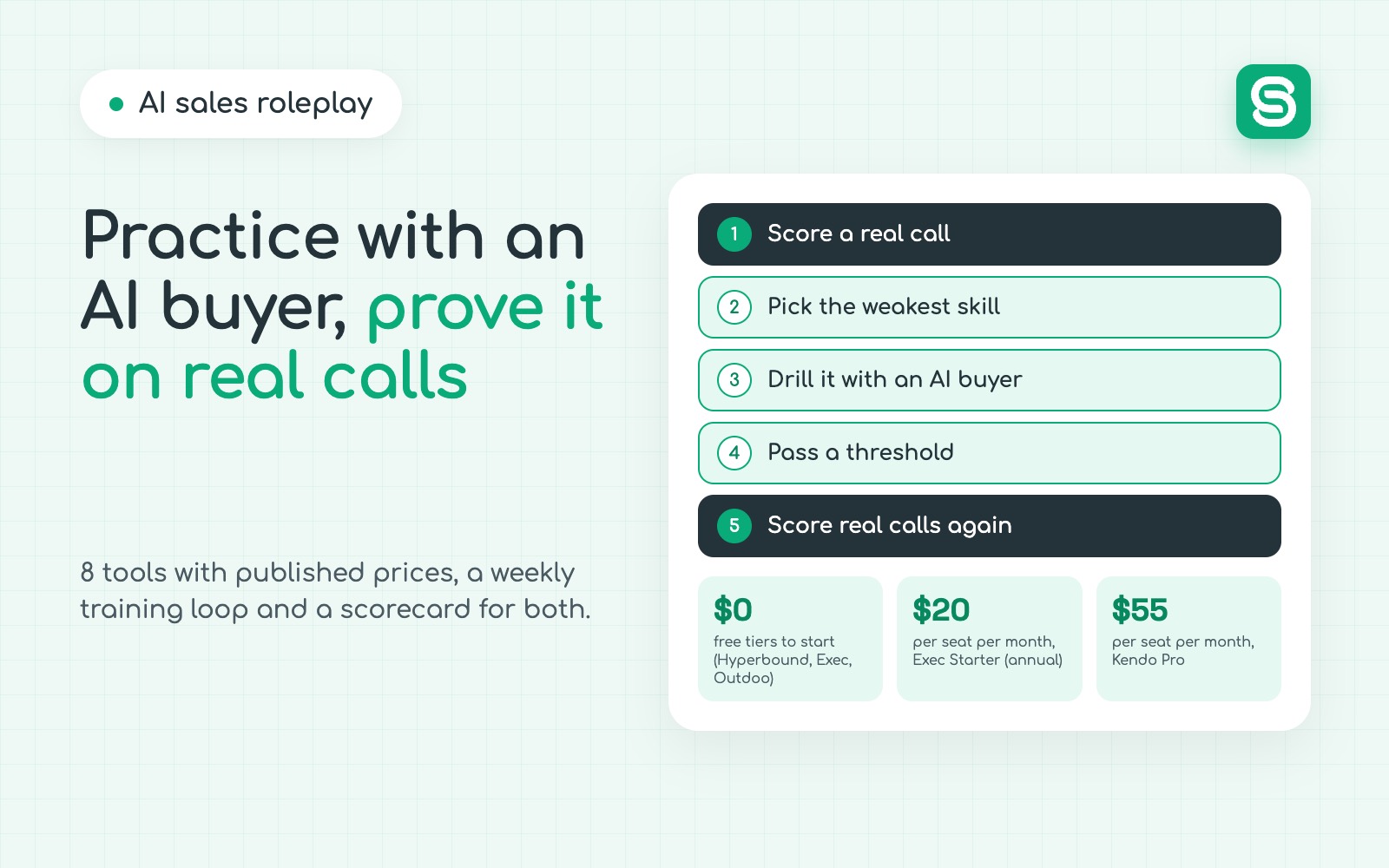
Buying the tool is the easy part. The programs that change behavior on calls share one design principle: practice starts and ends on real calls. The loop below is the one we recommend, written for this article.
The loop matters because the most common failure of AI roleplay is reps practicing what they already do well. A rep who’s great at openers will happily run opener drills all afternoon and post a great score. The loop forces practice onto the weakest line of the real-call scorecard.
A six-week program to copy
Baseline on real calls
Record and score two real calls per rep with one scorecard. Find each rep’s weakest line. Don’t buy anything yet: if you can’t score real calls, you can’t measure the tool. If your calls aren’t recorded, start there.
Build five scenarios
Write the five situations your reps face most: two cold call openers with different personas, the top two objections and one gatekeeper. Use real wording from your calls. A generic “skeptical VP” doesn’t sound like your market.
Drill one skill per rep
Three sessions a week, 15 to 20 minutes each, on the rep’s weakest skill only. Set a pass threshold: for example, three rounds in a row at the target score on the relevant line.
Back to the phone
After passing the threshold, the rep uses the skill on live calls the same week. The manager scores one real call per rep per week, on the same scorecard.
Compare and adjust
Did the weak line move on real calls? If yes, move the rep to the next skill. If the practice score is high but the real-call score didn’t move, the scenario is too easy or not realistic: rewrite it from a real call.
Make it a routine
Fold practice into the weekly rhythm: one review, two or three drills, one real-call check. Add new scenarios from fresh objections every month so the library doesn’t go stale.
For new hires, the same loop plugs into onboarding: certify the pitch and the top objections in AI roleplay before the first live list. Our SDR onboarding plan shows where it fits in the first 90 days, and the free 30-60-90 day sales onboarding plan generator builds the calendar. For the coaching rhythm around it, see our week-by-week sales coaching program.
Small team: with two or three reps, skip the custom scenario library at first. Start with the tool’s prebuilt cold call scenarios and spend your effort on scoring real calls every week.
How do you score AI roleplay sessions?
Every AI roleplay tool comes with a rubric. Use it, but don’t let it be the only one. The point of scoring is to compare practice with reality, which only works if the same criteria grade both. The scorecard below is built for that: the rep fills in the AI round score and the manager fills in the real-call score on the same lines. It was written for this article; adapt the lines to your sales motion but keep them observable.
Practice-to-real-call scorecard (cold call)
Template written for this article. Score each line 0 to 3 in the AI round and on a real call, same week.
REP: [name]   WEEK OF: [date]   FOCUS SKILL: [line number]

Scale: 0 = absent, 1 = attempted, 2 = done, 3 = done naturally

                                            AI round   Real call
1. Opener: permission + reason in 20 seconds    [ ]        [ ]
2. First question is about the buyer, not us    [ ]        [ ]
3. Listens: no interruption, follows up once    [ ]        [ ]
4. Objection: acknowledges, asks, then answers  [ ]        [ ]
5. Value: one specific result, not a feature    [ ]        [ ]
6. Next step: a date and time, not "I'll email" [ ]        [ ]
7. Pace and tone: calm, short sentences         [ ]        [ ]

TOTAL (out of 21)                               [ ]        [ ]

Gap on the focus line (AI minus real): [ ]
0 or 1: practice transfers, move to the next skill
2 or more: scenario too easy or unrealistic, rewrite it from a real call

Manager note (one keep, one change):
Keep:
Change:
Three rules make the scorecard useful. First, track the focus line, not the total: the total rewards what a rep already does well. Second, watch the gap: a big difference between the AI score and the real-call score means the practice isn’t realistic. Third, one keep, one change in every debrief, never a list of seven remarks. For a scorecard you can fill in online and share, use our free sales call scorecard.
A high score against an AI buyer is a rehearsal grade. Only the real call is the exam.
How do you write an AI buyer persona that sounds like your market?
Most disappointing AI roleplay pilots fail on the scenario, not the software. A generic “skeptical VP of Sales” produces generic objections, and reps learn to beat a buyer they’ll never meet. A good persona is built from your own calls and fits on half a page. Six fields do most of the work.
Write three difficulty levels for each persona. Easy: the buyer is curious and lets the rep finish a sentence. Standard: one objection, then openness if the rep asks a good question. Hard: two stacked objections, impatience, and an attempt to end the call in under a minute. New hires start at easy and certify at standard; experienced reps should spend most of their time at hard, because that’s what real cold calls feel like. If the AI tool lets you set a hang-up rule (for example, “end the call if the rep pitches before asking a question”), use it: nothing teaches discipline faster than an AI buyer who hangs up.
One more source of realism is often ignored: your best reps. Ask them to play the buyer in a live role play once, record it, and paste their objections into the persona. They know which lines actually come up on your calls, in your market, this quarter.
How do you get reps to actually use AI roleplay?
Adoption is the quiet failure mode. Usage typically spikes in the first two weeks, then fades once the novelty wears off and the calendar fills up. Four habits keep it alive.
- 01
Put it on the calendar.
A 15-minute drill right before the first calling block works as a warm-up, the way athletes warm up before a game. Practice that floats in “free time” doesn’t happen. - 02
Assign, don't suggest.
Each rep gets one assigned scenario a week, tied to their weakest line on the real-call scorecard. Optional practice is mostly done by the reps who need it least. - 03
Celebrate real-call progress, not practice scores.
Share the rep whose objection handling line went from 1 to 2 on real calls. A leaderboard of practice scores rewards gaming the rubric. If you want competition, our cold calling games for SDR teams use real activity instead. - 04
Have the manager practice too.
A manager who runs the hard scenario in front of the team, and sometimes fails it, does more for adoption than any memo.
What are the limits of AI roleplay?
Vendors are clear about what their tools do. They’re less clear about what they don’t. Here’s the balanced view.
- Unlimited repetitions, at any hour, without a manager.
- Consistent difficulty: the AI doesn’t go easy on a rep it likes.
- Safe space: reps practice the uncomfortable parts without an audience.
- Fast certification of new hires on the pitch and top objections.
- A clear practice record the manager can review.
- The AI is an average buyer, not your toughest real prospect.
- Reps can learn to please the rubric instead of the buyer.
- It can’t diagnose why a good rep has plateaued on real calls.
- Scenarios go stale without someone maintaining the library.
- Seat minimums and minute caps make the real cost higher than the headline price.
Gaming the rubric
This one deserves its own paragraph. If the rubric rewards “asked a discovery question,” reps learn to ask a discovery question at minute one, whether or not it makes sense in that conversation. Scores go up, calls don’t improve. The fix is the gap check in the scorecard above, plus a manager listening to a real call every week. No AI rubric replaces that. The same logic runs through the wider debate on whether AI will replace SDRs: AI is strong before and after a live conversation, and much weaker during it.
Can you do AI cold call practice for free?
Yes, and you should before you spend money. If your reps won’t practice with a free option for a month, they won’t practice with a paid one either. Three free routes work.
- 01
Free tiers of dedicated tools.
Hyperbound’s free plan (45 prebuilt roleplays), Outdoo’s 60 minutes of credits, and Exec’s free plan (5 sessions a year) are enough to test the format. - 02
Our objection practice tool.
The free objection handling practice tool draws a random objection, gives you ten seconds to answer out loud, then shows a model answer and the technique behind it. Flashcards, not a conversation, but perfect for a five-minute warm-up before a calling block. - 03
A general AI assistant in voice mode.
Most general AI assistants now have a voice mode. Give it the prompt below and it will play a buyer. It won’t score as reliably as a dedicated tool, but it’s a real conversation.
Prompt: turn an AI assistant into a cold call buyer
Written for this article. Paste it into an AI assistant, switch to voice mode, then start talking as the rep.
You are role-playing a B2B buyer receiving a cold call. Stay in character until I say "END ROLEPLAY".

Your persona:
- Title: [VP of Sales / Head of Operations / CFO]
- Company: [industry], [number] employees, based in [city]
- Current situation: uses [competitor or current process], mostly satisfied
- Mood: busy, mildly annoyed by the interruption
- Hidden pain (reveal only if I ask two good questions about it): [the real problem]

Rules:
- Answer the phone with your first name only.
- Keep answers short, like a real busy person. Never help me sell.
- Use these objections when they fit: "I'm not interested", "Send me an email", "We already use [competitor]", "Call me next quarter".
- If I pitch features before asking about your situation, get more impatient.
- If I ask a sharp question about your hidden pain, open up a little.
- Agree to a meeting only if I propose a specific day and time AND you see a reason.

When I say "END ROLEPLAY", step out of character and score me 0 to 3 on:
1. Opener (permission and reason)  2. Questions  3. Listening
4. Objection handling  5. Next step
Then give me one thing to keep and one thing to change.
To make the persona realistic, take the title, objections and hidden pain from your last ten real calls. Our guides on the “not interested” objection and cold call discovery questions are good sources for lines to practice.
Which AI roleplay option fits your team?
Three questions sort most teams. Answer them in order.
| Team | Start with | Why |
|---|---|---|
| Solo rep or founder who sells | A free tier or an individual plan | Build the habit before paying for a team tool |
| SDR team of 3 to 15 | A per-seat tool with published prices | Predictable cost, quick setup, cold call scenarios |
| Team with heavy hiring | A tool with certification and custom scenarios | Certify new hires before the first live list |
| Team already on a coaching suite | Ask about the suite roleplay module | Same scorecards for practice and real calls |
Whatever you pick, the practice only pays off if reps get to use it on enough real conversations, and if those conversations are recorded so you can score them. That second part is where Skipcall comes in: it doesn’t do AI roleplay, but it records, transcribes and summarizes every call reps place through its power and parallel dialer, so managers can pick the real calls to score each week. Our call recording software guide covers the options and the recording and transcription feature page shows how it works in Skipcall.




