In late 2024, billboards around San Francisco told companies to “Stop Hiring Humans” and to interview Ava, an AI BDR, instead. In August 2026, the company behind them, Artisan, retired the slogan and announced it was hiring its first human BDR: one person on the phone, with the AI running everything around them. That reversal is the most honest answer you’ll get to the question “will AI replace SDRs?” AI is eating the SDR job from the inside. It is not eating the person who picks up the phone.
Will AI replace SDRs? What the data actually shows
The loudest answers to this question come from two camps with something to sell: AI SDR vendors who need you to believe the job is over, and sales tool vendors who need you to believe it isn’t. The useful answer comes from the few sources that survey a lot of companies and don’t sell an AI SDR. Here is what they say.
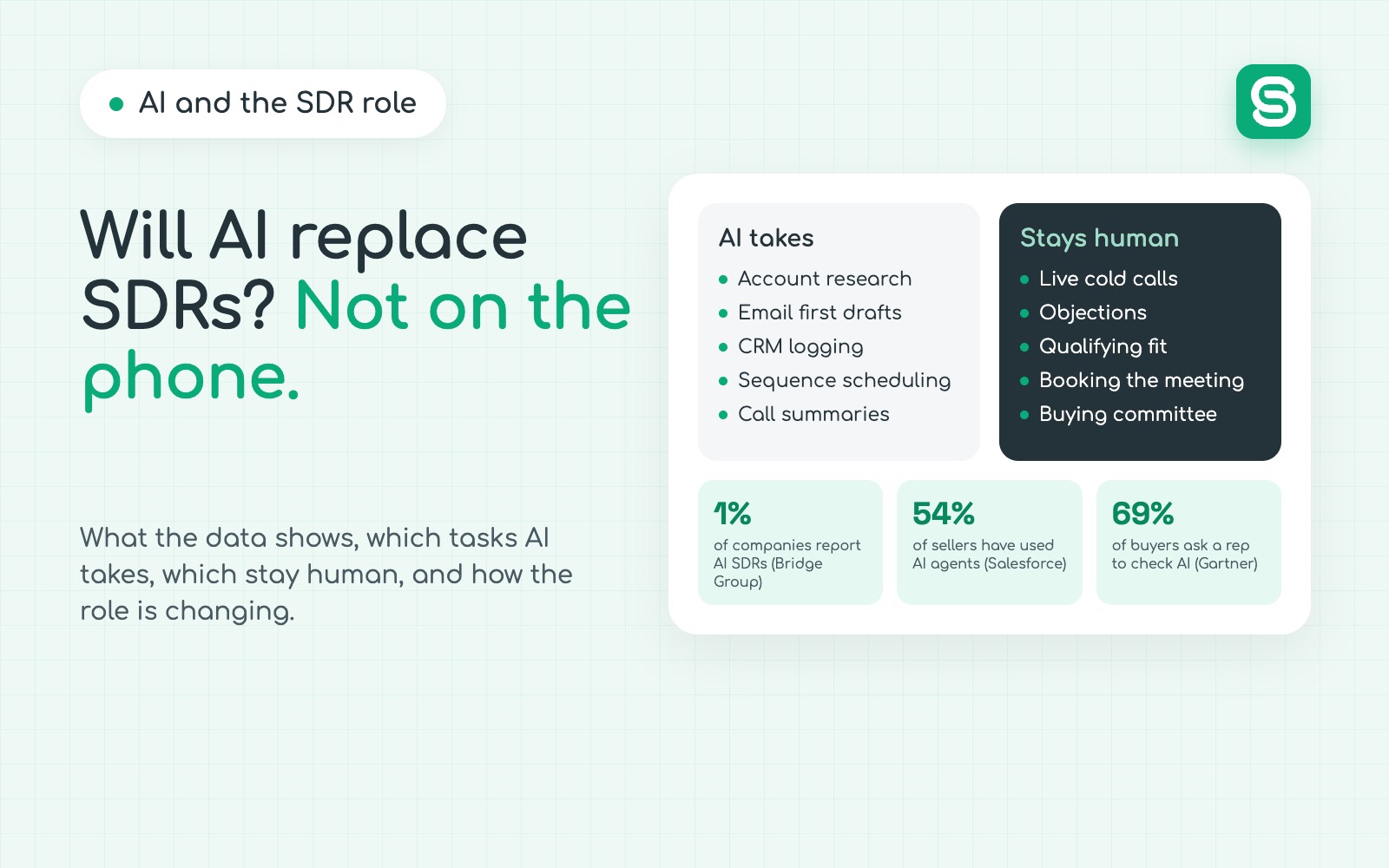
of the 351 B2B companies in the Bridge Group's 2025 SDR study reported AI SDRs as a category, the first year it showed up
Source : Bridge Group, 2025
of sellers say they've used AI agents; nearly 9 in 10 plan to by 2027
Source : Salesforce State of Sales, 2026
of B2B buyers turn to sales reps to validate AI-generated insights at key decision points
Source : Gartner, May 2026
projected employment change for US wholesale and manufacturing sales reps, 2025 to 2035: little or no change
Source : BLS, Oct. 2026
Read together, these numbers tell a consistent story. Adoption of AI by sales teams is fast. Replacement of sales people is slow. The Bridge Group’s 2025 SDR report is the best single read on the role: it still found a median SDR OTE of $80K, average tenure of 1.9 years (the highest since the early 2010s) and an average ramp of 3.0 months, the lowest since 2010. The authors suggest the faster ramp may reflect AI-assisted onboarding. That’s AI making SDRs productive sooner, not making them unnecessary. The same report flags a warning sign, though: only 60% of reps hit quota, the lowest the study has recorded.
Salesforce’s 2026 State of Sales, based on 4,050 sales professionals surveyed in August and September 2025, shows how fast agents are spreading: 54% of sellers say they’ve used them. The same release says sellers expect agents, once fully implemented, to cut prospect research time by 34% and email drafting time by 36%. Note the verbs. Those are the two tasks that fill an SDR’s morning, and they’re expectations, not measured results.
The BLS doesn’t track SDRs as a separate occupation, so the closest public proxy is wholesale and manufacturing sales representatives, about 1.57 million jobs in 2025. Its Occupational Outlook Handbook projects little or no change in employment from 2025 to 2035, with about 123,400 openings a year, mostly to replace people who leave. The BLS is explicit about why: “Advances in artificial intelligence (AI) and integration with automation technologies, such as chat bots, may limit employment growth for sales representatives.” That is a projection for the whole occupation, not for SDRs specifically. Flat, not collapsing.
What Gartner’s “10 agents per seller” prediction really says
The most quoted number in this debate is a Gartner prediction from November 2025, cited in an April 2026 release on Business Wire: by 2028, AI agents will outnumber human sellers by ten to one. It gets quoted as proof that SDRs are finished. Read the full title of the Gartner release and it says almost the opposite: fewer than 40% of sellers will report that those agents improved their productivity.
Two things follow. First, the ratio counts agents, not lost jobs: a single seller can trigger a research agent, a drafting agent, a CRM agent and a scheduling agent before lunch. Second, Gartner is predicting that most of those agents will disappoint. That’s not a forecast of replacement. It’s a forecast of a lot of software doing small jobs, unevenly.
Do AI SDRs actually work?
“AI SDR” usually means software that researches accounts, writes and sends personalized emails, follows up on its own and sometimes books meetings. Most products run over email and LinkedIn. A few add an AI voice that places calls. Venture money poured into the category in 2024. The early results deserve a careful look before you sign an annual contract.
The 11x story: logos and break clauses
In March 2025, TechCrunch reported that 11x, an AI SDR startup backed by Andreessen Horowitz and Benchmark, had displayed logos of companies that weren’t customers. ZoomInfo said it ran a one-month pilot from mid-January to mid-February and didn’t move forward; Airtable said it ran a short trial and never rolled the product out. Former employees told TechCrunch that many early customers used break clauses, and that revenue figures counted those contracts as full-year deals. 11x said it reported contracted ARR and that investors knew. Other customers, such as Pleo and Rho, confirmed they used the product. The CEO stepped down in May 2025.
Artisan: from “Stop Hiring Humans” to hiring one
Artisan’s billboard campaign was built to provoke, and it did. In August 2026, it retired the slogan after two years, as KRON4 reported, and its own blog announced a first human BDR. The org chart it now describes is the useful part: a human on the phone, AI handling everything around that person.
What buyers do with more AI outreach
The demand side matters as much as the tools. In a Gartner survey of 645 B2B buyers fielded in August and September 2025 and published in May 2026, 67% said they prefer a rep-free buying experience, yet 69% turn to sales reps to validate AI-generated insights at key decision points. Buyers were almost as likely to say they encounter misleading information from generative AI (51%) as from a sales rep (49%). In other words, buyers use AI to research, then want a human to check it. If AI lets every competitor send ten times more email, the inbox gets worse, filters get stricter and the marginal email is worth less. Volume was never the scarce resource. Attention is.
AI made outreach cheap. That’s exactly why a real conversation got more valuable.
None of this means AI SDR tools are useless. They’re good at work that is high volume, low stakes and easy to check: re-engaging closed-lost leads, following up on webinar sign-ups, answering inbound form fills at 2 AM, drafting the first version of a sequence. Where they struggle is the work that defines a good SDR: getting a skeptical stranger to give you eight minutes, and turning those minutes into a meeting an account executive is happy to take. Our guide to AI for sales prospecting lists the use cases that hold up and the ones that don’t.
Which SDR tasks will AI automate, and which stay human?
The clearest way to answer the question isn’t “the job” but “the tasks.” An SDR’s week mixes work that software already does well with work that depends on a live human reading another live human. The matrix below sorts the common SDR tasks on those two axes. You can enlarge it or download it.
| Task | What AI does today | What stays with the SDR |
|---|---|---|
| Account research | Pulls news, hiring, tech stack and triggers into a brief in seconds | Deciding which trigger is worth a call today |
| List building and enrichment | Finds missing numbers and emails for contacts you already own | Choosing the accounts that fit the ICP |
| Email writing | Drafts first lines and follow-ups at scale | Cutting what sounds fake, sending fewer and better |
| Cold calls | Dials, skips voicemail, shows context on screen | The conversation itself |
| Objection handling | Suggests responses in practice drills | Reading tone and choosing what to say live |
| Qualification | Scores fit from firmographics and intent data | Judging real pain, urgency and authority |
| CRM logging and notes | Transcribes, summarizes and logs the call | Checking the next step is right |
Look at the pattern. Everything that happens before and after a conversation is exposed: research, data, drafting, scheduling, logging. Everything that happens during a conversation is not. That’s not a temporary gap waiting for a better model. It comes from what the conversation is for: a buyer deciding whether to trust a person and a company with their time. For a step-by-step version of this split across the whole prospecting workflow, see our guide to sales prospecting automation.
The tasks AI already does better than most SDRs
Be honest about this part. A research agent will out-read any SDR on a list of 200 accounts. An AI summary of a call is more complete than the notes most reps type at the end of a long day. Answering machine detection beats a human listening for the beep. Fighting these tools is a losing strategy, and an SDR who still spends ninety minutes a morning on manual research is volunteering for replacement. If you need a starting point, our free AI sales prompt generator writes research and drafting prompts for the common prospecting tasks.
Why the phone conversation stays human
If AI can write, research and log, why can’t it just make the calls too? Voice agents exist, and they’re getting better fast. Three obstacles keep them out of cold outbound for now, and none of them is about voice quality.
The legal line in the US
On February 8, 2024, the FCC released a Declaratory Ruling (FCC 24-17) stating that the TCPA’s restrictions on “artificial or prerecorded voice” cover AI technologies that generate human voices. In practice, calls using an AI voice to a cell phone or a residential line generally need the called party’s prior express consent, and prior express written consent when the call is telemarketing. Most B2B contacts now answer on their cell phones, which is why cold calling with an AI voice is so hard to do legally. Calls placed by a human rep through a dialer are a different question, covered in our guide to whether cold calling is legal. This is general information, not legal advice; several states add their own rules on top.
There’s also a trust problem the law doesn’t fix. Prospects are learning to spot AI callers, and many hang up when they do. Our article on how to tell if an AI is calling lists the tells buyers now listen for. For the calls where an AI agent can make sense (confirmations, reminders, consented inbound follow-up), our comparison of AI voice agents vs. sales reps runs a call-by-call handoff test.
Why the phone gets more valuable as AI spreads
Here’s the counterintuitive part. As AI floods inboxes with competent, personalized-looking email, the channel that’s hardest to fake gains value. A live voice, a real question, a rep who can say “fair enough, can I ask one thing before you go?” stands out precisely because it can’t be produced at zero cost. That’s why the debate over whether cold calling is dead keeps landing on the same answer: the channel is harder, not dead, and it rewards the people who do it well. For the AI tools that sit around the human caller rather than replacing them, see our breakdown of AI cold calling and its three layers.
Are SDRs dead? How the role is changing
SDRs have been “about to be automated” for more than a decade. Each wave of tooling took a slice of the job and, each time, the role reorganized around what was left: the conversation. The timeline below shows the pattern.
The SDR role was popularized by Aaron Ross’s Predictable Revenue in 2011, which made the case for separating the people who open deals from the people who close them. Then sales engagement platforms automated follow-up. Then generative AI automated writing and research. At every step the forecast was the same, and at every step the job came back narrower and more focused on live contact. What’s different this time is speed: agents remove tasks in months, not years. That makes the transition sharper for SDRs who don’t adapt.
What an AI-era SDR week looks like
The job description is shifting from “send volume” to “hold conversations and judge deals.” Here’s a realistic day for an SDR on a team that uses AI well, written for this article.
- 01
8:30 AM: review AI briefs, don't write them.
An agent has already summarized the 40 accounts on today’s list. The SDR spends 20 minutes picking the ten with a real trigger and noting one question for each. - 02
9:00 AM: first calling block.
Ninety minutes of live dials. The dialer handles voicemail and logging. The SDR’s only job is the conversation. - 03
11:00 AM: edit, don't draft.
AI drafts the follow-ups for every connected call. The SDR rewrites the first line of each so it sounds like the conversation that just happened. - 04
1:30 PM: second calling block, a different time zone.
Pacific-time prospects get called in their late morning. Same rule: AI preps, the rep talks. - 05
4:00 PM: review two calls.
The SDR reads the AI summaries, listens to the two worst calls of the day and drills one objection. Coaching moves from weekly to daily.
Compare that with the classic SDR day, where research, writing and logging could eat half the hours. Same seat, very different job. Our SDR daily routine guide has the hour-by-hour version.
The skills that keep an SDR employable
How many SDRs will you need with AI?
This is the question managers and founders are actually asking. The answer depends less on AI than on where your SDRs’ hours go today. If most of the week is research, writing and logging, AI frees a lot of capacity. If most of it is already live calling, it frees less. Plug in your own numbers.
What AI frees up on your SDR team
Hours freed per week, whole team45 h
Equivalent full-time SDRs (40 h)1.1
Extra conversations per week if those hours go to calls90
Example values. Time a typical week before you trust the hours field: most teams underestimate research and logging.
The second option is the one most teams underestimate. Freed hours only turn into pipeline if they go to a channel where more effort produces more results. Email has hit that ceiling for many teams; phone usually hasn’t. To check your own conversation and meeting rates, our cold call connect rate benchmarks give realistic ranges by industry and title.
Small team: with one or two SDRs, AI won’t let you cut a seat. It lets each SDR make more calls. Spend the freed hours on the phone, not on more email.
Should you buy an AI SDR or hire a human SDR?
For most B2B teams this isn’t either/or, but the budget conversation often is. Here’s how the two compare on the criteria that decide outbound results.
| Criterion | AI SDR tool | Human SDR |
|---|---|---|
| Email volume | Very high, around the clock | Limited by hours |
| Live phone conversations | Constrained by TCPA consent rules for AI voices | Core strength |
| Handling objections | Scripted, breaks off-script | Adapts in real time |
| Quality of booked meetings | Variable, often lightly qualified | Depends on training and coaching |
| Ramp time | Days to weeks of setup and tuning | 3.0 months on average (Bridge Group, 2025) |
| Risk | Brand damage from off-target outreach, deliverability | Turnover, inconsistent performance |
- High-volume, low-stakes motions: inbound follow-up, re-engaging old leads, event follow-up.
- A large total market where a light touch per account is enough.
- A team that already has strong human callers and wants to feed them warmer leads.
- Complex B2B sales where the first meeting needs real qualification.
- Phone-first motions: cell phone contacts, decision makers who don’t answer email.
- A small, high-value account list where one bad email burns an account.
Inbound SDRs vs. outbound SDRs: who is more exposed?
The answer differs by motion. Inbound SDRs answer people who already raised their hand: a demo request, a pricing page visit, a webinar sign-up. A large share of that work is routing, answering standard questions and booking the slot, which AI handles well, especially after hours. Expect inbound qualification to be the first SDR seat that shrinks. Outbound SDRs start from zero: the prospect didn’t ask to talk, and the first job is earning thirty seconds of attention. That’s the part software does worst. If your team mixes both, the safe move is to let AI absorb inbound triage and point human time at outbound calls and at the inbound leads worth a real conversation. Our comparison of inbound vs. outbound sales covers how the two motions are staffed and measured.
If you’re still deciding whether you need an SDR at all, our four tests before you hire an SDR come first. To compare the full cost of an in-house rep with an agency, try the in-house vs. outsourced SDR calculator. And before you sign anything with an AI SDR vendor, run a pilot with written success criteria.
AI SDR pilot scorecard
Template written for this article. Fill it in before the pilot starts, not after.
AI SDR PILOT: [vendor name]   Dates: [start] to [end] (minimum 60 days)

1. Scope
 Segment tested: [ICP, industry, company size]
 Channels: [email / LinkedIn / voice]   Volume cap per week: [number]
 Control group: same segment, worked by [SDR name]

2. Success criteria (agreed in writing with the vendor)
 Meetings HELD per 1,000 contacts: target [number]
 Share of meetings the AE rates qualified: target [%]
 Pipeline created: target $[amount]
 Spam complaint rate and bounce rate: under [%]

3. Compliance check
 Who places calls, if any: [human / AI voice]
 If AI voice: how prior express consent is collected and stored: [answer]
 Opt-out handling on every channel: [answer]

4. Contract
 Break clause after the pilot: [yes / no]
 Price per seat or per meeting: $[amount]
 Our logo used in vendor marketing: [no, unless signed approval]

5. Verdict at day 60
 AI vs. control: meetings held [ ] vs [ ], qualified [ ] vs [ ]
 Decision: [scale / extend pilot / stop]
How can SDRs future-proof their careers?
If you’re an SDR reading this with a knot in your stomach, the good news is that the skills that protect you are learnable, and most of your peers are avoiding them. Five moves, in order.
Own the phone
Book two protected calling blocks a day. Most SDRs drift toward email because it’s comfortable. That comfort is exactly what’s automated.
Drill objections until they're boring
Practice the five objections you hear most until your answers come out without thinking. Use our cold call role play scenarios with a teammate, or practice alone with the objection handling practice tool. Our guide to AI sales roleplay covers the paid tools.
Use AI for everything around the call
Let it research, draft and summarize. Your job is to check it and edit it. An SDR who uses AI well can work twice the accounts of one who doesn’t.
Qualify like an AE
Learn a qualification framework properly and book meetings your account executive thanks you for. Meeting quality is the metric AI SDRs are worst at.
Plan the next step
The SDR seat is still a launchpad. Our SDR career path guide maps the moves to account executive, management and RevOps.
What should SDR managers do in the next 12 months?
Managers have more to lose from getting this wrong than reps do: cut too early and pipeline drops; ignore AI and your cost per meeting looks bad next to a competitor’s. Here’s a practical plan.
- 01
Time the week before you buy anything.
Have every SDR log a typical week by task for five days. You can’t plan capacity on hours you haven’t measured. - 02
Automate the before and after first.
Research, enrichment of the contacts you own, logging and call summaries. Low risk, quick payback, and nobody’s job changes overnight. - 03
Send freed hours to live conversations.
Raise the calling block, not the email quota. Measure conversations held, not dials. - 04
Change what you measure.
Track meetings held and meetings the AE rates qualified. Activity counts mean less when software produces most of the activity. - 05
Rewrite the job description and the hiring profile.
Hire for live calling and judgment, not for typing speed. Our guide to the sales development manager role covers how the manager’s own job shifts too.
The tooling that supports this approach is the one that keeps the human on the call and takes everything else off their plate. That’s the job of a parallel dialer: it calls up to four numbers at once and connects the rep to whoever answers, so calling blocks produce more conversations. Skipcall adds voicemail detection, call recording and AI transcription and summaries logged to HubSpot, Pipedrive, Salesforce or Attio. It doesn’t place calls with an AI voice: the rep is always the one talking.
The bottom line
Sources
- Artisan: The AI sales org chart, what should AI vs. humans own? (2026)
- KRON4: AI startup behind “Stop Hiring Humans” billboards to retire slogan
- The Bridge Group: SDR Models, Motions and Metrics, 2025 Research Report
- Salesforce: State of Sales Report announcement, 2026 (7th edition)
- Gartner via Business Wire: 69% of B2B buyers turn to sales reps to validate AI-generated insights (May 20, 2026)
- Infobip on Business Wire, citing Gartner’s November 2025 prediction on AI agents and sellers (April 2026)
- Bureau of Labor Statistics: Wholesale and Manufacturing Sales Representatives, Occupational Outlook Handbook (updated October 29, 2026)
- TechCrunch: a16z- and Benchmark-backed 11x has been claiming customers it doesn’t have (March 24, 2025)
- TechCrunch: 11x CEO Hasan Sukkar steps down (May 5, 2025)
- FCC: Declaratory Ruling FCC 24-17 on AI-generated voices under the TCPA (February 8, 2024)




