The best SDR on the team gets promoted to sales development manager on a Friday. On Monday, they’re running a standup for seven people who were their peers, the CRO wants a pipeline forecast by Wednesday, two reps are about to quit and an AE is complaining that last week’s meetings were junk. Nothing in the SDR job prepared them for any of it. That’s the gap this guide fills.
What is a sales development manager?
A sales development manager is the first-line leader of a sales development team: the SDRs who work inbound leads and the BDRs who prospect outbound (the line between the two varies by company; see SDR vs. BDR). The team’s job is to book qualified meetings for account executives. The manager’s job is to make that happen predictably, quarter after quarter, with reps who are often in their first sales role.
Titles vary. You’ll see SDR manager, BDR manager, sales development manager, manager of sales development, and on larger teams a team lead (a senior rep who coaches part-time) below the manager and a director or VP of sales development above. In the Bridge Group’s 2025 SDR Models and Metrics report, a survey of 351 B2B companies, 60% of SDR teams report to Sales, 26% to Marketing and 10% to an executive directly. Who the manager reports to shapes the job: under Sales, meeting quality and AE alignment dominate; under Marketing, inbound speed and lead conversion do.
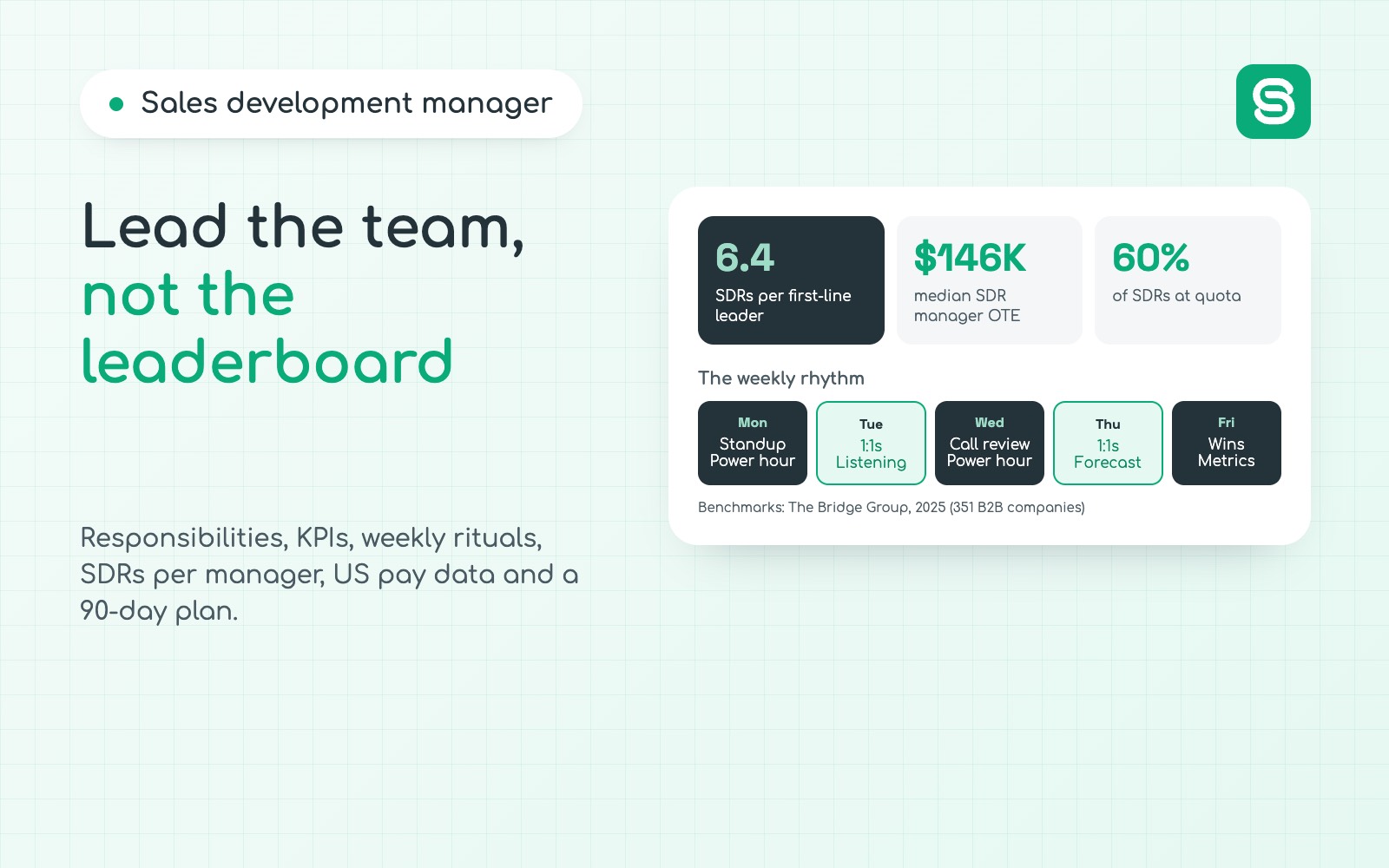
Those three numbers define the job better than any job description. The manager serves more than twice as many AEs as they have reps, gets a new hire productive in about a quarter, and loses close to four in ten reps a year to churn or promotion. A sales development manager is, permanently, hiring, ramping and handing off.
What does an SDR manager do?
Strip away the meetings and the job comes down to six responsibilities. The weighting changes with team size and maturity, but all six are always there.
- 01
Hire.
Write the job description, source, interview, run a cold call role-play, close candidates. With 40% annual attrition, a seven-person team needs roughly three hires a year just to stand still. Our SDR interview questions give you the structure. - 02
Ramp.
Turn a new hire into a productive rep in about three months: product, ICP, tools, scripts, then supervised calling. Our SDR onboarding plan lays out the 30-60-90. - 03
Coach.
One-on-ones, call reviews, live listening, role-plays. This is the job that gets bumped first and matters most. The sales coaching program guide covers the system week by week. - 04
Run the number.
Set targets, track activity and conversion, forecast meetings and pipeline, explain the gap before anyone asks. Our SDR metrics and KPIs guide has benchmarks for each one. - 05
Protect meeting quality.
Agree with sales leadership on what a qualified meeting is, review rejected meetings with AEs, fix the routing. A team that books meetings AEs don’t want is a cost center. - 06
Retain and promote.
Comp plans that pay for the right outcome, a visible promotion path, stay conversations before resignations. Our playbook on reducing SDR turnover goes deeper.
SDR manager vs. sales manager vs. team lead
| Role | Leads | Measured on |
|---|---|---|
| SDR team lead | 2 to 4 reps, part-time, while still prospecting | Own quota plus pod meetings |
| Sales development manager | A team of SDRs or BDRs, full-time | Team meetings held or pipeline created, reps at quota |
| Sales manager (AE manager) | Account executives who close | Closed-won revenue, forecast accuracy |
| Director or VP of sales development | Several SDR managers, sometimes several regions | Pipeline contribution, cost per meeting, program design |
Which KPIs is a sales development manager measured on?
A manager is measured on the team’s output, but managed through its inputs. The trap is to confuse the two: a manager who chases dials gets dials, and a manager who only watches meetings finds out about problems four weeks late. Use one outcome KPI, three or four leading indicators, and two health metrics.
| KPI | Type | Benchmark (Bridge Group, 2025) |
|---|---|---|
| Meetings held or pipeline created vs. target | Outcome | Median monthly quota: 10 first meetings held per SDR |
| Share of reps at quota | Outcome | 60% of SDRs at quota, lowest on record |
| Quality conversations per rep per day | Leading | 4.1 per day; 4.6 on phone-centric teams |
| Dials per rep per day | Leading | 56 on phone-centric teams, 28 on email-centric ones |
| Meeting acceptance and show rate | Leading | No public benchmark: set your own baseline |
| Ramp time of new hires | Health | 3.0 months on average |
| Attrition and promotions | Health | 40% median annual attrition, 16% via promotion |
Two notes on reading these. First, the quota of 10 meetings a month is a global median across very different models: the same report shows 16.0 for teams booking introductory meetings and 9.0 for teams booking fully qualified ones, so compare yourself with teams that qualify the way you do. Second, conversations predict meetings better than dials do. The Bridge Group found phone-centric teams averaging 56 dials and 4.6 quality conversations a day, against 28 dials and 3.4 conversations on email-centric teams. If your conversation count is low, the fix is usually list quality, number type or timing, not more effort. Our diagnostic on how to improve SDR performance helps you find which.
Measure the team on meetings. Manage it on conversations. Coach it on calls.
To set targets that hold, work backward from the pipeline the AEs need. The sales quota calculator does the math, and our call disposition codes guide makes sure the call data you’re reading means the same thing for every rep.
What does an SDR manager’s week look like?
The difference between a manager who coaches and one who means to is a calendar. Rituals on fixed slots survive a busy week; rituals “when there’s time” disappear by the second Tuesday. Here’s a week for a seven-person team. You can enlarge or download it.
Daily standup
Same time every day. Yesterday’s numbers, today’s plan, one blocker per rep. No status reports read aloud: put them on screen beforehand.
Team power hour
Everyone dials at the same time, camera on if remote. The manager dials too. Our guide to the call blitz and power hour has formats that keep it from turning into a contest of dial counts.
Team call review
Two or three recorded calls, picked for a reason (a great opener, a lost objection, a meeting that got rejected). The team discusses; the manager asks questions.
One-on-ones
The rep’s agenda first, then one skill to work on with one call as evidence. Keep pipeline review out of it; that’s what the standup and the CRM are for.
Pipeline sync with AE leads
Meetings booked, accepted, rejected and why. This is where meeting quality gets fixed before it becomes a fight.
For a remote team, the same rituals need more structure; our guide to building a calling culture on a remote SDR team covers what changes. For the one-on-one itself, the sales call scorecard gives you a shared grid, and asking reps to review one of their own calls before the meeting doubles what you get out of it.
How the job changes with team size
“Sales development manager” covers very different jobs depending on the company. The six responsibilities stay the same; the weighting moves.
| Stage | What the manager spends time on | The main risk |
|---|---|---|
| First SDR manager, 2 to 5 reps | Building everything: ICP, lists, scripts, sequences, tools, comp plan, hiring loop. Often still prospects part-time | Becoming a super-SDR who fills the gap personally instead of building a repeatable process |
| Growing team, 6 to 10 reps | Coaching and hiring dominate. Rituals, a written qualification standard and a ramp plan become non-negotiable | Span of control creeps past what one person can coach; one-on-ones start slipping |
| Scaled org, several managers | Running a pod inside a program designed by a director: territories, routing, playbooks, enablement come from above | Managing to the dashboard and losing touch with the calls |
At a startup hiring its first SDRs, the manager is often a founder or the first AE, and the question is whether to hire a dedicated manager at all; our guide on whether to hire an SDR covers the tests before you build the team. The Bridge Group data in the next section explains why small companies run narrower teams: 3.6 SDRs per leader under $5 million in revenue, because that leader is building the machine while running it.
At the other end, in a large org, the first-line manager has less design freedom but more support. The job tilts toward coaching, calibration with other managers and the pipeline conversation with AE leaders. The skill that separates good from great at that level is still the same: staying close enough to the calls to know why the numbers move.
How many SDRs should one manager manage?
Span of control is the most underestimated decision in sales development. Too narrow and the manager is expensive and bored; too wide and coaching is the first thing to go. The Bridge Group’s 2025 data shows the industry moving toward smaller teams.
The median fell from 8 SDRs per leader in 2021 to 2023 to 6.4 in 2025, and the ratio climbs with company size: 3.6 at companies under $5 million in revenue, 8.1 at $500 million and up. Small companies often have a manager who is also building the playbook, the tool stack and the hiring process; large ones have enablement, RevOps and recruiters doing part of that work.
The right number for your team depends on how much each rep needs. Use the calculator below to see where your week lands.
Manager time calculator
Weekly hours on people work, for a 45-hour week. Defaults are an example written for this article.
15.3 hours a week on coaching and team rituals, 34% of a 45-hour week. What's left (29.7 hours) covers hiring, pipeline syncs with AEs, reporting and your own manager.
Rule of thumb: six to eight SDRs per manager when reps are mostly ramped; four to six when more than a third are in their first three months. Past ten, add a team lead before you add a manager.
How much does a sales development manager make?
Pay data for this role comes from three kinds of sources: industry surveys of companies, self-reported pay from reps, and government statistics that cover all sales managers. They don’t measure the same thing, so read them together.
| Source | Figure | What it measures |
|---|---|---|
| The Bridge Group, 2025 351 B2B companies, 83% SaaS | $146K median OTE for SDR managers | Company-reported, up from $127K in 2018 |
| RepVue self-reported, US | $100K median base, $150K median OTE | Rep-reported, data updated April 2025 |
| Bureau of Labor Statistics all sales managers, all industries | $148,270 median annual wage, May 2025 | Includes AE managers and regional sales managers |
| The Bridge Group, 2025 the next steps up | $189K director OTE, $240K VP OTE | Both slightly down from 2022 |
Three things to keep in mind. First, OTE matters more than base: SDR manager variable pay is usually tied to the team’s meetings or pipeline, and how attainable that target is decides what the job really pays. Second, the Bridge Group notes that manager OTE kept growing while director and VP OTE slipped for the first time on record; first-line leadership is where companies are investing. Third, for comparison, the same report puts median SDR OTE at $80K, unchanged since 2022, so a promotion to manager is roughly an 80% jump in on-target pay at the median. For rep-level pay design, see our guide to SDR commission structure.
The first 90 days as a sales development manager
New managers usually fail in one of two ways: they change everything in week one, or they change nothing for six months. A 90-day plan avoids both. Reps get their own 30-60-90; this one is for you.
Days 1 to 30: listen and measure
A one-on-one with every rep (what’s working, what’s in the way, where they want to be in a year). Listen to at least five calls per rep. Read the funnel for the last two quarters: dials, conversations, meetings booked, held, accepted, converted to opportunity. Meet each AE lead and ask one question: “Of the last ten meetings my team booked for you, which would you not have taken, and why?” Change nothing structural yet.
Days 31 to 60: install the rhythm and fix one thing
Put the weekly rituals on the calendar as recurring events. Write down the qualified meeting definition with sales leadership. Then pick the single biggest bottleneck you found (it’s usually one of: list quality, connect rate, the opener, qualification, show rate) and fix that one. One change at a time lets you see whether it worked. Our sibling article on A/B testing sales scripts shows how to test an opener without guessing.
Days 61 to 90: targets, hiring and the path up
Tie targets to the rhythm you installed, set a hiring plan for the next two quarters, and give your strongest reps a written promotion path with criteria. Our SDR career path guide lists the paths that pay back, from AE to RevOps to team lead. Present a one-page plan to your own manager on day 90: where the team was, what you changed, what you’ll change next.
90-day plan for a new sales development manager
Template written for this article. Fill in the brackets and share it with your manager in week one.
DAYS 1 TO 30: LISTEN AND MEASURE
[ ] 1:1 with every SDR (goals, blockers, what they'd change)
[ ] 5+ recorded calls reviewed per SDR, notes in one doc
[ ] Funnel for the last 2 quarters: dials > conversations > meetings booked > held > accepted > opportunities
[ ] Meeting quality interview with each AE lead
[ ] Tool and data audit: lists, numbers, sequences, CRM fields

DAYS 31 TO 60: RHYTHM AND ONE FIX
[ ] Recurring: daily standup, 2 power hours, weekly team call review, weekly 1:1s, weekly AE sync
[ ] Written qualified-meeting definition, signed off by [sales leader]
[ ] Biggest bottleneck: [list / connect rate / opener / qualification / show rate]
[ ] One change shipped, baseline and target: [metric] from [x] to [y] by [date]

DAYS 61 TO 90: TARGETS, HIRING, PATH UP
[ ] Targets per rep tied to conversations and meetings, not dials alone
[ ] Hiring plan for 2 quarters: [number] seats, profile, interview loop
[ ] Written promotion criteria for SDR > senior SDR > AE or team lead
[ ] Day-90 review with [manager]: before, changes, results, next 90 days
How do you know an SDR manager is doing well?
Hitting the team number is the obvious answer, and an incomplete one. A manager can hit the number for two quarters by riding a good inbound season or by booking meetings the AEs quietly reject. Look at five signals instead, every quarter.
The number, and how it was made. Meetings held against target, but also the spread across reps. A team at 100% where two reps carry everyone is fragile. A team at 90% where six of seven reps are within 20% of target is healthy.
Meeting acceptance. The share of booked meetings that AEs accept and that turn into opportunities. If it drops while volume rises, the manager is managing the wrong metric.
Ramp. How long the last three hires took to reach full target, compared with the Bridge Group’s 3.0-month average. A manager with a long ramp usually has an onboarding problem, not a hiring problem.
Who left, and why. Attrition is normal in sales development; regretted attrition isn’t. Count separately the reps who were promoted, the reps you let go and the good reps who resigned. The last group is the one that tells you about the manager.
Coaching that actually happens. Ask reps, not the manager: how many one-on-ones did you have last month, and what’s the one skill you’re working on? If they can’t answer the second question, coaching isn’t happening, whatever the calendar says.
From SDR to manager: what changes
Most sales development managers were promoted from the team they now run. The skills that made them a great SDR (persistence, speed, a thick skin, a personal system) are necessary but no longer sufficient. Four shifts matter most.
- 01
From doing to multiplying.
Your best day used to be five meetings booked. Now it’s a rep who books their first meeting with an opener you helped them rewrite. - 02
From talking to asking.
In a call review, the rep who finds the problem fixes it. The manager who points it out gets a nod and no change. - 03
From your numbers to the system.
You now own why the team’s numbers are what they are: hiring, ramp, lists, tools, routing, comp. - 04
From peer to manager.
Former peers need to see fairness: same rules, same rituals, same feedback standards for everyone, friends included.
Mistakes new SDR managers make
There’s a seventh, quieter one: treating automation as a substitute for coaching. AI can draft emails and summarize calls, but it can’t build a rep’s judgment on a live conversation. Our sibling articles on whether AI will replace SDRs and AI sales role-play look at where the line sits today.
How to hire a sales development manager
If you’re the VP or founder hiring this role, the first decision is internal promotion or external hire. Promote when you have a rep who already coaches informally, whom peers respect, and who has hit quota consistently. Hire externally when the team needs a rebuild (new process, new tools, new hiring bar) or when nobody internal has led people before and the team is larger than five.
- Can explain why a past team’s numbers moved, not just that they did.
- Brings a recorded call and coaches it live in the interview.
- Has promoted reps before and can name where they are now.
- Talks about AEs as customers of the team.
- Has a view on span of control and ramp time.
- Every success story is about their own quota.
- Manages by leaderboard only.
- Has never fired or performance-managed anyone, and avoids the question.
- Blames marketing, lists or AEs for every miss.
- Can’t describe a one-on-one they ran last month.
Interview loop for a sales development manager
Written for this article. Four steps, about four hours of candidate time in total.
1. HIRING MANAGER SCREEN (45 min)
"Walk me through a quarter your team missed. What did you see first, and what did you change?"
"How many SDRs did you manage, how many did you hire, and how many were promoted?"

2. CALL COACHING EXERCISE (45 min)
Give the candidate a recorded cold call (2 to 4 minutes) 24 hours ahead.
They run a 20-minute coaching session with a current SDR playing themselves.
Score: questions vs. statements, one focus skill, a concrete next step.

3. FUNNEL CASE (60 min)
Share 2 quarters of anonymized team data: dials, conversations, meetings booked, held, accepted.
"Where is the bottleneck, what would you check next, what would you change first?"

4. AE AND PEER PANEL (45 min)
An AE lead and an SDR ask about meeting quality, fairness and how disagreements get resolved.

DEBRIEF: score each step 1 to 4 before discussing. No hire with a 1 on step 2.
Before you open the requisition, check whether the team actually needs a new manager or a team lead; our guide on scaling an SDR team without hiring covers the alternatives.
What tools does an SDR manager need?
The manager doesn’t need more tools than the reps. They need the reps’ tools to produce data and recordings they can coach from.
Skipcall covers the calling part for SDR teams: a power dialer and a parallel dialer on four lines for team power hours, voicemail detection, call recording with AI transcription and summaries for reviews, and sync with HubSpot, Pipedrive, Salesforce and Attio. It doesn’t replace a coaching platform or a full conversation intelligence suite: it gives you the recordings, transcripts and summaries to coach from.




