Inbound vs outbound sales gets argued like a religion. One camp says nobody answers the phone anymore and buyers want to find you on their own. The other says waiting for leads is how startups die. Both camps are describing real companies, just not yours. The right answer depends on three things you can measure: what a meeting costs you in each channel, how long you can wait for results, and how many accounts you can actually sell to.
What is the difference between inbound and outbound sales?
One question settles it: who reached out first?
| Criterion | Inbound sales | Outbound sales |
|---|---|---|
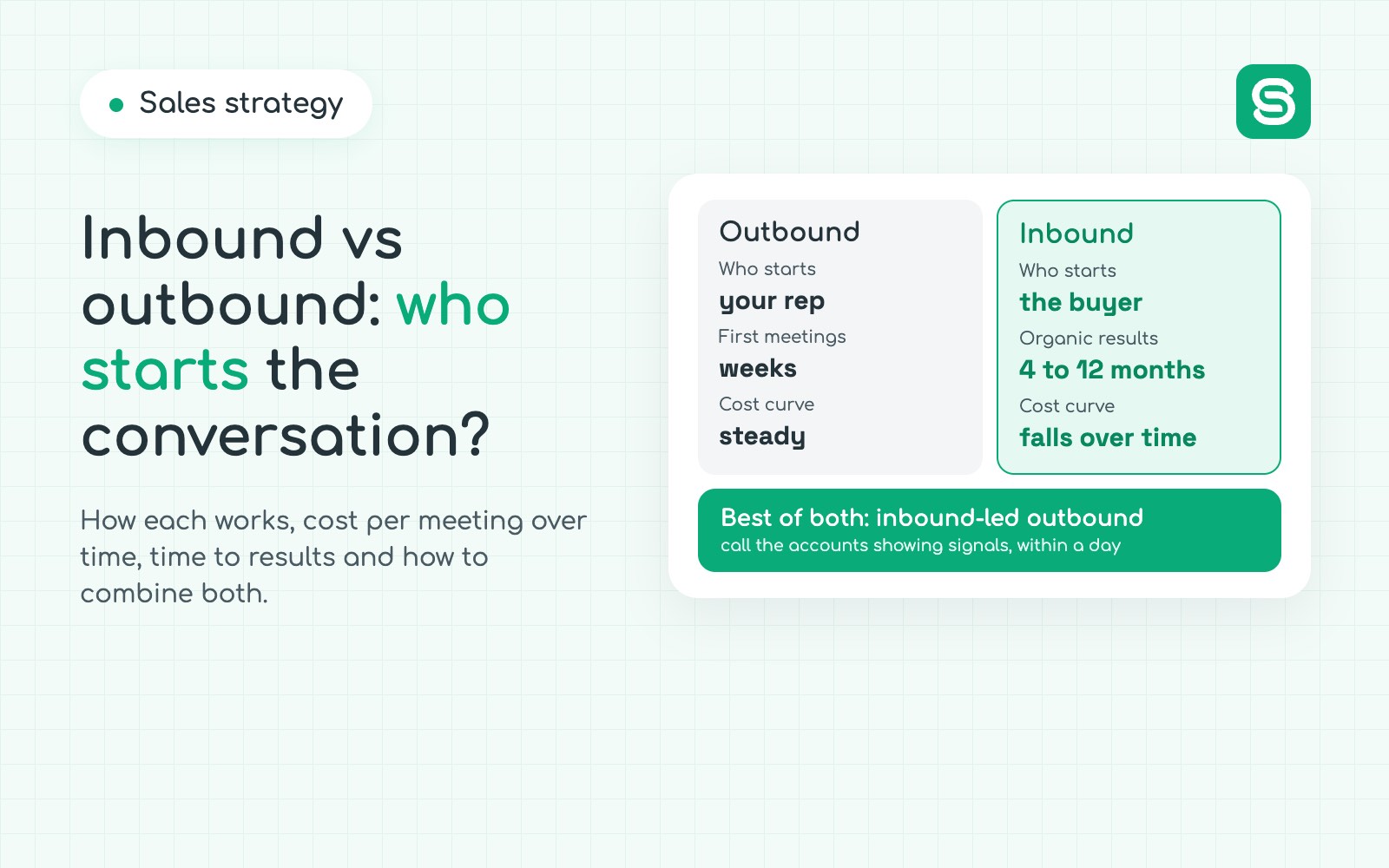
| Who starts the conversation | The buyer: form, demo request, chat, call | Your rep: call, email, LinkedIn message |
| Who you talk to | Whoever found you, fit or not | Accounts you picked from your ICP |
| Buyer awareness | Knows the problem, often comparing vendors | May not be looking yet |
| Main skill | Fast response, sharp qualification | Research, persistence, a strong opener |
| Time to first results | Months for organic, days for paid | Weeks |
| Cost curve | High upfront, falls as content compounds | Steady, mostly people and data |
| Control over volume | Low: depends on demand in the market | High: more reps, more conversations |
That last row is the one founders underestimate. With inbound, you can improve your odds, but you can’t decide how many buyers will look for your category this quarter. With outbound, you can decide how many conversations happen, because you control the dials. That’s why outbound is the lever most teams pull when a quarter looks short.
What is inbound sales?
Inbound sales is the work of turning buyers who came to you into customers. Marketing creates the reasons to come: search content, comparison pages, tools, webinars, reviews, referrals, ads. Sales handles the moment the buyer raises a hand.
- 01
Respond fast.
A demo or pricing request gets a call within minutes. In the 2007 InsideSales.com and MIT study, the odds of qualifying a lead dropped 21 times when the call came after 30 minutes instead of 5. - 02
Qualify.
Confirm the problem, the buying role and the timeframe. Many inbound leads are students, competitors, job seekers or companies far outside your ICP. - 03
Book the discovery meeting.
Hand the qualified lead to an account executive with notes on what triggered the request. - 04
Recycle the rest.
Not ready, not reached, not a fit: back to marketing nurture with a reason logged.
The stage names for this flow (MQL, SAL, SQL) and the exact moment the SDR should call each type of lead are covered in our guide to MQL vs SQL. The response-time part has its own deep dive: speed to lead.
What is outbound sales?
Outbound sales is reaching out first to accounts that fit your ideal customer profile but haven’t contacted you. The rep picks the account, finds the right people, and opens a conversation by phone, email or LinkedIn, usually in a cadence of several touches spread over a few weeks.
Outbound has a reputation problem it partly earned: generic sequences sent to thousands of people who never fit. Done that way, it burns lists and domains. Done well, it’s a short list of accounts that clearly need what you sell, researched, and called by someone who knows why they’re calling. Our sales prospecting guide covers the full cadence, and B2B sales cadence gives the number of touches by deal size.
Cold or warm?
Outbound isn’t always cold. A call to an account that just visited your pricing page, or that a mutual connection introduced, is still outbound, because you started it, but it’s warm. The difference in how prospects respond is usually large, which is why we wrote a separate comparison of warm calling vs cold calling. It’s also the basis of inbound-led outbound, below.
Inbound vs outbound marketing: is it the same thing?
Not quite, and mixing them up causes bad budget decisions.
| Function | Inbound | Outbound |
|---|---|---|
| Marketing | SEO content, tools, webinars, social posts, reviews, community | Display and TV ads, trade shows, sponsorships, direct mail, cold email campaigns |
| Sales | Responding to and qualifying hand-raisers | Reps calling, emailing and messaging target accounts |
Inbound and outbound marketing generate demand and awareness. Inbound and outbound sales are what reps do. The two don’t have to match: a company can run heavy outbound marketing (a booth at every trade show) and mostly inbound sales (reps only follow up on badge scans and demo requests). Paid search sits in between: it’s an ad you pay for, but it only shows to people already searching, so most teams count it as inbound.
Which costs less per meeting, inbound or outbound?
This is where most comparisons go wrong. They quote a “cost per lead” for inbound and a “cost per meeting” for outbound, or leave out salaries, or compare a mature inbound engine with a brand-new SDR team. The only fair comparison is all-in cost per meeting held, measured over the same period, then cost per closed deal.
All-in means everything: SDR salaries with benefits, tools, contact data, the share of a manager’s time, and for inbound the content team, freelancers, SEO tools and ad spend. If you’ve never computed it, our cost per meeting calculator walks you through the fields.
For reference, SDR salaries in that example aren’t invented: the Bridge Group’s 2025 SDR report, covering 351 B2B companies, puts median SDR on-target earnings at $80,000 ($55,000 base, $25,000 variable), before benefits and payroll taxes.
Cost per deal changes the picture again
A meeting isn’t the goal. If inbound meetings close at a higher rate, because the buyer came to you with a problem already defined, the gap per deal is wider than the gap per meeting. If your inbound is mostly content downloads that turned into meetings out of politeness, it can go the other way. Pull the numbers from your own CRM: meetings held by source, and how many became closed-won.
Inbound vs outbound: your cost per meeting and per deal
Default numbers are the worked example in this article (inbound at month 6), not benchmarks. All-in means salaries with benefits, tools, data, content, ads and management time.
The calculator’s defaults reuse the worked example at month 6, with an assumed 15% close rate on outbound meetings and 25% on inbound. Change them to your own.
Inbound is expensive early and cheap later. Outbound is fast and steady. The mistake is comparing one in month 12 with the other in month 2.
What moves outbound cost per meeting
In outbound, people are most of the cost, so the levers are about how many real conversations each rep has per hour. The biggest one is usually dialing: a rep dialing manually spends most of the session listening to rings and voicemail greetings. A power dialer chains calls automatically; a parallel dialer rings several numbers at once and connects the first person who answers. Better data (direct dials and mobiles rather than switchboards) and calling at the right hours come next. Our playbook on reducing cost per meeting works through each lever, and cold call vs cold email compares the two outbound channels on the same math.
How long does each take to produce pipeline?
Cost is half the decision. The other half is how long you can wait.
The practical rule: if you need pipeline this quarter, inbound alone can’t give it to you unless it already exists. That’s why most early-stage B2B companies start with founder-led outbound, then add inbound once they know which message works. Outbound conversations also teach you what to write: the objections you hear on the phone become your best blog posts and comparison pages.
Buying cycles add to the delay. In the 6sense 2026 Global B2B Buyer Experience Report, based on a survey of 4,611 recent B2B buyers, the average buying cycle ran 10.3 months. A meeting booked in March may only show up as revenue the following winter, whichever channel booked it. Our guides to sales cycle length and sales velocity explain how to factor that into a forecast.
Inbound or outbound: which is better for your company?
There’s no universal winner, but there are clear patterns. Score your situation on the five questions below.
| Your situation | Lean toward | Why |
|---|---|---|
| You need meetings this quarter | Outbound | Inbound takes months to build from scratch |
| Your buyers already search for your category | Inbound | Demand exists; you need to be found |
| New category nobody searches for yet | Outbound | You have to explain the problem before buyers look for a solution |
| A short list of large target accounts | Outbound (account-based) | You can name every account; waiting for them to show up is a gamble |
| Thousands of small customers, low price | Inbound, often self-serve | A rep call costs more than the margin on many deals |
| High deal value, long cycle | Both | Outbound opens accounts, inbound content educates the buying group |
- Lower cost per meeting once mature, and the cost keeps falling.
- Buyers arrive with a defined problem and often convert better.
- Content works for every buyer in the group, not only the person who replied.
- No compliance questions about who you’re allowed to call: they asked.
- Slow to build, hard to speed up.
- You can’t choose who shows up, so many leads don’t fit.
- Volume depends on market demand you don’t control.
- Buyers who find you have often found your competitors too.
The shortlist problem
There’s one more reason pure inbound is risky. Buyers decide early who they’ll consider. In the 6sense 2026 data, 92% of eventual winners were on the buyer’s initial shortlist, and the vendor the buyer favored before contacting a seller won 82% of the time. Buying groups spent roughly 60% of the cycle in selection before contacting anyone.
Read quickly, that sounds like a win for inbound: buyers come to you. Read carefully, it says the opposite. If the shortlist forms before the buyer contacts anyone, you need to be known before the buying journey starts. Content and brand do part of that work. Outbound does the rest: a good call six months before a project starts is how you become the vendor the buyer already has in mind. A Gartner survey of 632 B2B buyers adds a warning on how to do it: 73% actively avoid suppliers who send irrelevant outreach. Outbound that works is relevant outbound.
Early-stage startup: founder-led outbound first, to learn the message and land the first 10 to 20 customers. Start writing content from the objections you hear, and add inbound once you know what converts.
What is inbound-led outbound?
Inbound-led outbound means using inbound signals to decide who outbound reps call, and when. The rep still starts the conversation, but the timing comes from something the account did. It’s the motion most mature B2B teams converge on, because it combines outbound’s control (you pick the accounts) with inbound’s timing (they’re paying attention right now).
List the signals worth a call
Pricing or comparison page visits from an ICP account, a second or third person from the same company engaging, webinar attendance, a free tool used, a lost deal from last year back on the site, a past champion who changed companies.
Route signals to an owner
Each signal creates a task for the SDR or BDR who owns the account, with the trigger written on it. No owner, no call.
Call within a day, open with the trigger
“You were at our webinar on Tuesday about dialing productivity. Was that for a project on your team, or just research?” The trigger is the reason for the call, not a creepy detail to hide.
Widen to the buying group
One person engaging is a lead. Three people from the same account is a project. Call the others too, with a message adapted to each role.
Measure it as its own source
Track signal-based outbound separately from cold outbound and from hand-raisers. It usually sits between them on meeting rate and cost.
Our guide to turning buying signals into a call list gives the full list of signals and how to rank them.
A call-opener template for signal-based outbound
Signal-based call opener (inbound-led outbound)
Template written for this article. Replace the brackets; keep it under 30 seconds.
Hi [first name], it's [your name] from [company].

I'm calling because [someone on your team / you] [signal: looked at how we compare with (tool) / joined our webinar on (topic) / used our (tool name) calculator] [this week].

Usually when [role] at a company like [their company] does that, it's because [the problem you solve, in one line].

Is that what's going on for you, or was it just research?

[If yes] What made it a priority now?
[If research] Fair enough. Can I ask what you were trying to figure out? I might be able to save you some time.
How should you organize the team?
Once a company runs both motions, the question becomes who does what. There are three common setups, and the right one depends mostly on headcount.
Blended team (1 to 3 reps)
Every rep handles inbound leads and does outbound. It’s the simplest setup and avoids handoffs, but it has one trap: inbound always wins the rep’s attention, and outbound quietly stops. Fix it with protected calendar blocks (for example, outbound from 9 to 11 AM in the prospect’s time zone, inbound callbacks covered by a rotation) and separate targets for each motion.
Split team: SDRs on inbound, BDRs on outbound (4 reps and up)
Inbound reps (often called SDRs) are measured on speed to lead and qualification rate. Outbound reps (often called BDRs) are measured on meetings held from accounts they opened. The skills differ enough that splitting improves both. Titles vary between companies; our SDR vs BDR guide explains the usual split, and should you hire an SDR covers when the first hire makes sense.
Pods by segment (larger teams)
Each pod covers a segment (mid-market, enterprise, a vertical) with its own inbound and outbound reps and one or more AEs. Outbound reps in the pod work the target accounts; inbound reps cover hand-raisers from the same segment. The AE sees one pipeline, whatever the source. For enterprise accounts, where outbound is almost always account-based, see our guide to enterprise prospecting.
Comp and rules of engagement
To size the team for a revenue target, our sales team size calculator gives a headcount from quota and conversion rates. If you’re weighing hiring against an agency for outbound, the in-house vs outsourced SDR calculator compares the two.
What changes legally between inbound and outbound?
Inbound has an advantage here: the buyer asked you to get in touch. Outbound is legal in B2B in the US, but it comes with rules worth knowing before the first call. This is general information, not legal advice.
| Rule | What it covers | Inbound vs outbound |
|---|---|---|
| TCPA (FCC) | Calls and texts, especially to cell phones, with automated dialing or prerecorded messages | Outbound calls to mobiles need the most care; inbound leads often gave consent on the form |
| Telemarketing Sales Rule (FTC) | Telemarketing calls; most B2B calls are exempt from much of it | Since 2024, B2B calls are covered by its ban on misrepresentations |
| State telemarketing laws | Florida, Oklahoma, Washington, Maryland and others | Some have narrow or no B2B exemptions |
| CAN-SPAM (FTC) | Commercial email, including B2B | Applies to cold outbound email: honest headers, a postal address, a working opt-out |
The 2024 TSR amendments are in the Federal Register (April 16, 2024), and the FTC’s CAN-SPAM compliance guide covers the email side. For outbound calling in detail, read is cold calling legal?.
The mistakes that make teams pick the wrong motion
If you’re building the team that will run all this from scratch, our guide to inside sales explains how remote sales teams are structured, from SDRs to account executives.
Key takeaways
Sources
- 6sense via Business Wire: 2026 Global B2B Buyer Experience Report findings (November 2, 2026)
- Gartner: Sales survey finds 61% of B2B buyers prefer a rep-free buying experience (June 25, 2025)
- InsideSales.com and MIT: Lead Response Management Study (2007, PDF)
- Search Engine Roundtable: Google says give SEOs 4 to 12 months to see benefits (February 2017)
- The Bridge Group: 2025 SDR Models and Metrics report
- Federal Register: Telemarketing Sales Rule amendments (April 16, 2024)
- FTC: CAN-SPAM Act compliance guide for business




