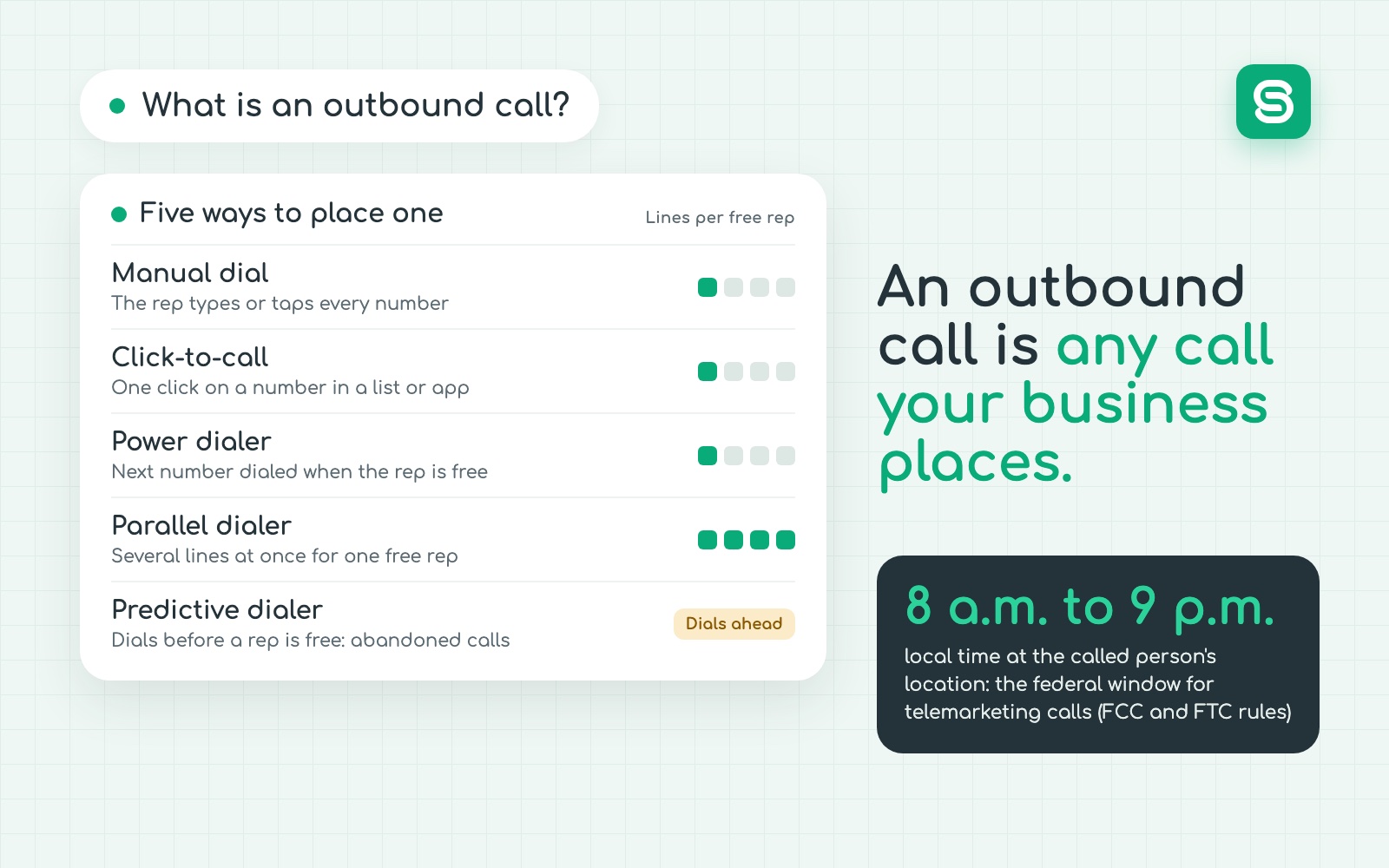
An outbound call is a phone call your business places to someone else, as opposed to an inbound call, which someone places to you. On a phone bill, it simply means an outgoing call from your line. In sales and call centers, it means the calls reps start: prospecting, follow-ups, appointment setting, collections, surveys and customer notifications.
Ask a phone company and a sales manager and you get those two answers, both right. This guide covers both meanings, then follows the call itself: who places it, how it travels, how it gets dialed, which US rules apply to it and how to measure it.
What is an outbound call?
An outbound call is a call that originates on your side and goes out to someone else: a prospect, a customer, a supplier, a patient, a candidate. The word describes direction, nothing more. If your rep dials, it is outbound. If the other person dials your number, it is inbound.
“Outbound call” and “outgoing call” mean the same thing. “Outgoing” is what you see in a smartphone’s call history; “outbound” is the word businesses, telecom providers and contact centers use. “Outbound calling” is the activity: a team, a campaign or a whole job built around placing those calls.
The term carries two meanings that are worth keeping apart, because people search for both.
What does “outbound call” mean on a phone bill?
On a bill or in a provider’s call log, outbound calls are the calls dialed from your number, listed with the number called, the date and time, the duration and sometimes a charge. They are listed apart from inbound calls because they can be priced differently. A domestic plan may include unlimited outbound calls within the US and Canada while international outbound calls are billed per minute. With a toll-free number, it is the other way around: the business that owns the number pays for the inbound calls, which is why toll-free lines exist in the first place.
If you see an outbound call on a bill that nobody remembers placing, look at three things: a forwarding rule that sends calls to an outside number (a forwarded call can appear as an outgoing leg), a voicemail or app that dialed back automatically, or a compromised account. Business phone providers can show which user or device placed each call.
Is every outbound call a cold call?
No, and the confusion costs teams money, because they apply cold calling rules of thumb to calls that are nothing like cold calls. RingCentral’s own explainer makes the same point: cold calling is a subset of outbound calling, not a synonym. A call to someone who has never heard of you is cold. A call back to a lead who requested a demo an hour ago is warm. A call to confirm tomorrow’s meeting is routine. All three are outbound.
The difference matters for scripts, for timing and for the law. A customer who gave you their number and asked to be called is not in the same legal position as a stranger on a purchased list. We compare the two in detail in warm calling vs cold calling.
Outbound vs inbound calls: what is the difference?
Direction changes everything around the call. An inbound call arrives when the caller is ready; your job is to answer, route and resolve. An outbound call happens when you decide; your job is to choose who to call, reach them, and earn the next thirty seconds.
| Aspect | Outbound call | Inbound call |
|---|---|---|
| Who dials | Your rep or agent | The customer or prospect |
| Who chose the moment | You | The caller |
| What you need first | A list, a reason to call and a trusted caller ID | A number people can find and someone available to answer |
| Typical tools | Dialer (manual, power, parallel, predictive), CRM, call recording | IVR or auto attendant, call queues, routing, ring groups |
| Main risk | Nobody picks up, or your number gets labeled as spam | Callers wait or hang up before anyone answers |
| Core metric | Connect rate and conversations per hour | Answer rate, wait time, abandonment in queue |
| US rules that attach | Calling hours, do-not-call lists, consent for autodialed or prerecorded calls to cell phones, caller ID | Mostly recording consent and privacy; telemarketing rules rarely apply |
This page is about the call. If you are deciding between inbound and outbound as a sales strategy (cost per meeting, time to pipeline, how to combine the two), read our guide to inbound vs outbound sales, which does that math.
The 7 types of outbound calls
Outbound calls differ by goal far more than by technology. The same dialer can place all seven types below. What changes is the list, the script, the metric and sometimes the law.
Sales prospecting calls
The call most people picture: a rep reaches a person who fits the ideal customer profile but has not contacted you, to start a conversation and book a meeting. In B2B this is usually an SDR or BDR calling decision makers, often as one touch in a cadence that also uses email and LinkedIn. Its metric is meetings booked, and the hard part is reaching someone at all. Our cold calling guide covers the craft.
Follow-up calls
Calls that continue something already started: after a demo, after a quote, after an inbound form, after an event. They convert better than cold calls because the prospect knows who you are, and they are the easiest to forget, because nothing forces them onto the calendar. A follow-up without a date in the CRM usually does not happen.
Appointment setting and reminders
Booking a slot for someone else (an account executive, a technician, a consultant) or confirming one that exists. Appointment setters live on outbound. Reminder calls are often automated, and an automated or prerecorded reminder is exactly the kind of call that brings TCPA consent rules into play, as the rules section explains.
Collections calls
Calls to recover overdue payments. Consumer debt collection has its own federal law, the Fair Debt Collection Practices Act, on top of telemarketing rules, so collections teams work from stricter scripts and call-frequency limits than sales teams. B2B collections between companies are lighter, but tone still decides whether you keep the customer.
Surveys and market research
Calls that ask questions rather than sell: satisfaction surveys, market research, political polling. Pure research calls fall outside the definition of a telephone solicitation, but a “survey” that turns into a pitch is a sales call and is treated as one.
Customer success and account management calls
Onboarding check-ins, renewal conversations, upsell and cross-sell calls to existing customers. They are outbound, they are commercial, and they are among the most valuable calls a company makes. Under US rules, an established business relationship changes what you may do, which is one reason to log every customer interaction properly.
Service notifications
Delivery windows, outages, fraud alerts, order issues. These are informational calls, often automated. When they are placed with a prerecorded or artificial voice, consent and identification rules still apply, and the message must say clearly who is calling.
The type of call decides the list, the script and the metric. The dialer is the last decision, not the first.
How does an outbound call work?
From the rep’s side, an outbound call is a click and a ring. Underneath, it is a relay between several companies, and two of them, your voice provider and the prospect’s carrier, decide how your call looks when it arrives. Understanding that path explains most connect-rate problems.
Caller ID: the number the prospect sees
Every outbound call carries a caller ID, the number displayed on the recipient’s phone. A business phone system lets you pick which of your numbers to display. Two US rules frame that choice. The FTC’s Telemarketing Sales Rule treats failing to transmit the caller’s telephone number as an abusive practice (16 CFR 310.4(a)(8)). And the Truth in Caller ID Act, now part of 47 U.S.C. § 227(e), makes it unlawful to transmit misleading or inaccurate caller ID “with the intent to defraud, cause harm, or wrongfully obtain anything of value”, with FCC forfeitures of up to $10,000 per violation. In practice: display a number that is genuinely yours, and that can be called back.
STIR/SHAKEN: the signature on your call
STIR/SHAKEN is the caller ID authentication framework the FCC required voice providers to implement on their IP networks by June 30, 2021, following the TRACED Act. In the words of the FCC’s report to Congress, it “employs public key cryptography” to transmit what the originating provider knows about the caller and the caller’s relationship to the number, in an “Identity header” that the terminating provider verifies. That knowledge is graded A (full: the provider knows you and your right to the number), B (partial: it knows you, not your right to the number) or C (gateway: it only knows where the call entered its network).
Attestation proves your number is yours. It does not prove your call is wanted. Our guide to STIR/SHAKEN caller ID authentication explains how to get A-level attestation and why signed calls can still be labeled spam.
CNAM: the name that sometimes appears
CNAM (caller name) is the business name stored against your number in shared caller name databases. The receiving carrier decides whether to look it up, and many wireless carriers do not, so your name often shows on a desk phone and not on a smartphone. Registration goes through whoever provides your number. Our explainer on CNAM caller name display covers registration and the branded caller ID alternatives.
Spam labels: decided at the far end
The label a prospect sees (“Spam Likely”, “Potential Spam”, or nothing) comes from the receiving carrier’s call analytics engine, which scores numbers on signals such as volume, call length and complaints. You do not see that score and your dialer will not tell you about it: it shows up as a falling connect rate. If you suspect a problem, our guide to a caller ID marked as spam walks through the checks.
Local numbers and local presence
Calling a Chicago prospect from a 312 number instead of a number from another state is called local presence. It is legal when the local numbers are really assigned to you, and it is spoofing when they are not. Whether it still lifts answer rates, and where it stops helping, is the subject of our guide to local presence dialing in B2B. To set up local numbers, see our page on the virtual phone number: a US local number with the area code you choose, active right away with no supporting document.
Outbound dialing methods compared
“Dialing method” means who, or what, starts the next call and how many lines run at once. There are five, and choosing between them is mostly a question of how many conversations you need per hour and how much risk of abandoned calls you can accept.
| Method | Who starts the next call | Lines per rep | Abandoned calls | Fits |
|---|---|---|---|---|
| Manual dialing | The rep types or taps the number | 1 | None | A few high-value calls a day, executive outreach |
| Click-to-call | The rep clicks a number in a list, CRM or app | 1 | None | Reps who research each contact before calling |
| Power dialer | The software, as soon as the rep is free | 1 | None | B2B prospecting from a list, steady pace |
| Parallel dialer | The software, several numbers at once for one free rep | 2 to 4 typically | None if it only dials for an available rep | B2B lists with low answer rates, high volume |
| Predictive dialer | An algorithm, before a rep is free, from forecast availability | Variable, across a pool of agents | Yes: capped by US rules | Large consumer call centers with many agents |
Manual dialing and click-to-call
The rep controls every call. Click-to-call only removes the typing: the rep still decides when the next call starts, and the time between calls (opening the record, reading notes, logging the outcome) stays with them. Good for precision, slow for volume.
Power dialer
The dialer works down a list and places the next call as soon as the current one ends and the rep has logged the outcome. One line, one prospect at a time, so if someone answers, a rep is always there. It removes the dead time between calls without changing the nature of the call. See our power dialer page and the comparison of auto dialer vs power dialer.
Parallel dialer
The dialer calls several numbers at the same time for one rep who is free, and connects the first person who answers. Voicemails, busy signals and no-answers on the other lines are handled by the software. Because it only dials for an available rep, a well-built parallel dialer does not create abandoned calls. Our parallel dialer page shows how the lines are managed.
Predictive dialer
The dialer forecasts when agents will become free and dials ahead of them, across a pool of agents. When the forecast is wrong, someone answers and no agent is there: that is an abandoned call, the “hello?… silence” call everyone has received. Our explainer on what a predictive dialer is details the mechanics and our call abandonment rate article covers the limits.
The umbrella term for the last three is “auto dialer”. If you are comparing them, our auto dialer page puts the modes side by side, and the progressive dialer explainer covers the variant where the rep sees the record before the call is placed.
Answering machine detection
Automatic dialing only pays off if the rep is not the one listening to voicemail greetings. Answering machine detection (AMD) tries to tell a human “hello” from a recorded greeting in the first seconds, then releases the line or drops a message. No detection is perfect, and a human mistaken for a machine is a lost conversation. Our guide to answering machine detection explains the trade-off.
What US rules apply to outbound calls?
US telemarketing law attaches to the call: who receives it, how it was dialed, whether a recorded voice is involved and what it is for. Two federal regimes overlap. The FCC enforces the Telephone Consumer Protection Act (TCPA) and its rules at 47 CFR 64.1200. The FTC enforces the Telemarketing Sales Rule (TSR) at 16 CFR Part 310. States add their own laws on top. Here is what each says on the points that matter for an outbound call, quoted from the texts we read on November 25, 2026.
| Rule | What it requires | Official text |
|---|---|---|
| Calling hours | No telemarketing call before 8 a.m. or after 9 p.m., local time at the called person's location | 16 CFR 310.4(c); 47 CFR 64.1200(c)(1) |
| National Do Not Call Registry | No telephone solicitation to a residential subscriber who registered the number | 16 CFR 310.4(b)(1)(iii)(B); 47 CFR 64.1200(c)(2) |
| Your own do-not-call list | Honor a request within a reasonable time, no more than 10 business days, then honor it for 5 years from the request | 47 CFR 64.1200(d)(3) and (d)(6) |
| Identify yourself | Give the caller's name, the company the call is for, and a phone number or address; in a sales call, say it is a sales call | 47 CFR 64.1200(d)(4); 16 CFR 310.4(d) |
| Transmit caller ID | Send your telephone number; never send misleading caller ID to defraud or cause harm | 16 CFR 310.4(a)(8); 47 U.S.C. § 227(e) |
| Autodialed or prerecorded calls to cell phones | Prior express consent; prior express written consent if the call is telemarketing | 47 CFR 64.1200(a)(1)(iii) and (a)(2) |
| Prerecorded telemarketing to residential lines | Prior express written consent | 47 CFR 64.1200(a)(3) |
| Abandoned calls | No more than 3% of live-answered calls per campaign over 30 days; connect within 2 seconds of the greeting | 47 CFR 64.1200(a)(7); 16 CFR 310.4(b)(4) |
Calls are allowed only “between 8:00 a.m. and 9:00 p.m. local time at the called person’s location.”
Calling hours: whose clock?
The prospect’s, not yours. A rep in New York dialing a list at 8:30 p.m. Eastern is fine for Los Angeles and too late for Boston. The window applies “without the prior consent of a person” in the TSR’s wording, so a customer who asked you to call at 9:30 p.m. is a different case. Some states set stricter windows of their own, as detailed in is cold calling legal. Our when to call tool shows the local time in a prospect’s area so reps stop doing time-zone math in their heads.
Do-not-call lists
There are two. The National Do Not Call Registry, run by the FTC, protects residential subscribers who registered their number. Your company-specific list holds everyone who asked your business not to call again; under the FCC rule, a request must be honored within a reasonable time not exceeding ten business days and honored for five years from the time it was made. The FCC also applies its do-not-call rules to wireless numbers (47 CFR 64.1200(e)), which is why a cell phone a prospect uses for work is not automatically safe to treat as a business line. Our guide to DNC scrubbing covers how to clean a list before a campaign.
Consent: when a dialer or a recording changes the rules
The TCPA requires prior express consent for calls to a cell phone “using an automatic telephone dialing system or an artificial or prerecorded voice” (47 CFR 64.1200(a)(1)), and prior express written consent when such a call is telemarketing (a)(2). Two parts of that sentence trip teams up.
The first is the prerecorded or artificial voice. A prerecorded voicemail dropped on a cell phone, or an AI-generated voice, falls into this category no matter how the number was dialed. The second is the automatic telephone dialing system. In Facebook v. Duguid (April 1, 2021), the Supreme Court held that to qualify, a device must have the capacity either to store or to produce a telephone number using a random or sequential number generator. A dialer that calls numbers from your own list was therefore outside the federal definition in most courts’ reading. Some state laws define automated dialing more broadly, so the federal answer is not the whole answer.
What about B2B calls?
The TSR exempts “telephone calls between a telemarketer and any business to induce the purchase of goods or services” (16 CFR 310.6(b)(7)), with exceptions, notably calls selling nondurable office or cleaning supplies. The FCC’s definition of telephone solicitation excludes calls to people with an established business relationship or who gave prior express invitation or permission (47 CFR 64.1200(f)(15)). That makes calls to a company’s switchboard or a business landline lightly regulated at the federal level. It does not exempt you from the caller ID rules, from honoring “don’t call me again”, or from state laws that drop the B2B exemption. For the state-by-state picture, read is cold calling legal; for what changed this month, our summary of the TCPA rule changes of November 2026.
What happens if you get it wrong?
The TCPA gives people a private right of action: they can sue for their actual loss or $500 per violation, whichever is greater, and a court may triple the award for willful or knowing violations (47 U.S.C. § 227(b)(3)). Because outbound teams place calls by the thousand, the exposure is counted by the thousand too.
Outbound call metrics: what to measure
Outbound teams drown in numbers. The ones below are enough to run a team, provided everyone uses the same definitions. We give definitions, not benchmarks: published averages vary with list quality, number type and industry, and comparing your connect rate with someone else’s average says less than comparing it with your own last month. If you want published figures with their sources, our cold call connect rate benchmarks article gathers them.
| Metric | Definition | What it tells you |
|---|---|---|
| Dials | Calls placed, answered or not | Activity. Useless alone, needed as the denominator |
| Connect rate | Calls answered by a human ÷ dials | List quality, number type, timing and caller ID reputation |
| Conversation rate | Conversations longer than a threshold you set (for example 60 seconds) ÷ connects | Whether your opener earns the next thirty seconds |
| Meeting rate | Meetings booked ÷ conversations | Targeting and the quality of the ask |
| Meetings held | Booked meetings that actually took place | Whether booked meetings were real |
| Conversations per hour | Conversations ÷ hours spent dialing | Dialing method and list work: the capacity of the motion |
Two practical rules keep these numbers honest. Log an outcome on every call, with a short list of disposition codes everyone uses the same way; our call disposition codes article gives a starter set. And track connect rate per number, not only per rep: a number whose connect rate falls while the others hold is the first sign of a spam label. For the wider set of call KPIs, see call metrics and KPIs.
How to set up an outbound calling motion
Whether you are a founder making the first calls or a sales leader building an SDR team, the order below avoids the most expensive mistakes, which are almost always made before the first dial.
- 01
Define the call's goal:
one outcome per call type. A prospecting call aims for a meeting, a follow-up for a decision date, a reminder for a confirmation. Write it down, because it decides the script and the metric. - 02
Build and clean the list:
contacts that fit your ideal customer profile, with the right phone number for each (direct line, mobile or switchboard, labeled as such). Remove numbers on your internal do-not-call list, and scrub residential and wireless numbers against the National Do Not Call Registry when they are in scope. - 03
Get numbers you own:
local numbers in the area codes you call, assigned to your account by the provider that signs your calls. Confirm the STIR/SHAKEN attestation level in writing, register a caller name where it helps, and make sure each number can receive the callbacks it triggers. - 04
Choose the dialing method:
manual or click-to-call for a few dozen researched calls a day, a power dialer for steady list work, a parallel dialer when answer rates are low and volume matters. Avoid predictive dialing for B2B unless you can manage the abandonment limit. - 05
Set calling windows by the prospect's time zone:
8 a.m. to 9 p.m. local time is the federal outer limit; stricter state windows apply in some states, and the best hours to reach business decision makers are narrower still. Sort lists by time zone so reps follow the sun. - 06
Write the opener and the ask, not a full script:
who you are, why you are calling this person, one question. Identify yourself and your company at the start, as the rules require. Decide in advance whether calls are recorded and how you disclose it. - 07
Connect the phone to the CRM:
every call logged with its outcome on the contact record, recordings and summaries attached, follow-ups created as dated tasks. A call that is not logged did not happen as far as the next rep is concerned. - 08
Review weekly, per list and per number:
connect rate, conversation rate and meetings per conversation. Listen to a few recorded calls each week. Retire numbers whose connect rate collapses, and lists that produce conversations but no meetings.
Where Skipcall fits for outbound calls

Skipcall is an outbound-first business phone system: it is built for teams that place more calls than they receive. Here is what it does, and what it does not, so you can tell whether it fits your motion.
Best for: B2B sales teams, founders and agencies whose calls are mostly outbound: prospecting, follow-ups, appointment setting and customer check-ins, in the US and in the other countries where we issue numbers.
Not the right fit if: your main need is answering and routing inbound calls, you want an AI voice agent to place calls for you, or you run a high-volume consumer call center that relies on predictive dialing.
Outbound call glossary
The vocabulary of outbound calling, in one place, for anyone onboarding a new rep.
Sources
Official texts and pages read on November 25, 2026.
- 47 CFR § 64.1200, Delivery restrictions (FCC TCPA rules), via Cornell Legal Information Institute
- 16 CFR § 310.4, Abusive telemarketing acts or practices (FTC Telemarketing Sales Rule), via Cornell LII
- 16 CFR § 310.6, Exemptions (FTC Telemarketing Sales Rule), via Cornell LII
- 47 U.S.C. § 227, Restrictions on use of telephone equipment (TCPA and Truth in Caller ID Act), via Cornell LII
- Supreme Court of the United States, Facebook, Inc. v. Duguid, No. 19-511 (April 1, 2021), via Cornell LII
- FCC Wireline Competition Bureau, Report on Caller ID Authentication Implementation Progress (December 2020, PDF)
- RingCentral: What is an outbound call




