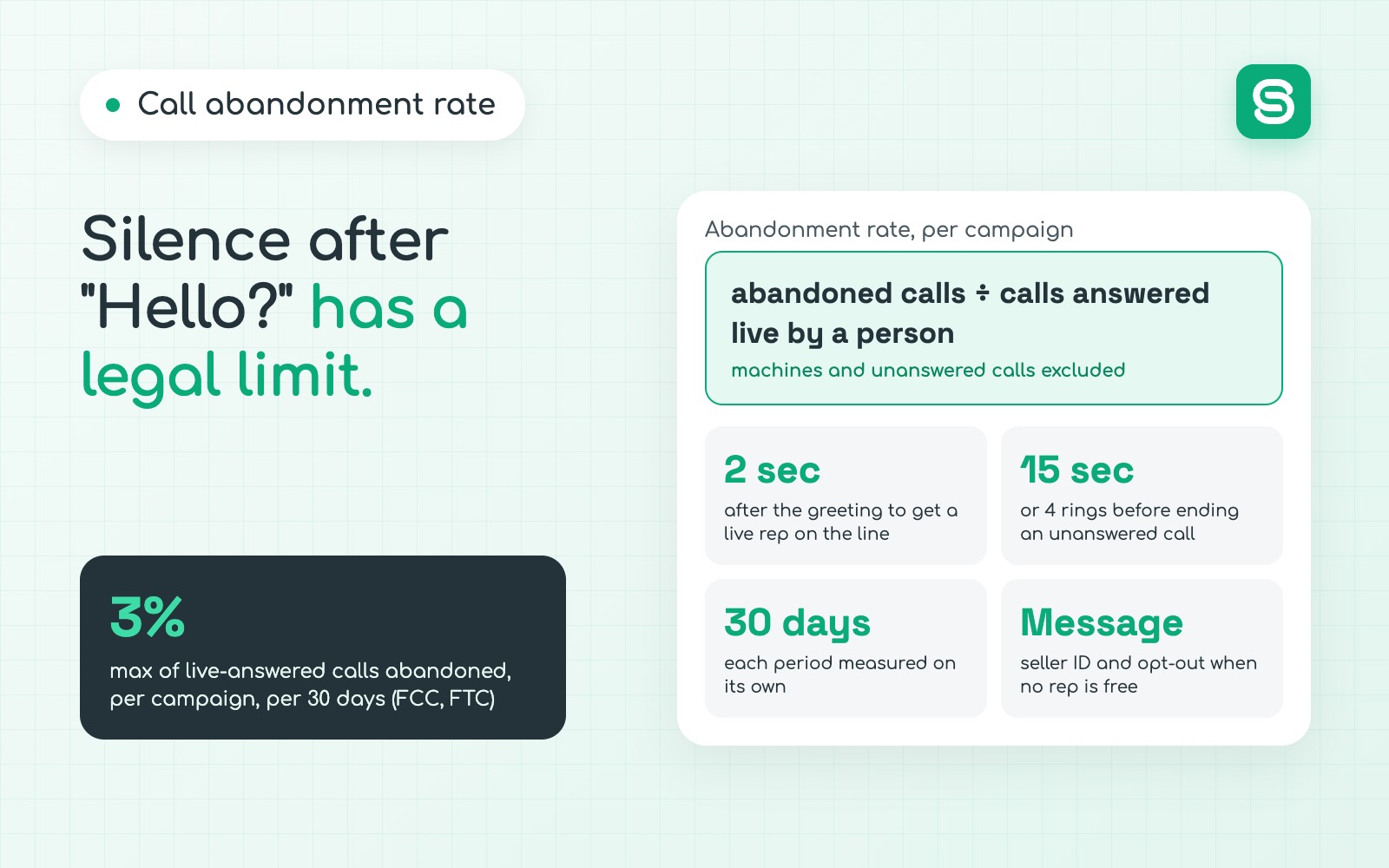
The prospect picks up, says “Hello?” and hears nothing. Then a click. On their side, it’s a creepy call from an unknown number. On yours, if you run a predictive dialer, it’s an abandoned call, and US rules put a hard ceiling on how many of those you’re allowed to make. Your call abandonment rate is one of the few sales metrics with a legal limit attached, and most teams only learn how it’s calculated after someone asks them to prove it.
What is call abandonment rate?
The phrase has two meanings, and search results mix them up constantly. Before you compare your number with anyone else’s, check which one you’re talking about.
| Point | Outbound (this guide) | Inbound contact center |
|---|---|---|
| What is abandoned | A call you placed, answered by a person, with no rep on the line within 2 seconds | A call a customer placed, hung up while waiting in the queue |
| Who abandons | The caller (your dialer) | The customer |
| Formula | Abandoned ÷ calls answered live by a person | Calls abandoned in queue ÷ calls offered |
| Limit | 3% per campaign per 30 days (FCC rule, FTC safe harbor) | An internal service target, no federal cap |
| Main cause | Predictive pacing: more answers than free reps | Understaffing, long hold times |
If you run a service desk, the inbound version is a staffing metric, and our call metrics guide covers how to track it. The rest of this article is about the outbound version: the one regulators define, cap and can ask you to document.
What counts as an abandoned call under FCC and FTC rules?
Two federal rulebooks define it in almost the same words. The FCC’s TCPA rules say a call is “abandoned” if it is “not connected to a live sales representative within two (2) seconds of the called person’s completed greeting” (47 CFR 64.1200(a)(7)). The FTC’s Telemarketing Sales Rule says an outbound call is abandoned “if a person answers it and the telemarketer does not connect the call to a sales representative within two (2) seconds of the person’s completed greeting” (16 CFR 310.4(b)(1)(iv)).
Three details in that wording matter more than they look:
The silence between “Hello?” and your rep’s first word has a name too: dead air. Our guide on dead air on cold calls breaks it into its four sources (answering machine detection, handoff, network delay and the rep) and shows how to measure yours with ten test calls.
What is the 3% abandoned call rule?
Here is the FCC text in full: no person or entity may “abandon more than three percent of all telemarketing calls that are answered live by a person, as measured over a 30-day period for a single calling campaign. If a single calling campaign exceeds a 30-day period, the abandonment rate shall be calculated separately for each successive 30-day period or portion thereof that such calling campaign continues” (47 CFR 64.1200(a)(7), eCFR, current as of November 2026).
The same paragraph adds four obligations that come with the cap:
- 01
A message when no rep is free.
Within two seconds of the completed greeting, the caller must play a prerecorded message that only says the call was for “telemarketing purposes,” names the business on whose behalf it was placed, and gives a phone number where the person can make a do-not-call request during regular business hours. That number cannot be a 900 number or charge more than normal transmission costs. - 02
An automated opt-out.
The message must include an automated, voice or keypress opt-out that records the number on the seller’s do-not-call list and immediately ends the call. - 03
Records.
The seller or telemarketer must keep records establishing compliance with the 3% rule. If you can’t produce your rate per campaign per 30 days, you can’t show you were under it. - 04
Two carve-outs.
Calls by or on behalf of tax-exempt nonprofits are not covered. And a prerecorded telemarketing message sent with the person’s prior express written consent is not counted as abandoned if it begins within two seconds of the greeting.
Notice what the rule does not say. It doesn’t ban predictive dialers. It doesn’t say anything about how many lines you dial. It sets an outcome (3% of live answers, at most) and a method of measurement (per campaign, per 30 days). How you get there is up to your dialer settings. For the wider legal picture of US phone prospecting, see is cold calling legal and our breakdown of the TCPA rule changes taking effect November 25, 2026.
How do you calculate call abandonment rate?
The formula is short. The traps are in what you put in each box.
Enter your own numbers below. Without JavaScript, the box shows the worked example.
Abandonment rate, one campaign, one 30-day period
Calls answered live by a person4,970
Abandonment rate2.41%
Abandons left before 3% at this volume29
Calls answered by machines and unanswered calls stay out of both numbers. Example values; use your dialer's records for the exact period and campaign.
Four counting traps
| Trap | What goes wrong | What to do |
|---|---|---|
| Blending campaigns | A clean campaign hides a bad one in a team-wide average | Report per campaign, as the rule is written |
| Machines in the denominator | Counting voicemails as live answers makes the rate look smaller | Use only calls answered by a person |
| Missing the late connects | Calls where the rep arrived after 3 seconds are logged as connected | Measure time from greeting to rep, not just whether a rep joined |
| Abandons to machines | The dialer dropped a call without knowing if a human or a machine answered | Decide and document a method before any audit |
That last trap has no clean answer in the US texts. The UK regulator, Ofcom, publishes one way to handle it: when you don’t know whether dropped calls reached people or machines, assume they split in the same proportion as the calls your agents did take (Ofcom, Persistent Misuse policy statement, Annex 3). It’s a reasonable, documented method, but it isn’t US law. Agree on your method with counsel and write it down.
Why small campaigns are the riskiest
The 3% cap is a ratio, so the same bad hour weighs very differently depending on volume. A campaign with 5,000 live answers in a 30-day period can absorb up to 150 abandoned calls. A niche campaign aimed at a few hundred accounts, with 300 live answers in the period, can absorb 9. One morning where the dialer over-dials into an unusually responsive list can use that up before lunch.
What is the safe harbor for abandoned calls?
The FTC’s Telemarketing Sales Rule treats abandoning a call as an abusive practice, then offers a safe harbor: a seller or telemarketer “will not be liable” for abandoned calls if it meets all four conditions of 16 CFR 310.4(b)(4).
The 3% technology test
It uses technology that ensures abandonment of no more than 3% of all calls answered by a person, measured over the duration of a single campaign if under 30 days, or separately over each successive 30-day period.
The ring minimum
It lets every call ring for at least 15 seconds or four rings before disconnecting an unanswered call.
The recorded message
Whenever no sales rep is available within two seconds of the completed greeting, it promptly plays a recorded message stating the name and telephone number of the seller on whose behalf the call was placed.
The records
It keeps records establishing compliance with the first three conditions, under the TSR’s recordkeeping rules.
Miss one condition and the safe harbor is gone for the calls concerned. The stakes are real: the FTC can seek civil penalties of up to $53,088 per violation of a trade regulation rule, the 2025 level that the agency kept unchanged for 2026 (Federal Register, January 17, 2025 and September 15, 2026).
FCC rule vs. FTC safe harbor: the differences that matter
| Point | FCC (47 CFR 64.1200) | FTC (16 CFR 310.4) |
|---|---|---|
| Legal form | A prohibition: do not abandon more than 3% | A safe harbor from a prohibition on abandoning calls |
| Message content | "Telemarketing purposes," business name, a do-not-call number for business hours | Seller's name and phone number |
| Opt-out | Automated voice or keypress opt-out required in the message | Not part of the safe harbor conditions |
| Business-to-business calls | No B2B carve-out in the paragraph; nonprofits excluded | Most B2B calls exempt (16 CFR 310.6(b)(7)), except e.g. retail sale of nondurable office or cleaning supplies |
The B2B row is where sales teams get overconfident. The FTC’s business-to-business exemption takes most B2B calls out of the TSR, but the FCC’s abandonment paragraph contains no equivalent wording, and B2B lists today are full of personal cell phones. Our guide to cold calling cell phones in B2B covers that overlap. Whether a given campaign is covered depends on who you call, from where and what you sell: that’s a question for your lawyer, not for a blog post.
Is the FCC getting rid of the 3% rule?
Maybe one day, but not yet. In a further notice of proposed rulemaking adopted October 28, 2025 and released October 29 (FCC 25-76, published in the Federal Register on December 5, 2025), the FCC included the abandonment rules in a list of “older rules that might no longer be necessary.” It asked “whether to eliminate our rules prohibiting callers from disconnecting an unanswered telemarketing call prior to at least 15 seconds or four rings, and from abandoning more than three percent of all telemarketing calls” (Federal Register, 90 FR 56101, paragraph 75).
Today’s predictive dialers appear to leverage advances in technology, including Artificial Intelligence, to drive efficiencies. (FCC 25-76, paragraph 76)
The FCC’s reasoning: it adopted the rules in 2003 “largely as a result of the predictive dialers callers used at the time,” and dialer improvements plus marketers’ own interest in avoiding dead air may make them unnecessary. It also asked the right hard questions: whether the Do-Not-Call Implementation Act requires keeping them, since Congress told the FCC to “maximize consistency” with the FTC’s rule, and whether deleting them would confuse callers when the FTC’s version still applies to the callers under the FTC’s jurisdiction. Comments were due January 5, 2026 and replies February 3, 2026.
What it means for you today:
How does Ofcom treat abandoned calls in the UK?
If your team also calls into the UK, the comparison surprises people. Many vendor pages still quote a UK “3% rule.” Ofcom’s current policy statement, published December 20, 2016 and applied since March 1, 2017, says plainly that the view that its old 3% figure “created a safe harbour is incorrect. Rather, it reflected a criterion for prioritising cases for action” (Ofcom, Persistent Misuse policy statement, archived copy, as Ofcom’s site blocks automated access). In the UK, there is no tolerated abandonment rate.
| Point | US (FCC and FTC) | UK (Ofcom) |
|---|---|---|
| Tolerated rate | 3% per campaign per 30 days | None; the rate is one factor for prioritizing cases |
| How the rate is measured | Per campaign, per 30-day period | Per calendar day: abandoned ÷ (abandoned + live calls) |
| When the 2 seconds start | After the completed greeting | Information message within 2 seconds of the person beginning to speak, if the dialer listens for a voice; otherwise of pickup |
| Ringing | At least 15 seconds or four rings | Under 15 seconds, or ringing for extended periods, is likely to cause more harm |
| Records | Records proving compliance | At least six months |
Two more UK points are worth knowing. Calling the same number again within 72 hours of an abandoned or silent call, without guaranteeing a live agent, is treated as an aggravating factor. And penalties for persistent misuse go up to £2 million. Our overview of cold calling laws by country puts the UK next to 13 other markets.
Why do predictive dialers abandon calls?
Because that’s how they reach their speed. A predictive dialer places more calls than there are free reps, betting that most won’t be answered by a person. When the bet is right, reps go from one live conversation to the next with almost no waiting. When more people answer than the dialer predicted, the extra calls have nowhere to go. Those are your abandoned calls. Our predictive dialer guide explains the pacing model in detail.
Why power dialers don’t create the problem
A power dialer dials one number per rep, and only when that rep is free. When someone answers, the rep is already on the line. The situation that drives predictive abandonment, more people answering than reps available, can’t arise by construction. That’s the main reason B2B teams that want speed without pacing math move to power dialing; our comparison of power vs. predictive vs. parallel dialers lays out the trade-offs.
There is one caveat, and it’s the one vendors skip. The definition is about time, not about pacing. If answering machine detection listens for a second or two to decide whether a human answered, and the connection adds its own delay, the rep can reach the person more than two seconds after the greeting ends. Answering machine detection is the usual culprit. Measure the gap on your own setup; don’t assume it’s zero.
Where parallel dialers fit
A parallel dialer dials a few numbers at once for one rep. When one person answers, that call goes to the rep and the dialer stops the other lines. With Skipcall’s parallel dialer, which runs up to four lines, the people on those other lines see a missed call. We’re describing the mechanics here, not offering a legal reading of how these rules apply to any particular configuration; our comparison of parallel and predictive dialers goes further into the differences, and the guide to how many lines to run explains why we stop at four.
How to keep your abandonment rate under 3%
If you run predictive campaigns into the US, here is the operating routine. If you run power dialing, steps 5 and 6 still apply.
Define what a campaign is
One offer, one target audience, one script family. Give each campaign an ID in the dialer so every call is attributed. Without a campaign ID, there’s no per-campaign rate.
Set a pacing ceiling below 3%
Configure the dialer to throttle well before the cap, so a bad hour doesn’t push the 30-day number over. The exact margin depends on your volume: the smaller the campaign, the more one bad batch moves the rate.
Record and test the message
Write the recorded message to the stricter FCC content (telemarketing purpose, business name, a do-not-call number answered during business hours, automated opt-out). Test that it plays within two seconds of a greeting.
Track the rate daily, per campaign
Check the running 30-day rate each morning. Pause or slow a campaign the day it trends toward the cap, not at month end.
Measure greeting-to-rep time
Pull a sample of answered calls and measure time from the end of the greeting to the rep’s first word. Anything over two seconds is an abandoned call, whatever the dialer logged.
Keep the records
Export rates per campaign per 30-day period, the dialer settings used and the message recording. The FCC and FTC both require proof; Ofcom expects at least six months.
Two things live next to abandonment in the same compliance file: honoring opt-outs and scrubbing lists. Every opt-out from the recorded message has to reach your do-not-call list; our guide to DNC scrubbing explains the federal registry, internal lists and state lists, and you can log each outcome cleanly with our call disposition codes. For a quick check of your overall setup, the free cold calling compliance checker walks through the main US requirements.
Questions to ask your dialer vendor about abandoned calls
Most of the work of staying under 3% happens in software you didn’t write. Before you sign, or before your next renewal, ask these questions in writing and keep the answers in your compliance file.
Dialer vendor checklist: abandoned calls
Copy into your RFP or vendor review. Ask for written answers.
1. Pacing: does the dialer ever place more calls than there are free reps? In which modes?
2. Cap: can we set a maximum abandonment rate per campaign, and does the dialer throttle automatically before it?
3. Measurement: does the dialer compute the rate per campaign over each 30-day period, using only calls answered live by a person?
4. Late connects: does it log the time from the end of the greeting to the rep joining, and flag calls over 2 seconds?
5. Message: can we record our own message with the telemarketing purpose, business name, a do-not-call number, and an automated opt-out? How fast does it play?
6. Opt-outs: do opt-outs from the message go straight to our do-not-call list? Within what delay?
7. Ringing: what is the minimum ring time before an unanswered call is ended? Can we set it?
8. Answering machine detection: how long does it listen before deciding? Can we turn it off per campaign?
9. Records: can we export rates, settings and call records per campaign and period? For how long are they kept?
10. Other lines: in multi-line modes, what exactly happens to the lines that are not connected to a rep, and what does the person on those lines see or hear?
Question 10 matters for every multi-line dialer, not only predictive ones. You want a plain description of the mechanics for each mode, then your counsel’s view on it, not a vendor’s promise of “compliance.” If you’d rather avoid the question altogether for some lists, a power dialer that dials one number per rep keeps the mechanics simple.
Common mistakes with abandoned call rules
Key takeaways
Sources
- Cornell LII (CFR text): 47 CFR 64.1200, delivery restrictions, paragraphs (a)(6) and (a)(7) (current as of November 2026)
- Cornell LII (CFR text): 16 CFR 310.4, abusive telemarketing acts or practices, (b)(1)(iv) and (b)(4)
- Cornell LII (CFR text): 16 CFR 310.6, exemptions, (b)(7) business-to-business calls
- Federal Register: Advanced Methods To Target and Eliminate Robocalls, FCC 25-76, 90 FR 56101 (December 5, 2025)
- Federal Register: FTC, Adjustments to Civil Penalty Amounts (January 17, 2025)
- Federal Register: FTC, Civil Penalty Inflation Adjustments (September 15, 2026)
- Ofcom: Persistent Misuse, a statement of Ofcom’s general policy (December 20, 2016), archived copy




