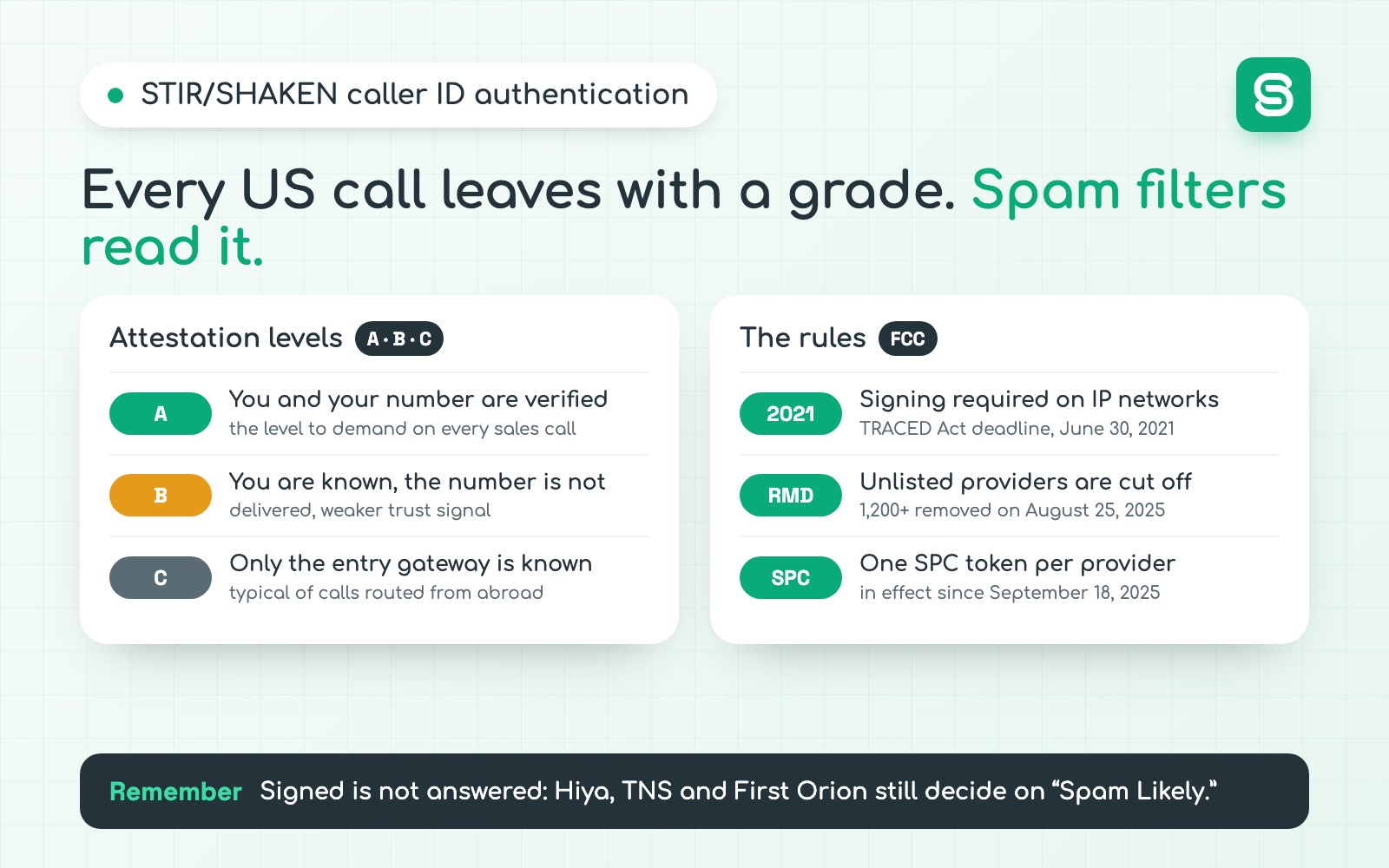
Every outbound call your team places in the US leaves with a grade. Your voice provider signs it A, B or C, the grade rides along with the call, and the carrier on the other end feeds it into the engine that decides whether your prospect sees your number, your name, or “Spam Likely.” That framework is STIR/SHAKEN. Most sales leaders have heard the acronym. Few know what their own calls are graded, or what the grade does and does not buy them.
What is STIR/SHAKEN?
STIR/SHAKEN is caller ID authentication for the US phone network. For decades, the network carried whatever number the caller declared, with no check. That is what made neighbor spoofing so cheap: a robocaller in another country could show a number from your area code, or your bank’s number, and the network would deliver it as is.
The name stacks two standards. STIR (Secure Telephone Identity Revisited) is the IETF working group that defined the protocols. SHAKEN (Signature-based Handling of Asserted information using toKENs) is the framework from ATIS and the SIP Forum, published as ATIS-1000074, that tells carriers how to apply those protocols with digital certificates.
The mechanics fit in one sentence. The provider that originates the call attaches an Identity header carrying a signed token (a PASSporT) that says what it knows about the caller and the number; the provider that terminates the call checks that signature against the public certificate. The FCC’s December 2020 report to Congress describes it the same way: public key cryptography, an Identity header, verification at the far end.
Three misconceptions are worth clearing before going further.
Why does the US require caller ID authentication?
Because spoofing had become the default tool of illegal robocalling, and blocking calls without knowing who really placed them was guesswork. Congress answered with the TRACED Act (Pub. L. 116-105), signed on December 30, 2019, which told the FCC to require STIR/SHAKEN on IP voice networks. The FCC set the deadline at June 30, 2021, then spent the next five years closing gaps: small providers, foreign gateways, providers that borrowed someone else’s signature, and providers that filed sloppy paperwork.
Four of those dates matter to a sales team.
June 30, 2021: the big carriers sign
The largest voice providers had to sign and verify calls on the IP parts of their networks. Small providers got more time: the FCC’s July 2026 notice recaps that their blanket exemption ended on June 30, 2022 for providers without their own facilities and on June 30, 2023 for the rest. Non-IP networks still have an ongoing extension, because STIR/SHAKEN only works over IP. A call that crosses an old TDM link can lose its signature on the way.
June 30, 2023: calls from abroad get a stamp
Gateway providers, the carriers where foreign traffic enters the US network, had to start signing unauthenticated calls that display US numbers. Those calls typically get C attestation. If your SDRs work from Lisbon, Manila or Bogotá and dial out through a platform that routes internationally, this is the level your calls may carry unless your provider originates them in the US.
September 18, 2025: no more borrowed signatures
For years, a provider without its own token could have another provider sign its calls under the other provider’s certificate. The FCC’s Eighth Report and Order, adopted in November 2024, ended that. Any provider that certifies full or partial STIR/SHAKEN implementation must register with the Policy Administrator, obtain its own SPC token, generate its own certificate and sign all its calls with it, directly or through a vendor. You will see “June 20, 2025” quoted in a lot of blog posts; according to the FCC’s public notice DA 26-72, those rules actually took effect on September 18, 2025.
August 25, 2025: 1,200 providers go dark
In a single action, the FCC’s Enforcement Bureau removed more than 1,200 providers from the Robocall Mitigation Database for failing to fix deficient filings, after removing 185 earlier that month. Removal means downstream carriers may no longer accept their traffic. If your dialer had been running on one of them, your calls would have stopped connecting overnight, with nothing in your dashboard but a wall of failed dials.
What do the attestation levels A, B and C mean?
The attestation level is the confidence grade the originating provider stamps on your call. It describes the provider’s knowledge, not your behavior: what it knows about you, and whether it has checked that the number you display is yours.
Which level you get depends on two questions your provider answers for you, in this order.
The table below maps common sales setups to the level they usually produce. “Usually” matters: each provider applies its own verification rules, so treat this as the question list, not the answer.
| Your setup | Typical level | What to do |
|---|---|---|
| Numbers your dialer or VoIP provider assigned to your account | A | Confirm it in writing and keep a list of numbers per rep |
| Your main line ported in to the provider that signs your calls | A once the port completes | Check the port finished before using it in campaigns |
| Numbers bought from carrier X, displayed through dialer Y | Often B | Ask Y what proof of ownership it accepts, or port the numbers |
| Reps abroad dialing US numbers through an international route | Often C | Make sure calls originate on a US provider that knows you |
| A number you do not own or control | Not a level: spoofing | Never. With intent to defraud or harm, it is illegal |
Is B or C illegal? No. A B-attested call is delivered like any other. But attestation is one of the inputs call analytics engines score on every call. Hiya, which labels calls for AT&T and for Samsung phones, lists STIR/SHAKEN attestation among the factors its engine checks on each call, alongside where the call originates, time and day, and whether the caller’s digits mimic the recipient’s. A B or C stamp is a handicap you carry into that scoring.
Two practical notes on getting A. First, A-level attestation follows the number and the account together: a number that is yours but sits on a different provider’s network than the one signing the call is the most common source of B. Second, local presence dialing, showing a number from the prospect’s area code, is compatible with A as long as each local number is genuinely assigned to you. Our guide to local presence dialing in B2B covers where that practice stops helping.
Who issues the certificates behind STIR/SHAKEN?
Trust in a signature is only as good as the chain behind the certificate. The FCC’s December 2020 report describes three layers.
Why should a sales leader care? Because the token is the provider’s license to sign. A provider that loses its token, or never had one, cannot sign anything at A. Since September 18, 2025, it also cannot borrow another provider’s signature. The question “do you sign with your own SPC token?” now separates real voice providers from resellers that depend on someone else’s compliance.
What is the Robocall Mitigation Database?
The Robocall Mitigation Database (RMD) is the FCC’s public registry of voice providers. It opened on April 20, 2021. At first, providers had to certify whether they had fully, partially or not implemented STIR/SHAKEN. The obligation has grown since: today every provider, including interconnected VoIP resellers, must file certifications, business identifying information, its provider type and a robocall mitigation plan, whether or not it has implemented STIR/SHAKEN. The FCC’s July 2026 notice counts more than 11,000 filings.
The database has teeth because of one rule: downstream providers may only accept calls from providers whose filings appear in it and have not been removed by an FCC enforcement action. Being delisted is being disconnected. The FCC keeps tightening the screws.
- 01
Annual recertification.
Since February 5, 2026, every filer must recertify by March 1 each year and update any change within 10 business days (FCC public notice DA 26-72). - 02
Higher fines.
The base forfeiture for false or inaccurate filings rose to $10,000 per violation, and failing to update a filing in time carries $1,000. A $100 filing fee is planned but was not yet in effect in January 2026. - 03
More to come.
On July 22, 2026, the FCC adopted a further notice (FCC 26-49) proposing stricter filing obligations and new ways to keep removed bad actors from coming back.
For you as a buyer, the check takes two minutes. The RMD listings are public: search your dialer or VoIP provider by name, then search the carrier it says signs your calls. If neither appears, or the listing shows no STIR/SHAKEN implementation, ask why before you load a single list.
Your caller ID is only as trustworthy as the provider that signs it, and that provider is only as reachable as its listing in the FCC’s database.
Does STIR/SHAKEN stop the Spam Likely label?
No, and this is the most expensive misunderstanding in outbound sales. STIR/SHAKEN tells the receiving carrier that you are who you say you are. It says nothing about whether people want your calls. That second judgment belongs to the carriers’ call analytics partners. As widely reported, Hiya labels for AT&T, First Orion for T-Mobile and TNS for Verizon, and each one scores every call on dozens of behavioral signals.
The data is blunt. In a July 2023 analysis, Hiya reported that 19% of A-attested calls from non-mobile lines were reported as unwanted by the people who received them, and that 89% of spam calls came from non-mobile lines. Authentication made it harder to fake a number. It did not make unwanted calls wanted.
That second job is caller ID reputation, and it is a discipline of its own: registering numbers, warming them up, spreading volume, watching answer rates number by number. Our guide to caller ID reputation covers the prevention side, and if a number is already flagged, our playbook for a business number marked spam walks through the diagnosis and the fix.
Where branded calling fits
Branded caller ID puts your business name, and sometimes a logo and a call reason, on the prospect’s screen. The industry standard, CTIA’s Branded Calling ID program, delivers that information through authenticated calls, which is why authentication comes first in any branding project. Branding is paid, carrier coverage is uneven, and it will not rescue a number with a bad reputation. Our branded caller ID providers comparison lays out the prices and network coverage of Hiya, First Orion, TNS and Numeracle.
What does STIR/SHAKEN change for an outbound sales team?
Authentication is not a carrier-only topic. It changes four decisions a sales leader makes.
Which numbers you use
Every number in your dialer should be assigned to your account by the provider that signs your calls, or ported to it. Keep a living inventory: number, owner, provider, use (cold outbound, inbound callbacks, customer follow-up), date activated. It is the first thing a provider asks for when attestation or labeling goes wrong. If you are still choosing between local and toll-free numbers, our local vs toll-free number tool helps you decide, and our business phone number requirements by country lists what each country asks for before it assigns a number.
How you set up remote and offshore reps
A rep in another country calling US prospects through a US-based provider that knows your account can be signed A. The same rep dialing through an international route can land at C. If you staff SDRs abroad, confirm where calls originate, not just where the rep sits.
How you read a sudden drop in connects
A provider that loses its listing, or its token, does not send you a warning. Your connect rate falls off a cliff across every number at once. A reputation problem looks different: it drags down one number at a time, more on one carrier than another. Before you blame the list or the opener, check which pattern you see. Our cold call connect rate benchmarks tell you what normal looks like.
How you stay legal
Authentication and telemarketing law are separate tracks. A perfectly signed call to a consumer on the National Do Not Call Registry is still a violation, and the TCPA’s rules on autodialers and consent apply regardless of attestation. Our guide to whether cold calling is legal covers the federal and state rules, the TCPA changes taking effect on November 25, 2026 explain what moved this month, and our cold calling compliance checker answers in a few questions whether a given call is allowed.
How can you tell if your calls are properly signed?
Your prospects do not see attestation and your dialer will not flag a signing problem. It logs “no answer.” So you read symptoms, then confirm with your provider in writing.
| What you see | Likely cause | What to check |
|---|---|---|
| Connects drop to near zero overnight, on every number and every carrier | Provider delisted, token lost, or routing broken | The provider and its upstream carrier in the public RMD listings |
| One number slides over two or three weeks, mostly on one carrier | Reputation label, not authentication | That number with Hiya, First Orion and TNS; see the reputation guide |
| Calls from offshore reps get flagged far more than calls from US reps | C attestation from an international route | Where those calls originate and which provider signs them |
| Newly added numbers underperform from day one | B attestation: numbers not tied to your account | Proof of ownership with the signing provider, or a port |
| Test calls show "Spam Likely" on one network only | That network's analytics partner has labeled the number | The mislabel channel for that carrier |
A fifteen-minute test settles most cases. Call three test phones from your dialer, one each on Verizon, AT&T and T-Mobile, from every active number. Note what each screen shows. Then ask your provider for the attestation level it applied to those exact calls, from its logs. Many providers can read it from their call detail records or SIP traces, and the terminating side of a test call can show the verification result too.
What questions should you ask your voice provider?
These answers are not on any pricing page. Ask before you sign, get them by email, and keep them. They apply to a dialer vendor as much as to a business VoIP carrier; if you are comparing those, our roundup of the best small business phone systems covers the other buying criteria.
- 01
What attestation level do my calls receive?
The answer you want is A for every number assigned to your account. Ask what happens to numbers you bring from elsewhere. - 02
Who signs my calls, and with whose SPC token?
Since September 18, 2025, a provider certifying compliance must sign with its own token. A vague “our carrier partner handles that” deserves a follow-up. - 03
What is the exact entity name in the Robocall Mitigation Database?
Then look it up yourself in the public listings, along with any upstream carrier it names. - 04
How do I prove ownership of numbers I bring?
Ask for the process and the timeline, and whether porting is the simpler route. - 05
Where do calls originate when my reps work abroad?
You want US origination by a provider that knows your account, not an international route that ends in C. - 06
Can you show me the attestation from your logs?
A provider that can pull it for a test call can help you when something breaks. - 07
Which number registration or branding programs do you support?
Some platforms register your numbers with the analytics engines for you; others leave it to you. - 08
What do you do when one of my numbers is mislabeled?
The answer tells you whether you will be filing remediation requests alone.
Here is an email you can send as is:
Hi, before we start our outbound campaigns, could you confirm in writing: (1) the STIR/SHAKEN attestation level our calls receive, number by number, including any numbers we port in or bring from another carrier; (2) the entity that signs our calls and whether it uses its own SPC token; (3) the exact name under which that entity, and any upstream carrier, is listed in the FCC Robocall Mitigation Database; (4) where our calls originate when reps dial from outside the US. Thanks in advance.
What STIR/SHAKEN mistakes should you avoid?
These come up again and again with teams that discover the topic after their numbers stop connecting.
Spoofing is also a fraud vector against your own company. If customers report calls “from you” that you never made, treat it as a security incident; our guide to VoIP security and toll fraud covers what to lock down.
If you also call France or Europe
STIR/SHAKEN is a US system, but the idea has traveled, and France went further. Its version, the MAN (mécanisme d’authentification des numéros), runs on the same technology with a much harsher consequence: an unauthenticated call is not flagged, it is cut. Here is what a US team dialing into France needs to know.
| Point | United States | France |
|---|---|---|
| Unauthenticated call | Delivered, scored with more suspicion | Cut if it shows a French landline (since Oct. 1, 2024) |
| Level required | None by law; A recommended | Only A meets the legal requirement, per the regulator Arcep |
| Numbers for dialers | No dedicated range | Automated dialers must show a "verified multi-use number" (NPV), since Jan. 1, 2023 |
| Mobile numbers | Usable if assigned to you | French mobiles (06, 07) cannot be used by dialers or delegated |
| From abroad | Gateway signs, usually C | French mobile number not authenticated: shown as "No caller ID" since Jan. 1, 2026 |
Source: Arcep’s guidance for operators on number authentication, updated March 27, 2026, and its December 2, 2025 decision.
The practical rule: if you call French prospects with a power or parallel dialer, you need a French NPV number signed at level A by a French carrier connected to the MAN, not a US number and not a rep’s French mobile. Spoofed-number reports to Arcep went from 531 in 2023 to over 19,000 in 2025, according to its January 29, 2026 release, so enforcement is only getting stricter. If Europe is part of your territory, our guide to European parallel dialers compares the tools built for those rules, and our cold calling laws by country table covers consent rules market by market.
Where Skipcall fits, and where it doesn’t

In the spirit of the questions above, here is what we do. Skipcall gives your team phone numbers in 160 countries, lets you assign them to reps and choose the caller ID for each sequence, and runs a power dialer and a parallel dialer on top. In France, the automatic dialing modes display a verified multi-use number, the range Arcep reserves for automated calls.
Skipcall does not monitor the reputation of your numbers, does not alert you when a number gets labeled and does not rotate numbers automatically. For that side of the job, the free and paid tools, and the calling habits that keep numbers clean, are in our guide to caller ID reputation.
What to remember
- STIR/SHAKEN is caller ID authentication for the US network: the originating provider signs each call, the terminating provider verifies it. It has been mandatory for voice providers on IP networks since June 30, 2021.
- Attestation A, B or C reflects what your provider knows about you and your number. Get A by using numbers the signing provider assigned to you or verified as yours, and get it confirmed in writing.
- Since September 18, 2025, providers certifying compliance sign with their own SPC token, and only providers listed in the Robocall Mitigation Database may hand off traffic. Check your provider’s listing yourself.
- Authentication is not reputation. A-signed calls still get labeled “Spam Likely” when the calling behavior looks like spam. Reputation and branding are separate jobs.
- France is stricter: unauthenticated calls showing a French landline are cut, and dialers must use verified multi-use numbers.
Sources
- FCC, report to Congress on caller ID authentication implementation progress, December 29, 2020.
- FCC, public notice DA 26-72, January 22, 2026 (RMD recertification, forfeitures, own SPC token rule effective September 18, 2025).
- FCC, news release of August 25, 2025 (more than 1,200 providers removed from the RMD).
- FCC, further notice of proposed rulemaking FCC 26-49, adopted July 22, 2026 (RMD history, exemptions, proposals).
- FCC, Robocall Mitigation Database public listings.
- Hiya, “Successes and shortcomings of STIR/SHAKEN”, July 12, 2023, and how Hiya’s Adaptive AI stops phone spam.
- CTIA, Branded Calling ID.
- Arcep, guidance for operators on number authentication, updated March 27, 2026; releases of December 2, 2025 and January 29, 2026.




