You bought a list of 5,000 contacts, or exported one from your CRM, and the team starts dialing Monday. Somewhere in that file are people who registered their number years ago, people who told one of your reps last spring to never call again, and cell phones that belong to a person more than to a company. DNC scrubbing is how you find them before your reps do. It takes an afternoon to set up, a few minutes a month to run, and it’s the cheapest insurance an outbound team can buy.
What is DNC scrubbing?
DNC scrubbing is the routine of comparing every phone number you plan to call against the lists of people who don’t want telemarketing calls, then removing the matches. The word comes from the call center world, where “scrubbing a list” means cleaning it before it’s loaded into a dialer.
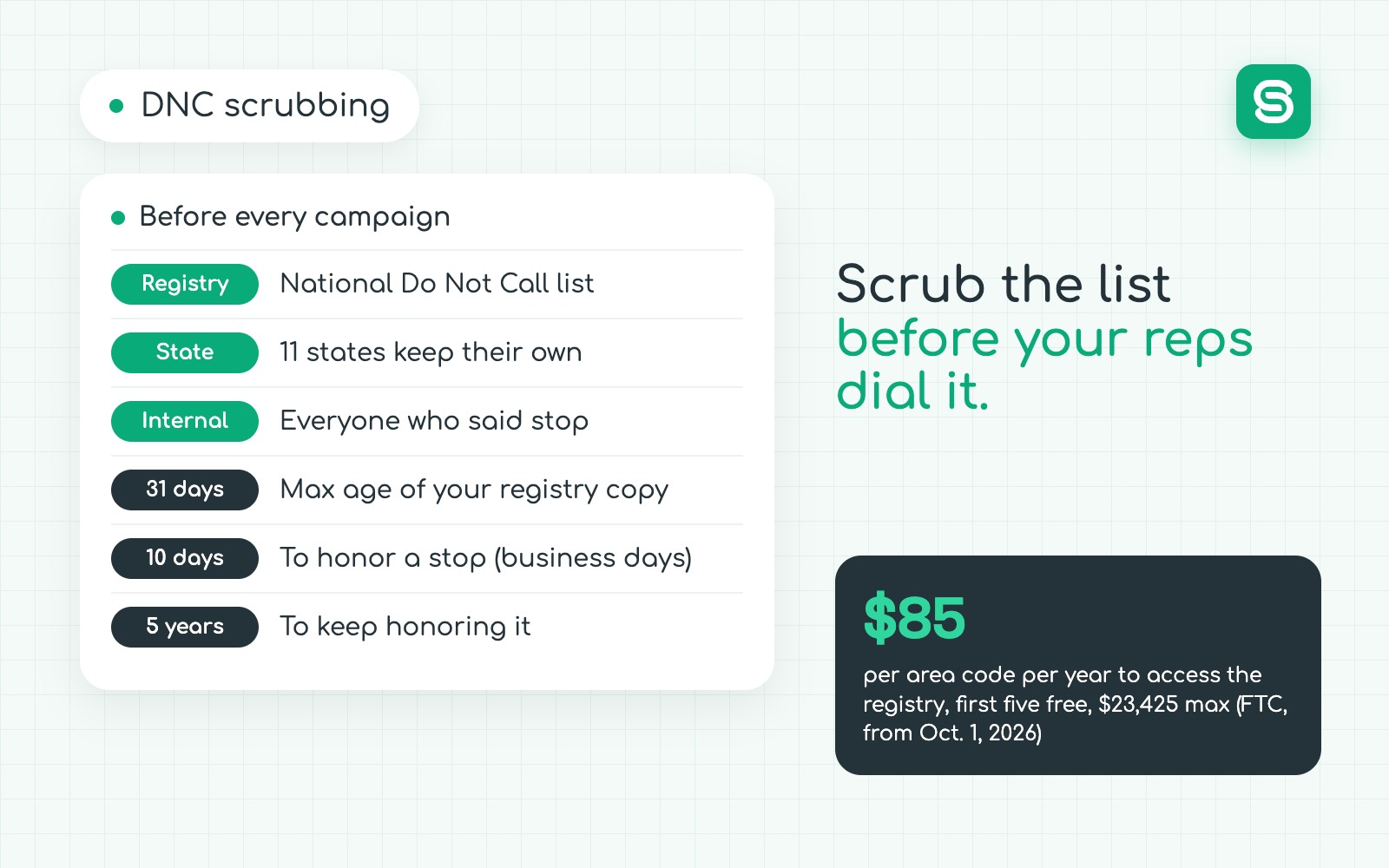
It matters because the lists are huge and they move. The FTC’s Data Book for fiscal year 2025 counts 258,515,050 active registrations on September 30, 2025, and the FTC received more than 2.6 million do-not-call complaints that year. Registrations never expire: a number leaves the registry only if it’s disconnected and reassigned, or if its owner asks. Any list of US phone numbers you didn’t build yourself last week contains registered numbers.
The three lists a complete scrub covers
The National Do Not Call Registry
Run by the FTC, enforced by the FTC, the FCC and state attorneys general. Consumers register their home or cell numbers there for free, according to the FTC’s consumer FAQ. The registry rules protect residential subscribers, and the FTC’s rule exempts most business-to-business calls (details below).
State do-not-call lists
Most states rely on the national registry, but about a dozen keep their own list, with their own access fees, update schedules and exemptions.
Your internal do-not-call list
Every person who told your company to stop calling. This list is yours to build and maintain, and it’s the one most often violated, because the person who heard the request isn’t the one who calls next.
How does the National Do Not Call Registry work for businesses?
Companies don’t search the registry one number at a time. They subscribe to it at telemarketing.donotcall.gov, pick the area codes they call, and download the registered numbers for those area codes.
Who has to register, and what a SAN is
The FTC’s compliance guide to the Telemarketing Sales Rule separates two roles. The seller is the company whose product is being sold. The telemarketer is whoever makes the calls, in-house reps or an outsourced agency. The seller pays for access and receives a Subscription Account Number (SAN), a unique ID tied to its subscription.
| Situation | What the FTC says |
|---|---|
| Your own SDRs call for you | Your company is the seller: it registers, pays and gets the SAN |
| An agency calls on your behalf | The agency uses your SAN at no extra cost, after confirming you have paid |
| The agency wants its own access | It pays a separate fee, and it may not split that cost among its clients or pass the data to another telemarketer |
| You change agencies mid-year | The new agency can use your SAN too; no second fee for your access |
| Your subscription period | Access lasts 12 months from the first day of the month you paid; renew before it ends, or your agencies lose access too |
If you outsource calling, ask the agency for the SAN it scrubs with and check it’s yours. An agency scrubbing with its own subscription for a different client doesn’t cover your campaign. Our guide to cold calling agencies lists the other questions to ask before signing.
What it costs: FY 2027 fees
The FTC updates the fees every year. For fiscal year 2027, which started on October 1, 2026, its final rule published in the Federal Register on August 26, 2026 sets the fees now written in 16 CFR 310.8:
The first five area codes are free, and callers that may use the registry without being required to, such as charities and political organizations, can access it without paying. The rule also bans any arrangement to share the cost of access, including an agency dividing one subscription among several clients. A team that calls a handful of metro areas often pays nothing; a team calling nationwide hits the cap. Run your own numbers below.
What will your registry subscription cost?
Paid area codes20
Annual fee (FY 2027)$1,700
First five area codes free, $85 each after that, $43 for an area code added in the second six months, $23,425 maximum for every area code nationwide. FTC fees in effect since October 1, 2026.
The 31-day rule
The federal safe harbor (more on it below) requires that your calls use a version of the registry obtained no more than 31 days before the call: that’s in the TSR at 16 CFR 310.4(b)(3), and in the FCC’s rules at 47 CFR 64.1200(c)(2)(i)(D). Two consequences that teams miss:
What are state do-not-call lists?
Most states use the national registry, but some keep their own list, and a number can be on a state list without being on the federal one. Compliance firm CompliancePoint counted 11 states with their own list in a March 2020 article: Colorado, Florida, Indiana, Louisiana, Massachusetts, Missouri, Oklahoma, Pennsylvania, Tennessee, Texas and Wyoming. State lists change, so confirm the current list with each state before you rely on it.
Each state sets its own terms: who must subscribe, what it costs, how often the list is published, and which calls are exempt. Texas, for example, lets telephone solicitors subscribe at texasnocall.com and download newly registered numbers every quarter for a fee, according to the Public Utility Commission of Texas. Check each state’s official page before you rely on a summary, including this one.
Why you need an internal do-not-call list
The registry tells you who never wants telemarketing calls. Your internal list tells you who doesn’t want your calls. It’s the list most likely to get you sued, because every entry is someone who already told you no.
The FCC’s rule at 47 CFR 64.1200(d) sets the minimum procedures for anyone making telemarketing calls to residential subscribers: a written policy, trained staff, a record of every do-not-call request, compliance within a reasonable time not exceeding 10 business days, and the request honored for five years. B2B teams calling cell phones are rarely sure which numbers count as residential, so the practical answer is the same for everyone: run an internal list and apply it everywhere.
How to run an internal list that actually works
- 01
Train reps on the words.
”Take me off your list,” “don’t call me again,” “stop calling”: any clear request counts, even phrased casually. Reps don’t negotiate it. - 02
Use a dedicated disposition.
One call outcome, “Do not call,” that every rep logs the moment the request is made. Our guide to call disposition codes shows how to set it apart from “not interested.” - 03
Store the list in one place.
The CRM, not a spreadsheet on someone’s laptop. Record the number, the date, who took the request and on which campaign. - 04
Apply it to every source.
Every list you import, every sequence, every tool that dials or texts checks the internal list first. Treat a stop request as covering every channel, not just the one where it was made. - 05
Never purge it.
Keep entries at least five years. A new list bought next year will contain the same people.
Does DNC apply to B2B calls?
Mostly not, but “mostly” is where B2B teams get into trouble. Here’s what the federal rules say, and where they stop.
What the B2B exemption covers
The FTC’s Telemarketing Sales Rule exempts calls between a telemarketer and a business to induce the purchase of goods or services (16 CFR 310.6(b)(7)), so its registry ban doesn’t reach them. The exemption has two written limits: it doesn’t apply to calls for the retail sale of nondurable office or cleaning supplies, and since 2024 it doesn’t cover the TSR’s ban on misrepresentations. On the FCC side, the registry rule protects a “residential telephone subscriber” (47 CFR 64.1200(c)(2)).
Where the exemption stops
- Calls to a company’s main line or switchboard.
- Calls to a direct business landline at the prospect’s office.
- Calls to a number published as a business contact by the company.
- Calls selling nondurable office or cleaning supplies, which the TSR explicitly excludes from the B2B exemption.
- Calls to a business line that ask an employee to buy something for their own use: the FTC’s compliance guide says these are not business-to-business calls.
- Personal cell phones, even when the person uses them for work.
- Sole proprietors and home-based businesses using a personal line.
- Calls covered by a state law with a narrower or no B2B exemption.
Two more points. Since the FTC’s 2024 amendments, B2B calls are covered by the TSR’s ban on misrepresentations (FTC announcement): being exempt from the registry doesn’t exempt you from honesty. And the B2B question only decides whether the registry applies; it says nothing about your internal list, which you honor regardless.
The B2B exemption follows the line, not your intent. A cell phone that belongs to a person is a personal number, whatever title sits next to it in your CRM.
Cell phones: the gray zone of every B2B list
Personal cell phones can be registered for free, and the FCC applies its do-not-call rules to wireless numbers (47 CFR 64.1200(e)). Modern B2B lists, and especially lists built with phone number enrichment, contain a high share of mobile numbers, because that’s where people answer. Many of those mobiles are personal phones the prospect also uses for work.
The prudent rule, followed by most compliance-minded teams: scrub every mobile number against the registry and the state lists, and treat a registered mobile as off-limits for cold calls unless you have consent. Our guide to cold calling cell phones covers the TCPA side (prerecorded messages, consent, and the auto dialer question), and direct dial vs. mobile vs. switchboard explains how to tell the line types apart.
How to scrub a list against the DNC registry, step by step
Here’s the full procedure for a team scrubbing in-house. If you use a scrubbing vendor, the steps are the same; the vendor runs steps 4 to 6 for you, using your SAN.
Register and get your SAN
Create your organization’s profile at telemarketing.donotcall.gov, pay for the area codes beyond the five free ones, and note your SAN. Give it to any agency that calls for you.
Clean and normalize your list
Put every number in the same 10-digit format, without +1, spaces, dashes or extensions, and drop duplicates and invalid numbers. A number written two ways won’t match the registry. Our free CSV cleaner normalizes a whole file in the browser, and the phone number validator checks individual numbers.
List the area codes you need
Extract the area codes present in your list and check they’re all in your subscription. A number in an area code you haven’t paid for can’t be checked.
Download a fresh registry copy
Download the full list for your area codes, or the changes since your last download. Note the download date: it starts your 31-day clock.
Match and remove
Remove every number that appears on the registry, on the state lists you subscribe to, and on your internal list, except numbers where you hold written consent or an established business relationship you can document.
Log the scrub
Save the date of the registry copy, the lists applied, the number of records in and out, and who ran it. That record is your defense.
Load, call, repeat
Load only the scrubbed file into your dialer. Set a calendar reminder to rescrub every list you’re still calling before the registry copy turns 31 days old.
Two exceptions to know before step 5. An established business relationship lets a seller call a registered number for 18 months after the customer’s last purchase or transaction, and for three months after an inquiry or application, under the FCC’s definition (47 CFR 64.1200(f)(5)); the TSR counts the same windows in days, 540 and 90. A do-not-call request ends the relationship for calling purposes, even if the person stays a customer. Written consent works too: under the TSR, a signed written agreement that clearly authorizes calls from your company and includes the number to call. Both must be documented, and neither survives a stop request.
Templates to copy
Scrub log and internal do-not-call policy
Templates written for this article. General information, not legal advice; have counsel review before use.
SCRUB LOG (one line per list, keep 5 years)
Date of scrub: [YYYY-MM-DD]
List name and source: [e.g. Q1 IT directors, CRM export]
Records in: [n]
Registry copy downloaded on: [YYYY-MM-DD] (must be 31 days old or less on every call date)
Entity that accessed the registry: [company or agency]
Area codes covered: [list] / SAN: [number]
Telemarketing campaign: [name]
State lists applied: [states, version dates]
Internal DNC list applied: [yes, version date]
Removed: registry [n], state [n], internal [n], invalid [n]
Records out: [n]
Run by: [name]

INTERNAL DO-NOT-CALL POLICY
1. Any request to stop calling, in any words, is recorded the same day with the "Do not call" disposition.
2. The request covers the number for every rep, campaign, agency and channel (calls and texts), and takes effect within 10 business days at the latest. Our target: within 24 hours.
3. Requests are kept at least 5 years and never purged.
4. Every list is scrubbed against the national registry (copy 31 days old or less), the applicable state lists and this internal list before any call.
5. Reps receive this policy and training at onboarding and every year.
6. Compliance owner: [name]. Spot-checks: [monthly].
The federal safe harbor: what protects you if a call slips through
Mistakes happen: a number typed wrong, a list loaded before the scrub. The TSR and the FCC rules both include a safe harbor: if a call to a registered number was an error, you aren’t liable when you can show you’d put the right process in place. Under the FTC’s rule (16 CFR 310.4(b)(3)), that process includes:
The scrub log in the template above is what turns your process into evidence. The rule itself says what that record must show (16 CFR 310.5(a)(11)): which version of the registry was used, with the name of the entity that accessed it, the date accessed, the subscription account number and the telemarketing campaign. The same section requires a record of every do-not-call request: the person’s name, the number, the seller, the telemarketer that called, the date of the request and what was being sold. Since the April 2024 TSR amendments, telemarketing records must be kept for five years instead of two, so keep the logs at least that long.
What it costs when you get it wrong
| Exposure | Amount | Source |
|---|---|---|
| FTC civil penalty | Up to $53,088 per violation (2025 level, kept for 2026) | Telemarketing Sales Rule, FTC Act 5(m)(1)(A) |
| Private lawsuit more than one call in 12 months that breaks the do-not-call rules | Up to $500 per violation, tripled to $1,500 at the court's discretion if willful or knowing | TCPA, 47 U.S.C. 227(c)(5) |
| State actions | Set by each state, often per call | State telemarketing laws |
The private right of action is what makes this expensive for B2B teams: plaintiffs’ firms recruit people who received two calls in a year, and class actions multiply $500 by every call in the campaign. The TCPA gives an affirmative defense to companies that show they had “established and implemented, with due care, reasonable practices and procedures” to prevent such calls, which brings you back to the scrub log.
How much does DNC scrubbing cost?
There are three ways to do it, and the right one depends on your volume.
| Approach | What you pay | Fits |
|---|---|---|
| In-house, registry download | FTC fees only ($0 for 5 area codes, up to $23,425 nationwide), plus someone's time each month | Teams calling a few regions with someone comfortable with spreadsheets or scripts |
| Scrubbing vendor | Your FTC subscription plus the vendor's fee, usually per record or per month | Teams calling nationwide or needing state lists and litigator lists managed for them |
| Scrubbing built into your dialer or CRM | Included or an add-on, depending on the tool | Teams that want the check at the moment of dialing |
Whichever you choose, the FTC subscription is yours: a vendor scrubs against the registry with your SAN, and the legal responsibility stays with the seller.
Small team, few regions: download the registry for your free five area codes and scrub in a spreadsheet or with a short script. It takes 20 minutes a month.
Nationwide or high volume: a scrubbing vendor costs more than the FTC fee but handles state lists, update schedules and the logs. Compare its price with the time your team spends.
Where Skipcall fits

Skipcall doesn’t scrub lists against the Do Not Call Registry or state lists. It’s the phone system you load the clean list into: import the scrubbed CSV, then call with a power dialer or a parallel dialer on four lines, with every call logged and recorded (our guide to call recording software explains what that should include). Run the scrub upstream, with your SAN or your vendor, before the import.
Beyond DNC: the other checks before you dial
A DNC scrub tells you who you may not call. It doesn’t tell you whether the number still belongs to the person you think, whether your calls will even get through, or whether calling the same numbers too often is burning your prospect list.
- 01
Reassigned numbers.
Numbers get disconnected and handed to someone else all the time. The FCC’s Reassigned Numbers Database tells you whether a number was permanently disconnected after a date you give, and querying it gives callers relying on consent a safe harbor for calls to reassigned numbers. Our guide on whether a phone number is still active shows the other checks. - 02
Calling hours.
Federal rules allow telemarketing calls between 8 AM and 9 PM in the called person’s local time; some states are stricter. The when to call tool finds the window across time zones. - 03
Texts.
Texting a cell phone brings its own rules (consent, 10DLC registration, opt-out keywords). Our guide to A2P 10DLC and cold texting covers them, and the TCPA changes of November 2026 update the opt-out rules. - 04
Caller ID.
Calling from numbers that carriers flag as spam kills your answer rate whatever your compliance. See caller ID reputation.
If you buy your lists, the scrub starts with the seller: our guide to B2B lead lists for cold calling covers what to ask a data vendor about sources and consent.
The most common mistakes
Key takeaways
This article is general information about US federal rules as of November 2026, not legal advice. State laws vary; consult a telemarketing attorney for your situation.
Sources
- Federal Register: Telemarketing Sales Rule Fees, final rule effective October 1, 2026 (August 26, 2026)
- 16 CFR 310.8, Fee for access to the National Do Not Call Registry (Cornell LII)
- 16 CFR 310.5, Recordkeeping requirements (Cornell LII)
- Federal Register: FTC Civil Penalty Inflation Adjustments (September 15, 2026)
- Florida Statutes, section 501.616
- Oklahoma HB 3168 (2022), Telephone Solicitation Act, enrolled text
- FTC: Complying with the Telemarketing Sales Rule
- FTC: Q&A for Telemarketers and Sellers About DNC Provisions in the TSR
- FTC: National Do Not Call Registry Data Book, fiscal year 2025
- FTC Consumer Advice: National Do Not Call Registry FAQs
- FTC: new protections for businesses against telemarketing fraud (March 2024)
- 16 CFR 310.4, Abusive telemarketing acts or practices (Cornell LII)
- 16 CFR 310.6, Exemptions (Cornell LII)
- Federal Register: Telemarketing Sales Rule final rule (April 16, 2024)
- 47 CFR 64.1200, Delivery restrictions (Cornell LII)
- 47 U.S.C. 227, Restrictions on use of telephone equipment (Cornell LII)
- National Do Not Call Registry for telemarketers
- Public Utility Commission of Texas: Texas No-Call list FAQ
- CompliancePoint: State Do-Not-Call Lists
- FCC: Reassigned Numbers Database




