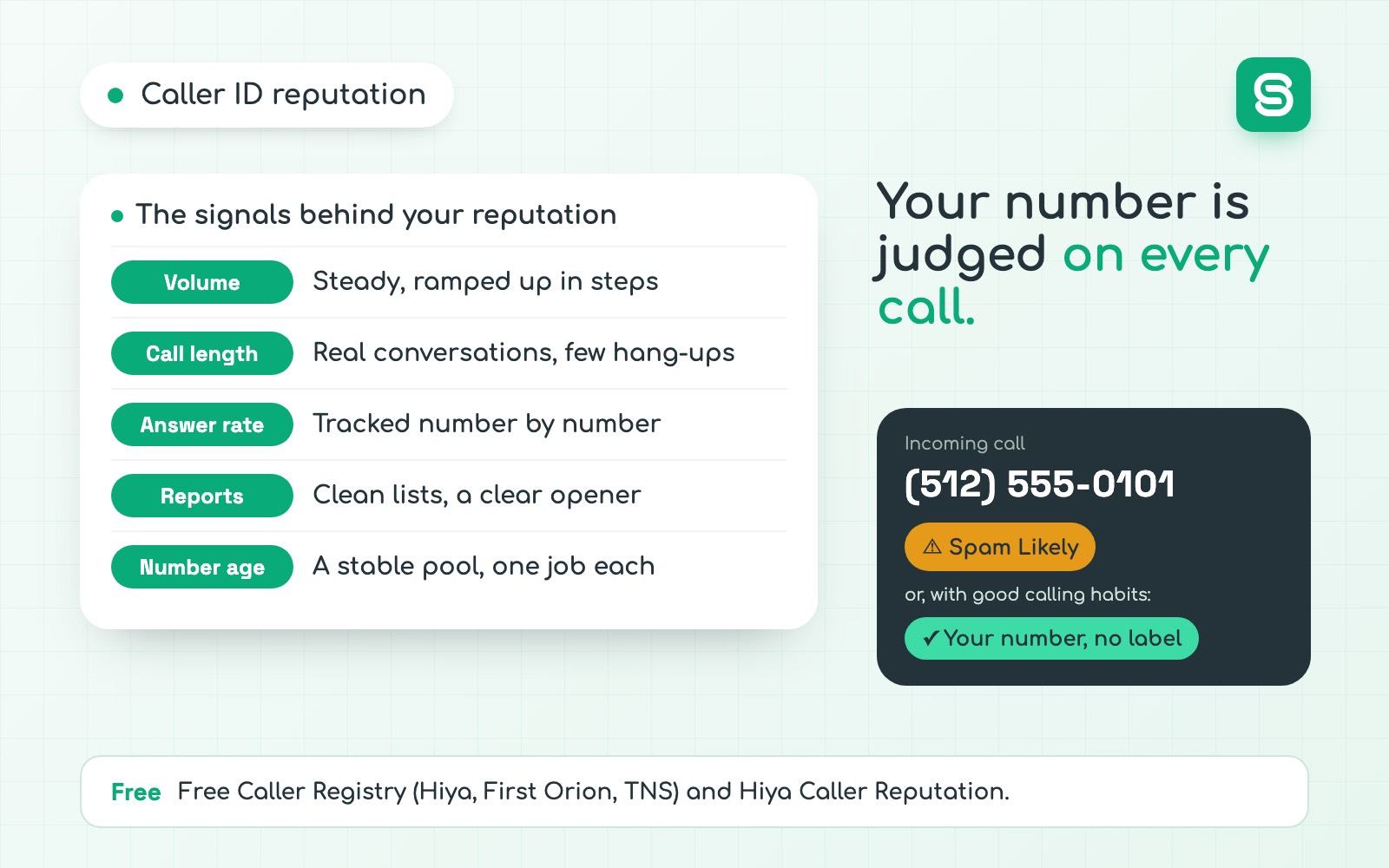
Caller ID reputation is built on every call you make, long before anyone reports you. By the time “Spam Likely” shows up on a prospect’s screen, the damage is weeks old: a run of calls sent the wrong signals and the number is paying for it. Most articles on the topic start there, with the fix. This one starts earlier. It is about keeping a number clean from the day you get it, so you never need the fix.
What is caller ID reputation?
Caller ID reputation, also called phone number reputation, is the judgment the systems that screen calls have formed about your number. It decides what your prospect sees when you call: your number alone, your verified business name, “Spam Likely” or “Scam Likely,” or nothing at all because the call was sent to voicemail or blocked.
Three things set it apart from related ideas.
The stakes are simple. According to Hiya’s State of the Call 2026 report, 86% of unidentified calls go unanswered. A number labeled spam does worse than an unknown one: it gives the prospect a reason to decline, and sometimes the phone never rings.
Who decides your caller ID reputation in the US?
Four groups read your calls. They do not all share data, which is why one number can carry several reputations at once.
Carrier analytics partners
US carriers mostly outsource spam labeling. As widely reported, AT&T’s ActiveArmor relies on Hiya, T-Mobile’s Scam Shield on First Orion and Verizon’s Call Filter on TNS. Those three engines also run the Free Caller Registry together, the free registration point for business numbers. Their labels vary (“Spam Likely,” “Scam Likely,” “Potential Spam,” “Telemarketer”), but they all come from the same kind of scoring.
Phone makers
Samsung’s Smart Call uses Hiya on Galaxy phones, whatever the carrier, and Google’s Phone app has its own spam detection on Pixel and many Android devices. Apple does not label calls itself, but since iOS 26 the iPhone can screen unknown callers before ringing by asking for their name and the reason for the call. That is not a reputation verdict, yet the effect is close: a call that cannot explain itself does not ring. Our guide to cold calling iPhone users covers what to say.
Caller ID apps
Truecaller, the Hiya app, RoboKiller and Nomorobo rely heavily on what their users report. A number with a handful of fresh reports can be flagged in these apps even when the carrier engines still see it as clean.
Your prospects
Every prospect who blocks you, reports you, or saves you as a contact feeds the other three. It is the only source of reputation you influence directly, one call at a time.
How is phone number reputation built?
No engine publishes how it weights its signals, on purpose: a public formula would be gamed within a week. The list of signals is known, though. Hiya’s documentation, published by Infobip, cites call frequency, high hang-up rates, short call durations and direct user reports, and stresses that labeling is dynamic: each call is assessed against the number’s history and its behavior in real time.
Here are the eight signals that matter, and what each one says about you.
Hiya’s report card: four grades, not one score
Hiya is the only engine that shows businesses part of its reasoning. Its free Caller Reputation dashboard gives each registered number a spam status and a report card on four factors. Hiya’s own dashboard names them Maturity, Connection, Engagement and Sentiment, each graded A to D. (Infobip’s documentation of the same report uses slightly different labels: Desirability and Reaction.) Each grade points at a behavior: a poor Maturity grade means the number is too new or you change numbers too often; a poor Sentiment grade means your calls trigger blocks and reports. The behavior grades stay empty on a freshly registered number until it has calling history.
The same documentation gives useful timings. The report card needs at least four hours of calling after registration to fill in. A redress review generally completes within two to four hours. Labels are based on at least the past week of calls, so a number that behaves well again drifts back toward “not labeled” in about a week. A reviewed number usually cannot be resubmitted for 60 days.
Why do honest numbers get flagged?
Good calling habits are not always enough, because part of a number’s reputation is decided outside your own calls. Four causes come up again and again, and each can be headed off before it hurts.
| Cause | What happens | How to prevent it |
|---|---|---|
| Your number gets spoofed | Scammers display your number; victims report it; your real calls inherit the reports | Ask your provider to investigate, file mislabel requests with each engine, warn your customers |
| A recycled number | The number you were assigned used to belong to a call center | Look it up and test it before the first call; ask for another if it carries reports |
| Inheritance across numbers | At Hiya, a new number takes on the company's reputation until it has its own | Look after the whole pool, not just today's number |
| The answer-rate death spiral | A label cuts answers; more unanswered calls deepen the label | Slow a number at the first dip, before any label appears |
Spoofing deserves a closer look because it is the least fair cause. In an August 7, 2026 post, TNS walks through the mechanics: fraudsters hijack a trusted number, recipients believe the call is genuine, realize it was a scam and report it. The analytics engines then label the number, though the business did nothing wrong, and its legitimate calls from the same number arrive marked as spam. STIR/SHAKEN makes this harder on US routes, since a spoofed call cannot get A-level attestation, but it has not ended it. If customers tell you they got calls “from you” that you never placed, treat it as an incident: document the reports, alert your provider and file mislabel requests on each network.
How do you register your numbers with AT&T, Verizon and T-Mobile?
Here is the part most guides get wrong: AT&T, Verizon and T-Mobile do not run their own business registration forms. Registration happens with the analytics engines that label for them, and the simplest route reaches all three at once.
- 01
Submit your numbers to the Free Caller Registry.
One form, run by First Orion, Hiya and TNS. You give your business name, address, website and contact, your call purpose and monthly outbound volume, then up to 20 numbers by hand or a file for more. US 10-digit numbers only. You get an acknowledgment from each engine. - 02
Register with Hiya to see its verdict.
Hiya Number Registration is free and unlocks the Caller Reputation dashboard with each number’s status and report card. It is the only free window into an engine’s view. - 03
Use your provider's program if it has one.
If your calls run on a programmable voice platform, check whether it registers numbers for you. Twilio announced on October 16, 2026 that Voice Integrity now covers Verizon as well as AT&T and T-Mobile. - 04
Know each carrier's mislabel channel before you need it.
AT&T’s review link (att.com/reviewmycalllabel) leads to Hiya’s request form; Verizon runs a voice spam feedback form at voicespamfeedback.com; T-Mobile mislabels go through its call reporting page, per First Orion.
Read the fine print once, then remember it. The Free Caller Registry says registration “does not guarantee redress” and “is not to be used as a replacement for caller reputation monitoring services.” Verizon’s form warns that a submission “may not result in a change to how future calls are labeled.” Registration tells the engines a real, identified business stands behind the number. Your calls still get scored, every one of them.
What Hiya actually sees in the US
Hiya is the most transparent engine, which makes it tempting to treat its dashboard as the whole picture. It is not. Its own documentation gives two US figures, 95% for registration and 35% for reputation accuracy, and outside the US its reach varies a lot by country.
The practical read: a clean Hiya status tells you what AT&T and Samsung users see. It does not tell you what T-Mobile or Verizon subscribers see. That is why test calls on all three networks stay part of the routine, and why teams that also prospect in Europe need to know which engines their markets actually use.
How do you check if your number is flagged as spam?
Prevention needs a light, regular check, not a forensic audit. Two families of tools cover it: those that show how the engines see your number, and your own call data. Our playbook for a business number marked spam goes deeper on reading results once something is wrong; this is the weekly version.
Hiya Caller Reputation
- What you see
- Spam status and a four-grade report card, number by number
- Covers
- Networks and phones that use Hiya labeling, including AT&T and Samsung Smart Call
- Price
- Free with Hiya Number Registration
Free Caller Registry
- What you see
- Nothing: it is a registration, not a dashboard
- Covers
- First Orion, Hiya and TNS; 10-digit US numbers only
- Price
- Free; up to 20 numbers by hand, or a file for more
Test calls on three networks
- What you see
- Exactly what a Verizon, AT&T or T-Mobile subscriber sees
- Covers
- The three national networks, one phone each
- Price
- Three prepaid lines
Truecaller
- What you see
- A number's name, report count and user comments
- Covers
- Truecaller app users
- Price
- Free lookup; Verified Business Caller ID on quote
CallerAPI
- What you see
- Reputation, spam score and complaint history for a number
- Covers
- CallerAPI's anti-fraud network
- Price
- Free one-off test; API from $25/month for 5,000 lookups
Your dialer's call data
- What you see
- Answer rate, call length and volume, filtered by number and week
- Covers
- All your calls, whatever the prospect's phone
- Price
- Included in your subscription
Prices and terms checked on November 18, 2026 on the official pages of Hiya, the Free Caller Registry and CallerAPI. Truecaller does not publish business pricing.
How many calls per day can one number make?
Everyone asks, and the honest answer is that no carrier or analytics vendor publishes a limit. The figures that circulate, often 100 or 200 a day, are field rules of thumb. They are fine as an order of magnitude and useless as a guarantee, because the engines do not just count calls. They look at what happens on them.
Two numbers making the same number of calls can end up with opposite reputations. The one whose prospects pick up and talk will hold. The one whose prospects hang up will fall.
The method that works is to find each number’s ceiling yourself.
- 01
Start every new number at a cautious volume.
Our phone number rotation calculator uses 50 dials per number per day as its cautious default, and says plainly that no carrier publishes a threshold. - 02
Raise it one step a week.
As long as the number’s answer rate holds and its status stays clean, move up a step. - 03
Stop at the first dip.
If one number’s answer rate drops while your other numbers on the same lists hold, you have found its ceiling. Step back down. - 04
Spread total volume over a stable pool.
Your daily dials divided by the observed ceiling gives the number of numbers you need. Keep them for the long run.
What calling habits keep a number off spam lists?
Here are the twelve habits that protect a number, ordered from setup to the call itself. None of them games the filters. They send the signals of a serious sales team, because that is what you are.
Before the first call
Display only numbers assigned to you
It is the baseline. Every number in your dialer should be assigned to your account, or ported to the provider that signs your calls, so it can get A-level attestation. A number you do not own is spoofing, and the engines specifically hunt for it. Our STIR/SHAKEN guide explains what your provider needs to sign you at A.
Check that a new number is clean
Numbers get recycled. The one you were just assigned may have spent last year with a call center. Before the first dial, look it up in Truecaller and run a one-off reputation test. If it carries reports, ask your provider for another.
Register it
Free Caller Registry, then Hiya, before the first call. Registration guarantees nothing, but it tells the engines an identified business stands behind the number, and Hiya’s dashboard gives you the status and report card from day one.
Make the number callable
A prospect who calls back and hits endless ringing, or a generic carrier greeting, has every reason to report you. Make sure callbacks reach a person or a voicemail that names your company. Our voicemail script generator writes a short, clear greeting.
During ramp-up
Warm up new numbers in steps
A new number has no history, so the engines judge it on its first days. Hiya’s documentation says it plainly: increase daily volume gradually over a few weeks and avoid launching a high-volume campaign from a freshly assigned number. Here is what a careful ramp looks like on an example.
The figures are starting steps, not limits. A team calling hot inbound leads can climb faster; a team dialing a cold, purchased list should stay lower. What matters is the rule for moving up: one step only if the number’s answer rate and status held steady the week before.
Start with your best lists
A number’s first calls shape its reputation. Spend them on your best-qualified contacts, the ones most likely to pick up and talk: inbound lead callbacks, target accounts, recent conversations. A new number that opens on a fresh inbound queue builds its standing fast; our guide to speed to lead explains why those callbacks should go out in minutes anyway.
On every call
Give each number one job
Do not mix cold outbound and customer follow-up on the same number. If prospecting drags the number down, your customers stop picking up too. Separate uses, and keep your most valuable numbers away from your riskiest campaigns.
Call clean, current lists
Wrong numbers, people who left the company and off-target contacts produce short calls and declines. Check numbers before you dial with our guide to whether a phone number is still active or our phone number validator, and learn the signs of a burned prospect list before it burns your numbers too. For consumer numbers, the FCC’s Reassigned Numbers Database tells you whether a number has been disconnected and possibly handed to someone else since you got consent.
Cap attempts per contact
Three missed calls from an unknown number in one day is a recipe for a report. Space attempts out and set a maximum per contact; our call attempts calculator helps you pick it, and our guide on how to follow up on a cold call gives the rhythm.
Say who you are in the first seconds
Your first name, your company and the reason for the call, before anything else. A prospect who knows who is calling hangs up less fast and reports less. If you reach voicemail, a short, identifiable message beats a silent hang-up: our cold call voicemail guide has scripts. A follow-up text works too, as long as it runs on a registered 10DLC campaign; see our guide to A2P 10DLC for cold texting.
Respect the law and the clock
Calls that break the rules are the fastest way to pile up reports. For consumers, the TCPA limits telephone solicitations to 8 a.m. to 9 p.m. in the called party’s time zone and the National Do Not Call Registry applies; Florida and Oklahoma go further, with 8 a.m. to 8 p.m. and no more than three sales calls to the same person in 24 hours on the same subject. B2B calls to business lines face fewer rules, but early mornings, late evenings and lunch hours still annoy. Our guide to whether cold calling is legal covers the details, and our best time to call tool suggests slots by persona.
Keep your numbers for the long run
The urge to swap a number at the first wobble is strong. It is the wrong move: Hiya grades maturity and passes the company’s reputation on to new numbers. Keep a stable pool, spread volume, and fix the cause instead of erasing the symptom.
How many numbers do you need, and for what?
“One job per number” turns into a pool plan. For a sales team, it has four families.
This is not number cycling to dodge filters. Hiya explicitly advises against rapid number swapping or cycling. The idea is the reverse: each number keeps one job, one audience and a long life, so it can build a history the engines can read. If you need a provider that can give you that pool, our roundup of the best small business phone systems compares what each one offers on numbers.
A weekly tracking sheet to copy
Monitoring only works if it is regular. This sheet fits in a spreadsheet and takes ten minutes every Monday.
| Number and job | Hiya / test calls | Answer rate this week | Decision |
|---|---|---|---|
| (512) 555-0101, cold outbound, list A | Clean / no label on 3 networks | In line with team average | Keep volume |
| (512) 555-0102, cold outbound, list B | Moderate risk / “Spam Likely” on T-Mobile | Down sharply, alone on the team | Slow down, review list B |
| (512) 555-0103, customer follow-up | Clean / no label | Steady | Never use for prospecting |
Two columns matter more than the rest: the answer rate compared with your other numbers on the same lists, and the decision. A number that drops alone has a reputation problem; numbers that drop together have a list or timing problem. To fold this into team reporting, our guide to sales KPIs shows which calling metrics belong on the weekly dashboard, and our connect rate benchmarks tell you what normal looks like.
How much does protecting caller ID reputation cost?
Prevention is cheap. Most checks are free; what you pay for is brand display and automated monitoring at scale.
| Service | What you pay | For whom |
|---|---|---|
| Free Caller Registry | Free | Every team calling from US numbers |
| Hiya Number Registration and Caller Reputation | Free | Every team, in the US and abroad |
| Truecaller lookup | Free | One-off checks on a number |
| CallerAPI | From $25/month (5,000 lookups), $99/month (20,000) | Automated checks across many numbers |
| Hiya Branded Call | From $99/month for 750 branded calls, or $0.14 per call | Showing your name on Hiya-covered networks |
| First Orion INFORM | From $31/month for 250 branded calls (checked Nov. 5, 2026) | Showing your name on T-Mobile |
Prices checked on November 18, 2026 on the official pages unless noted. Our CNAM guide explains the free, older way to attach a name to your number, and why mobiles often ignore it.
What should you do at the first warning sign?
The first warning is rarely a label. It is an answer rate sagging on one number while the others hold, or a Hiya status moving from low to moderate risk. At that stage, three moves are usually enough.
- 01
Slow that number down.
Cut its volume and move the rest to your other numbers. Do not rush a brand-new number into service. - 02
Look for the cause in the last two weeks.
A new list? More attempts per contact? A push to consumer numbers? A changed opener? The cause almost always sits in the recent calls. - 03
Request a review if the number is registered.
At Hiya, you can request one from the dashboard. If a label is already showing, follow our marked-spam playbook for the carrier-by-carrier fix.
How long should you wait? Hiya’s labels rest on at least the past week of calls, and a number that behaves well again drifts back toward “not labeled” in about a week. One week at reduced volume on one number costs far less than several weeks of sagging answers, and far less than warming a brand-new number that will inherit the company’s reputation anyway.
What caller ID reputation myths should you ignore?
Where Skipcall fits, and where it doesn’t

Skipcall lets you manage several numbers, assign them to reps and choose the caller ID for each sequence, with numbers available in 160 countries; if you need another number, the team sets it up from the chat. The parallel dialer and the power dialer run on top of those numbers.
Skipcall does not monitor the reputation of your numbers, does not alert you when one gets labeled and does not rotate numbers automatically. Monitoring runs through the tools above and through a weekly read of each number’s answer rate, which your call data already gives you.
What to remember
- Caller ID reputation is the verdict of carrier analytics engines, phone makers and caller ID apps on how your number calls. There are several verdicts, not one.
- The signals that count are behavioral: steady volume, call length, answer rate, quick hang-ups, reports, number age, attestation and the reputation of your other numbers.
- Registration is free: one Free Caller Registry form reaches First Orion, Hiya and TNS, and Hiya’s dashboard shows you its verdict. Neither is an allowlist.
- No safe call count exists. Find each number’s ceiling in weekly steps, then spread volume over a stable pool with one job per number.
- The twelve habits come down to one idea: send the signals of a serious sales team, with numbers you own, clean lists, few attempts and a clear opener.
Sources
- Hiya, Caller Reputation (State of the Call 2026 statistic, report card), Number Registration and Hiya Connect pricing, checked November 18, 2026.
- Infobip, “Number reputation (Hiya)” documentation: signals, report card grades, US and European coverage, timings, ramp-up advice.
- Hiya, “Successes and shortcomings of STIR/SHAKEN”, July 12, 2023.
- Free Caller Registry (First Orion, Hiya, TNS), terms and submission form.
- Verizon, voice spam feedback form.
- TNS, “Your calls didn’t change, your reputation did”, August 7, 2026.
- CallerAPI pricing and First Orion INFORM pricing.
- FCC, Reassigned Numbers Database.




