Most sales pitch examples you’ll find online were written for a slide deck or an email. Then a rep reads one out loud on a cold call to a VP of Finance in Chicago, and it sounds exactly like what it is: a paragraph. On the phone, the buyer can’t skim, can’t scroll back and can’t see your logo. They decide in a few seconds whether you’re worth the next sentence. This guide gives you sales pitch examples built for that moment: fifteen phone pitches, by persona and by situation, all on the same structure, all ready to copy.
What is a sales pitch?
A sales pitch is a short, spoken argument for why one specific buyer should take the next step with you. Not why your company exists, not everything your product does: why this person should give you this next step, usually a meeting.
The word gets used for very different things, and that’s where most bad pitches start. A rep who confuses a pitch with a script reads three minutes of text. A rep who confuses it with an elevator pitch gives every prospect the same generic line. Here’s how the four formats differ.
| Format | What it is | Length |
|---|---|---|
| Opener | The first line of the call, whose only job is to earn the next ten seconds | 5 to 10 seconds |
| Sales pitch | Why this buyer should care: problem, proof, fit question, ask | 30 to 45 seconds of talking |
| Cold call script | The whole call: opener, pitch, discovery, objections, close for the meeting | 3 to 6 minutes |
| Elevator pitch | What you do, for anyone who asks, at an event or in an intro | About 30 seconds |
If you need the full call, our cold call script template lays out twelve scripts across the four phases of a call. If you only need the first line, we tested fifteen cold call openers separately. This article sits in between: it’s about the pitch itself, the part that has to make a stranger say “okay, tell me more.”
Why is a phone pitch different from a deck or an email?
Three things change when your pitch travels by voice.
The buyer can’t skim. In an email, a buyer jumps to the line that matters. On the phone, they have to sit through every word in the order you chose. Anything that comes before the reason for your call is a cost they pay without knowing if it’s worth it.
You have no visuals. No logo slide, no customer wall, no chart. Proof has to fit in one sentence a person can remember: a company type, a city, a before and an after.
Silence works for you. A deck can’t ask a question and wait. A phone pitch can, and the question is where the conversation starts.
The data backs this up. Gong’s analysis of cold calls, first published in 2021 and updated in 2026, found three patterns that matter for pitch writers.
The same Gong study found that successful cold calls last nearly twice as long as unsuccessful ones (5 minutes 50 seconds on average) and that reps’ longest monologue on successful calls runs 53 seconds, against 25 on calls that fail. Read that carefully: it doesn’t say “talk more.” It says the reps who win earn a longer window, and they fill it with something specific. On discovery calls, the balance flips and the buyer should talk more; our analysis of the talk-to-listen ratio explains why the two call types behave differently.
There’s a second reason to get specific. In June 2025, Gartner reported that 61% of B2B buyers prefer a rep-free buying experience overall, and that 73% actively avoid suppliers who send irrelevant outreach (survey of 632 buyers, August to September 2024). Buyers don’t hate reps. They hate generic reps. A pitch that could be read to anyone is exactly what they’re avoiding.
The 5-part structure of a phone sales pitch
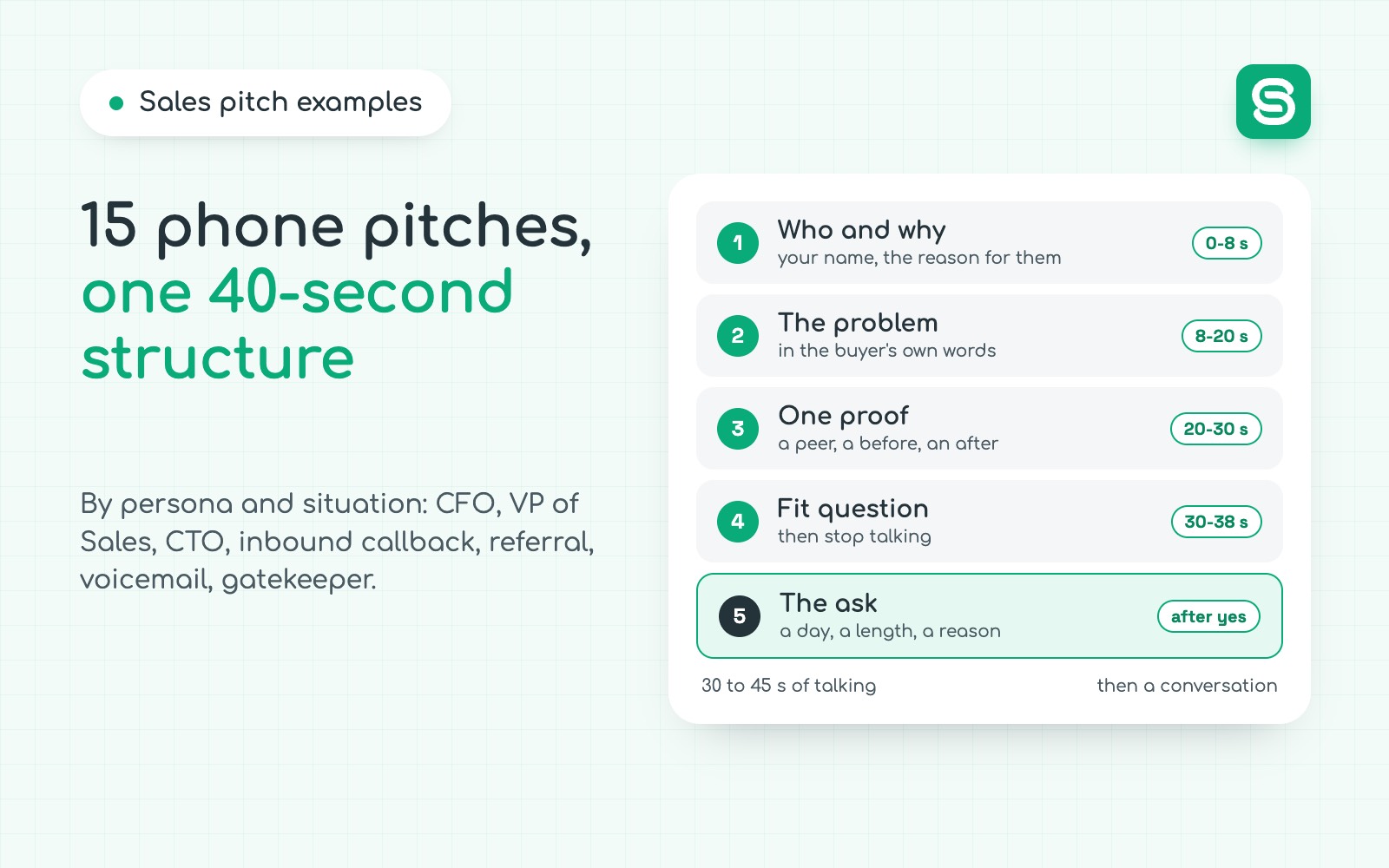
Every example in this article follows the same five parts. Each one answers a question the buyer is silently asking. Skip one, and the buyer fills the gap with “not interested.”
- 01
Who and why (0 to 8 seconds).
Your name, your company and the reason you’re calling this person: a hire, a funding round, a post, a referral, a role. Not “how are you today.” The reason is the bridge between a stranger and a conversation. - 02
The problem (8 to 20 seconds).
What you see at companies like theirs, in the words they’d use at their own desk. “VPs hiring in batches tell me new reps take a quarter to book a real meeting” beats “we optimize SDR onboarding.” - 03
The proof (20 to 30 seconds).
One result from a customer they’d recognize as a peer: company type, size or city, before and after. One. A second proof point rarely adds credibility; it adds length. - 04
The fit question (30 to 38 seconds).
A question they can answer in one sentence that tells you whether the problem applies. It hands them the floor and turns a pitch into a conversation. - 05
The ask (after their answer).
A specific next step: a day, a length, a reason. “Worth 20 minutes Thursday to see how [Customer] set it up?” If their answer showed no problem, you thank them and hang up. That’s a result too.
Notice what’s missing: your company history, your funding, your feature list, your “we’re the leading platform.” None of it answers a question the buyer is asking in the first 40 seconds. It can come later, in discovery, if they ask.
Sales pitch examples for the phone, by situation
The examples are grouped in three families: cold calls by persona, warm or trigger-based calls, and short formats. The products vary on purpose, so you can see the structure under different offers. Everything in brackets is a placeholder. Swap in a real customer and a real result before you dial.
Cold call pitches by persona
Cold call to a VP of Sales
Pitch 1: VP of Sales, SaaS company hiring SDRs
Product in this example: a sales onboarding platform.
Hi Dana, it's Chris from Rampwise. I'm calling because you just posted four SDR roles in Austin, and I'll be quick.

Most VPs of Sales who hire in batches tell me the same thing: new reps take a full quarter before they book a real meeting, and managers lose half their week to shadowing.

[Customer], a 30-rep SaaS team in Denver, cut SDR ramp from [11] weeks to [5] with us.

Is ramp time on your radar with this hiring wave, or is it under control?

(If yes) Worth 20 minutes Thursday to see how [Customer] set it up?
Why it works. The reason (four job posts) is public, recent and specific to her. The problem is something a VP of Sales says out loud in pipeline reviews. For more on this persona’s priorities and calendar, see how to cold call a VP of Sales.
Cold call to a CFO
Pitch 2: CFO, mid-market manufacturer
Product in this example: accounts payable automation.
Mr. Alvarez, this is Priya with Ledgerline. I'm calling CFOs at manufacturers in the Midwest because of one number I keep hearing.

Finance teams your size tell us they're paying [several] invoices twice a year, or paying late and losing early-payment discounts, because approvals live in email.

[Customer], a $90 million parts manufacturer in Ohio, recovered [$X] in the first two quarters by moving approvals out of the inbox.

How are invoice approvals handled at [Company] today: a system, or mostly email?

(If email) Would a 15-minute look at what [Customer] changed be worth it next week?
Why it works. CFOs listen for money they’re losing and risk they’re carrying. The pitch speaks in dollars, not in workflow features, and the fit question is easy to answer. Our guide to cold calling CFOs covers what else this buyer screens for.
Cold call to a CTO or CISO
Pitch 3: CISO or head of IT, 500-person company
Product in this example: phishing simulation and security training.
Hi Marcus, Jordan from Baitwise. I'll keep it to 30 seconds and you can tell me if it's relevant.

I'm calling security leads at healthcare companies around 500 employees because most of them tell us their training checks a compliance box but doesn't change who clicks.

At [Customer], a 450-person health network in Tennessee, the click rate on simulated phishing dropped from [X%] to [Y%] in [six] months.

Do you track click rates on your phishing tests today, or is training mostly the annual module?

(If they track it) Can I show you how [Customer] ran it, 20 minutes, Wednesday or Thursday?
Why it works. Technical buyers distrust adjectives. The pitch gives a metric they already know (click rate) and promises to “show,” not to “tell.” It also respects their time explicitly, which works better than asking if it’s a bad time. More on this audience in how to cold call CTOs and CISOs.
Cold call to an HR director
Pitch 4: HR director, multi-site retail or services company
Product in this example: a frontline hiring platform.
Hi Angela, it's Sam from Shiftly. I'm calling because I saw you're hiring store associates in 14 locations across Arizona.

HR directors running hiring across that many sites tell us the hard part isn't finding applicants, it's that candidates accept another offer before the store manager calls them back.

[Customer], a 40-store chain in Texas, cut time from application to interview from [six] days to [two].

How long does it usually take your store managers to get back to an applicant?

(If days) Worth a 20-minute look at how [Customer] did it?
Why it works. The problem is phrased from the HR director’s side of the desk (losing candidates), not the product’s side (automated scheduling). Our article on cold calling HR directors adds the gatekeeping and timing specifics for this role.
Cold call to an operations or logistics manager
Pitch 5: operations manager, regional distributor
Product in this example: freight invoice auditing.
Hi Kevin, this is Dana at Freightcheck. I work with distributors in the Southeast, and I'm calling about freight invoices.

Ops managers tell me they know some carrier invoices are wrong, accessorial charges, duplicate fuel surcharges, but nobody has time to check hundreds of them a month.

At [Customer], a distributor in Georgia, we found [X%] of invoices had an error in the first 90 days, and they got [$Y] back.

Is anyone on your team auditing freight invoices line by line right now?

(If no) Could I send our first audit of your last 30 days of invoices, and walk you through it Friday?
Why it works. The pitch names the exact charges an operations manager has seen on a carrier invoice, which signals expertise in one breath. The ask offers something concrete (an audit) instead of a generic demo.
Cold call to the founder of a small business
Pitch 6: founder or owner, 10 to 30 employees
Product in this example: outsourced bookkeeping.
Hi Lisa, Mike from Northbook. Quick reason for my call: we do the books for about [forty] design agencies, and agencies your size tend to have the same headache.

Founders tell me they find out whether a project made money three months after it's done, when the accountant finally closes the quarter.

[Customer], a 15-person agency in Portland, now sees profit per project every month, and dropped [two] unprofitable retainers in the first quarter.

When do you usually find out if a project was profitable?

(If late) Want me to show you what their monthly report looks like? Fifteen minutes, whenever suits you this week.
Why it works. Founders are busy, skeptical and the final decision maker, all at once. The pitch talks about their business, not about bookkeeping. If founders are your main buyer, our guide to cold calling founders goes further.
Warm and trigger-based pitches
Calling back an inbound lead
Pitch 7: callback after a demo request or a content download
Call within minutes if you can. The pitch is shorter because they came to you.
Hi Tom, it's Rachel from Ledgerline. You requested a demo on our site about ten minutes ago, so I thought I'd call while it's fresh.

You mentioned you're a 60-person company on QuickBooks. Teams in that spot usually reach out because month-end close is getting longer as they grow.

Is that what prompted you, or was it something else?

(Listen, then) Based on that, the most useful next step is a 30-minute walkthrough with our onboarding lead. Does tomorrow at 2 Eastern work?
Why it works. On an inbound call, the proof can wait: they already raised their hand. The job of the pitch is to reflect what they gave you and find out what triggered the request. Speed matters more than polish here; our guide to speed to lead explains why the first minutes count.
Trigger event: funding, new executive, expansion
Pitch 8: after a funding round or a new executive hire
Use a trigger the buyer would agree is public and recent.
Hi Nina, it's Alex from Rampwise. Congratulations on the Series B. I'm calling because the announcement said you're doubling the sales team this year.

When teams double sales headcount in twelve months, the first thing that usually breaks is onboarding: the best reps end up training new hires instead of selling.

[Customer] went from 12 to 30 reps last year and kept their top performers selling [90%] of the time.

Who's owning onboarding for the new hires: you, the managers, or enablement?

(Listen) Would it help to see how [Customer] structured the first 30 days? I can do Tuesday or Wednesday.
Why it works. The congratulations is short and the pivot to the reason is immediate. The trigger proves the call isn’t random. Spotting triggers like this is a skill in itself: funding news, leadership changes, job posts and new locations are the signals worth a call today.
Referral pitch
Pitch 9: someone the buyer knows suggested you call
Only use a name with that person's explicit OK.
Hi Greg, this is Jamie from Freightcheck. Monica Reyes at [Customer] suggested I call you. She said you two compare notes on carrier costs.

We audited Monica's freight invoices this year and recovered [$X] in billing errors. She thought you might be dealing with the same carriers.

Are you seeing the same surcharge creep she was?

(If yes) She said you'd want to see her numbers first. Can I walk you through them for 15 minutes on Thursday?
Why it works. The referral does the trust work, so the pitch can be shorter. The proof belongs to someone the buyer knows, which makes it far stronger than any logo.
Event or webinar attendee
Pitch 10: follow-up after a webinar, a booth visit or a conference talk
Reference what they did, not just that they attended.
Hi Carla, it's Ben from Shiftly. You joined our webinar on frontline hiring last Tuesday, and you asked the question about store managers who never check the hiring app.

That question comes up a lot, and it's usually the real reason time-to-hire stays high.

Is that still the main thing slowing hiring down for you?

(Listen) We fixed it for [Customer] with text-based scheduling. Want me to show you how in a 20-minute call this week?
Why it works. “You attended our webinar” is weak; “you asked this question” proves you paid attention. It’s the same principle as active listening, applied before the call even starts.
Re-engaging a closed-lost deal
Pitch 11: deal lost to timing, budget or a competitor 6 to 12 months ago
Lead with what changed, on their side or yours.
Hi Raj, it's Emily from Baitwise. We spoke in March, and you decided to stay with your current training vendor through the renewal.

I'm calling because two things changed since: you've added two offices, and we now cover Spanish-language simulations, which you'd said was a gap.

How is the current program working with the new offices?

(If there's friction) Would it be worth 20 minutes before your renewal in [month] to compare?
Why it works. It doesn’t pretend the first conversation didn’t happen. It names the reason they said no and the reason that might have changed. If the original objection was price, our guide to the budget objection shows how to reopen that conversation without discounting first.
Existing customer: expansion pitch
Pitch 12: upsell or cross-sell to a current customer
Start from their usage, not from your new product.
Hi Jen, it's Paul, your account manager at Northbook. I was looking at your account this morning.

Your team has added [three] new clients in Canada since spring, and right now those invoices are going through manual conversion.

Two of our agency customers in the same situation moved to our multi-currency module and cut [a day] off their month-end.

Is the Canadian billing taking extra time on your side?

(If yes) Want me to set up a 15-minute walkthrough with your controller?
Why it works. The customer already trusts you, so the pitch earns its place by showing you know their account better than a vendor would. The proof is a peer, not a feature.
Short formats
The 30-second elevator pitch
Pitch 13: elevator pitch for a trade show, a networking event or an intro
Generic by design, but it still names a buyer and a problem.
I run sales at Freightcheck. We audit freight invoices for distributors and manufacturers.

Most companies shipping a lot of freight overpay their carriers, through billing errors nobody has time to catch. We find those errors and get the money back, and we only get paid on what we recover.

Who handles freight costs where you work?
Why it works. An elevator pitch can’t be personalized to the listener in advance, so it ends on a question that lets the listener tell you whether they’re a buyer, a referrer or neither. Elevator pitch examples usually stop at the description; ending on a question is what turns them into a sales conversation.
The voicemail pitch
Pitch 14: voicemail after a cold call
20 to 30 seconds. One reason, one hook, your number twice.
Hi Dana, it's Chris from Rampwise, 512-555-0143.

I'm calling about the four SDR roles you posted. We helped [Customer] in Denver cut new-rep ramp from [eleven] weeks to [five], and I thought the timing might be right for you.

I'll send a short email with how they did it. Again, Chris at Rampwise, 512-555-0143.
Why it works. A voicemail pitch has one job: make the email that follows get opened. It skips the fit question (nobody can answer it) and repeats the number. For twelve more versions, see our B2B voicemail scripts, or build one in a minute with the voicemail script generator.
The gatekeeper pitch
Pitch 15: when an assistant or a receptionist answers
Pitch the reason, not the product. Be brief, polite and specific.
Hi, this is Priya with Ledgerline. I'm trying to reach Mr. Alvarez about how invoice approvals are handled in finance. Is he the right person for that, or would it be someone on his team?

(If asked what it's about) We work with manufacturers on paying invoices on time and catching duplicates. I only need two minutes to see if it's relevant. When is the best time to reach him directly?
Why it works. Asking “is he the right person, or someone on his team” treats the gatekeeper as a source of help, not an obstacle. Our gatekeeper script guide has twelve techniques for this moment.
Which pitch fits which call?
Fifteen examples is a lot to keep in your head during a call block. In practice, two questions decide which family you use: how warm the contact is, and how senior they are.
Executives respond to a single sharp number and a peer company; they think in outcomes. Managers and operators respond to friction they feel every day; they think in hours and headaches. Warm contacts don’t need the proof as early, because the relationship or their own action already did that work. Prepare at most four pitches per segment: one per quadrant you actually call. More than that, and reps improvise anyway.
Small team: start with one insight pitch and one pain pitch for your main buyer, plus a voicemail. Add the others only when your call lists include those situations.
How to write a sales pitch in 6 steps
The examples above are scaffolds. Your pitch has to come from your buyers and your results. Here’s the method we’d use to write one from scratch in an afternoon.
Pick one persona and one situation
“VP of Sales at a SaaS company that just raised” is a pitch. “Sales leaders” isn’t. If you sell to three personas, write three pitches.
Write the problem in their words
Pull five call recordings or notes where a customer described their problem before buying. Copy their exact phrases. If they said “my reps are drowning in admin,” don’t write “productivity challenges.”
Choose one provable result
One customer, recognizable as a peer, with a before and an after you can document. If you can’t prove it on request, don’t say it.
Write a one-sentence fit question
A question they can answer in a sentence, whose answer tells you if the problem applies. “How do you handle X today?” usually works better than “Do you have problem X?”
Write a specific ask
A next step with a length, a day and a reason. “Worth 20 minutes Thursday to see how [Customer] did it?” beats “Can we set up a call?”
Read it aloud, time it, cut it
Read it to a colleague. Anything that makes them frown goes. Anything over 45 seconds gets cut. Then test it on real calls before you change a word.
To speed up step 6, here’s a fill-in template that keeps you inside the structure. If you’d rather start from a generated draft, our free cold call script generator builds a first version from a few answers.
Fill-in template: your phone sales pitch
Template written for this article. Fill the brackets, then read it out loud.
WHO AND WHY (under 8 seconds)
Hi [first name], it's [your name] from [company]. I'm calling because [specific reason: trigger, referral, role, their action].

PROBLEM (in their words)
[Persona]s at [company type] tell me [problem, as a customer phrased it].

PROOF (one, provable)
[Customer], a [size, industry, city] company, went from [before] to [after] in [time].

FIT QUESTION (answerable in one sentence)
How do you handle [the problem area] today?

ASK (only if the answer shows the problem)
Worth [15 or 20] minutes [day] to see how [Customer] did it?

CHECK BEFORE YOU DIAL
- Under 45 seconds out loud?
- No feature list, no "leading," no company history?
- Every number backed by a real customer?
How long should a sales pitch be?
On a cold call, aim for 30 to 45 seconds of talking before your fit question. That’s our recommendation, built from two observations. Gong’s data shows that the longest rep monologue on successful cold calls averages 53 seconds, so a pitch under that bar fits the pattern of calls that work. And below about 20 seconds, there’s rarely room for both a specific problem and a real proof point.
Words matter more than intentions here. Paste your pitch below to time it.
Pitch length timer
Paste your pitch, set your pace, see how long it runs out loud. An example is prefilled.
- Words
- 85
- Spoken length
- 34 s
In the zone: short enough to finish before they decide, long enough to say something.
The whole call is longer, of course. A pitch is one moment inside a call that, when it goes well, runs several minutes. Our guide to how long a cold call should last breaks down where the rest of the time goes.
Why do sales pitches fail?
Most pitches don’t fail because of a bad product. They fail on one of these eight habits, each of which a buyer can detect in a few seconds.
Bad pitch vs. good pitch: one rewrite, line by line
Here’s a pitch we hear in some form on most call reviews, and the same pitch rewritten on the five-part structure. Same product, same buyer, same 40 seconds.
| Part | Before | After |
|---|---|---|
| Opening | "Hi, how are you today? Is this a bad time?" | "Hi Dana, it's Chris from Rampwise. I'm calling because you just posted four SDR roles." |
| Company | "Rampwise is the leading AI-powered enablement platform, founded in 2019..." | Cut. Nobody asked yet. |
| Problem | "We help sales teams improve productivity and efficiency." | "VPs hiring in batches tell me new reps take a quarter to book a real meeting." |
| Proof | "We work with hundreds of companies and get amazing results." | "[Customer], a 30-rep team in Denver, cut ramp from [11] weeks to [5]." |
| Question | "Is that something you'd be interested in learning more about?" | "Is ramp time on your radar with this hiring wave?" |
| Ask | "Can I send you some information?" | "Worth 20 minutes Thursday to see how they did it?" |
The “before” version isn’t rude or wrong. It’s just about the seller. The “after” version is about Dana, from the first word to the last. Notice also that the “after” question is easy to answer honestly. “Would you be interested in learning more?” invites a reflexive no; “Is ramp time on your radar?” invites a real answer.
The bad pitch is about the seller. The good pitch is about the buyer, from the first word to the last.
What to say when they interrupt the pitch
Buyers don’t always wait for your fit question. Three interruptions come up on most call blocks, and each one tells you which part of the pitch to fix.
- 01
"Sorry, who is this?"
Your who-and-why went too fast or was too vague. Slow down, repeat your name and company, and give the reason again in one sentence: “Chris, from Rampwise. I’m calling about the SDR roles you posted.” Then go straight to the problem line. - 02
"Just send me an email."
Often a polite exit, sometimes a real preference. Agree, then ask one question that makes the email useful: “Happy to. So I send the right thing, is ramp time for the new hires a priority this quarter, or not really?” The answer tells you whether to follow up or move on. - 03
"We already work with someone."
Your problem line didn’t separate you from what they have. Don’t attack the incumbent. Ask what they’d change about it: “Makes sense. If you could change one thing about how it works today, what would it be?” If the answer is “nothing,” thank them and log it.
Once the buyer answers the fit question, the pitch is over and the conversation begins. What you say next depends on what they said; our discovery call template picks up from there, and the way you open matters for trust too, which we cover in how to build rapport on sales calls. If the answer is an objection rather than a yes, our cold call objections guide has twelve responses.
How do you test and improve a sales pitch?
A pitch is a hypothesis about what a buyer cares about. You only find out if it’s right on real calls. Three habits make the difference between teams whose pitch improves every month and teams that rewrite it on a hunch.
Test one change at a time. Change the problem line, or the proof, or the fit question. Not all three. Run each version on enough real conversations to compare meeting rates; our guide to A/B testing sales scripts explains how many you need and includes a significance checker.
Listen to the first ten seconds after your pitch. The buyer’s reply tells you which part landed. “Who is this again?” means the who-and-why failed. “We already have something for that” means the problem was generic. “Interesting, how did they do that?” means the proof worked. Recording and transcribing your calls makes this review fast: Skipcall records and transcribes every call and produces an AI summary, so you can search your own pitches by phrase. Our cold call review routine turns that into a 15-minute habit.
Get enough reps in. You can’t judge a pitch on eight conversations. Teams that call at volume learn faster, which is one reason SDR teams use a parallel dialer: more live conversations per hour means a pitch test that finishes in days, not weeks.
A pitch scorecard to copy
Use this checklist on your own recordings or in a team call review. It also works as a peer-review grid in a role-play session. For a fuller grid covering the entire call, use our sales call scorecard.
Phone pitch scorecard: 10 checks, 1 point each
Checklist written for this article. 8 or more: ship it. Under 6: rewrite.
[ ] The reason for the call comes within the first 8 seconds.
[ ] The reason is specific to this person or company.
[ ] No apology, no "is this a bad time."
[ ] The problem is phrased the way a customer would say it.
[ ] The product is described in one sentence or less.
[ ] There is exactly one proof point, from a recognizable peer.
[ ] Every number can be backed by a real customer on request.
[ ] One fit question, answerable in a sentence, then silence.
[ ] The ask names a length and a day.
[ ] The talking part runs 45 seconds or less.




