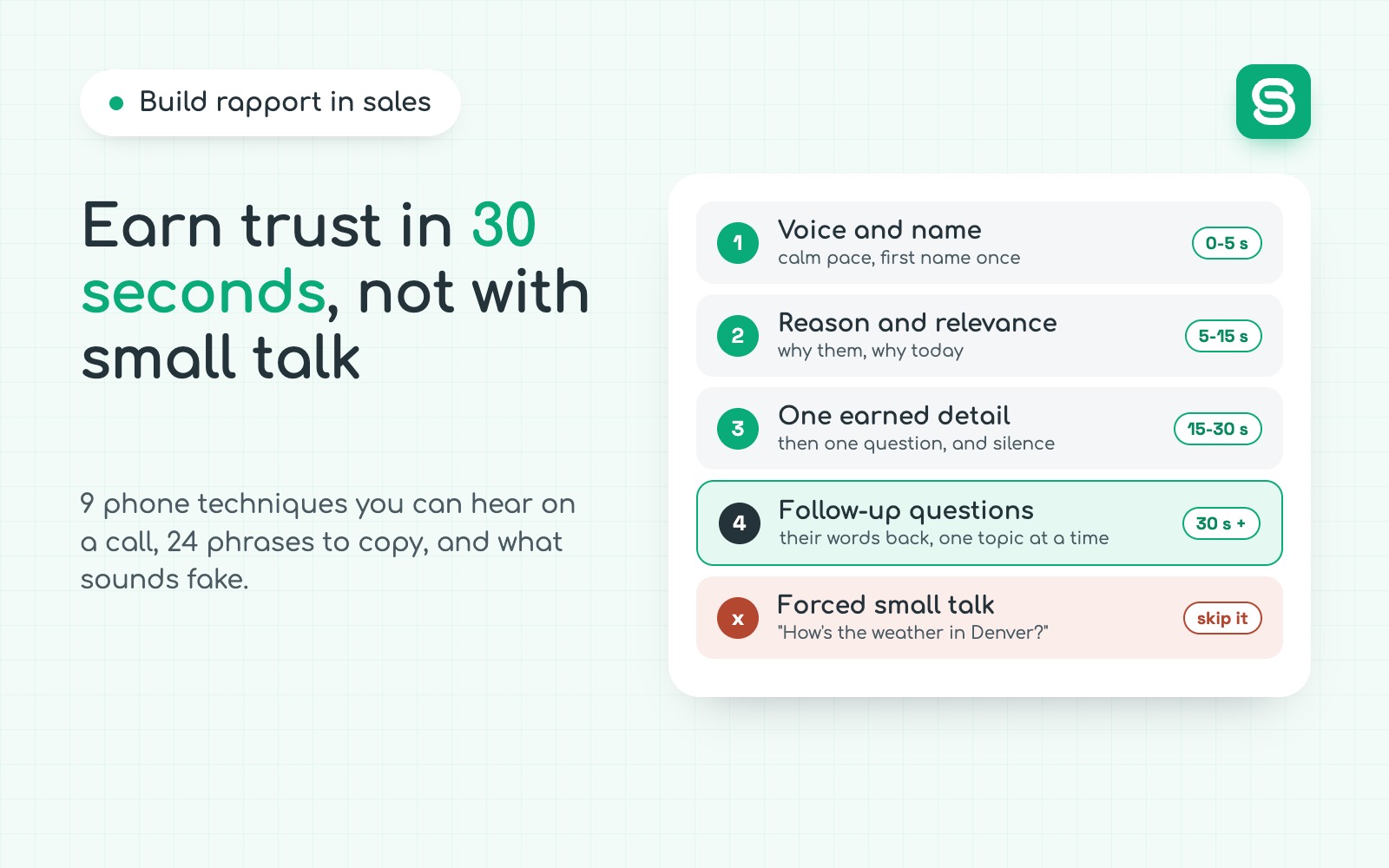
“Hi Mark, how’s the weather out in Denver today?” Every SDR has heard a version of this line on a call review, and every buyer has heard it on their cell phone. It’s meant to build rapport. It does the opposite: it tells a busy director of operations that the next minute will be about the caller, not about them. Learning how to build rapport in sales starts with dropping that reflex. On a B2B phone call, trust doesn’t come from chit-chat. It comes from proving, fast, that you’re relevant, that you respect their time and that you’re actually listening.
What is rapport in sales?
Rapport in sales is the buyer’s sense that talking to you is worth it: that you understand their situation, that you won’t waste their time and that you’re on their side of the problem. It’s a feeling on the buyer’s side, but it’s built from behaviors on yours.
Most guides define rapport as “a connection” or “a relationship of mutual understanding,” then jump to tips about finding shared hobbies. That definition works for a dinner party. In B2B, and especially on a call the buyer didn’t ask for, it misses the point. A CFO doesn’t need to like your taste in baseball teams. They need to believe you might be useful.
| Concept | What it means on a sales call | Can you build it in 30 seconds? |
|---|---|---|
| Rapport | The buyer feels you are relevant, respectful and listening | Yes, the first layer of it |
| Friendliness | A warm tone and good manners | Yes, but alone it changes nothing |
| Small talk | Conversation unrelated to the business | It can help or hurt, depending on the call |
| Trust | The buyer relies on what you say and do over time | No: it takes kept promises across several calls |
That last row matters. You can’t build trust in 30 seconds. You can build enough rapport to earn the next five minutes, and then a second call, and that’s where trust starts. If you want the broader profile of the reps who do this well, our article on the qualities of a good salesperson breaks them down into behaviors you can observe.
Why is building rapport on the phone harder?
Face to face, a lot of rapport happens without words: a handshake, a smile, eye contact, the coffee you’re both holding. On the phone, all of that is gone. You’re left with four channels, and every one of them is audible.
The other difficulty is context. A cold call interrupts someone. They were in a spreadsheet, a meeting, a car. In that state, anything that delays the reason for your call feels like a cost. That’s why techniques borrowed from in-person selling, like opening with a personal question, backfire more often on the phone.
What does the research say about rapport?
Rapport advice is full of folklore. Here’s what holds up when someone actually measured it, and what it means on a call.
Follow-up questions make people like you. In a 2017 paper in the Journal of Personality and Social Psychology, Harvard researchers Huang, Yeomans, Brooks, Minson and Gino found across three studies of live conversations that people who ask more questions, particularly follow-up questions, are better liked by their conversation partners. The mechanism is perceived responsiveness: listening, understanding, validation and care. They also found that people don’t anticipate this effect, which is why so few do it on purpose.
But more questions isn’t the answer. Gong’s 2025 talk-to-listen analysis of 326,000 sales calls longer than ten minutes found that sellers who won deals asked 15 to 16 questions per call, while those who lost asked about 20. Put the two findings together and the lesson is precise: follow-up questions build rapport, a checklist of new questions feels like an interrogation. Our article on the talk-to-listen ratio digs into how this changes between cold calls and discovery calls.
Verbal mirroring works. In a 2003 field experiment published in the Journal of Experimental Social Psychology, van Baaren and colleagues had a waitress either repeat customers’ orders word for word or simply acknowledge them. She received significantly larger tips when she repeated them. The words themselves carried the effect, no body language involved, which makes it one of the few mirroring findings that transfers cleanly to the phone.
A little non-business talk can help, in the right setting. In Morris, Nadler, Kurtzberg and Thompson’s 2002 study, half of the negotiating pairs had a short, strictly non-business phone call before negotiating by email. Those who “schmoozed” planned a more cooperative negotiation and reached better economic and social outcomes (the effect was strongest in mixed-gender pairs). Note the setting: two people who already had a reason to talk. That’s a warm call, not a cold one.
You don’t need to be an extravert. Wharton’s Adam Grant studied 340 outbound call center reps and found an inverted U: ambiverts, who move between talking and listening, produced more revenue than both strong extraverts and introverts. Rapport on the phone is less about a big personality than about knowing when to stop talking.
Follow-up questions build rapport. A checklist of new questions feels like an interrogation.
How do you build rapport in the first 30 seconds of a call?
On a cold call, the buyer makes most of their judgment before you’ve said anything about your product. Here’s how the first 30 seconds break down, and what builds or breaks rapport in each window.
- 01
0 to 5 seconds: voice and name.
Say their first name once, then your name and company, at a slightly slower pace than feels natural. Nervous reps speed up; a calm pace signals you’re not reading a script. Skip “How are you today?”: it’s a question nobody answers honestly, and it delays everything else. - 02
5 to 15 seconds: reason and relevance.
Why them, why now: a role, a job post, a funding round, a referral, an event. This is the single biggest rapport move on a cold call, because it answers the question every buyer is asking (“why are you calling me?”). Avoid “Did I catch you at a bad time?”: Gong found it makes a meeting 40% less likely. - 03
15 to 30 seconds: one earned detail, one question.
Something specific you learned about their business, then one question about it, then silence. “You opened a second warehouse in Reno this year. How are you handling inbound freight between the two?” One detail is research. Three details are a dossier, and that gets creepy. - 04
After 30 seconds: follow up, don't change topic.
Whatever they answer, your next sentence should prove you heard it. Repeat a key word, ask what’s behind it, or label it. This is where rapport turns into a real conversation.
The first line of the call deserves its own testing. Our guide to cold call openers compares fifteen of them, and our collection of sales pitch examples shows how the reason for calling flows into the rest of the pitch.
Real rapport vs. forced small talk
Why does “I love what you’re building at Acme!” sound fake while “You posted four SDR roles in Austin” sounds credible? Both are about the buyer’s company. The difference is on two axes: how specific the remark is to this person, and how relevant it is to their work.
- Flattery (generic, about work) could be said to anyone, so it sounds like a template. It’s the line every templated email already uses.
- Forced small talk (generic, about life) costs time and says nothing. “How’s the weather?” is the classic.
- Personal trivia (specific, about life) proves research but crosses a line on a first call. A marathon time from LinkedIn is fine to mention when they bring it up; opening with it feels like surveillance.
- Earned rapport (specific, about work) proves you did the work and points straight at a reason to talk. That’s the quadrant to aim for.
Here’s what the difference sounds like in practice.
| Moment | Sounds fake | Sounds real |
|---|---|---|
| Opening | "Hi Mark! How are you doing today?" | "Hi Mark, it's Ana from Freightcheck. I'm calling because you just opened the Reno warehouse." |
| Showing research | "I love what you guys are doing over there!" | "Your job post says you're hiring a freight coordinator, so I'm guessing volume is up." |
| Empathy | "I totally understand." | "So the month-end audit falls on you, on top of everything else?" |
| Agreement | "Absolutely, great point!" | "That's the second time you've mentioned the carriers. What happens with them?" |
| Respecting time | "I'll be super quick, I promise!" | "I'll take 30 seconds and you tell me if it's relevant." |
Rapport building techniques you can hear on a call
These nine techniques have one thing in common: a manager listening to the recording can tell whether you did them. That’s deliberate. Advice like “be genuine” or “show empathy” is impossible to coach. These aren’t.
Say why you called, early
The reason for your call is a rapport technique, not just a sales one. It removes the buyer’s main source of discomfort (who is this and what do they want?) and signals respect. Gong’s data ties stating the reason for calling to a 2.1x higher success rate. Aim to give it within 15 seconds.
Use one earned detail
One fact about their business you could only know by looking: a job post, a new location, a product launch, a quote from an interview. It proves the call isn’t random. Spend two minutes on it, not twenty: our guide to how many cold calls to make per day shows how research depth trades off against call volume by motion.
Match pace and energy, not style
If the buyer speaks slowly and deliberately, slow down. If they’re brisk, get to the point faster. Matching pace makes you easier to listen to. Copying their accent, slang or regional expressions is a different thing entirely, and people notice it.
Repeat their key words
When a buyer says “our reps are drowning in admin,” don’t translate it into “so productivity is a challenge.” Say “drowning in admin, how so?” It’s the verbal mirroring that worked in the van Baaren study, and it’s the core of active listening in sales, which covers paraphrasing and mirroring in detail.
Ask follow-up questions, not new ones
A follow-up question builds on the last answer: “What makes that hard?”, “What happened then?”, “Tell me more about that.” A new question changes the subject. The research says follow-ups drive liking; Gong’s data says more questions overall don’t help. Ask fewer, deeper questions. For the discovery part of the call, our discovery call template shows how to sequence them.
Label what you hear
Name the emotion or the stake behind an answer: “It sounds like this has been a sore point for a while.” “That sounds frustrating, especially before a board meeting.” A label shows you heard the feeling, not just the fact. If you’re wrong, the buyer corrects you, and you’ve learned something either way.
Give them control of the time
“I’ll take 30 seconds to explain why I called, and you tell me if it’s worth continuing.” Putting the buyer in charge of the clock lowers their guard more than any compliment. Then keep your word: when the 30 seconds are up, stop.
Be candid about fit
“If you’re under 20 reps, we’re probably not the right fit, so tell me if that’s the case.” Saying when you’re not useful is one of the fastest ways to sound credible. It also saves you from a meeting that would never close.
Keep the small promises
You said 15 minutes: end at 14. You said you’d send the case study by noon: send it by 11. Trust is built from kept promises, and the first ones are tiny. A same-day recap is the easiest to keep; our SMS templates after a call and our guide on how to follow up on a cold call cover the format.
- The buyer’s answers get longer as the call goes on.
- They volunteer information you didn’t ask for.
- They say “we” about the problem, not “they.”
- They ask you questions back.
- They tell you who else should be in the next call.
- One-word answers after the first minute.
- “Just send me something.”
- Long silences after your questions, followed by a polite exit.
- They correct your summary more than once.
- They stop mentioning specifics.
Rapport questions and phrases to copy
Questions and phrases work best when they’re adapted to the moment of the call. Here are 24 of them, sorted by when you’d use them. Copy the set, then cross out the ones that don’t sound like you: a phrase you wouldn’t say naturally will sound read.
24 rapport phrases and questions for B2B sales calls
Written for this article. Replace the brackets with what you learned or what the buyer said.
OPENING (reason and respect)
1. "I'm calling because [specific reason: job post, new location, referral]."
2. "I'll take 30 seconds to explain why I called, then you tell me if it's worth continuing."
3. "[Name] suggested I call you about [topic]."
4. "I saw you [specific action], so I wanted to ask you one question about it."

EARNED DETAIL (proof you did the work)
5. "Your team opened [location] this year. How has that changed [their area]?"
6. "You mentioned in [interview or post] that [quote]. Is that still the priority?"
7. "Companies that just [trigger] usually run into [problem]. Is that true for you?"

FOLLOW-UP QUESTIONS (build on their last answer)
8. "[Their key words], how so?"
9. "What makes that hard?"
10. "Tell me more about that."
11. "What happened the last time that came up?"
12. "How did you end up owning this?"
13. "What would a good quarter look like for your team?"

LABELING (show you heard the stake)
14. "It sounds like this has been a sore point for a while."
15. "That sounds frustrating, especially with [deadline or event] coming."
16. "So it lands on you, on top of everything else?"

CANDOR (credibility through limits)
17. "If you're [disqualifier], we're probably not the right fit. Tell me if that's the case."
18. "I don't know the answer to that. I'll find out and send it by [time]."
19. "Honestly, we're weaker on [area]. If that's critical, I'd rather say so now."

WARM CALLS ONLY (small talk the buyer can opt into)
20. "Before we dive in, how did [event they mentioned] go?"
21. "Last time you said you were heading to [place]. How was it?"

CLOSING (keep the promise visible)
22. "You said [their words]. Did I get that right?"
23. "I'll send the recap by [time] today, with the two things you asked for."
24. "We said 15 minutes and we're at 14. Want to pick this up [day]?"
For discovery-specific questions, our list of cold call discovery questions goes deeper into qualification.
When is small talk OK in sales?
Small talk isn’t banned. It’s a tool with a time and a place. The Morris study above found real benefits from a short personal chat before a negotiation. The difference is that the buyer had already agreed to talk.
Rule of thumb: let the buyer open the small-talk door, keep it under a minute, and be the one who brings the conversation back to business. They’ll appreciate not having to.
Time zones matter more than people think here. A buyer you reach at 4:45 PM their time on a Friday has less patience for anything off-topic than the same person at 10 AM on a Tuesday. Our guide to the best time to cold call and the free when to call tool help you reach people when they have room to talk.
Which rapport habits sound fake?
Most fake-sounding rapport comes from good intentions applied at the wrong time. Here are eight habits that make a call feel “salesy,” even when the rep means well.
There’s a quieter version of fake rapport too: agreeing with everything. A rep who never pushes back sounds like they want the meeting more than they want to help. Respectful disagreement (“I’d challenge that a little, here’s what we see at other distributors”) often builds more credibility than a dozen “great points.” It’s also the first step in handling objections well; our guide to cold call objections shows how to disagree without arguing.
How do managers coach rapport?
Rapport is coachable precisely because it’s audible. “Build more rapport” is useless feedback. “You asked four new questions and zero follow-ups” is something a rep can fix by Friday.
Pick two calls per rep
One that booked a meeting, one that didn’t. The contrast teaches more than either call alone.
Listen to the first 60 seconds only
Most rapport is won or lost there. Note when the reason for the call arrived and how the rep responded to the first answer.
Score with the ten checks below
Yes or no, no nuance. The rep scores their own call first, then compares with the manager.
Pick one technique for next week
One. “Repeat their key words at least twice per call” is a goal; “be more engaging” isn’t.
Recordings make this possible without sitting next to the rep. Skipcall records and transcribes calls with an AI summary, so a manager can search for “how are you today” across a week of calls in seconds. For the broader routine, our sales coaching program lays out a weekly cadence, our cold call role-play scenarios give you drills to practice the techniques before live calls, and our guide to AI sales role-play covers practicing with a simulated buyer. To grade the whole call, not just rapport, use the free sales call scorecard.
Rapport scorecard: 10 checks on the first minutes of a call
Written for this article. Score yes or no. 8 or more is strong; under 5, pick one technique for next week.
[ ] The rep said the buyer's first name once, not more than twice.
[ ] No "How are you today?" or "Is this a bad time?"
[ ] The reason for the call came within the first 15 seconds.
[ ] The reason was specific to this buyer or company.
[ ] The rep used one earned detail, and only one.
[ ] The rep's pace matched the buyer's.
[ ] The rep repeated at least one of the buyer's key words.
[ ] At least two follow-up questions built on the previous answer.
[ ] No more than one question at a time.
[ ] Any promise made (time, follow-up) was specific and kept.
Rapport beyond the first call
Rapport with one person isn’t enough on most B2B deals, where several people weigh in. The habits above apply to each new stakeholder, and the trust you’ve built with your first contact is what gets you introduced to the others. Our guide to multithreading in sales shows how to widen the relationship without going around your champion.
Key takeaways
Sources
- Gong: Evolve the cold call, 8 data-driven techniques (published August 2021, updated March 2026)
- Gong Labs: Talk-to-listen ratio, revisited with 326K sales calls (August 2025)
- Huang, Yeomans, Brooks, Minson, Gino: It doesn’t hurt to ask, question-asking increases liking (Journal of Personality and Social Psychology, 2017)
- van Baaren, Holland, Steenaert, van Knippenberg: Mimicry for money, behavioral consequences of imitation (Journal of Experimental Social Psychology, 2003)
- Morris, Nadler, Kurtzberg, Thompson: Schmooze or lose, social friction and lubrication in e-mail negotiations (Group Dynamics, 2002)
- Grant: Rethinking the extraverted sales ideal, the ambivert advantage (Psychological Science, 2013)
- Albert Mehrabian: Silent Messages, and the limits of the 7%-38%-55% equations




