A/B testing sales scripts is how SDR teams stop arguing about openers and start measuring them. The idea is simple: two versions of the same call, the same list, and you keep the one that books more meetings. The trouble is that most script tests can’t prove anything. They stop after 50 calls, change three things at once, and declare a winner the day one version pulls ahead. A month later the “winning” opener performs exactly like the old one, and the team concludes that testing doesn’t work.
Testing works. It just needs a bit of statistics that nobody explains to sales teams. This guide does, in plain English.
What is A/B testing a sales script?
A/B testing a sales script means running two versions of the same call at the same time, on comparable prospects, and comparing one outcome. Version A is your current script, the control. Version B differs by exactly one element. If B books meaningfully more meetings per conversation, and the gap is too big to be luck, B becomes the new standard and the next test challenges it.
That definition sounds like email or landing page testing, and the logic is the same. The conditions are not. A cold call test runs on far fewer events, with humans delivering the variable, which changes how you design it.
| Factor | Email or web page test | Cold call script test |
|---|---|---|
| Events per week | Thousands of sends or visits | Tens to a few hundred live conversations |
| Who delivers the variant | Software, identical every time | A rep, with their own voice, mood and timing |
| Main source of noise | Traffic source, day of week | Rep skill, list quality, time of day, gatekeepers |
| Outcome speed | Clicks within hours | Meetings booked on the call, held days later |
| What breaks the test | Stopping early | Stopping early, reps going off script, one rep calling only B |
Two consequences follow. First, sample size becomes the binding constraint: you will almost always have less data than you want, so you have to test changes big enough to show up. Second, the rep is part of the treatment. If your best SDR runs version B and a new hire runs version A, you are testing people, not words.
If you don’t have a script yet, start from our cold call script template, which maps a full library to the four phases of a call, or draft one with the cold call script generator. This guide is about what comes next: proving which version of a line actually works on your list.
Why do most cold call script tests give the wrong answer?
Most script tests fail for four reasons. None of them is about the script.
Benchmark data is not a test of your script
The best-known numbers on cold call openers come from Gong. Its cold call statistics report that stating the reason for your call is associated with a 2.1x higher success rate, that “how’ve you been?” performs 6.6x better than calls without it, and that opening with “did I catch you at a bad time?” makes reps 40% less likely to book a meeting. Those are useful starting hypotheses. They are also observational: they compare calls in which reps happened to say different things, across many companies, lists and skill levels. Reps who naturally state a crisp reason for calling may simply be better reps.
That isn’t a criticism of the data. It’s the reason to test on your own list. Our roundup of cold call openers gives you fifteen candidates; only a controlled test tells you which one works for your buyers, in your market, in your reps’ voices.
Benchmarks tell you what to test. Only your own test tells you what works on your list.
What peeking does to your results
We ran a simple simulation to show the effect of checking a test too often. Two identical scripts, both booking meetings on 10% of conversations, run to 450 conversations each. In one scenario the manager reads the result once at the end. In the other, they check after every 50 conversations per version and stop as soon as the gap looks significant.
Evan Miller’s classic essay How Not To Run an A/B Test explains the mechanism for web tests, and it applies word for word to calling. You can look at the data during the test to check that it’s running correctly. You just don’t act on the result until the planned end.
Which metric should you use to judge a sales script?
Pick one primary metric before the test starts, and pick one the script can actually move. Here is the ladder, from the top of the call down.
Connect rate: not a script metric
Whether a prospect picks up depends on the list, the number type, the time of day and how carriers label your caller ID. The script hasn’t started yet. If version B “wins” on connect rate, your randomization is broken. Use connect rate as a sanity check that both versions called comparable contacts; our connect rate benchmarks tell you what normal looks like.
Continuation past 30 seconds: the fast opener metric
The share of conversations that last beyond 30 seconds measures whether the opener earned the next sentence. It’s frequent (often 30 to 50% of conversations), so it reaches significance with far fewer calls. It’s the right primary metric when you test the first ten seconds of the call and the team is small. Its limit: an opener can keep people on the line longer without booking more meetings. Confirm the winner on meeting rate before rolling it out.
Meetings booked per conversation: the primary metric
This is the number that pays the bills, and the one the whole script exists to move. Divide meetings booked by live conversations with a decision-maker, not by dials. Dividing by dials adds all the noise of who picked up and hides the script’s effect. Use this metric for any test past the opener: reason for the call, discovery questions, objection responses, the ask.
Meetings held and pipeline: the slow truth
An aggressive ask can book more meetings that no-show. Track the held rate for both versions as a guardrail. Don’t make it the primary metric unless you have a large team: it arrives days later and needs a bigger sample.
To see how these numbers fit into a rep’s scorecard, our guide to SDR metrics and KPIs covers benchmarks for each step.
That sample works out to 9.1 dials per conversation of more than 30 seconds. It’s one dataset, not an industry average, but it shows why a script test measured per dial drowns in noise: seven dials out of ten never reach a human at all.
How many conversations do you need for a script test?
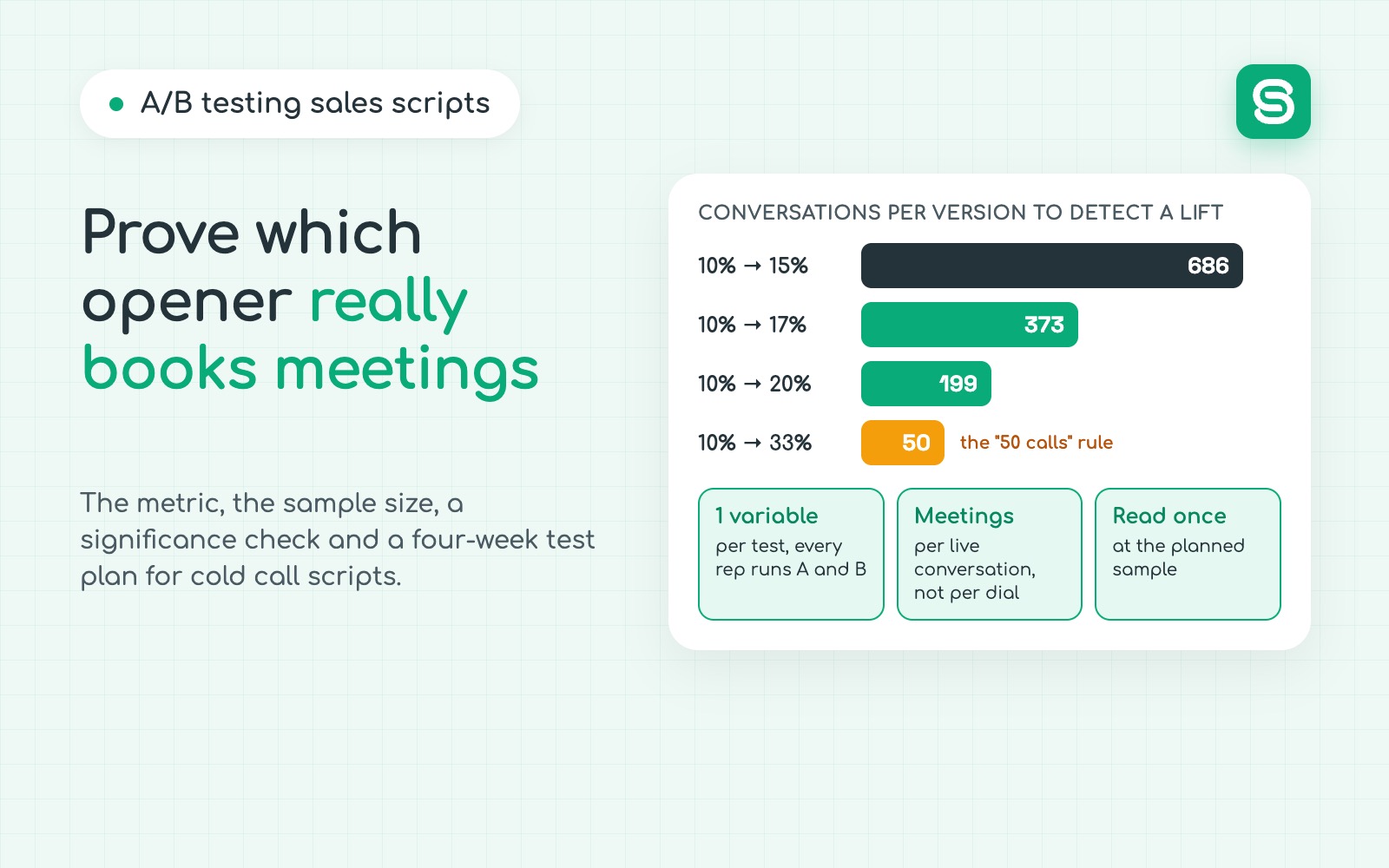
This is the question that decides whether your test can succeed, and almost nobody does the math. The sample you need depends on two things: your current meeting rate (the baseline) and the smallest improvement you care to detect. The smaller the improvement, the bigger the sample, and the relationship is brutal.
Read the chart from the bottom. With 50 conversations per version, the test can only reliably catch a meeting rate that goes from 10% to about 33%. Scripts don’t do that. Real wins from a better opener or a sharper ask are more like 10% to 13% or 15%, which takes between 690 and 1,770 conversations per version. That’s why teams that test “50 calls each” keep finding random winners.
What your team can detect in four weeks
Now turn the question around. Given your team’s volume, what’s the smallest difference a four-week test can catch? The table assumes 60 dials per rep per day and 9.1 dials per conversation (the Skipcall sample above), so about 33 conversations per rep per week, split evenly between A and B. Swap in your own numbers.
| Team | Conversations per version in 4 weeks | Smallest detectable change |
|---|---|---|
| 1 rep | About 66 | Meeting rate 10% → 29%, or continuation 40% → 64% |
| 3 reps | About 200 | Meeting rate 10% → 20%, or continuation 40% → 54% |
| 5 reps | About 330 | Meeting rate 10% → 17.5%, or continuation 40% → 51% |
| 10 reps | About 660 | Meeting rate 10% → 15%, or continuation 40% → 48% |
Two lessons. A team under five reps can’t detect modest meeting rate gains in a month, so it should test bold contrasts and lean on the continuation metric. And volume is the real accelerator: any change that doubles live conversations per rep doubles your sample and halves the test. That’s partly a dialer question: on a parallel dialer a rep reaches more people per hour, so the same four weeks yield a much larger sample. Our guide to how many cold calls per day gives the volume targets by dialing method, and the call attempts calculator helps you plan how many tries each contact gets.
How do you know if a script test result is real?
At the end of the test you have four numbers: conversations and meetings for each version. The question is whether the gap between them is bigger than chance would produce if both scripts were equally good. That’s what a significance test answers. Type your numbers in the checker below. It runs a standard two-proportion test in your browser; nothing is sent anywhere.
Script test significance checker
Enter the live conversations and meetings booked for each version. Example values prefilled.
- Meeting rate A / B
- 10.0% / 17.0%
- Relative lift
- +70%
- p-value
- 0.031
- Needed per version for this gap
- about 380
Likely a real difference (95% confidence). Check it holds rep by rep before you ship.
How to read the checker
- Meeting rate A / B is meetings divided by conversations for each version.
- Relative lift is how much better (or worse) B does relative to A. A move from 10% to 17% is a 70% lift.
- p-value is the probability of seeing a gap at least this big if both scripts performed identically. Under 0.05, the gap is unlikely to be luck. Between 0.05 and 0.2, it’s a lead worth confirming. Above 0.2, you have no evidence of a difference.
- Needed per version for this gap is how many conversations each version would need to reliably detect the gap you observed. If you’re far below it, a “significant” result is fragile; if you’re above it and still not significant, the true gap is probably smaller than it looks.
The default example (220 conversations and 22 meetings for A, 230 conversations and 39 meetings for B) gives a p-value of 0.031: a likely real improvement. Now change B to 50 conversations and 9 meetings: B’s rate is even higher, at 18%, yet the p-value rises to about 0.11. A better rate on a smaller sample, and no proof.
How do you set up a fair script test?
A test is only as good as its setup. These six rules remove most of the bias that sinks sales script optimization. They take an hour to put in place before the first call.
- 01
Write one hypothesis.
A sentence with a reason: “Opening with the specific trigger we found (a new VP of Sales) instead of a generic intro will raise meetings per conversation, because the call sounds researched.” If you can’t say why B should win, you won’t learn anything when it does. - 02
Change one element.
Opener, reason for the call, a discovery question, an objection response or the ask. Everything else stays word for word. Write both versions down and share them. - 03
Randomize by contact, not by rep or day.
Split each list randomly into A and B before calling, for example by sorting on a random column and alternating rows. Every contact gets one version for the whole test, including callbacks. - 04
Every rep runs both versions.
Each rep calls both halves of their list, so rep skill cancels out. If one rep can’t deliver B naturally, coach them first or leave them out of the test entirely. - 05
Same hours, same days.
A and B contacts get called in the same time windows across the week. Monday morning calls don’t behave like Thursday afternoon calls; if you’re unsure when your segment picks up, the best time to call tool helps. - 06
Tag every conversation.
Each call record carries its version, its outcome and whether it was a real conversation. Without the tag, you’ll be reconstructing the test from memory in week four.
Tagging is where most tests quietly break. The simplest setup is a version field on the contact or a tag on the list, plus a consistent outcome on every call. If your team doesn’t log outcomes the same way, fix that first: our guide to call disposition codes gives you a short standard list, and the call log template shows how to record each call so the test numbers fall out of a pivot table.
Check adherence by listening
Reps drift. By day four, version B has often turned into a hybrid of A and B. Have the manager listen to five calls per version each week, only to check that the words match the script, not to judge the result. Recordings and transcripts make that a fifteen-minute job: search the transcripts for B’s key phrase and you’ll know how many calls actually used it. Our cold call review routine fits this check into the review reps already do after each session. Remember that recording calls requires consent rules that vary by state; the call recording laws by state tool lists them.
A four-week plan to test one cold call script change
Here is the plan we recommend for a team of three to ten SDRs. It fits one clean test into a month, leaves room for setup and reading, and ends with a decision rather than a debate.
Design and launch
Write the hypothesis and both versions. Pull your baseline meeting rate per conversation from the last month. Use Figure 1 or the formula to set the sample per version, and write the stop date in the team channel. Randomize the lists, set up the version tag, brief the reps with a short role play of each version, and start calling by midweek.
Run and check the plumbing
Look at the data only to confirm it’s flowing: every call tagged, both versions getting similar volume and similar connect rates. Listen to five calls per version for adherence. Do not compare meeting rates yet, and do not share partial results with the team: reps who think B is losing deliver it worse.
Run to the planned sample
Keep both versions running in the same hours. No tweaks to B, even good ones. Write new ideas down for the next test. If volume is behind, extend the end date now rather than reading early.
Read once, decide, log
When both versions reach the sample, run the significance check once. Then check the result rep by rep and segment by segment. Decide: ship B, keep A, or plan a bolder test. Log the hypothesis, numbers and decision in a shared test log so the team builds on it.
The test log template
Teams that test for a year end up with a library of what works on their buyers. Teams that don’t log their tests run the same experiment three times. Copy this into a doc or a sheet and fill one block per test.
Sales script A/B test log
Template written for this article. One block per test, kept in a shared doc.
TEST #[number]: [short name, e.g. "Trigger opener vs. generic opener"]

Hypothesis: Changing [element] from [A] to [B] will raise [metric] because [reason].
Element tested: [opener / reason for call / discovery question / objection response / ask / voicemail]
Version A (control): "[exact words]"
Version B (challenger): "[exact words]"

Primary metric: [meetings booked per conversation / continuation past 30s]
Guardrail metric: [meetings held rate / connect rate]
Baseline (last 30 days): [x]%
Smallest gain worth detecting: [x]% → [y]%
Planned sample per version: [n] conversations
Start date: [date]   Planned end: [date]
Reps: [names, all running both versions]
Lists / segment: [description], randomized by [method]

RESULT (filled once, at the end)
A: [conversations] conversations, [meetings] meetings, [rate]%
B: [conversations] conversations, [meetings] meetings, [rate]%
p-value: [x]   Holds for most reps? [yes/no]   Holds by segment? [yes/no]
Decision: [ship B / keep A / retest bolder]
What we learned: [one sentence]
Next test: [idea]
What should you test first in a cold call script?
Test where the stakes are highest and the contrast can be large. In a cold call, that’s the first ten seconds, the reason for the call and the ask. Word swaps (“quick question” vs. “brief question”) produce effects too small for any SDR team to measure; skip them. Here are twelve hypotheses we’d start with, grouped by where they sit in the call.
| What you test | Version A vs. version B | Metric |
|---|---|---|
| Opener: permission | "Do you have a minute?" vs. "I know I called out of the blue; can I take 30 seconds to tell you why?" | Continuation past 30s |
| Opener: who or why first | "Hi, this is Sam from Acme, how are you?" vs. "Hi, Sam from Acme. The reason for my call is..." | Continuation past 30s |
| Reason for the call | A generic intro vs. a specific trigger (new hire, funding, job posts, a tech change) | Meetings per conversation |
| Problem framing | Leading with your product vs. leading with a problem peers in their role have | Meetings per conversation |
| Social proof | No reference vs. naming a similar company you work with (with permission) | Meetings per conversation |
| Number of questions | Two discovery questions before the ask vs. one sharp question | Meetings per conversation |
| Objection response | "Not interested": accept and pivot vs. ask what they use today | Meetings per conversation |
| Gatekeeper approach | Asking to be connected vs. asking for help finding the right person | Transfers per gatekeeper conversation |
| The ask: size | "A 30-minute demo" vs. "15 minutes to see if it is even relevant" | Meetings per conversation |
| The ask: format | "Are you open to a meeting?" vs. offering two specific time slots | Meetings per conversation |
| Voicemail | Full pitch vs. a 20-second message with one reason and a callback number | Callback rate |
| Follow-up after the call | No email vs. a same-day email recapping the reason for the call | Meetings per conversation (7-day window) |
A few notes on running them. The opener tests are the cheapest because the continuation metric is fast. The reason-for-the-call test is the one we’d run first on most teams: it’s where Gong’s 2.1x association points, and it’s the hardest to get right on instinct. For objection tests, only count conversations where the objection actually came up, otherwise the sample is mostly calls the change never touched; our breakdown of cold call objections gives you candidate responses, and the objection handling practice tool helps reps rehearse version B before the test starts.
Write the hypothesis in one sentence
Every hypothesis in the table becomes testable once you write it in this form. Copy the line and fill in the brackets.
Hypothesis sentence
One line per test, written before any call is made.
If we change [element] from "[version A]" to "[version B]", then [metric] will rise from about [x]% to at least [y]%, because [what the prospect hears differently].
How do you read the result and decide?
At the end of week four you’ll be tempted to look at one number and move on. Use the three questions below instead, in order. They take ten minutes and prevent most bad rollouts.
The third question is the one teams skip. A result driven by a single rep usually means that rep delivers B better, not that B is better; you’ve found a coaching lesson, not a new script. A result driven by one segment (say, B wins on VP-level contacts but loses on directors) is a real finding: keep both versions and route by segment.
When there’s no winner
Most honest tests end without a significant winner. That’s a result, not a failure. It tells you the change you tested doesn’t matter much on your list, which saves you from rolling out a script that only felt better. Keep version A (it’s already trained in), and make the next challenger bolder. If two or three tests in a row come back flat, the bottleneck probably isn’t the words: look at list quality, call timing or who you’re calling instead.
- Both versions reached the planned sample before anyone read the result.
- Connect rates for A and B are close, so the lists were comparable.
- Most reps individually did better with the winning version.
- The adherence checks found reps actually saying version B.
- The guardrail metric (held meetings) didn’t drop.
- The test was stopped early “because it was obvious.”
- One rep made most of the B calls, or the best rep only ran B.
- B was called mostly in a different week, list or time slot.
- Reps drifted from the script, or B changed midway.
- The win is on meetings booked but held meetings fell.
Can a small team A/B test cold call openers?
Yes, with honest expectations. With one to three reps, you’ll get roughly 30 to 100 conversations a week. That’s enough to catch big differences and not enough for small ones. Five adjustments make small-team testing worthwhile.
The fifth adjustment is a mindset one. Decide in advance what level of confidence you’ll accept. A founder doing their own outbound can reasonably adopt a version that leads with a p-value of 0.15 after a month, as long as they treat it as a working assumption and keep measuring. What they shouldn’t do is call it proven.
1 to 3 reps: opener tests on the 30-second continuation rate, bold contrasts, one test per month, and recordings to explain the result.
10 reps or more: meetings per conversation as the primary metric, held meetings as a guardrail, and room for segment-level analysis or a three-version test.
How do recordings and AI summaries help script testing?
Numbers tell you which version won. Recordings tell you why, and whether the test was clean. Three uses matter most.
Adherence. Searching transcripts for version B’s key phrase shows how often reps actually used it. A test where B was delivered on 60% of B calls is a diluted test, and you’ll want to know before you read the result.
Mechanism. Listening to ten B calls that booked and ten that didn’t usually reveals what the prospect responded to. That becomes the hypothesis for the next test. Our AI call transcription and summaries guide covers what transcripts get right and wrong, and the sales coaching program shows how managers turn those calls into weekly coaching.
Outcome hygiene. A summary attached to every call makes it easier to verify that a “meeting booked” outcome really was one. Skipcall records and transcribes calls and adds an AI summary to each one (call recording and transcription), and its contact lists take tags, which is one simple way to mark which version a contact received. The statistics stay your job: export the outcomes and run them through the checker above.
The mistakes that ruin sales script optimization
That last point deserves a word. Since May 2024, B2B telemarketing calls fall under the Telemarketing Sales Rule’s prohibition on misrepresentations (Federal Register, April 16, 2024). A test of a “pattern interrupt” that implies a prior relationship that doesn’t exist, or a reason for calling that isn’t true, is a compliance problem before it’s a statistics problem. Test honest framings against each other. For the wider legal picture, see is cold calling legal?. This is general information, not legal advice.
Key takeaways
Sources
- Gong: Evolve the cold call, 8 data-driven techniques (cold call statistics, updated March 2026)
- Evan Miller: How Not To Run an A/B Test
- Federal Register: Telemarketing Sales Rule amendments (April 16, 2024)
- Skipcall: a 100% anonymized sample of 86,168 calls placed on Skipcall over 12 months (pickup, conversation and voicemail rates)
- Sample sizes, detectable differences and the peeking simulation: calculations made for this article (two-sided two-proportion test, 95% confidence, 80% power)




