Search “business VoIP statistics” and you will find the same forty numbers on every vendor blog: “VoIP saves 30% to 50%,” “the VoIP market will reach $X billion,” “Y% of businesses have switched.” Follow the links and most of them lead to another vendor blog, then to a dead page or a press release from 2019. If you are writing a business case for your CFO or a slide for your board, that is a problem: the first person who checks will stop trusting the rest of your deck.
What are the key business VoIP statistics for 2026?
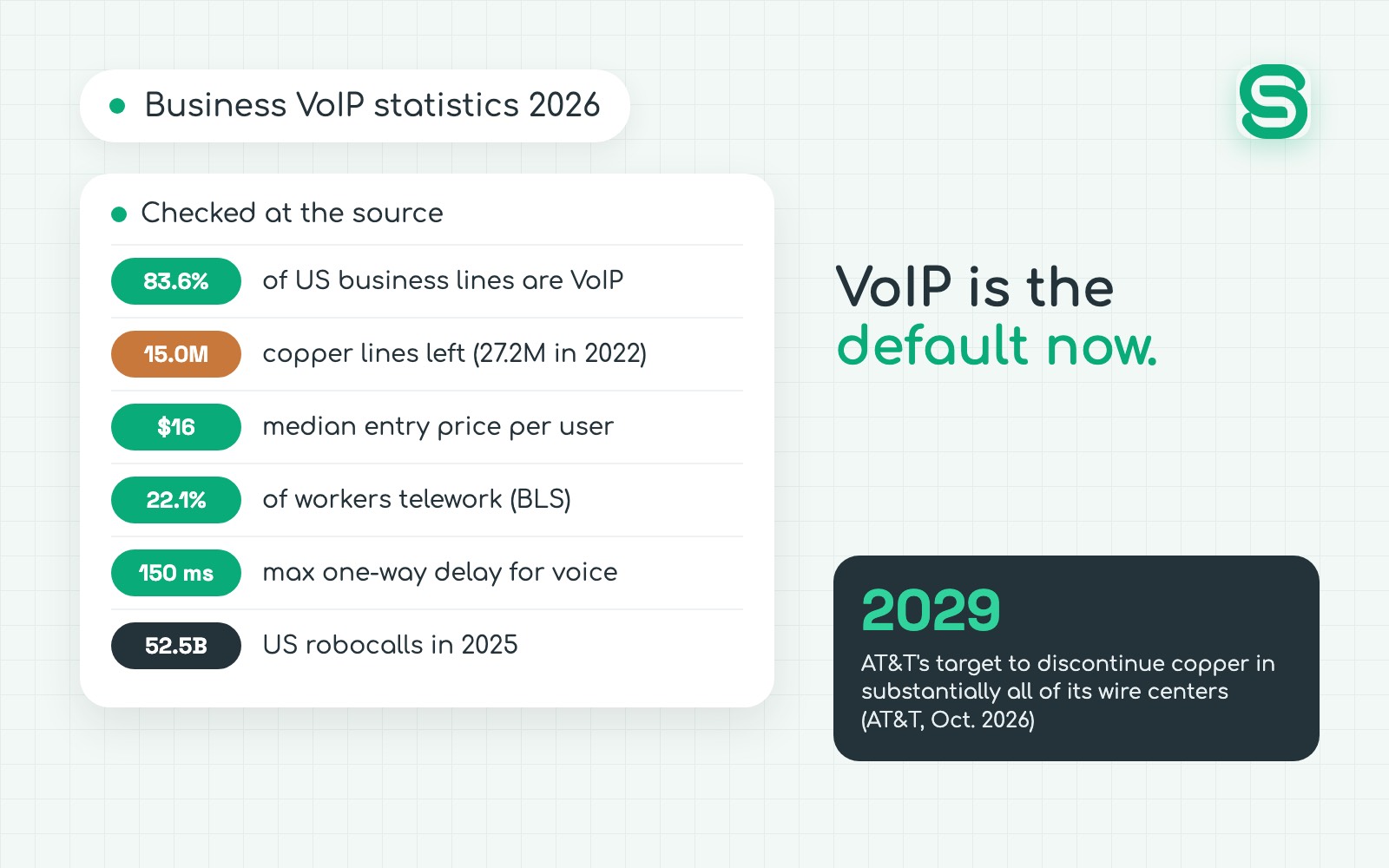
If you only have thirty seconds, these six numbers summarize the state of business telephony in the US. Each one is detailed, with its source, further down the page.
How did we check these statistics?
A statistic is only as good as the question it answers. For each number, we went back to the organization that produced it, read the definition, and noted the date of the data (not the date of the blog post that repeated it). Three rules decided what made the page:
- 01
Primary source only.
The FCC report, the BLS table, the carrier’s press release, the vendor’s own pricing page. If the only trace of a number was another article quoting it, we left it out. - 02
Date of the data, not of the article.
The FCC’s report published in May 2026 describes the network as of June 30, 2025. We give both when they differ. - 03
Vendors quoted as vendors.
A company’s revenue, its plan prices or its own survey are facts about that company. We say whose number it is and never present it as a market average.
The sources fall into five families. Read them in that order of trust: a regulator’s count beats a vendor survey every time.
| Source | What it measures | Latest data used here |
|---|---|---|
| FCC, Voice Telephone Services report | Every US voice connection reported on Form 477, by technology and customer type | June 30, 2025 (published May 2026) |
| BLS, Census Bureau, Gallup | Where Americans work: telework, work from home, hybrid | October 2026 (BLS), 2025 (Census), August 2026 (Gallup) |
| AT&T investor and newsroom releases | The copper phase-out schedule of the largest US copper owner | October 2026 |
| FTC, YouMail, Hiya | Do Not Call complaints, robocall volume, answer behavior | FY 2025 (FTC), October 2026 (YouMail), 2026 report (Hiya) |
| Vendor pricing pages and filings | Plan prices per user, company revenue | Read on November 20, 2026 |
How many businesses use VoIP?
No public source counts companies by phone technology. What the FCC counts is connections: every voice line or subscription that a provider sells to a retail customer, reported twice a year on Form 477. That is the number to use when someone asks for the “VoIP adoption rate,” and it tells a clear story.
All six figures come from the FCC’s Voice Telephone Services: Status as of June 30, 2025, published by the Office of Economics and Analytics in May 2026. The shares are our calculations from the FCC’s tables. The FCC defines interconnected VoIP as a service that needs a broadband connection and IP equipment and can both receive calls from and place calls to the regular phone network. Apps that only call other app users are not in the count.
What the business numbers say
Businesses moved first and moved further. Of the 52.6 million business wireline connections in June 2025, 44.0 million were VoIP and 8.6 million were switched access lines. The FCC also splits business VoIP by how it reaches the customer:
That over-the-top figure is the real adoption rate of cloud phone systems such as RingCentral, Zoom Phone, Dialpad or a sales dialer: the voice service and the internet line come from two different companies. Households, by contrast, mostly get VoIP bundled with their cable internet. If you want the mechanics behind the numbers, our guide to how business VoIP works and what it costs covers the network side, and VoIP vs. traditional phone systems covers the trade-offs for a sales team.
How fast is the copper phone network disappearing?
Switched access lines, the service most people still call a “landline,” fell from 27.2 million in June 2022 to 15.0 million in June 2025, a 44.7% drop in three years (FCC). In the last six months of that series alone, 1.4 million lines disappeared (16.4M in December 2024 to 15.0M in June 2025, according to the FCC’s December 2024 and June 2025 reports).
The carriers are now writing the end date. AT&T, the largest owner of copper in the US, is the clearest example:
Sources: AT&T’s 2024 Analyst & Investor Day release, its October 2026 network post and its third-quarter 2026 prepared remarks. These are company targets, not regulatory deadlines, and the dates can move. But the direction does not.
What breaks when copper goes is rarely the desk phone. It is the line nobody inventoried: the fax in accounting, the elevator emergency phone, the alarm panel, the credit card terminal at the front desk. Our POTS line retirement guide lists them and gives a six-step migration plan. If you are moving numbers, read business phone number porting before you cancel anything.
How big is the VoIP market?
This is the statistic everyone wants and nobody can verify for free. Market research firms publish headline figures for the “VoIP market,” the “VoIP services market” or the “UCaaS market,” and the numbers differ by a factor of three or more depending on whether they include consumer apps, mobile VoIP, contact center software or hardware. The full reports are paywalled, and the public summaries we tried to open on November 20, 2026 were behind bot protection. We do not quote them here, and you should be careful with any page that quotes one without saying which definition it uses.
What you can check are the filings of public companies. They measure one vendor, not the market, but they are audited and dated.
Source: RingCentral, third quarter 2026 financial results, October 22, 2026. Read together with the FCC data, the picture is of a mature market: adoption is nearly complete in business, and the big vendors grow in single digits by selling more per seat (AI features, contact center, analytics) rather than by converting copper customers.
One more market fact, because it still shows up in comparisons: Skype was retired on May 5, 2025, and Microsoft moved its users to Teams Free, according to Microsoft Support. Any “best VoIP” list that still recommends Skype credit for business calls was written before then. We cover what replaced it in the best VoIP for international calls.
What does business VoIP cost per user in 2026?
Here are the entry-level business plans of seven US providers, as shown on their own pricing pages on November 20, 2026. Prices are per user per month. Taxes and regulatory fees come on top everywhere.
| Provider and plan | Annual billing | Monthly billing |
|---|---|---|
| Google Voice Starter (up to 10 users, requires Google Workspace) | $10 | Billing term not stated on the page |
| Quo Starter (formerly OpenPhone) | $15 | $19 |
| Dialpad Connect Standard | $15 | Billing term not confirmed |
| Zoom Phone, US & Canada Unlimited | $16 | $18 |
| RingCentral RingEX Core | $20 | $30 |
| 8x8 X2 (unlimited calling to 14 countries) | $24 | Not stated |
| Skipcall Business VoIP | $25 | $30 |
Three patterns are worth knowing before you compare quotes:
For a full breakdown by tier, see our comparison of the best small business phone systems, and for teams that mostly make outbound calls, the best VoIP for sales teams, which adds the cost of the dialer. Skipcall’s Business VoIP plan, at $25 per license per month billed annually, includes 150 conversations, 100 text messages and one number; the dialer plans start at $70.
How has hybrid work changed business phone use?
The desk phone assumed that people sit at a desk. Three surveys measure how far that assumption has drifted, and they measure different things, which is why their numbers differ.
Sources: BLS Table A-41, people at work by telework status (October 2026, not seasonally adjusted), the Census Bureau’s American Community Survey commuting summary and Gallup’s hybrid work indicator.
The BLS counts anyone who worked from home for at least part of the reference week. The Census asks how people usually get to work. Same workforce, two questions, a 9-point gap.
For phone systems, the BLS figure is the useful one: a hybrid employee who works from home two days a week needs their business number on a laptop and a cell phone those two days, which a copper line or an office-bound desk phone cannot do. That is the practical reason business VoIP adoption sits above 80%. If you are equipping people at home, our guide to the phone system for remote teams lists what each employee needs, and running a business number on a personal phone compares the four ways to do it.
What call quality numbers should a VoIP network hit?
Most VoIP complaints are network complaints. The thresholds below are the reference values engineers use, from the organizations that set them.
| Metric | Reference value | Source |
|---|---|---|
| One-way delay, recommended for voice | 150 ms or less | Cisco, Voice Over IP per call bandwidth consumption (doc 7934, updated December 2023) |
| One-way delay, planning limit | 400 ms should not be exceeded | ITU-T Recommendation G.114 |
| Bandwidth per G.711 call on Ethernet | 87.2 kbps, each direction | Cisco doc 7934 |
| Bandwidth per G.729 call on Ethernet | 31.2 kbps, each direction | Cisco doc 7934 |
Bandwidth is rarely the bottleneck on a modern office connection. Upload jitter, Wi-Fi congestion and a VPN that sends calls around the country are. Run a VoIP speed test from the desk that has the problem, not from the server room, and see VoIP call quality problems for the fix behind each symptom: choppy audio, echo, one-way audio, delay.
How many robocalls and spam calls hit US phones?
Business VoIP made calling cheap for everyone, including scammers. The numbers below explain why your legitimate calls get screened, and why the network now treats unknown numbers with suspicion.
Two more FTC data points give the scale: consumers filed 2,085,133 Do Not Call complaints in FY 2024 (Data Book 2024), and in FY 2025 Arizona topped the states with 1,028 complaints per 100,000 people, followed by Tennessee (1,017) and Nevada (960), according to the FTC’s FY 2025 Data Book announcement of December 11, 2025. Robocall volumes come from the YouMail Robocall Index, which extrapolates from its app users; treat them as a trend, not a census. The Hiya figure is from its State of the Call 2026 consumer survey.
What do these statistics mean for a sales team?
Most VoIP statistics are written for IT buyers. If your team lives on outbound calls, five of the numbers above change how you work.
Copper is not your problem, reputation is
With 83.6% of business lines already on VoIP, the technology question is settled. The open question is whether your calls get answered. When 86% of unknown calls go unanswered (Hiya) and carriers label numbers based on calling patterns, a clean number is an asset. Read how caller ID reputation is built and what to do if your business number is marked as spam.
Answer rates are low, so measure them on your own list
In a 100% anonymized sample of calls placed on Skipcall (86,168 outbound calls by one B2B team), 17.9% of calls were picked up and 11% became a conversation longer than 30 seconds. Public benchmarks vary widely with list quality and number type; our cold calling statistics page compares them source by source.
The Do Not Call Registry keeps growing
258.5 million active registrations means most consumer and many sole-proprietor numbers are on it. B2B calls to business lines are treated differently from consumer telemarketing, but a list that mixes cell phones and small-business numbers needs checking. See DNC scrubbing and is cold calling legal in the US, and note the rule changes taking effect on November 25, 2026.
Hybrid reps need the same line everywhere
A rep who works from home on Fridays (one of the 11.5% who telework some of their hours) should call from the same number, with the same CRM logging, on a laptop or a phone. Anything else breaks your call history.
Price per seat is the smallest line in the budget
At a median of $16 per user per month, the phone line costs about $192 a year per rep, a rounding error next to the rep’s salary. The meaningful cost is conversations per hour. That is where a dialer, not a cheaper phone plan, changes the economics.
Which popular VoIP statistics could we not verify?
These numbers appear on dozens of pages. On November 20, 2026, we could not trace any of them to a primary source with a method and a sample, so they are not on this page. If you find the original, it may be fine to use; until then, do not put them in front of a CFO.
| The claim | What we found |
|---|---|
| "Businesses save 30% to 50% by switching to VoIP" | Quoted by vendors citing each other. No study with a sample, a baseline or a date. Savings depend entirely on what you were paying for copper and how many lines you cut. |
| "VoIP cuts startup phone costs by up to 90%" | Traced to review sites and vendor blogs; no underlying data set. |
| "X% of businesses use VoIP" | Usually an old survey of a vendor's own prospects. The FCC counts connections, not companies; use the 83.6% connection share and say so. |
| Global VoIP market forecasts in billions | Paywalled reports with incompatible definitions (VoIP, VoIP services, UCaaS). Summaries were blocked when we tried to open them. |
| "Remote workers are X% more productive with VoIP" | No primary source found. Telework data from BLS and Gallup describe where people work, not how a phone system changes output. |
Which business VoIP statistics can you quote?
Copy the block below into a deck, a business case or an article. Each line carries its source and date, so whoever reads it can check it.
Business VoIP statistics, ready to quote
Checked on November 20, 2026. Sources in brackets.
83.6% of US business wireline voice connections are VoIP: 44.0 million of 52.6 million (FCC, Voice Telephone Services, data as of June 30, 2025, published May 2026).
US switched access lines fell from 27.2 million in June 2022 to 15.0 million in June 2025, a decline of 17.9% a year (FCC).
The US had 63.4 million interconnected VoIP subscriptions and 394.5 million mobile voice subscriptions in June 2025 (FCC).
AT&T targets discontinuing copper-based services in 50% of its wire centers outside California by the end of 2027 and substantially all by the end of 2029 (AT&T, Q3 2026 earnings remarks, October 2026).
Only 1% of AT&T's eligible customers still use legacy copper voice technology (AT&T, October 19, 2026).
22.1% of people at work teleworked in October 2026; 10.6% teleworked all their hours (BLS, Current Population Survey, Table A-41).
54% of remote-capable US employees work hybrid, 25% fully remote, 21% on-site (Gallup, August 2026).
Cisco recommends one-way voice delay of 150 ms or less; a G.711 call uses about 87.2 kbps on Ethernet (Cisco, doc 7934).
About 52.5 billion robocalls were placed in the US in 2025 (YouMail Robocall Index, estimate).
The National Do Not Call Registry held 258.5 million active registrations on September 30, 2025 (FTC, FY 2025 Data Book).
Need more figures for a sales audience? Our page of cold calling statistics applies the same method to answer rates, calls per meeting and best time to call, and the business phone system guide explains what each line on a quote means.
What to remember
Business VoIP is a finished migration in the US: more than four in five business lines already run on it, and the copper that remains has a published end date at the largest carrier. The statistics that still matter are the ones you can act on: what you pay per seat and per international minute, whether your network holds 150 milliseconds, whether your calls get answered. Take the numbers on this page with their dates, and recheck the FCC’s next report (it is published about eleven months after the data date) before you reuse them in 2027.
Sources
- FCC, Voice Telephone Services: Status as of June 30, 2025 (May 2026)
- FCC, Voice Telephone Services: Status as of December 31, 2024 (February 2026)
- FCC, Voice Telephone Services report page
- AT&T, Analyst & Investor Day 2024 release (December 3, 2024)
- AT&T, Modernizing our network (October 19, 2026)
- AT&T, third-quarter 2026 earnings prepared remarks
- RingCentral, third quarter 2026 financial results (October 22, 2026)
- Microsoft Support, Skype retirement
- BLS, Table A-41: People at work by telework status (October 2026)
- Census Bureau, American Community Survey 1-year commuting summary (2025)
- Gallup, Global Indicator: Hybrid Work
- Cisco, Voice Over IP: Per Call Bandwidth Consumption (doc 7934)
- ITU-T Recommendation G.114, One-way transmission time
- FTC, National Do Not Call Registry Data Book FY 2025 announcement (December 11, 2025)
- FTC, National Do Not Call Registry Data Book FY 2024
- YouMail Robocall Index, historical robocalls by time
- Hiya, State of the Call 2026
- Pricing pages read on November 20, 2026: Google Voice, Quo, Dialpad, Zoom Phone, RingCentral, 8x8




