Your SDR in Austin books a call with a prospect in Manchester. Your AE in Chicago follows up with a distributor in Monterrey. Your support lead calls a customer in Bangalore. On most business phone plans, all three calls sit outside the “unlimited” in the plan name, and you will only find out what they cost when the invoice arrives. Picking the best VoIP for international calls is less about the brand than about three questions most comparison pages skip.
How did we compare international VoIP rates?
Most “best VoIP for international calls” pages rank providers on features and quote rates from 2022, or none at all. We did the opposite: we opened each provider’s own pricing page and international rate table on November 20, 2026, and noted what a minute from the US costs to four countries US teams call often: the United Kingdom, Mexico, India and Germany, landline and mobile separately when the provider separates them.
Two things we found before any number:
If you also need the dialing format for each country (exit code, country code, dropped zero), our list of international dialing codes covers 245 countries and territories.
International calling rates: VoIP providers compared
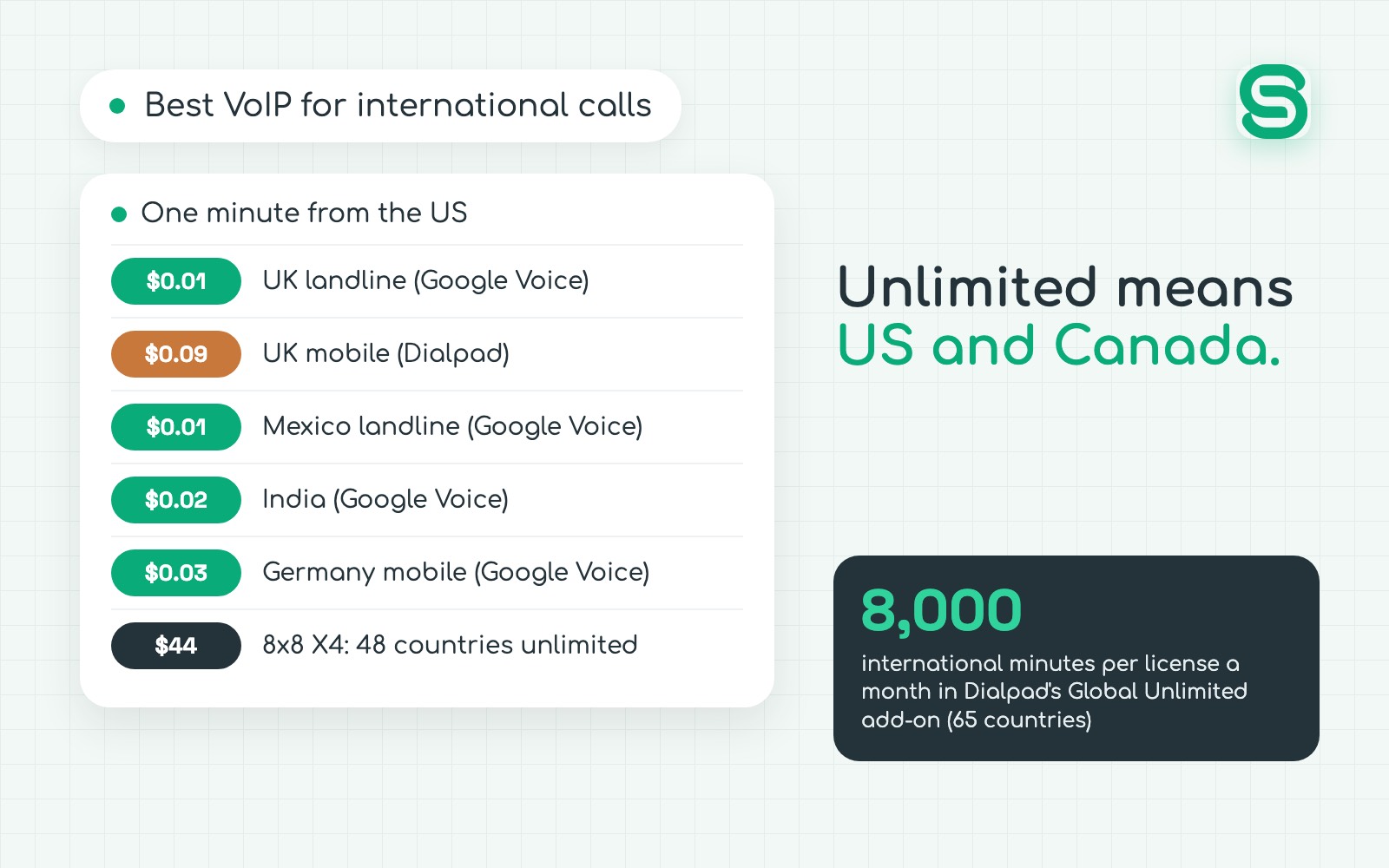
Here is what a minute from the US cost on the providers that publish their rates, and what the 8x8 bundles include. Rates are in US dollars per minute, before taxes and fees.
What the matrix shows, destination by destination:
| Destination | Lowest published rate | What to watch |
|---|---|---|
| United Kingdom (+44) | $0.01 to landlines and to EE, O2, Vodafone and Three mobiles on Google Voice | Other UK mobile networks cost $0.28 on Google Voice, and Quo shows up to $1.36; UK premium numbers cost $2.50 on Google Voice |
| Mexico (+52) | $0.01 to landlines on Google Voice | Dialpad charges $0.08 landline and $0.09 mobile; 8x8 X2 does not include Mexico, X3 and X4 do |
| India (+91) | $0.02 on Google Voice | Only 8x8 X4 includes India among the bundles we checked; Dialpad lists $0.05 for landlines |
| Germany (+49) | $0.01 landline, $0.03 mobile on Google Voice | 8x8 X2 includes German landlines but not German mobiles; Quo shows $0.03 to $0.48 |
Price is not the only difference between routes. An international call crosses more networks, and each one adds delay. If your calls to one country sound choppy or lag, our guide to VoIP call quality problems walks through the fixes, starting with the ones on your side of the line.
The best VoIP for international calls: 7 providers, one by one
Each profile below sticks to what the provider’s own pages said on November 20, 2026. Prices are per user per month. We give the annual-billing price first when the page shows both.
Google Voice
- Plans
- Starter $10 (up to 10 users), Standard $20, Premier $30, plus Google Workspace
- Included calling
- US calling included; Canada at $0.00 on the rate table
- International
- Pay per minute from a public rate table
- Best for
- Low-volume international calls at the lowest published rates
8x8
- Plans
- X2 $24, X4 $44
- Included calling
- Unlimited to 14 countries (X2) or 48 (X4), fair use
- International
- Bundled; out-of-zone and premium numbers metered
- Best for
- Teams calling the same countries every day
 Dialpad
- Plans
- Connect Standard $15, Pro $25
- Included calling
- US and Canada
- International
- Calling Credits, or Global Unlimited add-on: 8,000 min to 65 countries
- Best for
- Teams that want a published rate list and a bundle option
 RingCentral
- Plans
- RingEX Core $20 ($30 monthly), Advanced $25, Ultra $35
- Included calling
- Unlimited US and Canada
- International
- Billed at RingCentral's rates; international numbers from $5.99
- Best for
- Companies with offices in several countries (Global RingEX)
Zoom Phone
- Plans
- US & Canada Unlimited $16 ($18 monthly), Pro Plus $20.50, Business Plus $24.50
- Included calling
- Unlimited US and Canada
- International
- Metered per minute; Global Select plan for domestic calling in 40+ countries
- Best for
- Teams already on Zoom with staff in several countries
Quo
- Plans
- Starter $15 ($19 monthly), Business $23, Scale $35
- Included calling
- Unlimited US and Canada, fair use
- International
- Pay per minute, one range per country
- Best for
- Small teams with occasional international calls
Nextiva
- Plans
- Core $15, Engage $25 (billing term not labeled), Scale $75
- Included calling
- US and Canada
- International
- Off by default, enabled through support
- Best for
- Teams that rarely call abroad and want it locked by default
Google Voice
Best for: small teams already on Google Workspace that call abroad occasionally.
Google publishes the most detailed rate table we found, at voice.google.com/rates, split by landline, mobile network and special numbers. The rates are among the lowest on the market for the four countries we checked. The Google Voice plans run $10 (Starter, up to 10 users), $20 (Standard) and $30 (Premier) per user, on top of a Google Workspace subscription; Premier is the one for teams with users in several countries.
- Public rate table, per network type
- $0.01 a minute to UK and German landlines, $0.02 to India
- Requires Google Workspace
- No country bundles: every international minute is billed
- No sales dialer: one call at a time
8x8
Best for: teams that call the same countries all day and want a flat bill.
8x8 is the only provider in this comparison that builds countries into the base plan. According to its VoIP phone page, X2 costs $24 per user per month with unlimited voice calls to 14 countries, and X4 costs $44 with unlimited calls to 48 countries. The detail sits in 8x8’s help article Calling Countries for X-Series Licenses (updated April 2026): calls are unlimited “subject to 8x8 fair-use policy,” and an asterisk excludes mobile calling in some countries.
| 8x8 plan | Unlimited to | Mobiles excluded in |
|---|---|---|
| X2, 14 countries | US, Canada, Puerto Rico, UK, Australia, France, Germany, Ireland, Italy, Netherlands, New Zealand, Spain, Sweden, Switzerland | Australia, France, Germany, Ireland, Italy, Netherlands, New Zealand, Spain, Sweden, Switzerland |
| X3, 32 countries | Adds Mexico, Brazil, Belgium, China, Hong Kong, Poland, South Korea and others | Brazil, Italy, Luxembourg, Poland, Portugal, Switzerland, Taiwan |
| X4, 48 countries | Adds India, Japan, Singapore, South Africa, Chile, Peru, Turkey and others | Argentina, Brazil, Cyprus, Italy, Japan, Luxembourg, Poland, Portugal, Russia, Switzerland, Taiwan, Turkey |
Read that table before you buy: on X2, a call to a German mobile is metered even though Germany is “included.” Premium-rate, special-service and out-of-zone numbers are metered on every plan.
Dialpad
Best for: teams that want a published rate list and the option of a bundle later.
Dialpad’s pricing page lists Connect Standard at $15 and Pro at $25 per user per month, with domestic calling to the US and Canada. International calls run on prepaid Calling Credits, and admins must enable international calling first. For heavier users, the Global Unlimited Calling add-on covers outbound calls to 65 countries with 8,000 international minutes per license per month. Unused minutes do not roll over, and past 8,000 minutes calls are charged to Calling Credits at the listed rates: $0.03 to UK landlines, $0.09 to UK mobiles, $0.08 and $0.09 to Mexican landlines and mobiles, $0.05 to Indian landlines. The add-on’s price is shown in the admin settings, not on the public page. Dialpad also sells local numbers in more than 50 countries, including the UK, Germany and Mexico. We compare it with an outbound-first setup on our Dialpad alternative page.
RingCentral
Best for: companies with offices and employees in several countries.
The RingEX plans page lists Core at $20 per user per month billed annually ($30 monthly), Advanced at $25 ($35) and Ultra at $35 ($45), with unlimited calling in the US and Canada. International calls are billed at RingCentral’s published rates, which we could not read in a stable form: the rate pages load a country selector. International numbers are an add-on “starting at $5.99” per user per month, and international toll-free numbers cost $14.99 per user per month plus a $25 one-time fee. For real international offices, Global RingEX lets you run local users in other countries on one account, with two tiers (Standard and Select) set by each country’s regulatory and cost requirements; it requires two or more DigitalLines. If the dialer side matters more to you than the global PBX, see our RingCentral alternative page.
Zoom Phone
Best for: organizations already on Zoom with staff based in several countries.
Zoom Phone costs $16 per user per month billed annually ($18 monthly) for US & Canada Unlimited, and the bundles with Zoom Workplace run $20.50 and $24.50 ($24 and $29 monthly). International calls are metered on all three. Zoom’s Global Select plan is different: it gives a user based in one of 40+ countries domestic calling in that country and a direct number, for a fixed price per user that Zoom does not publish. It solves “my rep in London calls UK numbers,” not “my rep in Denver calls London.”
Quo (formerly OpenPhone)
Best for: small teams that call abroad a few times a week.
Quo’s pricing is Starter $15 ($19 monthly), Business $23 ($33) and Scale $35 ($47), with unlimited calling and texting to the US and Canada under a fair-use policy. International calls are pay per minute, and the rate page gives one range per country because “rates vary by carrier”: UK $0.03 to $1.36, Mexico $0.02 to $0.09, India $0.07 to $0.09, Germany $0.03 to $0.48. An additional number costs $5 a month. A range is honest, but it makes budgeting harder: ask which end your typical numbers fall on. Our Quo alternative page covers what changes for a team that makes outbound calls all day.
Nextiva
Best for: teams that rarely call abroad and want it blocked by default.
Nextiva’s pricing page showed Core at $15 and Engage at $25 per user per month (with the billing term not labeled) and Scale at $75, with US and Canada calling included. International calling is disabled by default and enabled through support, and international text messaging is not supported. We could not find a public international rate table. Blocking by default is a sensible protection against toll fraud; it also means you need a support ticket before your first call to London.
What about Skype?
Skype was retired on May 5, 2025, according to Microsoft Support, and its users were moved to Microsoft Teams. The Skype Credit habit, cheap minutes from a laptop, has no direct replacement in Teams Free. If your team relied on it, one of the pay-per-minute providers above is the closest substitute.
Pay per minute or a bundle: where is the break-even?
A bundle is insurance: you pay a fixed amount whether you call or not. It only pays off above a certain volume. The rule is one division.
Try it with your own numbers. The calculator runs in your browser and sends nothing anywhere.
Pay per minute or buy a bundle? Your break-even, per user
Pay per minute: $36.00 a month. Bundle: $20.00. The bundle pays off above 222 minutes a month.
Two cautions before you trust the result. First, compare the right rates: if most of your calls go to mobiles, use the mobile rate, not the landline one. Second, a bundle with a fair-use policy is not infinite; 8x8 and Quo both state one, so a call center running ten hours a day on one license is outside what they intend to cover.
What traps hide behind “unlimited” international calling?
Every provider in this comparison uses the word unlimited somewhere. Here is what it really covers, and the six traps that turn a $20 seat into a $60 invoice.
- 01
Unlimited means the US and Canada.
On RingCentral, Zoom Phone, Quo, Nextiva and Dialpad’s entry plans, the unlimited calling in the plan name stops at the US and Canadian border. Every other country is billed per minute or from credits. - 02
Bundles often exclude mobiles.
8x8 X2 includes Germany, France, Spain and seven other countries for landlines only. Dialpad’s Global Unlimited list includes Indian and German landlines but not their mobiles. In B2B, many direct dials are mobiles. - 03
Special numbers are always extra.
Premium-rate, shared-cost and special-service numbers are metered on every plan we read. Google Voice prices UK premium numbers at $2.50 a minute. - 04
Minutes don't roll over.
Dialpad’s 8,000 minutes per license reset each month. A bundle bought for a busy quarter keeps billing in the quiet one. - 05
International calling is a fraud target.
Hijacked accounts are used to call premium international numbers overnight. Enable international calling only for the users who need it, and cap credits. Our guide to VoIP toll fraud lists the settings. - 06
Rates are not where the plan page says.
Three of the seven providers send you to a rate table you cannot read without a country selector, a login or a support ticket. Get the rates for your top five destinations in writing.
Do you need a local phone number in each country?
Rates answer “what does it cost me to call them.” A local number answers a different question: what does it cost them to call me back? A prospect in Manchester who sees a +1 number on a missed call either pays to call the US or does not call back. With a UK number on your account, the callback is a local call for them and rings on your app in Austin.
What a local number abroad costs, on the pages we read:
The price is rarely the obstacle; the paperwork is. Most countries outside North America require a proof of address or a company document before a number is activated, and some require a local address. Check what each country asks for with the free business phone number requirements by country tool, and if you are deciding between a local and a toll-free number, use the local vs. toll-free number comparison. Our guide to virtual business phone numbers explains how these numbers ring on your existing phone or app, and direct inward dialing covers how each user gets their own direct line. Already have numbers abroad with another provider? Read the number porting checklist by country before you cancel anything.
What is the best international setup for a sales team?
A sales team calling abroad has a different profile from an office: many short call attempts, a high share of mobiles, and conversations that matter more than minutes. Four rules follow.
Skipcall is built for that outbound pattern, so here is honestly what it covers internationally. Plans count conversations (any call longer than 10 seconds) rather than minutes: 150 on Business VoIP ($25 per license per month, billed annually), 400 on Starter ($70), 1,000 on Intermediate ($140) and unlimited on Expert ($240). Those conversations, and the numbers included in each plan, cover 23 countries, including the US, Canada, the UK, Germany, France, Mexico, Brazil and Australia. Numbers in 160 countries are available on request through support, with the price quoted per country. India is not in the included list. Most numbers outside the US and Canada need a company document before activation. Skipcall is an outbound tool: it has no IVR or call queues, so a company that needs an international switchboard should look at a UCaaS such as RingCentral or Zoom Phone. See the pricing page for the full list.
For a broader comparison of phone systems built for outbound, read the best VoIP for sales teams; if you also run an office line for the rest of the company, the best small business phone systems compares 12 providers on real price.
How do you get comparable quotes from VoIP providers?
Because rates sit in different places and formats, the only reliable comparison is one you run yourself on your own call pattern. Send this request to each shortlisted provider; it takes them five minutes to answer, and the answers will tell you more than any review.
Request for international calling rates
Fill in your countries and volumes, then send it to each provider.
Hello,

We are evaluating your service for [number] users based in the US. Before we decide, please send in writing:

1. Per-minute rates from the US to these destinations, landline and mobile separately:
 - [Country 1]: landline / mobile
 - [Country 2]: landline / mobile
 - [Country 3]: landline / mobile
2. Billing increment (per second, per 6 seconds, per minute) and any connection fee per call.
3. Which of these destinations are included in any plan or bundle you offer, and whether mobiles are included.
4. Fair-use limits on "unlimited" plans, in minutes per user per month.
5. Price and activation requirements (documents, local address) for a local number in each country.
6. How international calling is enabled, restricted and capped per user.

Our expected volume: about [minutes] international minutes per user per month, [share]% to mobiles.

Thank you.
What to remember
The best VoIP for international calls is the one whose pricing matches your pattern. Low volume: a published per-minute table, where Google Voice was the cheapest we found for the UK, Mexico, India and Germany. High volume to a fixed set of countries: a bundle, after checking that it covers mobiles, with 8x8 X2 and X4 the clearest offers. Callbacks from abroad: a local number in each country, priced around $5 to $6 a month at RingCentral and Quo, plus the paperwork. Recheck the rates every six months; we read these on November 20, 2026, and per-minute prices move with the carriers. For the bigger picture on what businesses pay for VoIP and how fast copper is disappearing, see our business VoIP statistics.
Sources
- Google Voice, calling rates and Google Voice plans
- 8x8, VoIP phone plans (X2 and X4) and Calling Countries for X-Series Licenses
- Dialpad, pricing and Global Unlimited Calling add-on
- RingCentral, RingEX plans and pricing and Intro to Global RingEX
- Zoom Phone, pricing
- Quo, pricing and international calling and texting rates
- Nextiva, pricing
- Microsoft Support, Skype retirement
- All pages read on November 20, 2026.




