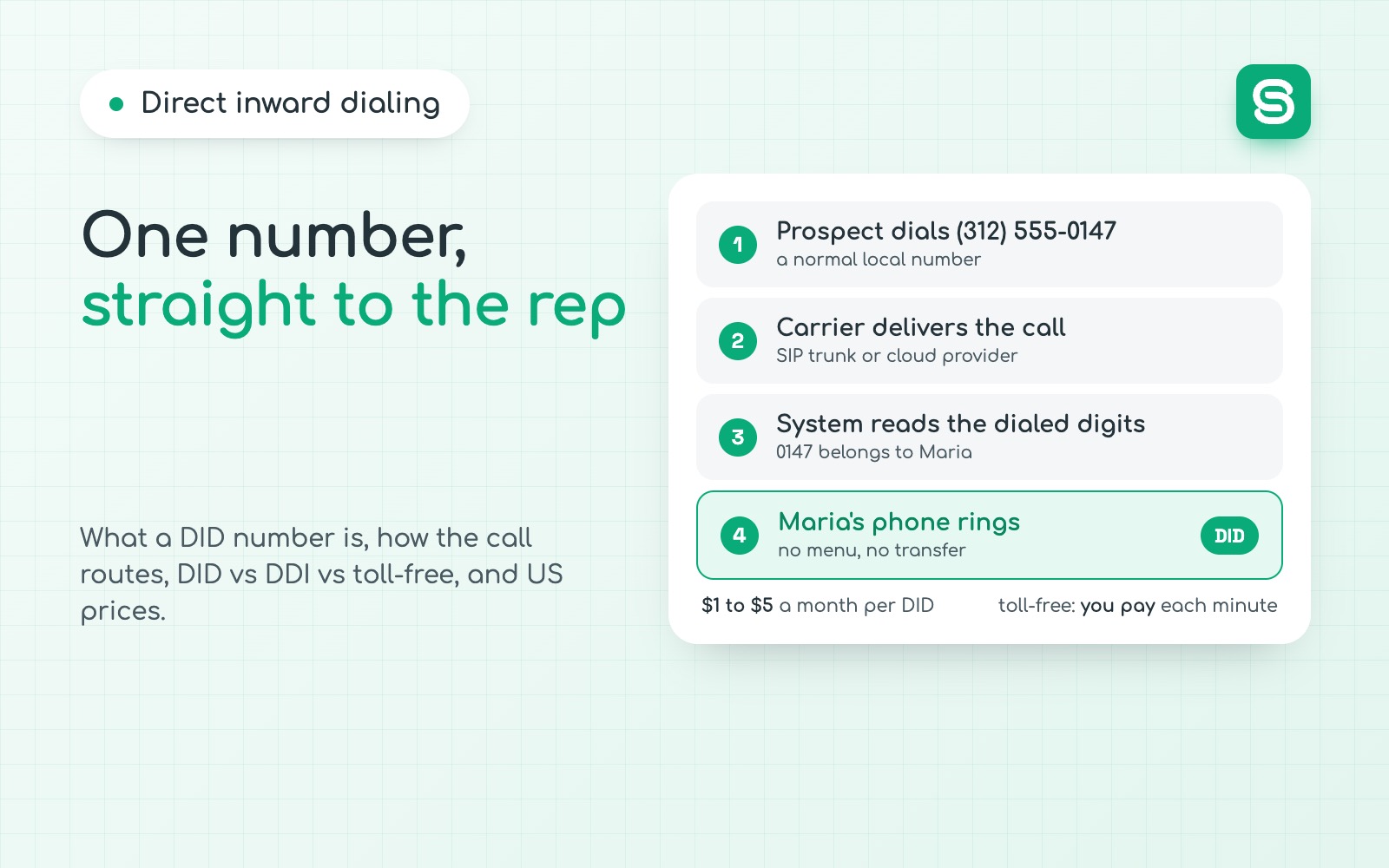
A prospect in Chicago gets your rep’s voicemail, likes the message and calls back the number on their screen. Two things can happen next. They land on “Thank you for calling Acme, press 1 for sales, press 2 for support,” wait, get transferred, and maybe hang up. Or the phone of the rep who called them rings, and the conversation picks up where the voicemail left off. The difference between those two outcomes has a name: direct inward dialing.
What is direct inward dialing?
Direct inward dialing is a service carriers sell to businesses that run their own phone system. The carrier assigns the business a block of phone numbers and delivers calls to all of them over a shared connection. Along with each call, it passes the number that was dialed. The business phone system reads those digits and sends the call to the person, team or device that owns the number.
The idea is old. According to the Wikipedia entry on direct inward dial, AT&T developed the feature in the United States in the 1960s, modeled on a service the German post office already ran. For decades it meant renting physical trunk lines into an on-premises PBX (private branch exchange), the box in the server closet that switched calls between desk phones. Later, DIDs were delivered on digital PRI circuits, then over the internet as SIP trunks.
What hasn’t changed is the economic trick at the heart of it. A company with 80 employees doesn’t hold 80 conversations with the outside world at once. So instead of renting 80 lines, it rents enough capacity for its peak (say 15 simultaneous calls) and attaches 80 numbers to that capacity. Every employee gets a number the world can dial; the company pays for the lanes it actually uses. Our guide to SIP trunking explains how to size those lanes, and why ordering one channel per number is the classic overspend.
What a DID number is, and isn’t
A DID number is simply one of those numbers. To the person dialing, nothing distinguishes it: it’s a 10-digit US number with an area code, or a toll-free number. The “direct” part happens on your side, in how the number is routed.
How does direct inward dialing work?
Here is what happens, hop by hop, when someone dials a direct number. The same five steps apply whether the business runs an old PBX on a SIP trunk or a cloud phone system; only the place where step 4 happens changes. You can enlarge the diagram or download it.
- 01
The caller dials the direct number.
They dial (312) 555-0147 from a cell phone, a landline or an app. Nothing in the dialing process differs from calling any other number. - 02
The public network finds the carrier.
The originating carrier looks up which carrier currently holds that number (numbers move between carriers through porting, so this is a database lookup, not a guess from the area code) and hands the call over. - 03
The carrier delivers the call to your system.
On a premises PBX, the call arrives over a SIP trunk or a PRI circuit. With a cloud phone provider, the provider is the customer of the carrier, and the call lands directly on its platform. - 04
Your system reads the dialed digits.
The carrier signals which number was dialed. The telecom term is DNIS (dialed number identification service); on older trunks the carrier sent only the last three or four digits. The system now knows the caller wanted 0147, not the main line. - 05
It rings whoever owns that number.
A routing table says 0147 belongs to Maria. Her desk phone, her softphone on the laptop and the mobile app ring, according to her settings. If she doesn’t pick up, her voicemail answers, not the company’s.
The whole lookup takes a fraction of a second. What the caller experiences is simply that the right person answers.
Premises PBX vs. cloud: where the DID lives
| Setup | Where DIDs are configured | What you manage |
|---|---|---|
| Premises PBX on a SIP trunk | A routing table on your PBX maps each DID to an extension | The PBX, the trunk, channel count, network quality, 911 location data |
| Premises PBX on PRI | Same, with digits delivered over a T1 circuit | All of the above, plus a legacy circuit being retired by many carriers |
| Cloud phone system (UCaaS) | In the provider's admin console: assign a number to a user | Users and numbers; the provider runs the rest |
| Sales dialer or softphone app | Each user gets one or more numbers in the app | Which number each rep calls from and where callbacks ring |
If your company still runs PRI lines or copper, check your carrier’s retirement schedule: our guide to POTS line retirement lists what to move before the copper goes dark. And when you change systems, the direct numbers can usually come with you: see business phone number porting for the process and the traps.
DID vs. DDI, DOD, extensions and DNIS: the vocabulary
Half the confusion in buying phone numbers comes from five acronyms that describe closely related things. Here they are, in the order you’ll meet them.
DID vs. DDI: two names, one service
DID (direct inward dialing) is the North American term. DDI (direct dial-in) is what the same service is called in the UK, Ireland, the rest of Europe, Australia and New Zealand. If a London office or a European vendor talks about “DDIs,” they mean direct numbers. There’s no technical difference worth paying for.
DOD: the outbound twin
DOD (direct outward dialing) lets users call outside the company directly, without going through an operator, and present their own number as caller ID. Old office phones made you dial 9 first to reach an outside line; that prefix was the DOD gateway. Today DID and DOD are sold together, and nobody uses the term DOD outside of telecom contracts. What matters for you: make sure the number shown when a rep calls out is their DID, not the company switchboard.
Extension: an internal number only
An extension (ext. 147) is a short internal number. Colleagues dial it inside the system; outsiders can only reach it through the main line, a menu (“if you know your party’s extension…”) or a transfer. A DID is what makes an extension reachable from outside. Many systems match the two (DID ending 0147 maps to ext. 147), which keeps things readable.
DNIS: how the system knows which number was dialed
DNIS (dialed number identification service) is the signal that tells your system which of your numbers the caller dialed. It’s what makes DID possible. Call centers also use it to tell campaigns apart: a call to the number printed on a direct-mail piece can be tagged differently from a call to the website number.
Trunk and channel: the pipe, not the number
A trunk is the connection between the carrier and your system. A channel is one simultaneous call on it. You buy numbers and channels separately, and you need far fewer channels than numbers. If you’re sizing a premises system, our VoIP bandwidth calculator turns peak concurrent calls into the upload and download your network must carry.
DID vs. virtual number vs. toll-free: which do you need?
This is where the search “did vs toll free” usually comes from, and where vendor pages muddy things. The cleanest way to see it: all three are phone numbers routed into a business system. They differ in who can dial them, who pays for the call, and what the number signals to the person who sees it.
DID vs. virtual number
On a modern cloud phone system, the distinction mostly disappears. When a provider gives you a “virtual number,” it has bought a DID from a carrier and routes it to its own platform, which then rings your app wherever you are. The word “virtual” just emphasizes that the number isn’t tied to a desk, a building or a copper pair: you can pick a Dallas area code while sitting in Boston.
The difference that still matters is practical. A DID in the classic sense lives on your system, so you control routing, but you also maintain the PBX. A virtual number lives on the provider’s system, so routing options are whatever the provider offers. For a deeper look at choosing and configuring one, see our guide to the virtual business phone number, and if you just want one live today, how to get a virtual phone number walks through it step by step.
DID vs. toll-free
A toll-free number starts with one of seven US codes: 800, 888, 877, 866, 855, 844 or 833. The call is free for the caller and billed to the business that owns the number. The FCC’s toll-free numbers page lists the codes and explains that you obtain a number through a Responsible Organization (“RespOrg”). It also points out that the codes aren’t interchangeable: 1-800-555-0199 and 1-888-555-0199 are two different numbers that can belong to two different companies.
| Question | Local DID | Toll-free number |
|---|---|---|
| Who pays for the inbound call | The caller, usually nothing extra on a modern plan | You, per minute received |
| Inbound rate on Twilio (Nov. 2026) | $0.0085 per minute | $0.0220 per minute |
| Monthly number fee on Twilio | $1.15 | $2.15 |
| What it signals | A person or office in that area | A company line: support, orders, hotline |
| As outbound caller ID | Normal: looks like someone you might know | Reads as a call center; often ignored |
| Best use | Each rep, each local office | Published number for customers nationwide |
Toll-free is a number customers call. A local DID is a number people call back.
A toll-free number is built for inbound demand you invited: a support line printed on packaging, an order line in a catalog, a number in a national ad. It’s a poor outbound caller ID, because most people don’t pick up an 8XX number they don’t expect. If you’re unsure which type fits each use, our local vs. toll-free number tool ranks the options for how you’ll use the number and shows what it costs the caller.
When the answer is “both”
Plenty of companies end up with both: one toll-free number for customers and one local DID per rep. The toll-free number goes on the website and the invoices; the DIDs go in email signatures and on outbound calls. The mistake is the reverse: reps calling out from the toll-free number, so that every callback lands in the support queue.
How much does a DID number cost in the US?
There are three ways you’ll be charged for direct numbers, depending on what you buy. Here are list prices checked on the vendors’ own pricing pages in November 2026.
Carrier and API pricing: per number, plus per minute
Communications platforms that developers and phone systems build on sell numbers individually. Twilio’s US voice pricing lists a local number at $1.15 a month and a toll-free number at $2.15 a month, plus $0.0085 a minute to receive calls on a local number and $0.0220 a minute on a toll-free number. Telnyx’s number pricing lists local and toll-free numbers from $1 a month, with volume discounts. This is the raw material: cheap per number, but you need a system on top to make it ring anyone.
UCaaS pricing: one number per user included, extras billed
Business phone systems bundle one direct number into each user license and charge for extras. On RingCentral’s US plans, each additional local or toll-free number is $4.99 a month, and a vanity number adds a $30 one-time fee. Here the number price matters less than the license: you’re paying for the app, the routing, voicemail and support.
SIP trunk pricing: channels, with DIDs on the side
If you run your own PBX, you pay the trunk by channel or by minute and DIDs as a separate line item, typically $1 to $5 each a month. Toll-free inbound minutes are almost always metered. Our SIP trunking guide has the full pricing models.
Estimate your own DID bill
DID cost estimator
Example values use Twilio's US list prices (local number $1.15 a month, $0.0085 a minute received). Swap in your quote.
- Per month
- $39.30
- Per year
- $471.60
- Same traffic on toll-free numbers
- $91.80 / month
Carrier cost only. A per-user phone system or dialer plan usually bundles the number and the minutes; compare the full price per rep.
What do businesses use DID numbers for?
A DID is just a number that points somewhere specific. That makes it useful far beyond giving each employee a direct line. Here are the six uses you’ll meet most.
That last use is easy to forget and isn’t optional. Under Kari’s Law and Section 506 of RAY BAUM’S Act, multi-line telephone systems must let users dial 911 directly, without a prefix, and send a dispatchable location with the call; the 911.gov summary of both laws explains the requirements. When you add DIDs for remote reps, update the address registered for 911 on each user. Our guide to phone systems for remote teams covers that setting.
The routing side (menus, ring groups, business hours, overflow) is what turns a set of DIDs into an inbound phone system. If you’re designing that, start with our guides to configuring an IVR and to call forwarding vs. call transfer.
When does a sales team need direct numbers?
For a sales team, a DID isn’t about internal convenience. It’s about one moment: the prospect calls back. Outbound reps miss most of the people they dial, leave voicemails, send texts and emails with their number in the signature. Every one of those touches only works if the number leads back to the rep.
- Callbacks reach the caller. The prospect who returns a voicemail lands on the rep who left it, with the context, not on a receptionist who doesn’t know them.
- A consistent identity. Same number for the call, the voicemail, the text and the signature. The prospect recognizes it the second time.
- Clean attribution. Every inbound call to a rep’s number lands in that rep’s history and CRM record.
- Local presence where you sell. A rep covering Texas can call from a Texas area code and be called back on it.
- A number that survives the desk. It rings the laptop at home and the mobile app on the road.
- A number doesn’t make people answer. Connect rates depend on the list, the timing and the caller ID reputation of the number.
- Burned numbers. A number that dials hundreds of strangers a day can get labeled as spam by carrier analytics, direct or not.
- Rep turnover. When a rep leaves, their prospects keep calling the number. Decide who it goes to before it happens.
- Inbound coverage. A rep in back-to-back calls misses callbacks. Voicemail and a quick call back have to cover that.
The callback is worth more than it looks
A prospect who calls you back is the warmest lead your outbound team produces all day. They heard the voicemail or saw the missed call, and they picked up the phone themselves. Sending that call to a menu wastes it. Our guide on how to call a prospect back covers the other direction, the 30-second prep before you return a call; the direct number is what makes the first direction work.
For an outbound team, a DID isn’t a convenience. It’s what makes the callback reach the right person.
Local area codes: useful, within limits
Because a DID can carry any area code, sales teams often pick numbers local to the territory they call. Whether that lifts answer rates is debated, and the honest answer depends on your market and how you use the numbers. Our analysis of local presence dialing in B2B weighs the evidence. Two rules hold either way: a rep should keep the same number long enough for prospects to recognize it, and the number they call from must be one they can be called back on. Rotating through dozens of numbers that ring nowhere defeats the purpose of having a DID at all.
Number type on the other end matters too. A direct number you dial on a prospect’s desk behaves very differently from a switchboard or a cell phone; our guide to direct dial vs. mobile vs. switchboard shows how connect rates differ by type. And if you’re checking whether a number in your list is a direct line at all, the direct dial checker helps sort it.
Keep your numbers clean
A DID that dials a lot of people can be flagged by carrier analytics engines and shown as “Spam Likely,” which lowers answer rates without warning. Two reads before your first calling block: caller ID reputation, which explains how those labels are assigned, and STIR/SHAKEN caller ID authentication, which covers the signature that now travels with US calls.
How this works in Skipcall

In Skipcall, each user gets their own number, with numbers available in 160 countries, and calls out with it from the web or mobile app. A prospect who calls that number back reaches the rep’s line instead of a switchboard. Skipcall is built for outbound prospecting, so it doesn’t provide menus, call queues or inbound routing rules; if you need a main line with a menu and ring groups, that’s a job for a business phone system next to it. Plans with a number included start at $25 per user per month for Business VoIP and $70 for Starter, billed annually; details are on the pricing page.
How to choose a DID number provider
“DID number provider” can mean a carrier that sells numbers wholesale, a communications API, a cloud phone system or a sales dialer. Before comparing prices, decide which of those you actually need: if you don’t run a PBX and don’t have developers, a wholesale DID is useless to you on its own. Then ask every vendor the questions below.
DID provider checklist: 12 questions to ask before you buy
Checklist written for this article. Paste it into your RFP or your vendor call notes.
NUMBERS
[ ] 1. Do you have numbers in the area codes we need, today, in stock?
[ ] 2. Can we port our existing numbers in? How long does a port take, and who files it?
[ ] 3. If we leave, will you release our numbers for porting out without a fee or delay?
[ ] 4. Can each number send and receive texts? Who handles A2P 10DLC registration?

PRICE
[ ] 5. What is the all-in monthly price per number, including taxes and regulatory fees?
[ ] 6. Are inbound minutes included, metered, or capped? Toll-free minutes?
[ ] 7. Are there setup, vanity number or number change fees?

ROUTING AND USE
[ ] 8. Can one number ring a desk phone, a desktop app and a mobile app at the same time?
[ ] 9. Can a user call out with their own number as caller ID?
[ ] 10. Can we register a caller name (CNAM) on each number?
[ ] 11. How do we set the 911 location for remote users?

DATA
[ ] 12. Do calls on each number sync to our CRM, with the recording and notes?
The criteria that actually separate vendors
| Criterion | Why it matters | Red flag |
|---|---|---|
| Number inventory | You need the area codes your customers recognize | Only a handful of states, or "available on request" |
| Porting in and out | Numbers your customers know are an asset | Port-out fees or a vague answer about releasing numbers |
| All-in price | Fees can rival the number price on small bills | A quote with no taxes or fees line |
| Texting on the same number | Prospects reply to the number that called them | Texts sent from a different number than calls |
| CRM sync | A callback logged nowhere is a lead lost | Manual logging or a CSV export |
| International numbers | Local numbers abroad for teams selling outside the US | Countries listed but numbers out of stock |
If you sell outside the US, number availability and requirements change a lot by country: some require a local address or ID documents before activating a number. The business phone number requirements tool lists what each country asks for, and our comparison of the best VoIP for international calls covers providers built for cross-border teams. For the system around the numbers, our guide to choosing a business phone system compares the main categories.
Small sales team: a cloud phone system or a sales dialer that includes one number per user. Wholesale DIDs only make sense if you already run a PBX or build your own telephony.
How to set up DID numbers for a sales team
The technical part takes minutes on a cloud system. The decisions around it are what make DIDs work for sales. Here’s a five-step plan.
Map who needs which number
List every rep and every shared function. Reps who call out get a personal DID. Shared functions (support, billing) get a team number that rings a group. The main company number stays on the website.
Pick the area codes
For each rep, choose an area code from the territory they cover most, or from your headquarters if they sell nationwide. Write the rule down so new hires get numbers the same way.
Port or provision
New numbers are live the same day on most cloud systems. Numbers you already own need a port: gather the account details and letter of authorization, and keep the old service running until it completes. The number porting checklist lists what each country requires.
Configure caller ID, voicemail and 911
Set each rep’s DID as their outbound caller ID, register the caller name, record a personal voicemail greeting and enter the 911 address for where they work.
Put the number everywhere the prospect sees it
Email signature, LinkedIn contact info, follow-up texts, voicemails (“call me back at…”). The same number, every time.
What happens when a rep leaves
Decide this before it happens. The rep’s DID belongs to the company, not to the person, and their prospects will keep calling it for months. Three options, in order of preference: reassign the number to the rep who takes over the territory, forward it to a team number for 90 days, or keep it on a voicemail that gives the new contact’s number. Never release a number that prospects have saved; it may be reassigned to a stranger.
Common DID mistakes
Key takeaways
Sources
- Twilio: Programmable Voice pricing, United States (pricing current as of October 2026)
- Telnyx: phone number pricing, United States
- RingCentral: RingEX plans and pricing, United States
- Federal Communications Commission: Toll-free numbers
- 911.gov: Kari’s Law and RAY BAUM’S Act, MLTS dispatchable location
- Wikipedia: Direct inward dial




