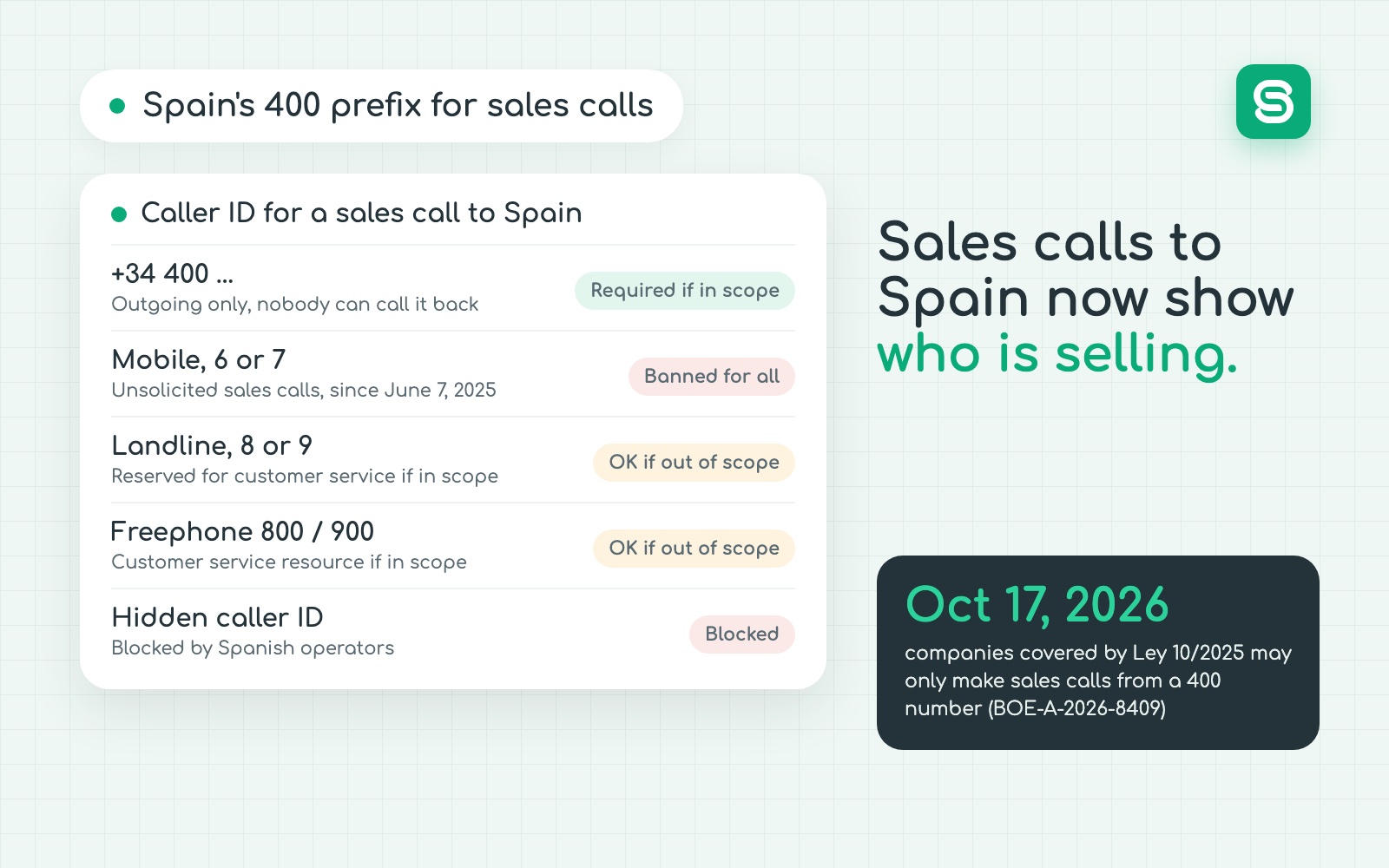
Spain’s 400 prefix is a range of nine-digit phone numbers reserved for sales calls. Since October 17, 2026, companies covered by Spain’s customer service law (Ley 10/2025) may make commercial calls only from a 400 number, which can place calls but never receive them. Everyone else must still avoid Spanish mobile numbers for unsolicited sales calls.
That is the short answer. The long one matters if your team calls Spanish prospects, because the rule sits on top of three other texts, and most summaries you will find online mix them up. We read the official texts in the Boletín Oficial del Estado (BOE), Spain’s official gazette, on November 25, 2026, and this guide sticks to what they say, with the article numbers so your counsel can check.
What is Spain’s 400 prefix for sales calls?
The 400 prefix is a block of the Spanish national numbering plan. The resolution of April 14, 2026 from the Secretary of State for Telecommunications and Digital Infrastructure “attributes the code 400”, meaning the first three digits of the national number, “for making commercial calls”. A 400 number has nine digits, like every Spanish number, and is written +34 400 followed by six digits in international format.
Three features make it different from any number a sales team has used in Spain before.
The stated goal is transparency. The preamble of the resolution explains that using numbers not specifically allocated to commercial calls “makes it harder for the end user to identify the nature of the call received”. Put plainly: Spain wants a person who sees +34 400 on their screen to know, before answering, that it is a sales call. The government chose outgoing-only numbers to stop the range from becoming “a new communication channel” that confuses people who try to call back.
Once that period has ended, commercial calls may only be made through the NXY = 400 range, and no other numbering range may be used from then on to make commercial calls.
The timeline: from the mobile ban to the 400 range
The 400 prefix is the last step of a sequence that started in early 2025. Each step comes from a different text, which is why dates get confused. Here they are in order, each with its source.
- 01
February 15, 2025:
Orden TDF/149/2025 of February 12 is published in the BOE. It sets measures against phone and text scams, including a ban on using mobile numbers for customer service and unsolicited commercial calls (article 9). - 02
March 7, 2025:
the order enters into force, twenty days after publication (third final provision). - 03
June 7, 2025:
article 9 takes effect, three months after entry into force. From then on, no company may make unsolicited commercial calls from a Spanish mobile number. - 04
December 27 and 28, 2025:
Ley 10/2025 of December 26, regulating customer service, is published and enters into force the next day. Its article 16.3 requires a specific numeric code for telephone customer service, distinct from the code used for commercial calls. Companies get twelve months to adapt their customer service. - 05
April 16 and 17, 2026:
two resolutions dated April 14 are published. One allocates numbers for customer service (BOE-A-2026-8408), the other allocates the 400 range to commercial calls (BOE-A-2026-8409). Both take effect the day after publication and set a six-month transition. - 06
July 3, 2026:
the CNMC, Spain’s telecom and competition regulator, announces that it has started assigning 400 numbers to the operators that requested them. - 07
October 17, 2026:
end of the six-month transition. Companies within the scope of Ley 10/2025 may only make commercial calls from a 400 number.
The six-month date is a calculation from the resolution, not a date printed in it: the text says the range must be “fully operational within 6 months” of entry into force, which was April 17, 2026. The press coverage that followed placed the switch in October 2026, and we found no later text in the BOE that postponed it. The consolidated version of the resolution, which we checked on November 25, 2026, shows no amendment since publication.
Who must use a 400 number?
The obligation does not apply to every company that calls Spain. Section Primero.2 of the resolution limits it to “companies within the scope” of Ley 10/2025. So the real question is whether your company falls under that law. Article 2 answers it in two parts.
| Group | Who is in it | Size threshold |
|---|---|---|
| Basic services of general interest (art. 2.1) | Water, gas and electricity supply; air, rail, sea and bus passenger transport; postal services; electronic communications, including phone services; financial services, when offered or provided in Spain | None: every company, whatever its size |
| Other goods and services sold mainly to consumers (art. 2.2) | Companies and groups selling goods or services in Spain "mainly to consumers and users" | In the previous financial year, at least one of: 250 employees, turnover above €50 million, balance sheet above €43 million (individually or at group level) |
| Exception (transitional provision, para. 4) | Electricity, gas and phone service retailers from group 2.1 | Exempt from articles 16.2 to 16.4 while their group stays below a 5% national market share and is not a large company under 2.2 |
Two details in article 2 matter for anyone reading from outside Spain.
Does the 400 rule apply to B2B sales calls?
This is the question most B2B teams ask, and the honest answer has two layers.
The first layer is the law’s scope. Ley 10/2025 is a consumer protection law. Its general scope (article 2.2) covers companies whose goods or services are intended “mainly for consumers and users”, and article 3 defines customers by reference to consumers. A software company, an agency or a manufacturer that sells only to businesses, and is not in one of the sectors of article 2.1, generally falls outside the law, and therefore outside the 400 obligation.
The second layer is the resolution itself. It says nothing about who receives the call: it speaks of “commercial calls” made by in-scope companies, without distinguishing calls to consumers from calls to businesses. So if your company is in scope, for example a bank, an energy supplier, a telecom operator or a large consumer brand, the prudent reading is that all its commercial calls must come from a 400 number, including the ones its sales team places to business customers.
What about agencies and outsourced call centers?
Article 2.3 of Ley 10/2025 says the law applies regardless of whether customer service is run inside the company or by a third party. The text is written for customer service, and the 400 resolution does not address outsourcing in so many words. In practice, an agency calling on behalf of an in-scope client should assume the client’s obligation travels with the campaign: the client is the company “making commercial calls” in the eyes of its customers. Settle in the contract who obtains the 400 numbers and who answers for compliance.
Which numbers can you use for sales calls in Spain now?
This is the table we would have wanted before writing this guide. It combines the three texts in force on November 25, 2026: Orden TDF/149/2025, the resolution on customer service numbers and the resolution on the 400 range.
| Number shown to the prospect | Company in scope of Ley 10/2025 | Company outside its scope |
|---|---|---|
| 400 (+34 400 …) | Required for commercial calls since October 17, 2026 | Allowed: the range is attributed to commercial calls in general, if your operator can provide one |
| Mobile, starting with 6 or 7 | Prohibited for unsolicited commercial calls and customer service since June 7, 2025 | Prohibited for unsolicited commercial calls and customer service since June 7, 2025 |
| Geographic landline, starting with 8 or 9 (91 Madrid, 93 Barcelona…) | Not for commercial calls: reserved for customer service at standard rates | Not prohibited by any text in force for commercial calls |
| Freephone 800 or 900 | Not as caller ID for commercial calls: customer service resource | Expressly allowed for unsolicited commercial calls (Orden TDF/149/2025, art. 10), and free for the person calling back |
| Foreign number (+1, +44…) | Not addressed expressly; the resolution forbids "any other numbering range", so do not treat it as a workaround | Not addressed by these texts |
| Hidden or empty caller ID | Blocked by operators (Orden TDF/149/2025, art. 4) | Blocked by operators (Orden TDF/149/2025, art. 4) |
Two lines in that table deserve a closer look.
Mobile numbers. Article 9 of Orden TDF/149/2025 prohibits “the use of numbering ranges attributed to the mobile communications service for providing customer service and for making unsolicited commercial calls”. This applies to every company, in scope of Ley 10/2025 or not. The word “unsolicited” is important: a call the customer asked for, such as a callback they requested, is not targeted by article 9. A cold call is.
Spanish numbers used from abroad. Article 5 of the same order requires operators to block voice calls “received from abroad” that show a Spanish number as caller ID, except in international roaming. If your team in Austin or London calls Spain with a Spanish geographic number, ask your provider how the call enters the Spanish network. The order targets calls that reach Spain through an international interconnection presenting a Spanish number, a classic spoofing pattern.
What a 400 number changes for caller ID and connect rates
For teams in scope, the 400 range changes how every call looks on the prospect’s phone. Nobody has published reliable connect rate data on 400 numbers yet, so we will not quote any. Here is what the texts make certain, and what follows from it.
The resolution adds two technical rules. Calls from a 400 number are treated as originating from a fixed network for interconnection purposes. And they may only reach numbers that identify end users: geographic, mobile and nomadic voice numbers (section Tercero.4). A 400 number cannot call an 800 or 900 number, which matters if your lists contain company switchboards on freephone numbers.
Our guide to caller ID reputation explains why connect rates move with the number you show, and cold call connect rate benchmarks gathers the published figures with their sources and their limits.
Penalties for calling without a 400 number
The 400 resolution sets no fine of its own. Three regimes can apply, and a fourth consequence, call blocking, may hurt sooner than any fine.
| What applies | What the text says | Maximum |
|---|---|---|
| Telecom law: numbering conditions | Breaching the conditions of the national numbering plans "or their implementing provisions" is a serious infringement (Ley 11/2022, art. 107.19). Orden TDF/149/2025 expressly sanctions the mobile ban under that article. | Fine of up to €2 million for a serious infringement (art. 109.1.c) |
| Consumer law: Ley 10/2025 | Breaches of Ley 10/2025 are consumer infringements under the consumer code (art. 23), with sector rules applied first when the same facts are covered by both | Minor €150 to €10,000; serious €10,001 to €100,000; very serious €100,001 to €1,000,000, which can be exceeded up to 2 to 8 times the illicit profit (consumer code, art. 49) |
| Data protection | Calling people without a legal basis, or without checking the Lista Robinson when required, falls under the GDPR and the Spanish data protection act (LOPDGDD) | GDPR fines, enforced by the AEPD |
| Call blocking | Operators that originate or receive a call must block any voice communication from a number showing signs of making commercial calls without the specific numeric code (Ley 10/2025, art. 16.4), under criteria authorized by the Secretary of State | Your calls stop connecting |
The blocking rule in article 16.4 is the one to watch. It is written for operators, and its criteria need authorization from the Secretary of State for Telecommunications before use. Once authorized, operators may block “irregular traffic” without a new individual authorization, provided they notify it within two working days. A sales team whose calls are blocked loses its pipeline long before any fine arrives.
How to comply: a checklist for teams calling Spain
Whether you run a Madrid sales floor or a US team that adds Spain to its territories, the order below avoids the expensive mistakes.
Decide whether you are in scope of Ley 10/2025
Check the sector list of article 2.1, then the consumer test and the size thresholds of article 2.2, at group level. Write the answer down with the date and the figures used, and review it each financial year: crossing 250 employees or €50 million in turnover brings you into scope.
Remove every Spanish mobile number from sales caller IDs
Numbers starting with 6 or 7 have been off-limits for unsolicited commercial calls since June 7, 2025. Check personal phones too: a rep who calls a Spanish prospect from their own Spanish mobile is breaking the same rule.
If you are in scope, get 400 numbers through an operator
Only operators of publicly available telephone services can obtain 400 numbers from the CNMC. Ask your current provider whether it holds a 400 block and can present it on outbound calls from your dialer. If it cannot, you need a provider that can, at least for Spain.
Separate sales and customer service numbers
Sales calls go out on 400. Customer service runs on 800, 900 or standard-rate geographic numbers, and those numbers must not appear as caller ID on sales calls. Give prospects the customer service number, not the 400, as the way to call you back.
If you are out of scope, choose a Spanish geographic or 900 number
A Spanish landline in your target province, or a freephone 900, remains allowed for your commercial calls. Make sure your provider originates the calls in a way Spanish operators accept, since calls received from abroad with a Spanish caller ID are blocked outside roaming.
Keep the rules that did not change
A legal basis for each call, the Lista Robinson check before direct marketing to people who did not consent, the consumer calling window, identification at the start of the call and a working opt-out. The next section details each one.
Measure Spain separately
Track dials, connects and conversations for Spanish numbers on their own, per number and per list. A drop on one number can mean blocking or a spam label; a drop on every number after a switch to 400 is the new baseline.
Our cold calling compliance checker walks through the rules country by country, and the Spanish business phone number requirements page lists the documents needed to open a Spanish number.
The Spanish rules that did not change
The 400 range is about the number on the screen. The rest of the Spanish framework for sales calls stays in place, and it is stricter than what US teams are used to for consumer calls.
Automated calls without human intervention need the consumer’s prior express consent (consumer code, art. 96.3), so a parallel or power dialer that connects a live rep is a different case from a prerecorded message. For a side-by-side view of Spain and thirteen other countries, see our guide to cold calling laws by country.
What it means for US and international SaaS teams calling Spain
Most readers of this guide are not Spanish banks. They are software companies, agencies and startups that add Spain to a European territory. Here is how the rule lands for the most common profiles, based on the scope tests above.
| Your profile | In scope of Ley 10/2025? | What to show when you cold call Spain |
|---|---|---|
| B2B SaaS selling to Spanish companies | Generally no: not a listed sector, not selling mainly to consumers | A Spanish geographic or 900 number; never a Spanish mobile |
| Consumer app or e-commerce brand, 250+ employees or above €50M turnover at group level, selling in Spain | Yes, under article 2.2, even without a Spanish entity | A 400 number since October 17, 2026 |
| Fintech, payments, insurance or lending offered in Spain | Likely yes: financial services are in article 2.1, with no size threshold, under sector rules first | A 400 number; confirm with counsel how sector rules interact |
| Telecom, VoIP or connectivity provider selling in Spain | Yes: electronic communications are in article 2.1; small phone service retailers below 5% market share are exempt from article 16.3 for now | A 400 number unless the 5% exemption applies |
| Agency or BPO calling for a client | Depends on the client | Follow the client: 400 if the client is in scope |
A US team should also reset two habits formed at home.
Time zones matter too. Madrid is six hours ahead of New York and nine ahead of San Francisco for most of the year. The consumer window of 9 a.m. to 9 p.m. in Spain is 3 a.m. to 3 p.m. in New York. For business calls, the when to call tool shows the prospect’s local time before you dial.
This law applies to companies and groups, established in Spain or in any other State, that sell goods or provide services in Spanish territory intended mainly for consumers and users.
Where Skipcall fits when you call Spain

Skipcall is an outbound-first business phone system for sales teams. Here is what it does for calls to Spain, and what it does not, based on the published offer.
Best for: B2B teams outside the scope of Ley 10/2025 that call Spanish companies alongside the US and other European markets, and want one dialer, one CRM sync and Spanish landline numbers.
Not the right fit if: your company is in scope of Ley 10/2025 and needs 400 numbers for its Spanish sales calls today, or you need an inbound customer service line with IVR and call queues.
If you call several European countries, our guide to European parallel dialers compares the options, and international dialing codes explains how to write and dial +34 numbers without errors.
Spain 400 prefix glossary
Sources
Official texts read on November 25, 2026, in Spanish. Quotations in this guide are our translations.
- Resolution of April 14, 2026 allocating numbering for commercial calls (BOE-A-2026-8409) and its consolidated version
- Resolution of April 14, 2026 allocating numbering for customer service (BOE-A-2026-8408)
- Ley 10/2025, de 26 de diciembre, regulating customer service, consolidated text (BOE-A-2025-26698)
- Orden TDF/149/2025, de 12 de febrero, consolidated text (BOE-A-2025-2870)
- Orden TDF/558/2026, de 4 de junio, amending Orden TDF/149/2025 (BOE-A-2026-12045): it only moved the date for the SMS alias rules to September 15, 2026, and does not touch the mobile ban
- Ley 11/2022, de 28 de junio, General de Telecomunicaciones, consolidated text (BOE-A-2022-10757), articles 66, 107 and 109
- Consumer code, Real Decreto Legislativo 1/2007, consolidated text (BOE-A-2007-20555), articles 49 and 96
- Ley Orgánica 3/2018 on data protection (LOPDGDD), consolidated text (BOE-A-2018-16673), article 23
- CNMC press release of July 3, 2026 on numbering




